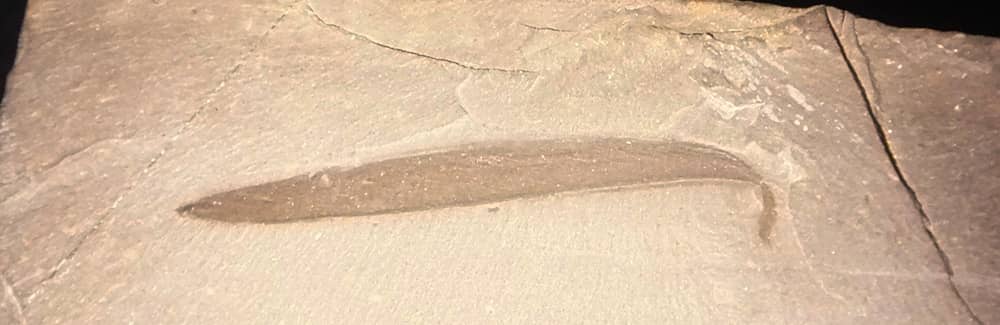
Basic Data of Pikaia
| Scientific Name (Genus) | Pikaia |
| Meaning of Name | Derived from the "pika," a small mammal living in the nearby Rocky Mountains |
| Classification | Chordata, Stem-group chordate |
| Period | Middle Cambrian (approx. 508 million years ago) |
| Total Length | Average approx. 3.8 cm (max up to approx. 5 cm) |
| Diet | Herbivorous (Deposit feeder, eating organic matter in sediments) |
| Discovered in | British Columbia, Canada (Burgess Shale) |
| Year of Paper Publication | 1911 |
The Cambrian Seas and the Oldest Chordate
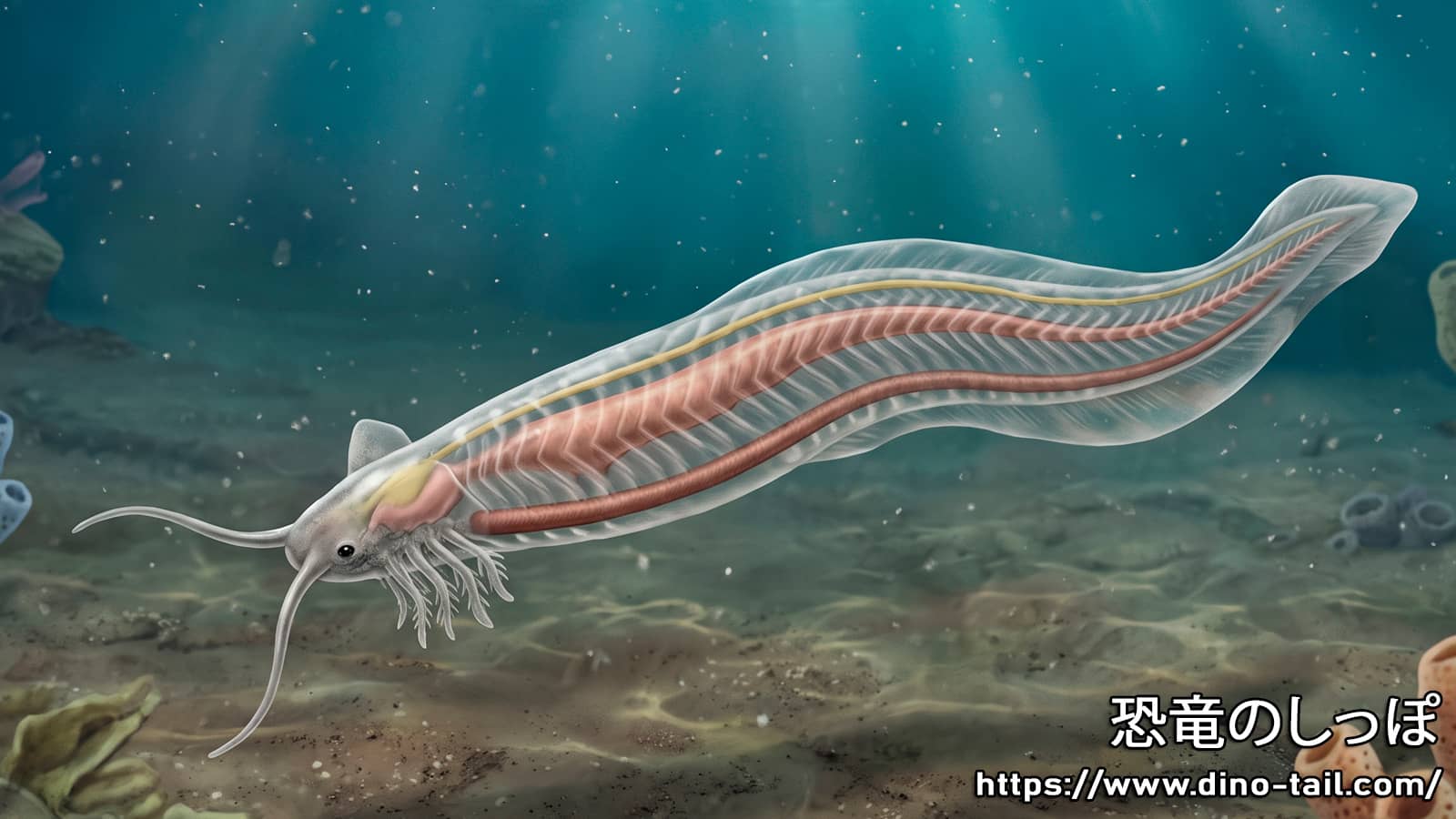
In the Middle Cambrian, about 508 million years ago, the sea in what is now British Columbia, Canada, was home to a wide variety of marine life symbolizing the "Cambrian Explosion," the most important event in evolutionary history.
In the world-famous fossil site "Burgess Shale," which conveys the state of the Cambrian period, quietly lived at the bottom of the sea a creature that holds the key to unraveling the origin of vertebrates: Pikaia (scientific name: Pikaia gracilens).
Pikaia is a small organism averaging about 3.8 cm in length and up to 5 cm at most. It had a spindle-shaped body flattened on the left and right, looking very similar to modern lancelets. It is thought to have been an herbivore (deposit feeder) that swam at the bottom of the sea, searching for and eating organic matter in the mud.
What is a Notochord?
The notochord is a flexible, rod-like structure that runs along the axis of the body. It serves as a support when moving muscles to swim. In vertebrates (animals with a backbone), including us humans, this notochord was replaced by a "backbone (spine)" during the course of evolution. Pikaia is known as a representative of early animals (stem-group chordates) that possessed this notochord.
Over a Century of Debate Surrounding Pikaia
The appearance and classification of Pikaia have been repeatedly reinterpreted by researchers for over a century since its first discovery in 1911.
Initially Thought to Be a "Polychaete Worm"
When first reported by the famous American paleontologist Charles Doolittle Walcott, Pikaia was thought to be a member of the "annelids" (or similar worms) such as polychaetes, due to its elongated body and features that appeared to have segments.
Promotion to the "Oldest Chordate"
The evaluation of Pikaia changed drastically in the late 1970s. When a research team from Cambridge University re-examined the fossils in detail under a microscope, they discovered that what were thought to be body segments were actually "myomeres" (muscle blocks) seen in fish muscles. Furthermore, the existence of a "notochord" supporting the body was confirmed, and Pikaia was positioned as a primitive chordate.
This reevaluation was heavily featured in Stephen Jay Gould's global bestseller "Wonderful Life," making Pikaia famous overnight as the "first known chordate in the world" and "our direct ancestor."
2012 Research and Biomechanical Mysteries
However, the more detailed the research, the more mysterious features of Pikaia were revealed.
A 2012 study pointed out that the curvature of its muscles was extremely gentle compared to modern fish. This presented a physical contradiction: "contracting muscles to swim fast would destroy its own body," leading to the speculation that Pikaia could only swim very slowly.
Furthermore, there was an unidentified thick tube called a "dorsal organ" on its back, and conversely, the "dorsal nerve cord" that all chordates are supposed to have could not be found, keeping it a creature full of mysteries.
The Great Discovery of 2024: "Upside Down for 113 Years"
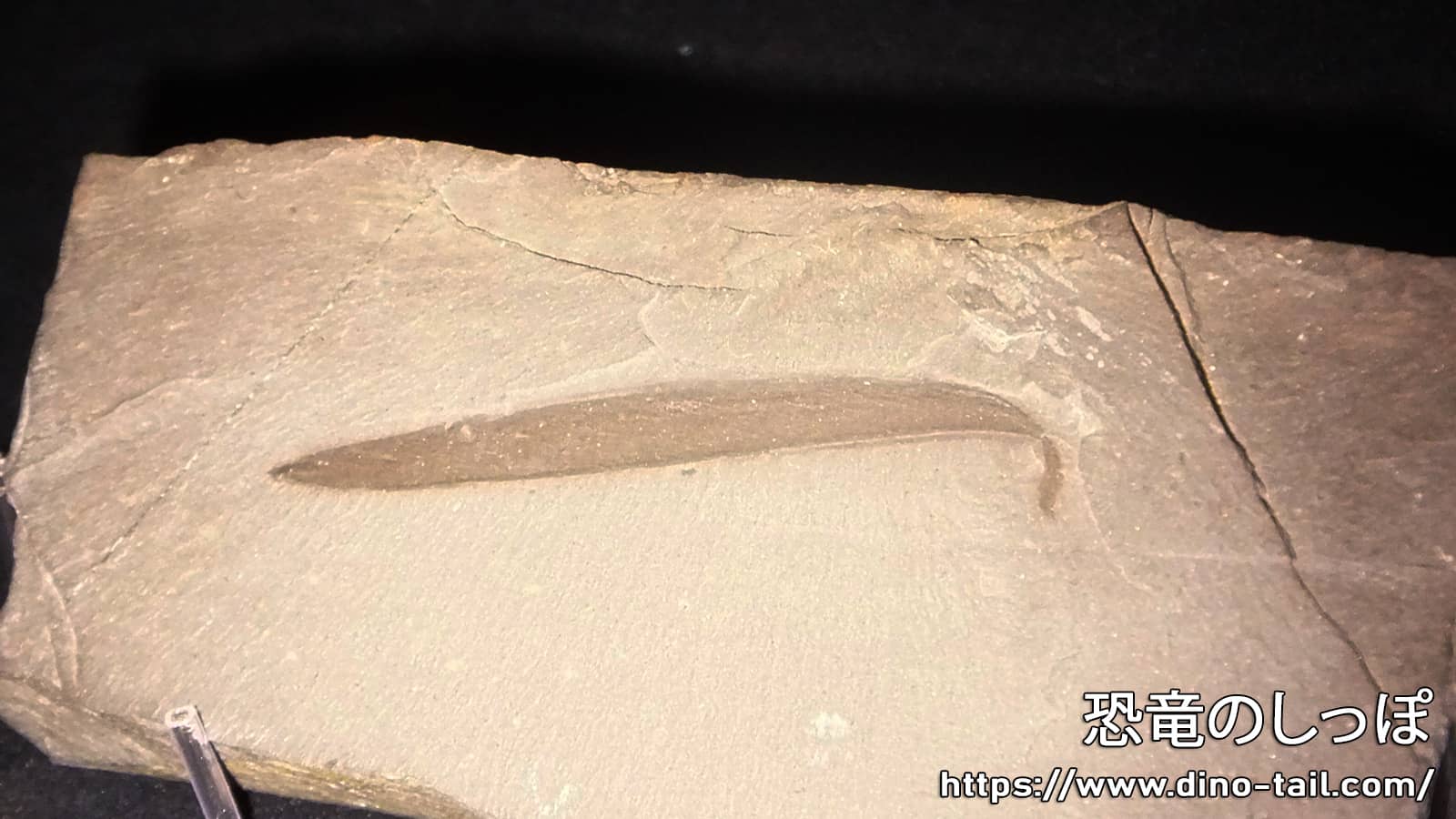
The long-standing mystery of Pikaia reached a dramatic conclusion in a study published in 2024 by Dr. Giovanni Mussini and his team at Cambridge University. Analysis using a high-resolution electron microscope revealed a shocking fact: "for the past 113 years, the back and belly (top and bottom) of Pikaia had been interpreted upside down."
Flipping the fossil upside down beautifully solved all the contradictions it had harbored.
- The mysterious "dorsal organ" was the "digestive tract": The thick tube previously thought to be on the back turned out to be the digestive tract (gut) passing along the ventral side. Traces of eaten food have also been found inside the tube.
- Discovery of the "nerve cord": The thin streak previously thought to be a blood vessel on the ventral side became the dorsal side, and it was confirmed to be the "dorsal nerve cord," which swells slightly toward the head like a brain.
- Swimming contradiction resolved: Turning it upside down changed the arrangement of the muscles, showing a structure capable of swimming powerfully and efficiently, just like lancelets and fish.
The Trap of Taphonomy (Fossilization Process)
In paleontology, the field that studies how organisms become fossils after they die is called "taphonomy." The reason Pikaia's top and bottom were mistaken for a long time was due to a taphonomic trap: the belly tissue, caused by bacteria around the digestive tract, was easily transformed into a special mineral (fossilized) and preserved conspicuously. Component analysis by the latest equipment became the key to seeing through this trap.
An "Evolutionary Bridge" Connecting to Our Roots
Corrected to the "right way up," Pikaia was finally proven beyond doubt to be a member of the chordates (stem-group chordate).
The structure of Pikaia's body, an "anterior part like a giant filtration device" and a "posterior part for swimming," shows an intermediate stage of evolution where it gradually integrates into a streamlined body like a fish.
They are an extremely important piece of the evolutionary puzzle, marking the transition from a life of waiting quietly for food at the bottom of the sea to a life of actively swimming around the ocean using muscles and nerves.