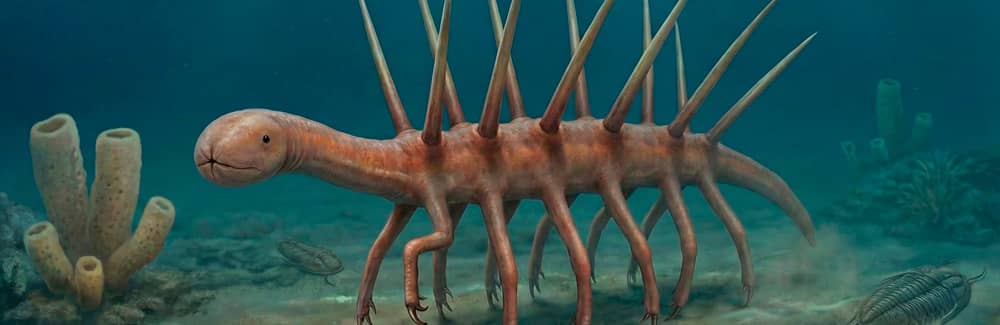
About Hallucigenia
| Scientific Name (Genus) | Hallucigenia |
| Meaning of Name |
Derived from "Hallucination"
Latin: hallucinatio |
| Classification | Panarthropoda, Lobopodia, Hallucigeniidae |
| Period | Middle Cambrian (approx. 508 million years ago) |
| Length | 10mm - 50mm |
| Diet | Scavenger or micro-predator |
| Sub-classification / Species Name |
Hallucigenia sparsa
(Type species)
H. fortis H. hongmeia |
| Year of Paper Publication | 1977 (Genus establishment) / 1911 (Described as Canadia) |
The Strange "Hallucination" Creature
Hallucigenia is a "strange" prehistoric creature that lived in the Cambrian sea, known for baffling researchers and undergoing dramatic changes in its reconstructed appearance.
From its initial discovery, its appearance was so bizarre that it was described as "nightmarish" or "like seeing a hallucination," which became the origin of its scientific name, Hallucigenia.
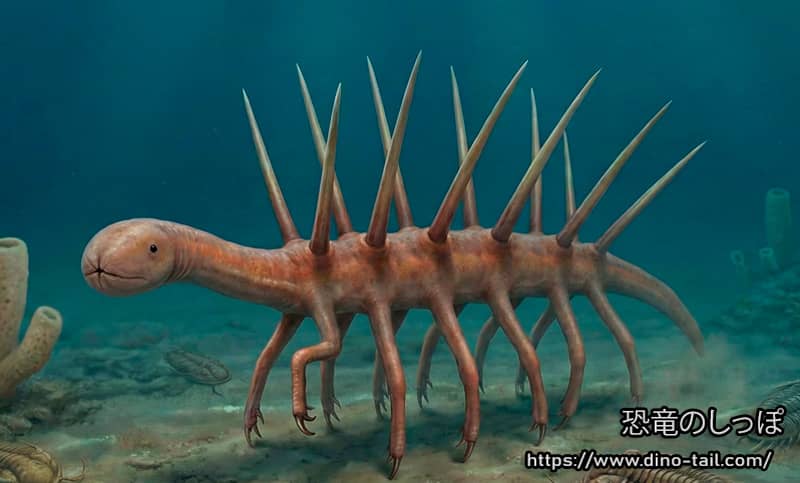
Reversal Drama: Upside Down and Backwards!
In the history of paleontology, few creatures have been as misunderstood as Hallucigenia.
- 1977 Reconstruction (Stilt Model): Initially, it was thought to walk using its long spines like stilts, using tentacles on its back to catch food.
- 1991 Reversal (Upside Down): With the discovery of similar fossils in China, it was revealed that the "stilts" were actually defensive spines on its back, and the "tentacles" were its legs. This flipped the animal upside down.
- 2015 Reversal (Front-Back): For a long time, the round balloon-like part was thought to be the head. However, electron microscopy revealed a pair of eyes and a mouth with teeth on the tip of the slender tube at the other end. What was once thought to be the tail was actually the head.
Thus, after nearly 100 years, Hallucigenia has finally regained its correct form: carrying spines on its back, walking on fleshy legs, and searching for food with a head at the end of a long neck.
Features and Ecology
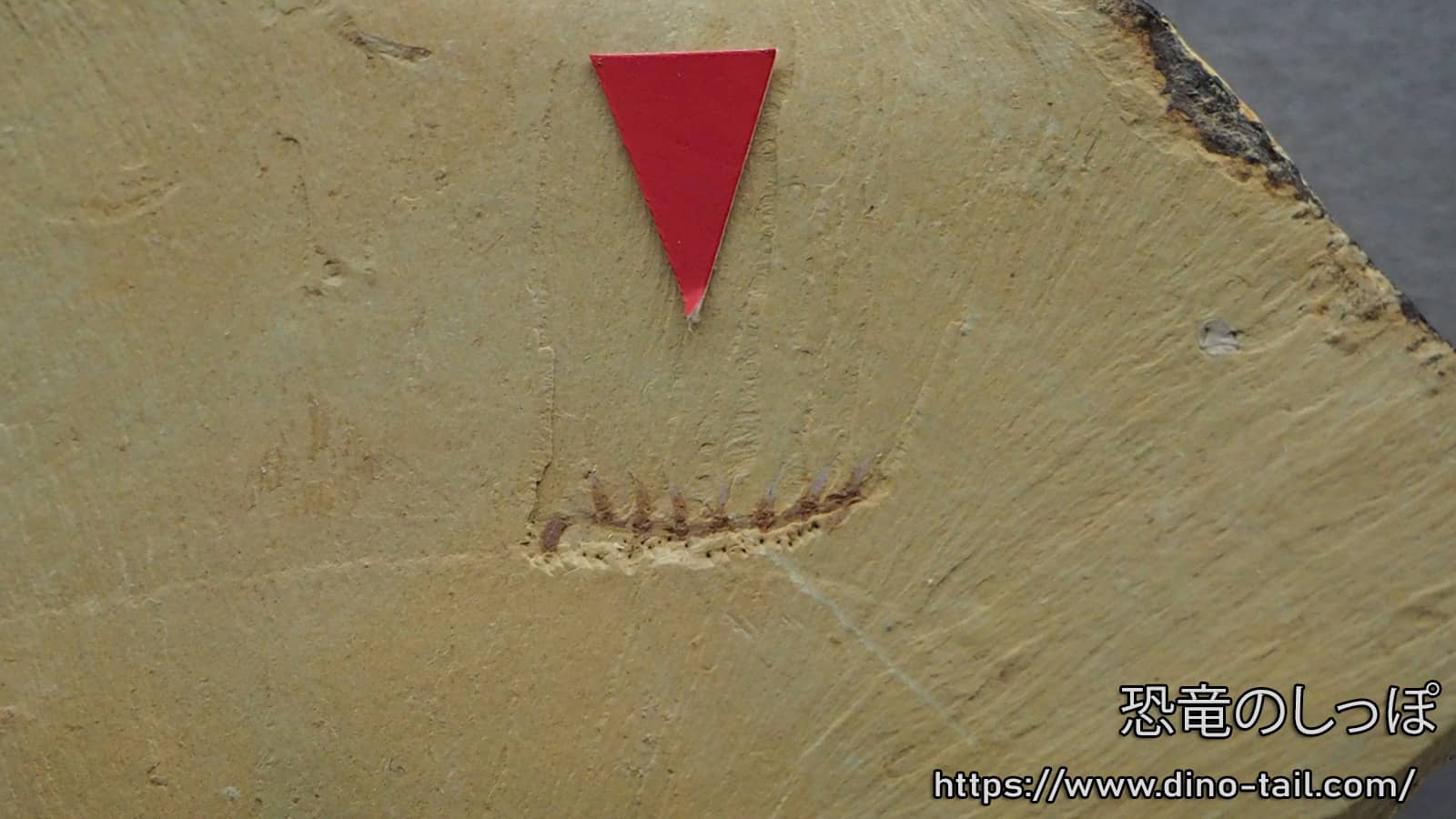
Hallucigenia had a slender, cylindrical body with 7 pairs of sharp spines on its back and 7 pairs of slender legs (lobopods) on its belly.
Defensive Spines:
The spines on its back were a powerful defense against large predators like Anomalocaris. In the Cambrian sea, where "eat or be eaten" survival competition was fierce, this armor likely evolved to protect its soft body.
Ancestor of Velvet Worms:
Hallucigenia is known to be an ancestor of the "velvet worms" (Onychophora) that still live in forests in the Southern Hemisphere today. The microstructure of the claws at the tips of its legs shares a common feature (nested structure) with modern velvet worms, serving as definitive evidence.
Feeding Method:
Radial plates and teeth lined the mouth, and needle-like teeth were also present deep in the pharynx. It is thought to have performed "suction feeding," sucking in food along with water like a dropper.
Species Comparison: Diversity of the Genus Hallucigenia
The genus Hallucigenia currently includes three confirmed species: H. sparsa , H. fortis , and H. hongmeia , each with slightly different morphological features. These differences suggest speciation and adaptation to their environments.
The type species, H. sparsa (from Burgess Shale), is characterized by a slender neck and spines with fine scale-like structures on the surface. In contrast, the older H. fortis (from Chengjiang biota) is generally stouter with shorter, thicker spines.
Additionally, H. hongmeia (from Chengjiang/Guanshan biota) has been confirmed to have countless microscopic net-like holes (net-like texture) on the surface of its spines. This is thought to be a trace of sensory papillae, suggesting the spines functioned not only for defense but also as sensors to detect the surrounding environment.
| Feature | H. sparsa | H. fortis | H. hongmeia |
|---|---|---|---|
| Locality | Canada, Burgess Shale | China, Chengjiang (Maotianshan) | China, Chengjiang (Guanshan) |
| Period |
Middle Cambrian
(approx. 508 Ma) |
Early Cambrian Stage 3
(approx. 518 Ma) |
Early Cambrian Stage 4
(approx. 515 Ma) |
| Head Shape | Slender, distinct neck | Rounded, somewhat thick | Unknown (complete head specimen not found) |
| Spine Shape | Slender, slightly curved | Short, more robust and thick | Anterior/posterior spines large, middle small |
| Spine Surface | Fine triangular scales | Generally smooth | Net-like texture (openings) |