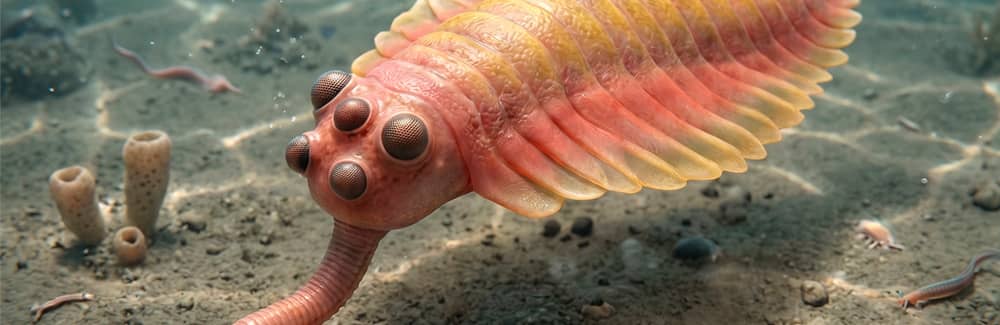
Opabinia Basic Facts
| Scientific Name (Genus) | Opabinia |
| Meaning of Name | Named after Opabin Pass (a location in Canada) |
| Classification | Arthropoda, Basal arthropod, Opabiniidae |
| Total Length | Approx. 4.3 - 7.0 cm (maximum specimen approx. 10.1 cm) |
| Diet | Carnivorous / Scavenger (microorganisms and organic matter on the seabed) |
| Period | Middle Cambrian (approx. 505 - 508 million years ago) |
| Discovered in | British Columbia, Canada (Burgess Shale) |
| Year of Description | 1912 |
Features: A bizarre appearance with five eyes and a nozzle
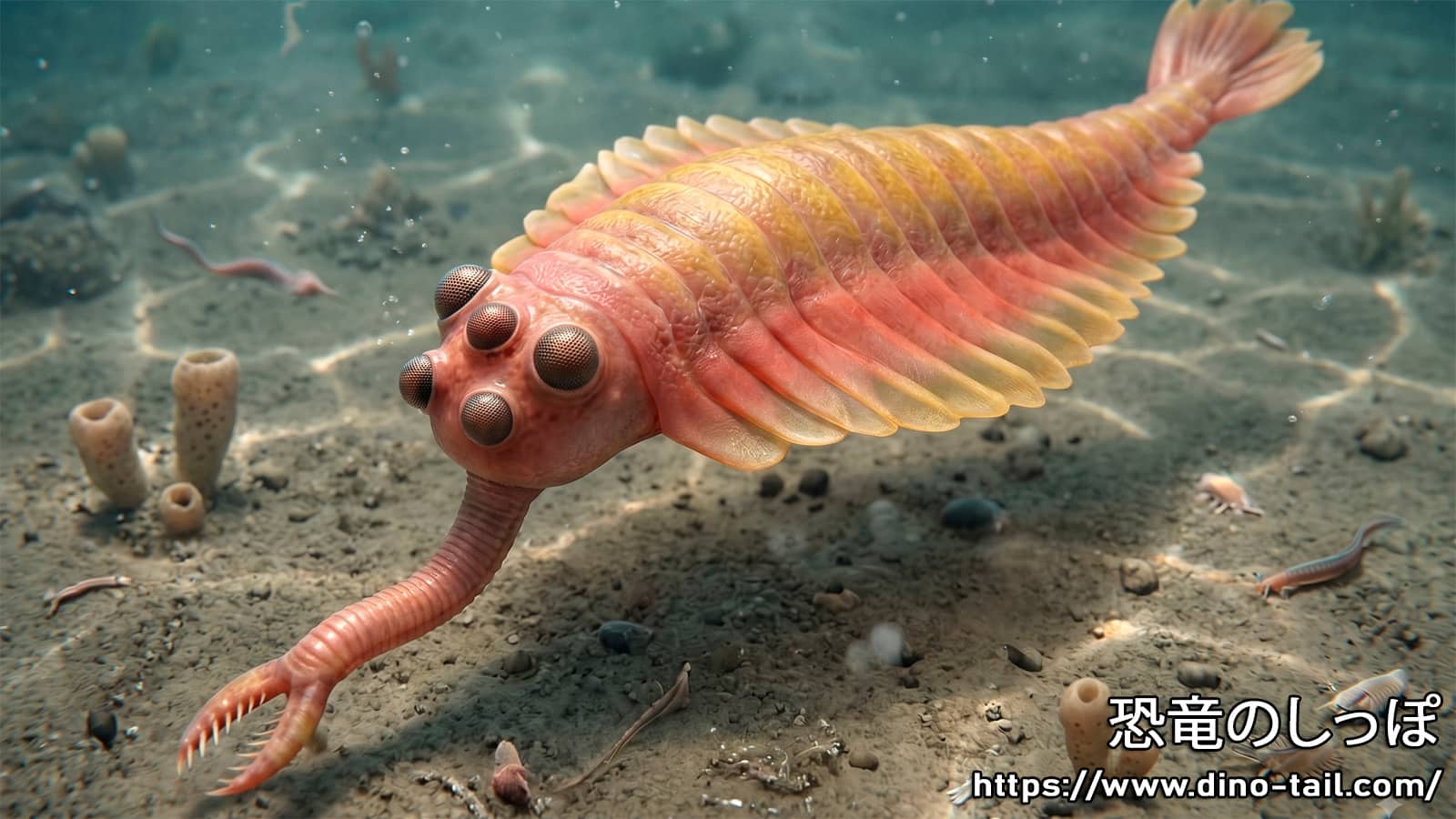
Opabinia (Opabinia regalis) is a small invertebrate, measuring a few centimeters in length, that lived in the Cambrian seas about 500 million years ago. Discovered in the famous "Burgess Shale" World Heritage site in Canada, this creature had an extremely bizarre appearance that does not fit into any group of animals living today.
Its rounded head featured five eyes mounted on short stalks. This is thought to have given Opabinia a nearly 360-degree field of vision, allowing it to search for prey on the sea floor while keeping an eye out for enemies approaching from above.
Even more bizarre was the long, flexible "proboscis" (a nozzle or tube-like organ) extending from the front of its head, resembling a vacuum cleaner hose. At the end of this proboscis was a claw with spines, used for grabbing prey. Opabinia's mouth was located on the underside of its head, opening facing "backward" (towards its tail). It is presumed that they caught prey with the tip of their proboscis and bent the entire nozzle into a "U" shape to deliver the food to their backward-facing mouth.
Why were soft bodies preserved as fossils?
Usually, an animal's soft body rots quickly after death, leaving only hard bones or shells to fossilize. However, in the Burgess Shale formation in Canada, a massive underwater mud avalanche (turbidity current) instantly buried the creatures deep on the ocean floor without oxygen. Without oxygen, bacteria could not decompose them, allowing soft-bodied organisms like Opabinia to be miraculously preserved, down to their eyes and internal organs.
Controversy and Evidence of Evolution: What about the legs?
Opabinia's body was divided into 15 segments, with fin-like "lateral lobes" projecting diagonally downwards on both sides. It is thought to have swum near the seabed by undulating these fins from front to back.
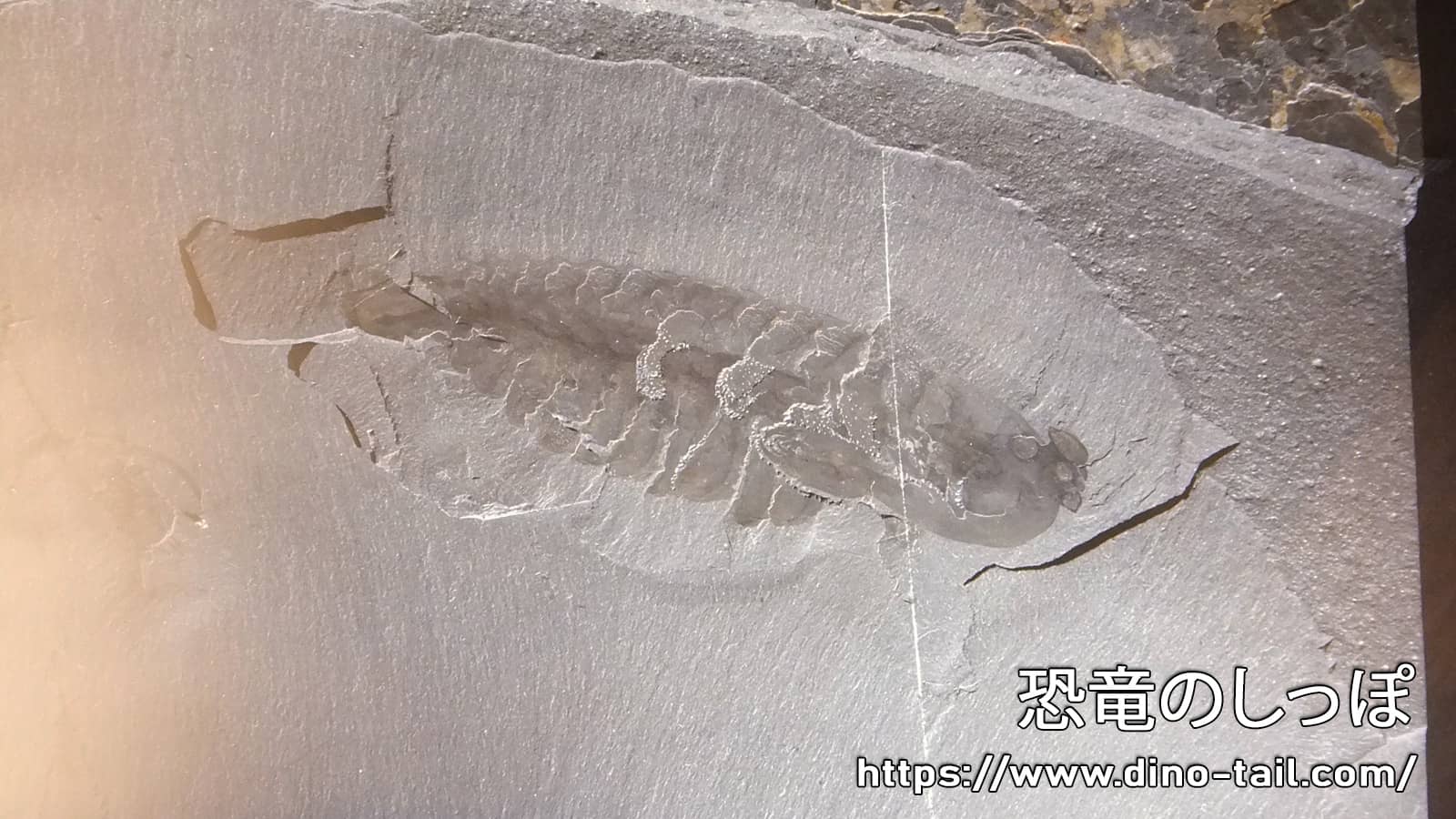
Actually, there has been a decades-long debate among paleontologists regarding the structure of Opabinia's abdomen. The question was whether "the triangular traces left on the fossils were soft walking legs (lobopods) on the belly side, or if they were digestive organs (parts of the intestine) protruding from inside the body."
As a result of recent scientific studies and 3D verification, the prevailing theory now is that "it had fins on its back for swimming and breathing, and soft legs on its belly for walking." This provides a crucial clue for understanding how the "complex, bifurcated legs" of later arthropods (like shrimp, crabs, and insects) evolved.
New Discoveries and Survival: Opabiniids thrived for a long time
For over a century after its discovery in 1912, Opabinia was believed to be the only species of its family (Opabiniidae) in the world. It was sometimes treated as a transient evolutionary failure born during the era of biological diversification known as the "Cambrian Explosion."
However, in 2022, a series of discoveries overturned this conventional wisdom. A slightly hairy relative named "Utaurora" was found in Utah, USA, and a small new species named "Mieridduryn" was discovered in the UK.
In particular, Mieridduryn was found in strata from the "Ordovician period (about 462 million years ago)," approximately 40 million years after the Cambrian. This proves that these bizarre creatures with five eyes and a nozzle did not quickly go extinct in the Cambrian but were successful survivors that adapted and lived in various seas for tens of millions of years.
Impact on Evolutionary Theory and "Wonderful Life"
Charles Walcott, who first described Opabinia fossils in 1912, was constrained by the contemporary belief that "organisms evolve along a straight, predetermined path from simple to complex." As a result, he forced this bizarre creature into the group of crustaceans, similar to modern fairy shrimp.
However, in the 1970s, a research team led by Harry Whittington re-examined the fossils in three dimensions by carefully chiseling the rock with needles. There is an anecdote that when Whittington presented a slide of Opabinia with its "five eyes and tubular proboscis" at a conference in 1972, the scholars filling the room erupted in "laughter" out of sheer surprise and bewilderment at its incredibly unconventional appearance.
Wonderful Life and Contingency of History
Opabinia's unique morphology was featured as a core theme in the famous best-selling book "Wonderful Life" by American evolutionary biologist Stephen Jay Gould. Using Opabinia as an example, Gould argued for the "contingency of history," stating that "if the tape of life were rewound and played again, slight differences in luck would lead to completely different creatures surviving, resulting in a world entirely different from today."
Today, Opabinia is classified as an "early ancestor of arthropods (stem group)," related to insects and crustaceans. It continues to be one of the most important model organisms in paleontology.