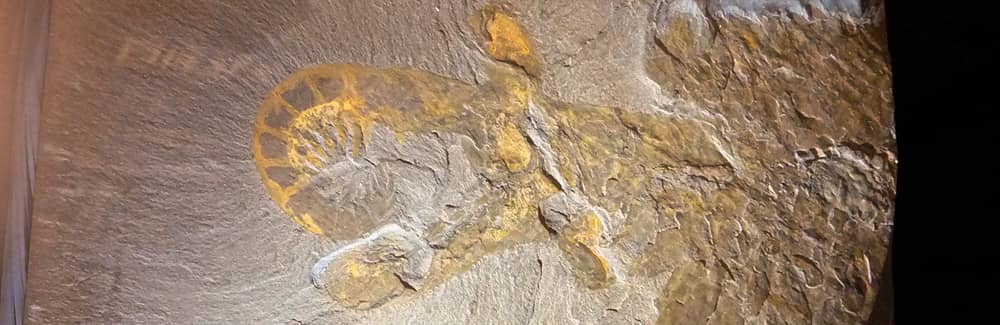
About Anomalocaris
| Scientific Name (Genus) | Anomalocaris |
| Meaning of Name |
Abnormal or irregular shrimp
anōmalos(abnormal)[Ancient Greek] - karís(shrimp)[Ancient Greek] |
| Classification | Animalia, Arthropoda (stem-group), Dinocaridida, Radiodonta, Anomalocarididae |
| Period | Cambrian period (about 541 to 485 million years ago) |
| Habitat | Canada (Burgess Shale), China (Chengjiang biota), Australia (Emu Bay Shale), etc. |
| Total Length | About 25cm - 38cm (Some estimates suggest up to 50cm) |
| Diet | Carnivorous |
| Sub-classification / Species Name |
Anomalocaris canadensis Anomalocaris daleyae etc. |
| Year of Paper Publication | 1892 (when frontal appendages were discovered) |
The Cambrian Explosion and the Appearance of the "Strange Shrimp"
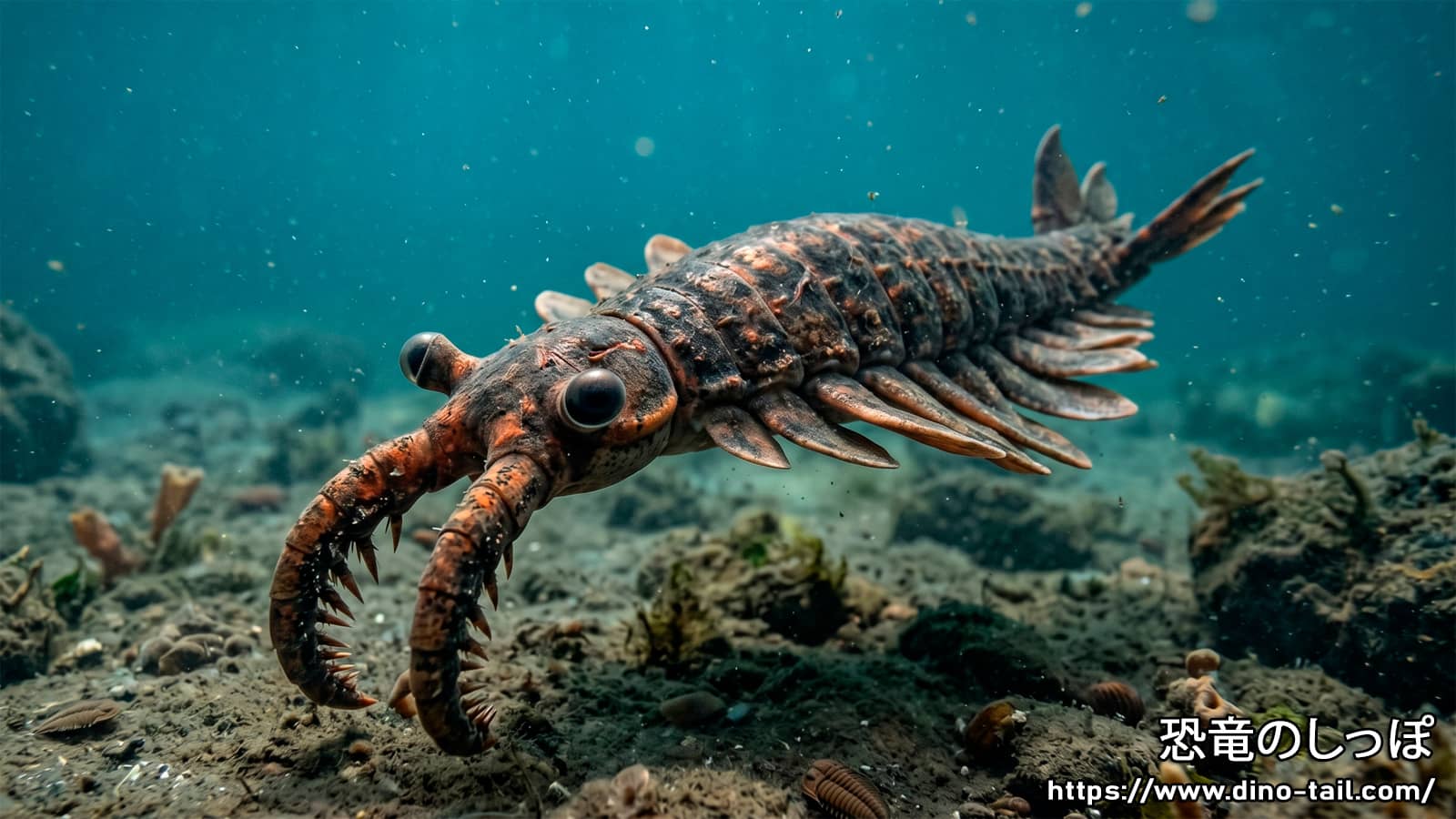
The Cambrian period (about 541 to 485 million years ago) is defined as the era of the "Cambrian Explosion," when Earth's biodiversity dramatically expanded. During this time, the body plans that form the foundation of major modern animal phyla appeared in a short period. At this testing ground of evolution, it was Anomalocaris that reigned at the apex of the marine ecosystem.
Its body length was once estimated to exceed 1 meter, but recent precise studies have shown that it was around 38 cm for the main species, Anomalocaris canadensis, and about 50 cm for species like Anomalocaris daleyae from Australia. Nevertheless, in an ocean where the vast majority of organisms were millimeters to a few centimeters long, this size was overwhelmingly giant, cementing its position as the first true "apex predator."
The existence of Anomalocaris goes beyond being a mere record of an ancient creature; it holds importance as the spark for the interaction between predators and prey in the early oceans, in other words, the "evolutionary arms race."
Etymology and Taxonomic Background: Its Position as a Stem-Group Arthropod
Its name, combining the Ancient Greek words "anōmalos" (abnormal or irregular) and "karís" (shrimp), originated from the fact that the initial discoveries were extremely fragmentary, and when its full picture was revealed, it had an "abnormal" morphology that greatly deviated from existing biological frameworks. Anomalocaris is a stem-group arthropod belonging to an extinct group called Radiodonta, and it is positioned close to the common ancestor of modern crustaceans, insects, and spiders.
Wondrous Anatomical Structure
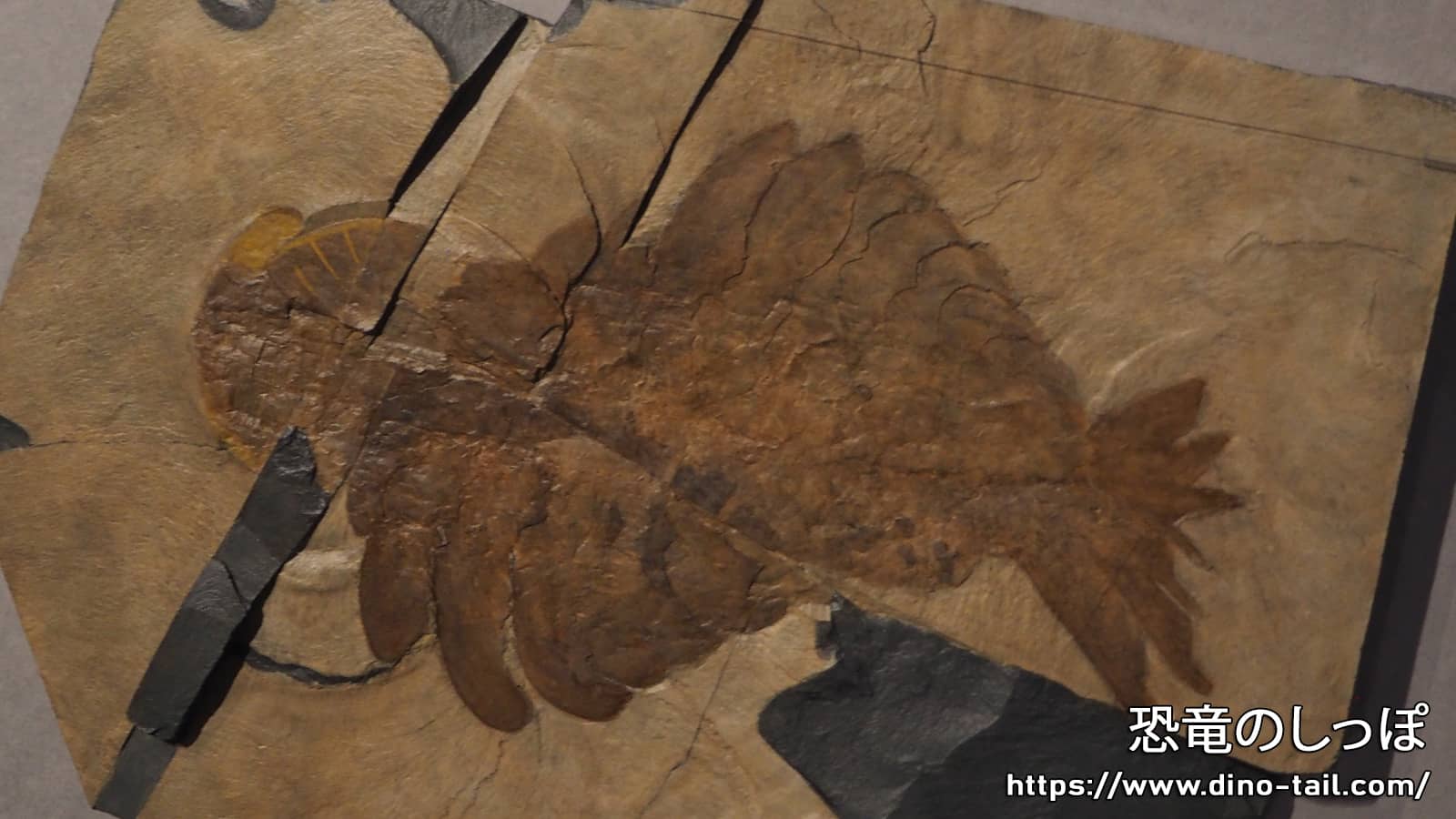
The body of Anomalocaris is divided into a head equipped with highly specialized sensory and predatory organs, a trunk with lateral flaps that generate propulsion, and a complex tail fan. Its anatomical features highlight the ecology of a sophisticated hunter combining high mobility and vision.
Head and Frontal Appendages: Precision Machinery for Predation
The most iconic organ of Anomalocaris is the pair of frontal appendages located at the front of the head. In Anomalocaris canadensis, it consists of a total of 14 segments, with sharp paired spines called "endites" protruding from the ventral side of each segment. These spines were extremely effective for piercing prey or enclosing them like a basket to block their escape. It is thought that because there were flexible intersegmental membranes, allowing the appendages to bend greatly inward, it could efficiently carry prey caught in the water column to the mouthparts located on the ventral side.
Visual System: The Highest Resolution in the Cambrian
The visual capabilities of Anomalocaris reached an unparalleled level for creatures of its time. From well-preserved fossils, it has been revealed that a single compound eye contained up to 16,000 to over 24,000 hexagonal ommatidial lenses. This is equivalent to the vision of a dragonfly (about 28,000), which is the pinnacle of modern times, and because they were located at the ends of long "stalked eyes" protruding from the sides of the head, they secured a wide field of view close to all directions.
Radial Mouthparts and Swimming Flaps
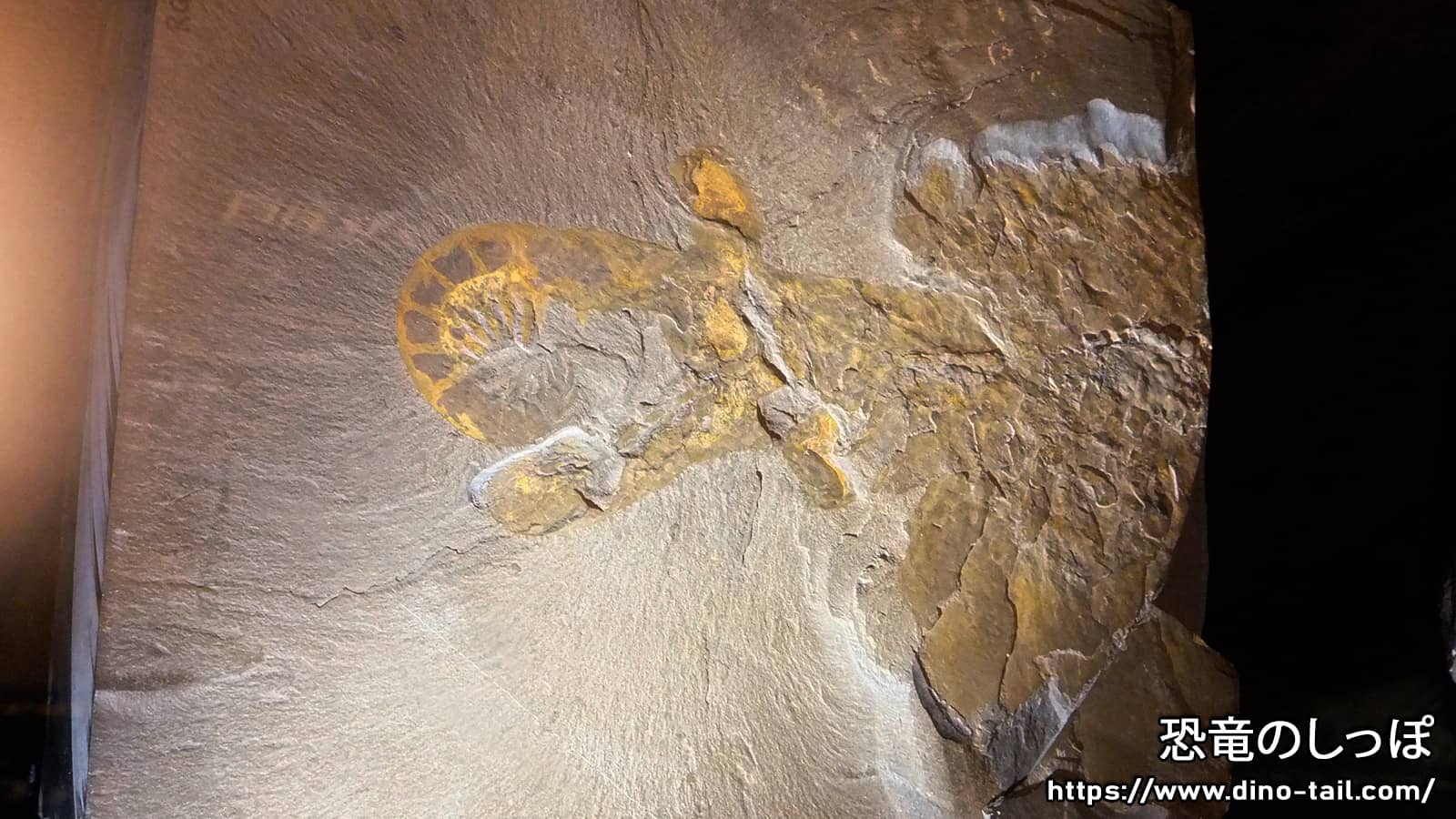
The mouthparts of Anomalocaris are called an "oral cone" and consist of radially arranged hard plates. Because it had a structure that could not close completely, it suggests that rather than crushing hard shells by force, it may have sucked in relatively soft prey or chewed pieces of meat torn small by its appendages.
The trunk was covered with 13 to 16 pairs of lateral flaps (swimming fins), which were the source of propulsion. Swimming by undulating the flaps sequentially allowed for stable, high-speed swimming while minimizing energy consumption. In addition, there was a "tail fan" with 3 pairs of large fins spreading out in a fan shape at the end, which was key to sharp turns and acceleration.
History of Research: A 100-Year Puzzle from Fragments to the Whole Picture
The research history of Anomalocaris is one of the most dramatic cases of misidentification and rediscovery in paleontology. From the 1890s to the early 1980s, each part of Anomalocaris was described as a completely different organism belonging to a separate animal phylum.
- Anomalocaris (Frontal Appendage): In 1892, Whiteaves described this as the "abdomen" of a shrimp-like crustacean.
- Peytoia (Mouthparts): In 1911, Walcott considered the disc-shaped mouthparts to be an independent "jellyfish."
- Laggania (Trunk): Also by Walcott, the flat trunk was described as a type of "sponge" or "sea cucumber."
During a reinvestigation in the 1980s by a research team led by Harry Whittington and Derek Briggs of Cambridge University, while cleaning old specimens, the "complete whole picture" emerged: an Anomalocaris appendage attached to the front end of a Laggania trunk specimen, with a Peytoia mouthpart located in the center. A paper published in 1985 proved that all these fragments were a single giant carnivore.
Stephen Jay Gould's "Wonderful Life" and Beyond
It was Stephen Jay Gould's book "Wonderful Life," published in 1989, that popularized this scientific discovery to the general public. Gould introduced Anomalocaris as the prime example of a "weird wonder" that did not belong to any classification system of modern organisms. Today, Anomalocaris is classified not as a completely unknown phylum, but as a "stem group" representing the early stages of arthropod evolution.
Marine Order and Predation Strategy of the Cambrian
For many years, Anomalocaris was depicted as a "trilobite killer" that crunched and ate the hard shells of trilobites. However, recent biomechanical research has cast doubt on this traditional view.
A study published in 2023 showed through computer simulations that the spines of its frontal appendages and the plates of its mouthparts were too fragile to penetrate or destroy hard, calcified trilobite shells. Rather, it is highly likely that Anomalocaris preyed on soft prey swimming in the water, such as worms like Priapulida or early arthropods without shells, by skewering them with its sharp spines.
It is thought that it was most efficient for them to swim in a "Superman posture" with their appendages stretched straight forward, and from this posture, they would sight their prey, approach at high speed, and strike a single blow.
Geographical and Stratigraphic Distribution
Anomalocaridids were widely distributed in shallow waters worldwide during the Cambrian period.
- Burgess Shale (Canada): The most famous locality, where the type specimen of Anomalocaris canadensis was found. Because it was instantly buried in a anoxic deep sea by a mudflow, soft tissues are preserved in incredible detail.
- Chengjiang Biota (China): Even older than the Burgess Shale, it is an important locality showing the early diversity of the Anomalocarididae family. Close relatives like Amplectobelua have also been discovered.
- Emu Bay Shale (Australia): The most important source of information regarding the "vision" of Anomalocaris, where extremely well-preserved giant compound eye fossils were discovered.
Latest Research Topics: The Major Discovery of "Mosura fentoni" in 2025
In May 2025, the discovery of a new radiodontan, "Mosura fentoni," from the Burgess Shale was reported. Despite its small size of only about 5 cm in total length, it possessed very aggressive equipment.
Mosura's head had "three eyes," featuring another eye in the center of its head in addition to the left and right stalked compound eyes. It also had appendages with very long and sharp spines, making it suitable for instantly piercing and capturing small crustaceans and worms.
Even more surprisingly, internal structures of soft tissues were preserved clearly, such as an "open circulatory system" which is a space filled with blood pumped from the heart, traces of complex nerve bundles, and gill-like respiratory organs concentrated at the rear. This suggests that they had already established a highly advanced system at a level close to modern arthropods more than 500 million years ago.