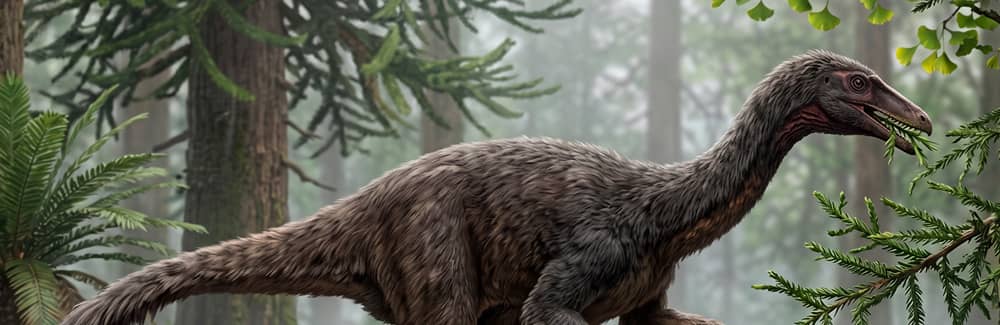
An entirely new genus and species of therizinosaur, Kayrasaurus changliensis, has been discovered from the Jehol Biota in China.
Ranking among the largest therizinosaurs found in this region, this new species possesses startling features not seen in other dinosaurs:
- The Most Teeth: Over 45 closely packed dentary teeth, the most of any known therizinosaur.
- Extremely Long Neck: A cervical region evolved significantly to access high-growing vegetation.
- Specialized Claws: Powerful claws with a unique "protuberance" designed to pull down branches.
In this article, we explain the peculiar anatomical features of Kayrasaurus and how it achieved niche partitioning with other dinosaurs in an ecosystem dating back about 125 million years, based on the latest research.
Introduction
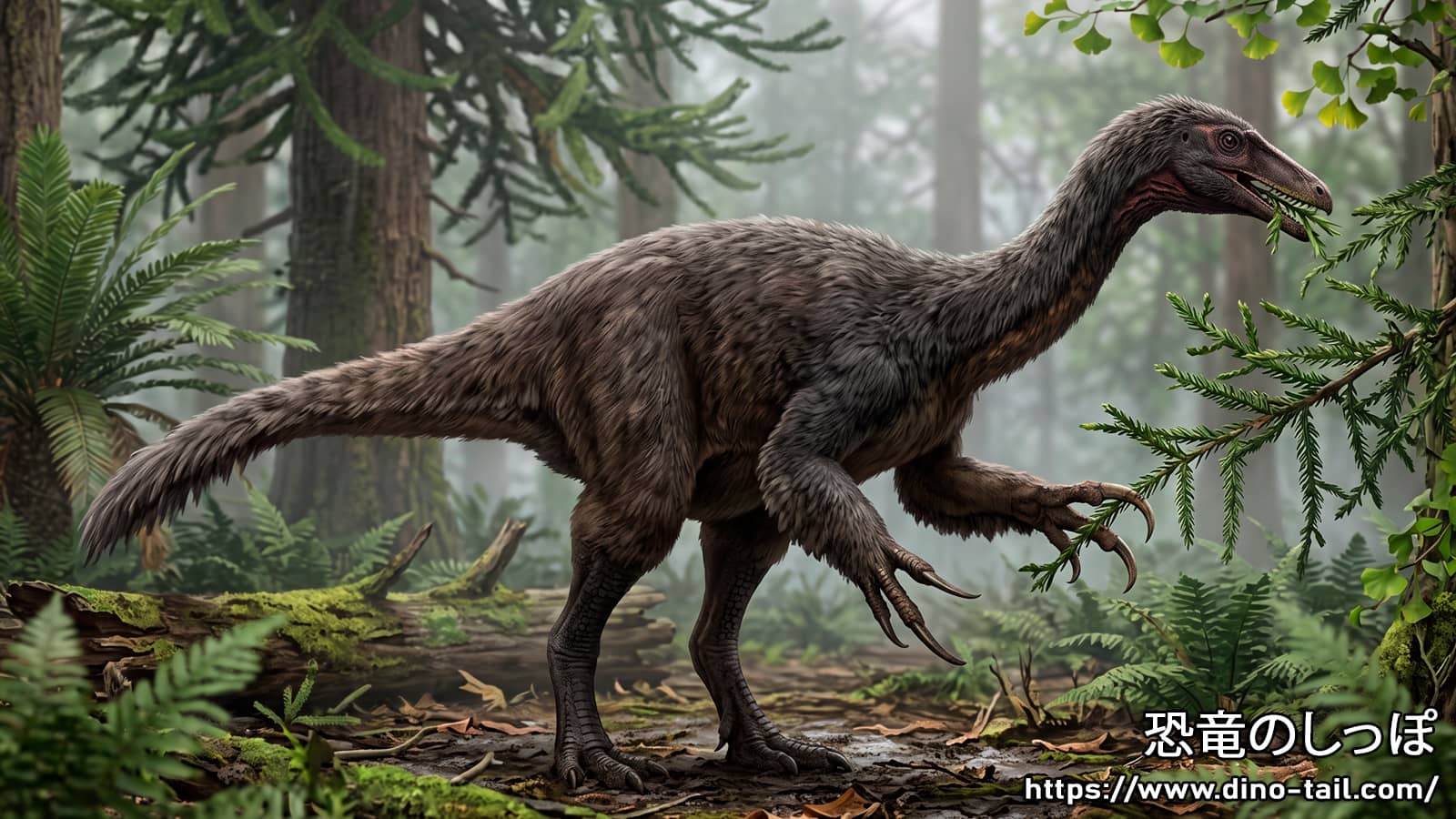
Gemini Generated Image
Theropods are generally known as "carnivorous dinosaurs," but several examples show that some lineages underwent an unusual shift toward herbivory or omnivory. Among them, the group that achieved the most peculiar and extreme morphological evolution is the Therizinosauria.
While retaining the basic bipedal skeletal structure typical of theropods, this clade possesses unique anatomical features: a relatively small head, leaf-shaped teeth for snipping foliage, an elongated neck, a broad, barrel-like torso housing a massive digestive tract for fermenting plant matter, and enormous, sharply curved claws on the forelimbs. These bizarre morphologies made their phylogenetic classification difficult for many years. However, as the fossil record of basal (early-diverging) taxa accumulates, their evolutionary pathway is gradually being unraveled.
The Early Cretaceous Jehol Biota in northeastern China is renowned for yielding exceptionally well-preserved fossils of feathered dinosaurs, early birds, and mammals, making it a crucial formation for understanding the early evolution of therizinosaurs. In September 2026, an international research team led by Dr. Xing Xu of the Institute of Vertebrate Paleontology and Paleoanthropology (IVPP) and Yunnan University formally described a new genus and species of therizinosaur from the Jehol Biota in the paleontological journal Journal of Systematic Palaeontology (Vol. 24, Issue 2).
This new species was named Kayrasaurus changliensis. It has been revealed as the largest and most anatomically distinctive therizinosaur discovered in the Jehol Biota.
Taxonomic Background and Etymology
Kayrasaurus is classified as a therizinosaurian belonging to the clade Coelurosauria. The naming of this species reflects both its phylogenetic connections in paleontology and the geographical and historical context of its discovery.
The first part of the genus name, "Kayra", derives from the name of the creator god in Turkic mythology. Kayra is considered the father of "Erlik", the god of death, which served as the namesake for another famous therizinosaur, Erlikosaurus. This suggests that Kayrasaurus occupies an "ancestral" position, representing a basal taxon leading to more derived therizinosaurs like Erlikosaurus. The latter part, "saurus", is a common suffix meaning "lizard" in Greek.
The specific name, "changliensis", comes from "Changli", a historical geographical name from the Three Kingdoms period for the region in northeastern China where the fossil was unearthed, paying homage to the land of its origin.
| Rank | Scientific Name (Taxon) | Namer and Year |
|---|---|---|
| Superorder | Dinosauria | Owen, 1842 |
| Suborder | Theropoda | Marsh, 1881 |
| Infraorder | Coelurosauria | sensu Gauthier, 1986 |
| Clade | Therizinosauria | Russell and Dong, 1993 |
| Genus | Kayrasaurus | Liao et al., 2026 |
| Species | Kayrasaurus changliensis | Liao et al., 2026 |
Geological and Stratigraphic Context
The fossils of Kayrasaurus were excavated from an outcrop of the Yixian Formation located in Dabangou village, Sihetun area, near Beipiao City, Liaoning Province, China. The Yixian Formation was deposited during the Early Cretaceous period (about 125 million years ago).
This region during the Early Cretaceous enjoyed a warm and humid climate, an era when early angiosperms (flowering plants) were evolving and gradually changing the ecosystem. While conifers and ferns were still dominant, the emergence of new plants likely provided a strong impetus for the evolution of herbivorous and omnivorous animals, including the diversification of small theropods.
Taphonomy (fossilization process) and the preservation of the Yixian Formation:
The Jehol Biota was an environment where the soft tissues and microscopic skeletal structures of organisms were miraculously preserved due to the rapid accumulation of fine volcanic ash associated with active volcanic activity. The Kayrasaurus specimen was also compressed two-dimensionally flat by geological pressure during deposition, flattening the skull thickness to just 3 to 5 millimeters. While this flattening, characteristic of Yixian Formation fossils, makes three-dimensional reconstruction difficult, it provides the advantage of preserving the skeleton in an articulated state without scattering.
The holotype specimen described for this species is housed at the Institute of Vertebrate Paleontology and Paleoanthropology in Beijing under the specimen number "IVPP V 18957". Although it lacks the hind limbs, most of the pelvis, and the tip of the tail, it consists of a nearly complete articulated skeleton including the skull.
Detailed Anatomy of Holotype Specimen IVPP V 18957
Kayrasaurus displays specific autapomorphies (unique features found only in this species) that clearly distinguish it from other early therizinosaurs. In particular, the anatomical morphology of its skull, neck, and forelimbs tells a story of high ecological adaptation for efficiently consuming specific plants.
Peculiarities of the Cranial and Mandibular Skeleton
The skull fossil of this species confirms it had large, rounded orbits (eye sockets) and elongated external nares (nostrils). While it shares the edentulous (toothless) nature of the anteriormost part of the upper jaw common to therizinosaurs, the subsequent region of the maxilla holds an array of about 32 small, closely packed teeth.
Particularly noteworthy is the dentition and structure of the lower jaw (dentary). The front 5 millimeters of the lower jaw are edentulous and curve downward. In the anterior two-thirds region behind this, there are at least 45 tiny, densely packed teeth. This number of lower jaw teeth is unusually high compared to other early therizinosaurs, which have fewer than 40 teeth, making it the highest among all known therizinosaurs. The shape of the teeth shows powerful adaptations for efficiently snipping plant leaves and stems. Furthermore, it has been pointed out that it likely possessed an "underbite" structure, where the robust lower jaw protruded forward relative to the upper jaw.
Proportional Changes in the Axial Skeleton
The ten preserved articulated cervical (neck) vertebrae show extremely peculiar proportions; even the shortest cervical vertebra is more than 30% longer than the longest dorsal (back) vertebra. Such a remarkable elongation of the neck suggests an adaptation for feeding on high-growing vegetation.
At least eleven dorsal vertebrae are preserved. The neural spines of the anterior ones are rounded and slope backward, but they show a morphological shift towards a rectangular shape moving posteriorly. The back and ribs are very robust.
Mosaic Evolution of the Shoulder Girdle and Forelimbs
The structure of the shoulder girdle and forelimbs in Kayrasaurus exhibits a classic example of mosaic evolution, where traits of early taxa and later, more derived taxa are intermingled. The shoulder girdle, consisting of the scapula and coracoid, is partially fused. This is in contrast to the unfused state in other basal taxa and is a feature akin to derived therizinosaurs.
The forelimbs were almost completely preserved. The ulna is bowed, while the radius maintains a straight, slender morphology.
Specialized Structure of Phalanges and Unguals (Claws)
The large, strongly curved forelimb claws (unguals) emblematic of therizinosaurs are also preserved in Kayrasaurus.
Of the three fingers, digit II (the inner finger) is the shortest, but its basal bone is the longest and most robust. The outermost digit IV is the most gracile, and its claw is smaller than the other two, yet it possesses a unique "protuberance" projecting upward near its base. This upward-projecting ridge is a distinct morphology specific to this species, clearly differing from all other therizinosaurs, and likely reflects a specialized attachment for the muscles operating the claw and a unique motion during foraging.
Ontogeny, Size, and Growth Dynamics
Kayrasaurus boasts the largest size among therizinosaurs discovered from the Jehol Biota. The body length of the discovered individual reached at least 3.6 meters, with an estimated weight between 117 and 274 kilograms.
However, these figures do not represent the true maximum size of this species. Judging from the degree of fusion in the vertebrae, this holotype specimen was found to be a "subadult" still growing at the time of death. Considering the growth curves of dinosaurs, it is estimated that a fully mature adult Kayrasaurus would significantly exceed the current estimates, surpassing 500 kilograms in weight and reaching 4 to 5 meters in length.
Additionally, since traces of feathers have been confirmed in closely related species, it is highly likely that Kayrasaurus was similarly covered in feathers across its entire body.
Paleoecology: Niche Partitioning in the Jehol Biota
One of the academic contributions brought by the discovery of Kayrasaurus is the demonstration of "niche partitioning" among therizinosaurs in the Early Cretaceous Jehol Biota.
What is Niche Partitioning?
According to the "competitive exclusion principle" in ecology, multiple species with exactly the same lifestyle or diet (ecological niche) cannot coexist in the same environment for long periods. Therefore, avoiding direct competition by utilizing different resources within the environment is called "niche partitioning."
The confirmation of as many as four closely related therizinosaur species from the same formation and ecosystem (Yixian Formation) indicates that they were segregating habitats using different strategies. It has been pinpointed that they had diverged into at least two distinct groups.
1. Robust, Intra-oral Processing Strategy (e.g., Kayrasaurus, Beipiaosaurus)
Characterized by an enlarged body, a more robust skeletal structure, and jaw mechanics adapted for high bite force. They were not suited for agile movements or long-distance running. It is thought that they used their powerful forelimb claws to pull down plant branches and efficiently chop leaves within their mouths using countless fine teeth. The extremely elongated neck of Kayrasaurus strongly suggests access to higher vegetation.
2. Agile, Cursorial, Forelimb-driven Strategy (e.g., Jianchangosaurus, Lingyuanosaurus)
Inferred to have had leg strength suited for running, given their relatively small body size, gracile skeletal structure, and long shin bones. They are believed to have foraged widely for relatively lower vegetation, relying heavily on forelimb-driven gathering behavior.
| Ecological and Morphological Features | Robust, Intra-oral Processing Strategy (e.g., Kayrasaurus) |
Agile, Cursorial, Forelimb-driven Strategy (e.g., Jianchangosaurus) |
|---|---|---|
| Build and Skeletal Structure | Robust, heavy, tendency toward gigantism | Gracile, lightweight, small to medium-sized |
| Cursoriality (Running Ability) | Low (short and thick lower limb bones) | High (long and slender lower limb bones) |
| Neck Proportions | Markedly elongated (feeding on high vegetation) | Relatively short to moderate |
| Dentition and Jaw Structure | Numerous, dense teeth; high bite force | Relatively fewer teeth; lightweight jaws |
| Primary Foraging Behavior | Emphasis on intra-oral processing | Emphasis on forelimb-driven gathering |
| Target Vegetation | Mid to high-canopy trees, tough leaves/stems | Low-growing vegetation, wide-ranging foraging |
Thus, a complex and sophisticated ecosystem was established in the Jehol Biota 125 million years ago, where species divided the height of the plants they ate by altering their body size and neck length, and divided the toughness of the plants they ate by altering their jaw strength and tooth structure.
Biomechanical Adaptations and Evolutionary Significance
The data from Kayrasaurus indicates that several important evolutionary changes were taking place.
First, regarding the morphology of the claws. The unique upward-projecting protuberance seen on the claws of Kayrasaurus likely altered the attachment angle of the extensor muscles, generating a powerful force capable of pulling down sturdy branches. This suggests that altering claw shape was a driving force behind the exploitation of diverse plant resources.
Next is the change in digestive methods. Derived therizinosaurs of the Late Cretaceous show a reduction in the number of teeth and heavily rely on fermentation and grinding in the gastrointestinal tract using gastroliths. However, Kayrasaurus possessed over 45 teeth in the lower jaw alone and relied strongly on physical processing within the mouth. This can be seen as transitional evidence showing that in the evolutionary process of shifting to herbivory, "pulverization by jaws and teeth" developed first, before the primary role shifted to "chemical fermentation in an enlarged digestive tract."
References and Bibliography
- Scientists Found a New Giant Feathered Dinosaur With Nightmare, https://www.zmescience.com/science/paleontology/scientists-found-a-new-giant-feathered-dinosaur-with-nightmare-claws-but-it-ate-plants/
- Scientists Just Unearthed China's New Giant Dinosaur, and Its Body, https://dailygalaxy.com/2026/09/china-giant-dinosaur-unique-body-structure/
- This Newly Discovered Dinosaur Looks Terrifying—But ... - Nautilus, https://nautil.us/this-newly-discovered-dinosaur-looks-terrifying-but-probably-wouldnt-eat-you-1285466
- [Paleontology • 2026] Kayrasaurus changliensi, http://novataxa.blogspot.com/2026/09/kayrasaurus.html
- New Therizinosaurian Dinosaur Unearthed in China | Sci.News, https://www.sci.news/paleontology/kayrasaurus-changliensis-15082.html
- Kayrasaurus - Wikipedia, https://en.wikipedia.org/wiki/Kayrasaurus
- KAYRASAURUS - DinoChecker dinosaur archive, http://www.dinochecker.com/dinosaurs/KAYRASAURUS
- 凯拉神龙揭示早期镰刀龙类的生态分化, https://www.ivpp.ac.cn/xwdt/kyjz/202609/t20260917_8284044.html
- New therizinosaur species unearthed in northeastern China, https://signal-update.com/update-feed/new-therizinosaur-species-kayrasaurus-china/
- 学者も「奇妙」と呼ぶ巨大恐竜の仲間を中国で発見 - ナゾロジー, https://nazology.kusuguru.co.jp/archives/200315
- New 120 million year old dinosaur species described from China, https://www.reddit.com/r/Dinosaurs/comments/1wd90cx/new_120_million_year_old_dinosaur_species/