About Therizinosaurus
| Scientific Name (Genus) | Therizinosaurus |
| Meaning of Name |
Scythe lizard
therizo (reap) [Greek] - saurus (lizard) [Greek] |
| Classification | Saurischia, Theropoda, Therizinosauridae |
| Total Length | Approx. 9 - 10m |
| Diet | Herbivorous |
| Period | Late Cretaceous (Maastrichtian, approx. 70 million years ago) |
| Sub-classification / Species Name | Therizinosaurus cheloniformis |
| Year of Paper Publication | 1954 |
| Genus Name Publication | Новый черепахообразный ящер в Монголии. Evgeny Maleev (1954). |
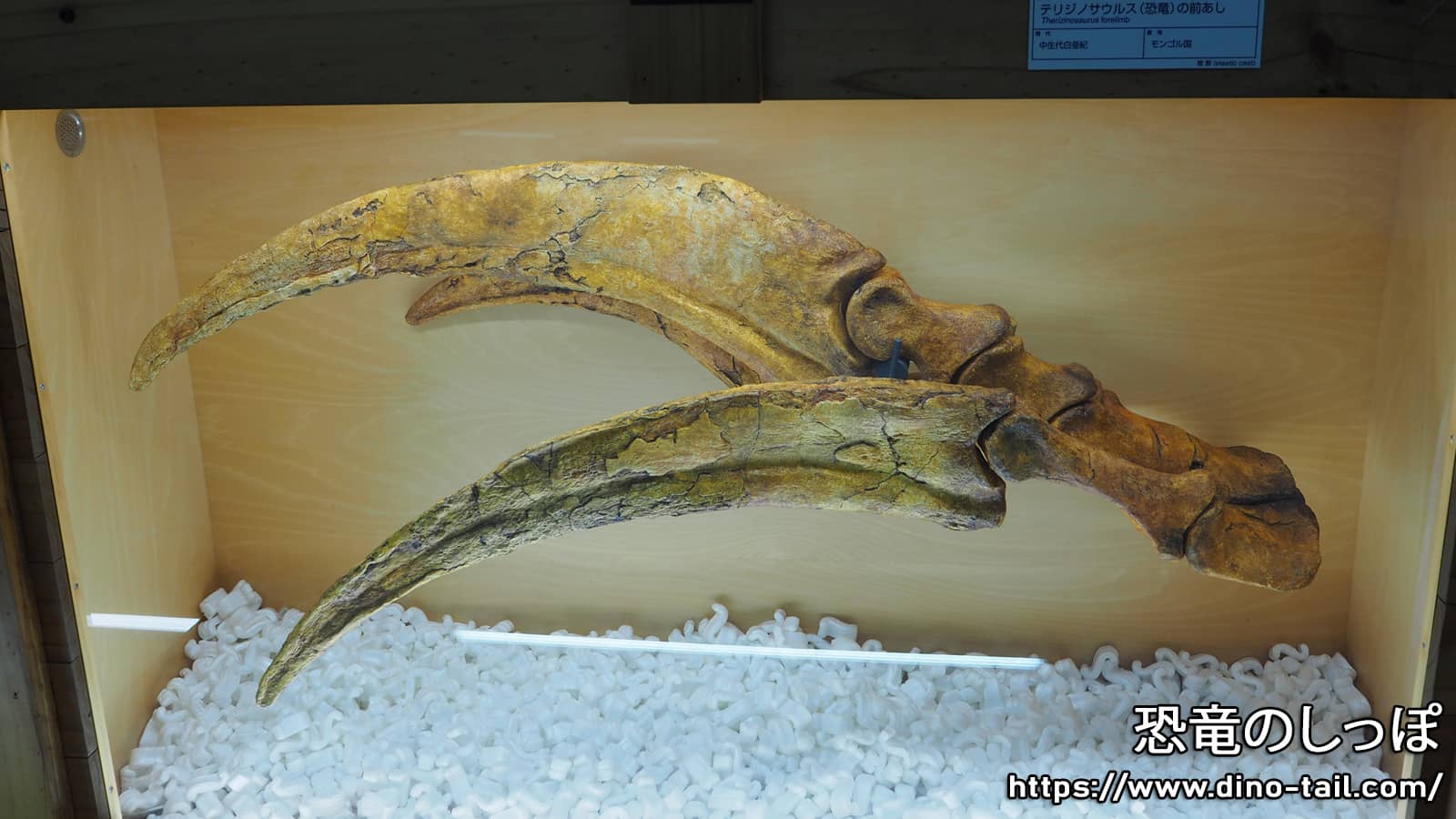
Therizinosaurus is a theropod dinosaur belonging to the maniraptorans that lived in East Asia about 70 million years ago during the Maastrichtian stage of the Late Cretaceous.
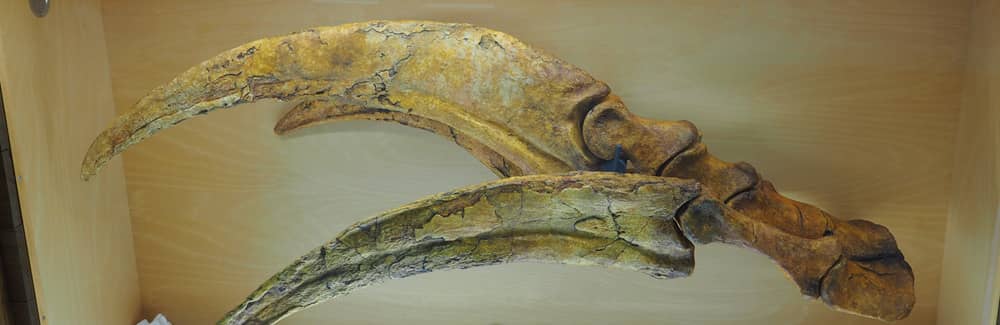
It has long drawn the attention of the paleontological community as an embodiment of an "evolutionary paradox", as it evolved into an extremely specialized ecological niche of herbivory while retaining the ancestral morphology of a carnivorous dinosaur. As the meaning of its genus name, "scythe lizard," suggests, its most distinctive feature is its massive scythe-like hand claws that reached up to 1 meter in length, recorded as the largest claws in the history of terrestrial animals.
Physical Morphology: A Bizarre Giant Maniraptoran
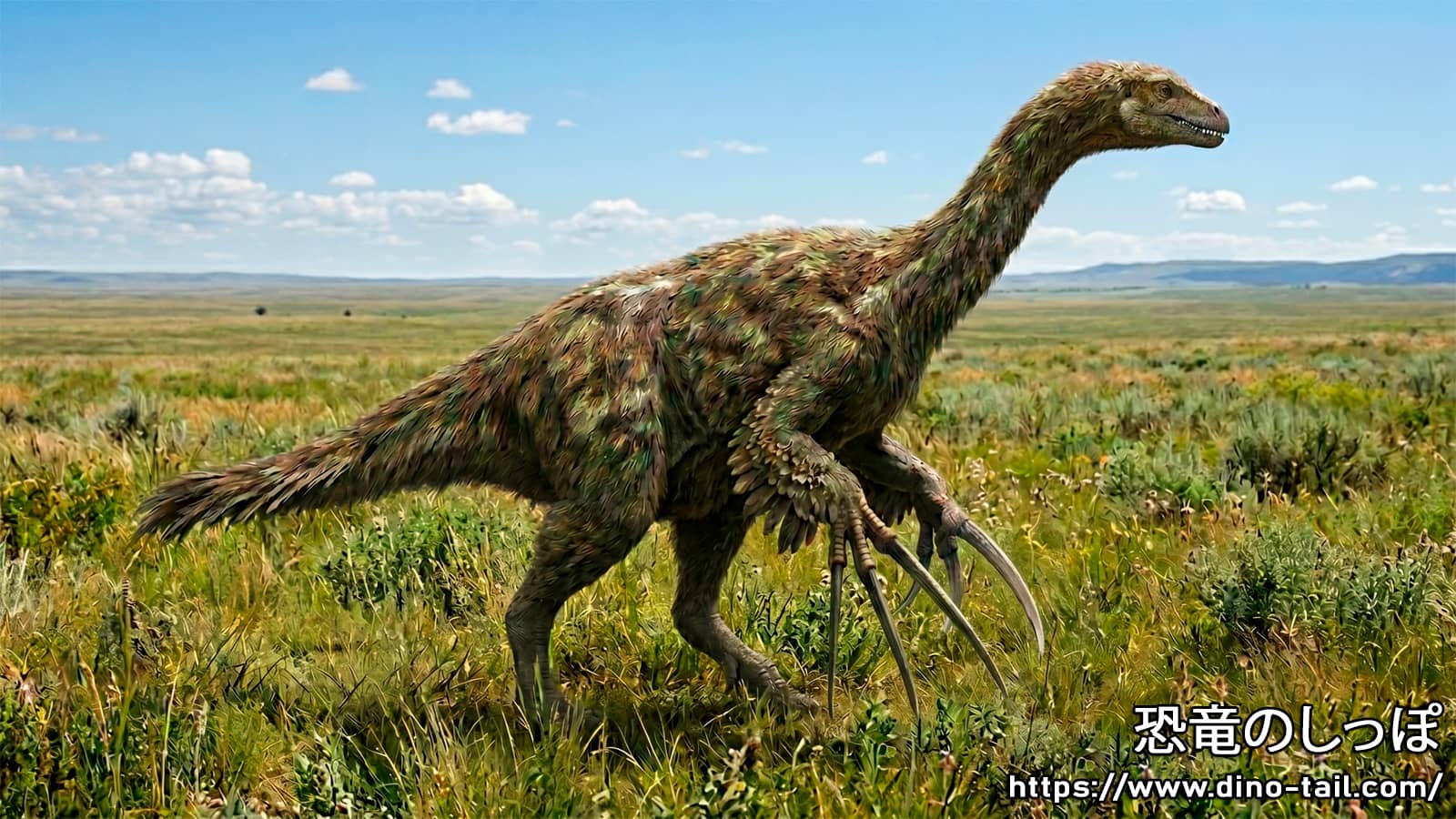
Therizinosaurus evolved into an exceptionally giant size among the maniraptorans, a group that typically includes small to medium-sized dinosaurs closely related to birds. Its overall appearance consisted of extremely unusual proportions: a small head, a long neck, a massive torso, and disproportionately huge arms.
Estimated Size and Weight
Although a complete skeleton has not been discovered, scaling using data from closely related species estimates its total length at 9 to 10 meters and its total height (in a normal posture) at 4 to 5.7 meters. Its weight is estimated at 3,000 to 6,000 kilograms, rivaling that of the contemporary tyrannosaurid Tarbosaurus.
Forelimbs and Giant Scythe-like Claws
Its most iconic feature is its forelimbs, which reached 2.4 to 3.5 meters in length. It boasts one of the longest reaches among bipedal dinosaurs. The claws (unguals) on the ends of its three fingers are estimated to have reached 50 to 70 centimeters for the bone core alone, and up to 1 meter when including the keratinous sheath. These claws were very thin, relatively straight, and had a unique shape curving only at the tips.
Torso, Pelvis, and Tetradactyl Feet
The torso was extremely broad and deep, forming a "pot belly." This was necessary to accommodate a long digestive tract for fermenting and breaking down low-nutrient plant matter. To support the massive internal organs, the pubis of the pelvis had evolved into an opisthopubic condition, pointing backwards like in ornithischians and birds.
Furthermore, while normal theropods are tridactyl (three-toed) with a thumb that does not touch the ground, therizinosaurs evolved to be tetradactyl (four-toed), with the first toe (thumb) developing to touch the ground and support their weight.
Evolutionary History and Phylogenetic Significance: A Major Shift from Carnivory to Herbivory
The evolution of therizinosaurs is one of the processes involving a dramatic shift in diet within dinosaur history. Although positioned within the bird-like maniraptorans, they abandoned their function as predators (carnivores) and took the path of giant herbivores.
| Evolutionary Stage | Representative Genus | Changes in Morphological Features |
|---|---|---|
| Theropod Ancestor | Coelurus, etc. | Carnivorous, slender build, tridactyl feet, sharp teeth |
| Transitional Form | Falcarius | Transition to omnivory/herbivory, denticulation of teeth, neck elongation |
| Basal Therizinosaur | Beipiaosaurus | Retention of feathers, beak development, medium size |
| Derived Therizinosaur | Therizinosaurus | Gigantism, complete tetradactyly, highly specialized herbivorous adaptations |
The rise of angiosperms (flowering plants) in the Cretaceous provided a new food resource. It is thought that their success stemmed from a subset of maniraptorans breaking away from highly competitive predatory (carnivorous) forms and acquiring the ability to efficiently utilize abundant but difficult-to-digest plants.
Additionally, fossils of species like Beipiaosaurus confirm that therizinosaurs possessed feathers. While the giant Therizinosaurus itself might have lost its adult feathers for thermoregulation, it is currently widely accepted that they possessed feathers at least during their juvenile stage or on parts of their bodies.
Neuroanatomy and Sensory Abilities
The evolution into herbivores did not mean a regression in sensory abilities. CT scan analysis of the well-preserved skull of its close relative, Erlikosaurus, has revealed that therizinosaurs possessed extremely acute senses.
Highly developed olfaction from large olfactory bulbs would have been useful for selecting edible plants and detecting hidden predators early, while developed hearing is inferred to have been used for communication within herds. Furthermore, the anterior semicircular canals, which control balance, were particularly well-developed, likely contributing to the dexterous head movements during feeding.
Paleoecology and Behavior: The "Giant Sloth" of the Nemegt Formation
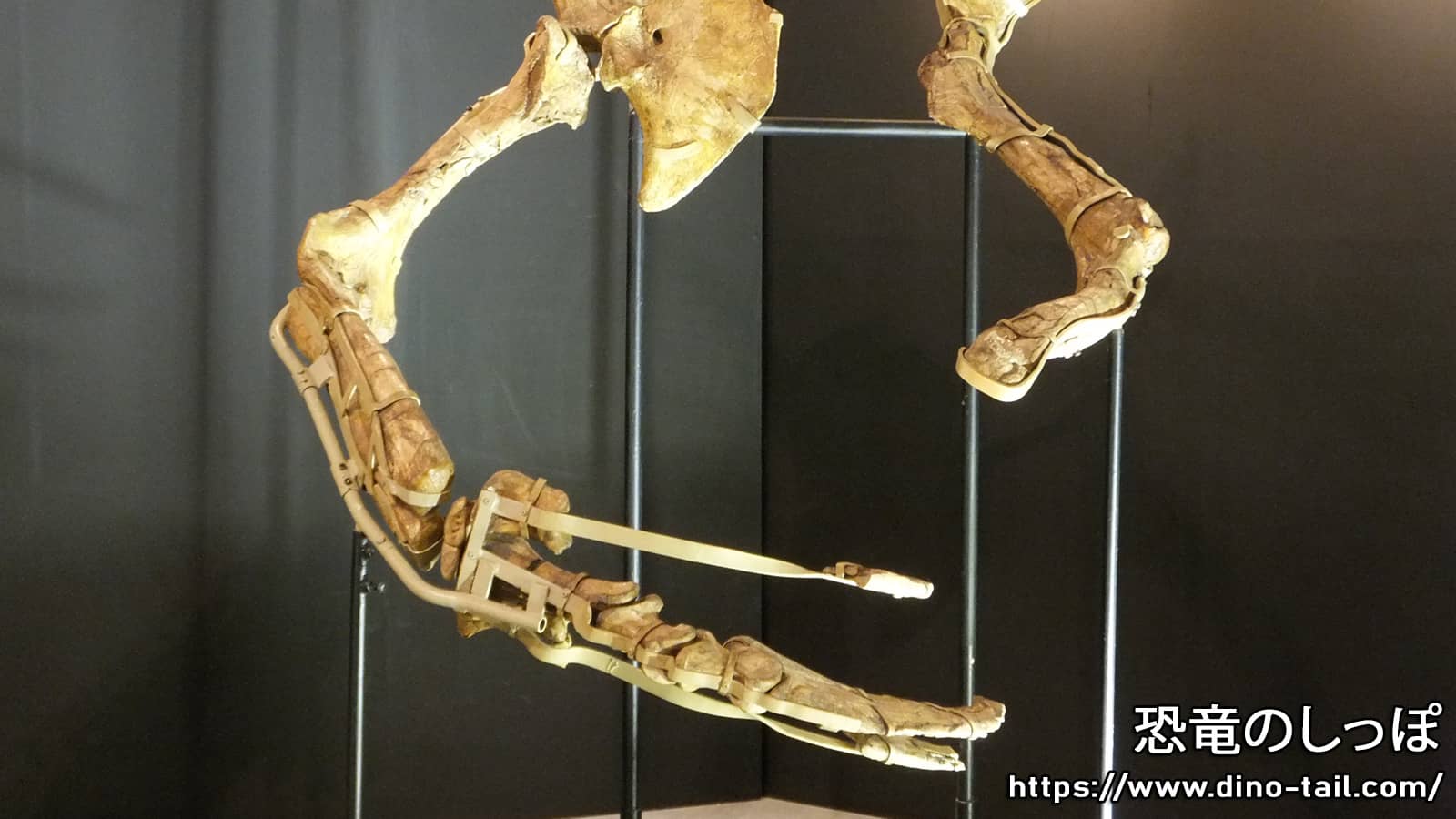
Utilizing its unique body structure, Therizinosaurus exploited plant resources differently from other herbivorous dinosaurs. With their long necks and powerful forelimbs, they held an overwhelming advantage in vertical reach.
Biomechanics research suggests their claws were optimized for a "hook-and-pull" motion, hooking branches high up and pulling them down to their mouths. This behavior is similar to the feeding habits of modern anteaters and extinct giant ground sloths.
Even if the primary purpose of the claws was for feeding, a 1-meter blade wielded by a 10-meter giant body undoubtedly functioned as a formidable weapon against natural enemies. However, recent analyses suggest that as the claws became too large, their physical work efficiency decreased, and they might have functioned more strongly as a "display structure" for attracting mates or intimidating rivals during the breeding season.
In 2011, one of the world's largest colonial nesting sites attributed to therizinosaurs was discovered in the Javkhlant Formation in eastern Mongolia. This suggests that they gathered in groups, at least during the breeding season, and jointly protected their nests.
Cohabitants of the Nemegt Formation
In the Mongolian strata where Therizinosaurus was excavated, closely related therizinosaurids such as Segnosaurus and Erlikosaurus have also been found.
Segnosaurus was somewhat smaller, had strongly curved claws, and the front of its lower jaw bent sharply downwards, showing morphological features different from Therizinosaurus. This is thought to be a case of "niche partitioning," where closely related species living in the same environment coexisted by dividing the types and parts of plants they consumed.
History of Discovery and Research: A Trajectory from Misunderstanding to Truth
The discovery of Therizinosaurus dates back to the late 1940s. In 1948, during a Mongolian paleontological expedition organized by the Soviet Academy of Sciences, several giant claw fossils were discovered in the Nemegt Formation in the southwestern Gobi Desert.
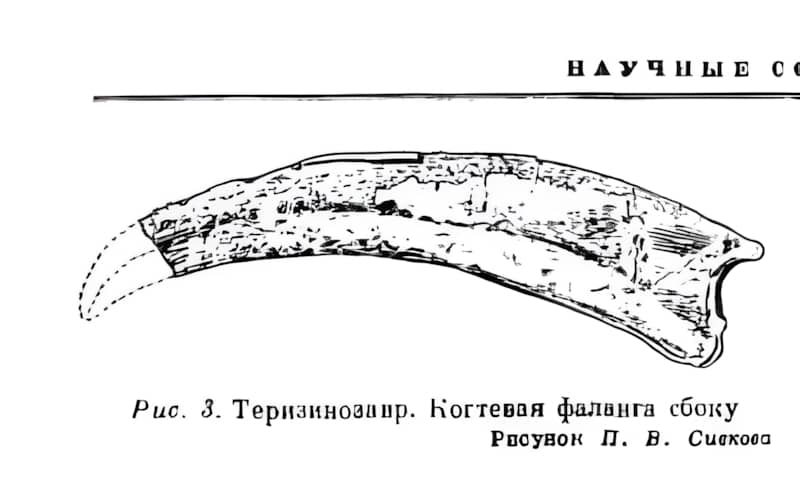
Новый черепахообразный ящер в Монголии.
Evgeny Maleev (1954).
In 1954, Russian paleontologist Evgeny Maleev described these fossils as a new genus and species, Therizinosaurus cheloniformis. However, with the knowledge of the time, it was difficult to associate these giant claws with a theropod. Maleev interpreted the claws as the ribs or part of the limbs of a giant sea turtle that had evolved to harvest seaweed. The specific name "cheloniformis" means "turtle-shaped," and this initial misidentification served as the basis for the name.
It took the discovery of more fossils to correct this erroneous interpretation. In the 1970s, research by Anatoly Rozhdestvensky and Rinchen Barsbold showed that Therizinosaurus was a theropod, not a turtle.
Subsequently, from the 1970s to the 1980s, closely related species such as Segnosaurus and Erlikosaurus were discovered one after another in Mongolia and China. And with the discoveries of Alxasaurus and Beipiaosaurus in the 1990s, it was finally proven that they were highly specialized theropods positioned within the bird-like maniraptorans.
Therizinosaurus in Modern Culture
The bizarre appearance of Therizinosaurus has made it an indispensable presence in dinosaur-themed media.
In the documentary program "Prehistoric Planet" (2022), based on the latest scientific findings, it was depicted with its entire body covered in feathers, presenting a realistic image as an animal with similarities to modern birds.
Furthermore, in the movie "Jurassic World: Dominion" (2022), while given a cinematic dramatization of being blind and moving by sound, it appeared as the series' first full-fledged feathered dinosaur.
In the video game "Ark: Survival Evolved," it is well-loved by players for its high capabilities utilizing its multi-functional claws.