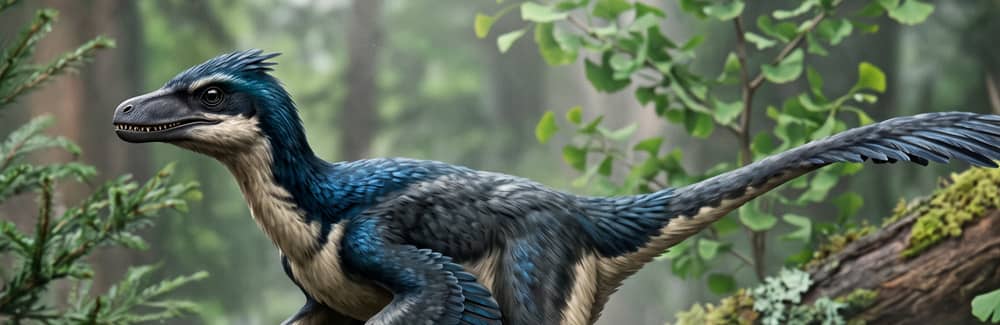
In the evolution from dinosaurs to birds, did the anatomical mechanism for flying (the flight apparatus) evolve only once, or did it evolve independently across multiple groups? A decisive discovery has brought an end to this long-standing debate.
Announced in September 2026, it is a new genus and species of feathered dinosaur discovered in Early Cretaceous strata in Liaoning Province, China: Norellraptor barsboldi. Analysis of this well-preserved fossil has revealed astonishing facts:
- A New Species of Four-Winged Dinosaur: A small microraptorine measuring about 57 cm in total length, possessing well-developed feathers on both its forelimbs and hindlimbs.
- Reversed Order of Evolution: While sharing about 30% of its flight-related traits with birds, the sequence in which its hand and chest bones modified was the exact opposite.
- Unique Growth and Multiple Attempts at the Skies: Growth rings in its bones confirmed a slower growth rate distinct from birds, demonstrating that multiple dinosaurs aimed for the skies through separate evolutionary routes.
We explain in an easy-to-understand manner how the discovery of the new species Norellraptor unraveled "the feathered dinosaurs' challenge to the skies," incorporating the latest research findings.
Research Background: Was Evolution Toward the Skies a "Single Path"?
In the evolutionary process from dinosaurs to birds, the question of what pathway was taken to acquire the anatomical mechanisms for aerial locomotion is one of the most important themes in paleontology. In particular, among Paraves—the group of theropod dinosaurs most closely related to birds (Avialae)—several "four-winged" dinosaurs possessing well-developed flight feathers (pennaceous feathers) not only on their forelimbs but also on their hindlimbs have been reported.
However, a long-standing debate has continued over whether the "flight-related traits" seen in these non-avian feathered dinosaurs were remnants inherited from a single common ancestor, or the product of "convergent evolution" acquired independently in different lineages.
What are Paraves and Convergent Evolution?
Paraves: A taxonomic group combining the "avian lineage (Avialae)" leading to modern birds and their closest feathered dinosaur relatives (Dromaeosauridae—which includes Microraptor and Velociraptor—Troodontidae, and Unenlagiidae).
Convergent Evolution: A phenomenon in which organisms from different lineages independently evolve similar body shapes or functions as a result of adapting to similar environments or lifestyles (e.g., the wings of birds and the wings of bats).
Published in the scientific journal Nature Communications on September 29, 2026, the paper "Independent assembly of the flight apparatus in a non-avian dinosaur clade" presented decisive evidence for this debate. An international joint research team led by Dr. Xuri Wang and Dr. Qiang Ji (Chinese Academy of Geological Sciences and Hebei GEO University), Dr. Andrea Cau (Museo Paleontologico OPHIS, Italy), and Dr. Martin Kundrát (Slovakia) described and reported a well-preserved new genus and species of Microraptorinae from Early Cretaceous strata in Liaoning Province, China: Norellraptor barsboldi.
The greatest significance of this study goes beyond simply adding a well-preserved new species of four-winged dinosaur. By combining detailed skeletal comparisons, analysis of the internal structure of forelimb bones (osteo-histology), and large-scale phylogenetic analysis, the research team identified "in what order flight-related traits were assembled step by step" in both "microraptorines" and "birds." As a result, it was proven that although both share many similar traits, the order in which they evolved was completely opposite, and their flight apparatuses were built independently under demands from different environments (selective pressures).
The True Identity of the New Genus and Species "Norellraptor barsboldi"
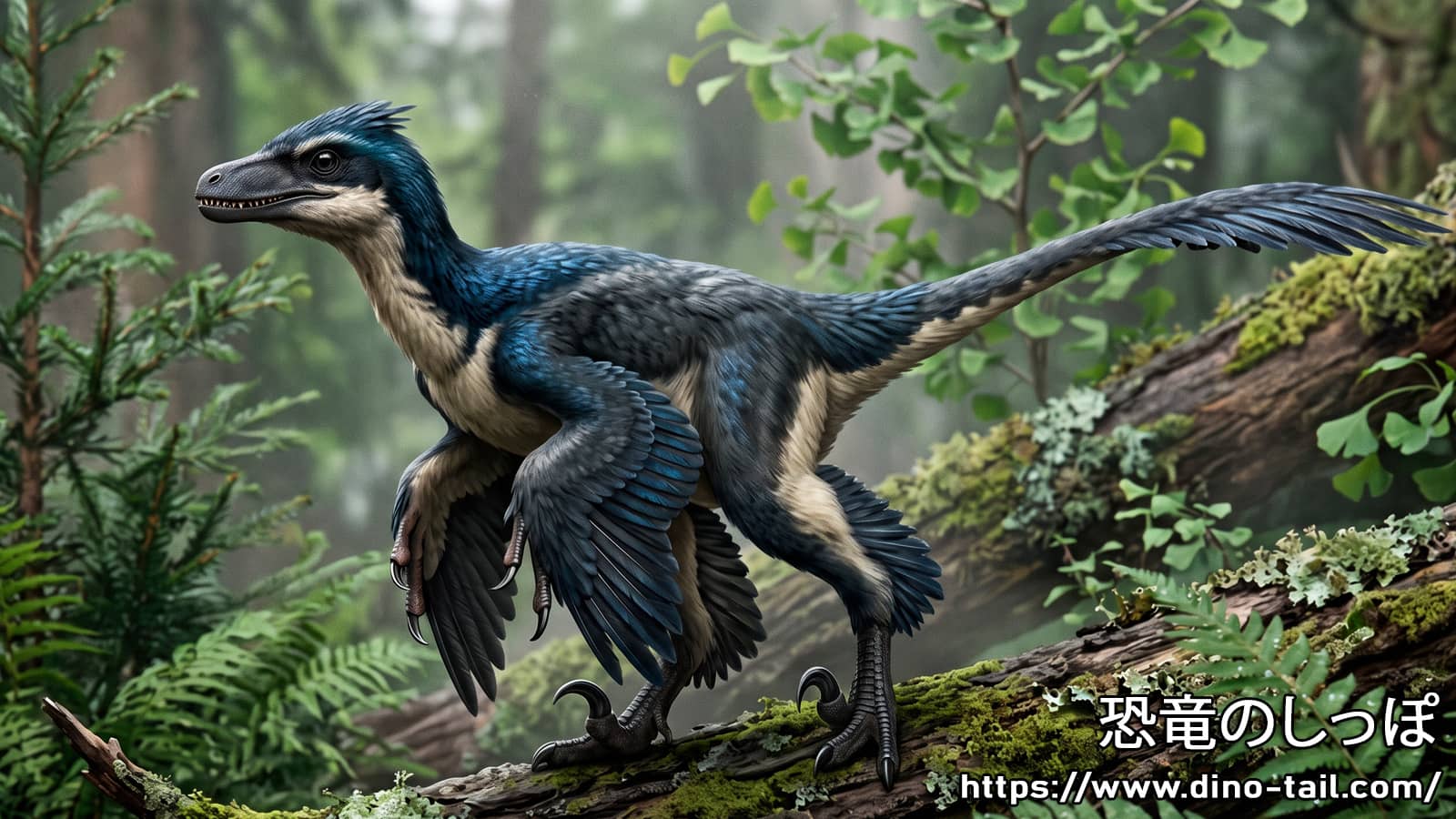
Gemini Generated Image
Circumstances of Discovery and Dedication to Great Researchers
The type specimen (holotype specimen number: 130108-MHGU-F4281) of Norellraptor barsboldi was discovered by a local farmer in the Early Cretaceous "Jiufotang Formation" (approx. 120 million years ago) near Lamadong Town, Jianchang County, in western Liaoning Province, northeastern China, and was donated to the Museum of Hebei GEO University in 2023. Rigorous verification by the research team confirmed that the bones of the entire body maintained their natural articulation and that it is a complete, single-individual specimen without any composite slabs or alterations.
The scientific name Norellraptor barsboldi was named in honor of the immense academic contributions of two world-renowned paleontologists who led research on the evolution from theropod dinosaurs to birds for many years and both passed away in 2025: Dr. Mark Allen Norell (1957–2025) of the American Museum of Natural History and Dr. Rinchen Barsbold (1935–2025) of the Mongolian Academy of Sciences.
The Early Cretaceous Jiufotang Formation (a later phase of the Jehol Biota) where this species lived was a rich environment of warm forests and lakes. In the ecosystem of that time, the tyrannosauroid Sinotyrannus, the herbivorous ceratopsian Psittacosaurus, the early mammal Liaoconodon, diverse pterosaurs, and numerous early birds coexisted, with advanced niche partitioning (ecological differentiation) progressing across the three-dimensional space of the forest.
A Body Combining Four Wings and a Hunter's Weapons
The discovered specimen is an individual measuring approximately 57 cm (about 22 inches) in total length. Although there is slight disarticulation around parts of the shoulder and hip, it is preserved in an almost complete state from the skull to the tip of the tail. Phylogenetic analysis revealed that this species is positioned in a late-diverging group within Microraptorinae, forming the closest sister group with Zhongjianosaurus, which was also found in the Jiufotang Formation.
A total of four unique features (autapomorphies) distinguishing Norellraptor from all other microraptorines have been identified in the structure of the snout (rostrum) of the skull and the pelvis. Specifically, it possesses: "unique proportions of the bone at the tip of the upper jaw (premaxilla)," "an enormous window-like opening (premaxillary fenestra) that occupies the anterior third of the depression in front of the eye (antorbital fossa) and is inclined at 35 degrees," "a very thin bony pillar partitioning the openings," and "a pubic bone of the pelvis that curves gently backward with a remarkably small tip (pubic boot)."
Furthermore, fossilized feather impressions remain around the skeleton (around the right upper arm, hip, tail, and from the shin to the foot), confirming that it was equipped with the four-winged structure ("forelimb wings + hindlimb wings") that is the hallmark of microraptorines. The forelimbs had asymmetrical flight feathers that generated lift, and the tail was equipped with feathers possessing thick, strong shafts. At the same time, traits of a carnivorous hunter—such as sharp, serrated teeth and the "sickle claw" on the second toe of the hindlimb characteristic of dromaeosaurids—also coexisted, indicating that early adaptations to aerial locomotion were closely linked with hunting on the ground and in trees.
| Compared Dinosaur | Body Part | Characteristics of Norellraptor | Differences in Compared Genus |
|---|---|---|---|
| Zhongjianosaurus (Sister group) |
Chest, Torso, Tail | Sternum and tail are short relative to the length of the thigh bone (femur). Outer projection of the shoulder bone (coracoid) is prominent. | Proportions of the sternum and tail relative to the femur are longer, and the shape of the bones around the shoulder differs. |
| Zhongjianosaurus (Sister group) |
Forelimb, Wrist | Forelimbs are short and slender relative to the hindlimbs. Phalanges just before the hand claws lack downward curvature. | Forelimbs are more robust and longer, with strong downward curvature seen in the finger bones. |
| Zhongjianosaurus (Sister group) |
Instep, Toes | Prominent projection on the upper outer side of the instep bone (tarsometatarsus); bone just before the claw of the third toe is not very long. | Outer projection is weakly developed, and the corresponding bone of the third toe extends longer. |
| Microraptor | Dentition | Anterior teeth of the upper jaw are larger, and the first three teeth at the tip of the lower jaw do not procumb (lean forward). | Characterized by teeth at the tip of the lower jaw leaning forward (procumbent). |
| Microraptor | Forearm, Instep | Bulbous projection at the tip of the forearm bone (ulna), and the upper parts of the 2nd to 4th metatarsals of the instep are fused over a wider area. | Lacks the bulbous projection at the tip of the ulna, and the fusion area of the metatarsals is not as extensive as in Norellraptor. |
| Changyuraptor | Lower Jaw Teeth, Wrist | Bases of the lower jaw teeth are constricted, and the semilunate carpal bone of the wrist only slightly covers the palm (2nd metacarpal). | Lacks constriction at the base of the teeth, and the overlapping area between the wrist bone and palm bone differs. |
| Graciliraptor | Distal Instep | Distal widths of the 2nd and 3rd metatarsals of the instep are almost equal. | There is a clear difference in the distal widths of the 2nd and 3rd metatarsals. |
| Sinornithosaurus / Hesperonychus | Pelvis (Pubis) | Expansion at the tip of the pubis called the "pubic boot" is remarkably small in proportion. | Possesses a large, well-developed pubic boot. |
| Wulong | Skull (Depression in front of eyes) | "Premaxillary fenestra" in the antorbital fossa is huge, occupying the anterior third, with a unique size ratio to the adjacent maxillary fenestra. | Size ratio and arrangement of the premaxillary fenestra and maxillary fenestra differ. |
Reversed Order of Evolution! Independent Evolution Proven by How the Parts Were "Assembled"
The biggest breakthrough in this study was incorporating Norellraptor into the latest phylogenetic dataset and identifying a total of 194 anatomical changes that occurred along the evolutionary branch of Microraptorinae.
About 30% of Traits Match Birds, Yet the Sequence is Opposite
Of the 194 changes that occurred in microraptorines, 57 traits—accounting for about 30%—were also acquired in the same way in the "avian lineage (Avialae)" leading to modern birds. These 57 commonalities include many crucial parts directly linked to flapping and gliding in the air, such as thickening and strengthening of the forelimb bones, reinforcement of the ribs and chest area, fusion of the wrist and palm bones (carpometacarpus), elongation of the sternum where flight muscles attach, and shortening of the finger bones of the hand.
If one looked only at the "number of similar traits," one might misunderstand that these mechanisms evolved only once in a common ancestor. However, when the research team tracked "in what order" these 57 traits appeared chronologically within each evolutionary history, they found that the order of assembly was completely reversed between microraptorines and the avian lineage.
- Assembly Order in Microraptorinae (From Hand to Sternum): At a very early stage of evolution, "shortening of the finger bones of the hand" occurred first. As a result, the ability originally possessed by theropods to "grasp prey or branches with their forelimbs (hands)" weakened early on. Only later, in the late-diverging group where Norellraptor and Zhongjianosaurus are positioned, were features that fix and strengthen the skeleton—such as "fusion of the wrist and palm bones" and "elongation of the sternum" supporting flapping muscles—added step by step.
- Assembly Order in the Avian Lineage (From Sternum to Hand): In the ancestors of birds, the order was the exact opposite. Before the fingers of the hand shortened, "modification and fusion of the wrist and palm bones" and "enlargement and elongation of the sternum" were acquired first. In other words, early birds first prepared the wing base and the thoracic propulsion engine while maintaining the function of grasping objects with their forelimbs, and shortened their finger bones at a subsequent stage.
Why Could Microraptorines Give Up "Hand Grasping Power" So Early?
The significance of this "mismatch in assembly order" is extremely important. If microraptorines and birds had inherited their flight systems from a single flight-capable common ancestor, or followed a single shared developmental program, the order in which the fingertips and the chest/wrist changed should match. The fact that it is clearly reversed conclusively proves that both groups faced different environmental challenges and assembled their flight apparatuses independently through different procedures.
So why could "finger shortening," which sacrifices manual grasping power, happen first in microraptorines? The key lies in their powerful "hindlimbs." As the Norellraptor specimen shows, microraptorines possessed an extremely powerful hindlimb predation and jumping mechanism: a structure in which the bones of the instep were tightly bundled (the arctometatarsalian condition) and a huge sickle-shaped claw on the second toe.
What is an Arctometatarsal?
A structure in which the upper part of the middle bone ("3rd metatarsal") among the three bones making up the instep (2nd to 4th metatarsals) is strongly pinched and narrowed by the bones on both sides, allowing the entire foot to function like a single sturdy pillar. It is an evolutionary adaptation that enhances running speed and shock absorption during jumping, seen in tyrannosauroids, troodontids, and microraptorines.
Previous studies on the closely related Microraptor have also pointed out that they actively used their "hindlimbs (feet)" rather than their forelimbs when capturing prey. Precisely because the hindlimbs played the leading role in hunting, the constraint of "having to grasp things with the forelimbs" was lifted early in microraptorines, allowing evolution to proceed toward shortening the fingers and remodeling them into wings that support flight feathers before the chest and wrist bones were fully consolidated.
Bone "Growth Rings" Reveal a Growth Speed Different from Birds
In order to accurately evaluate at what stage of evolution a fossil's traits appeared, it is necessary to determine whether the fossil individual is a "still-developing juvenile" or a "mature individual." Immature features of a juvenile must not be mistaken for primitive evolutionary features.
Age of "3 Years or Older" Revealed by Microscopy
The research team took a tiny bone fragment sample from near the center of Norellraptor's left forearm bone (radius: total length 49 mm), prepared an ultra-thin section 52 micrometers thick (about 1/20th of a millimeter), and conducted an "osteo-histological" analysis by observing it under a microscope.
What are Lines of Arrested Growth (LAGs)?
Like growth rings in trees, these are layered lines seen in cross-sections of animal bones that indicate "periods when growth temporarily stopped or slowed down." Often formed once a year in accordance with seasonal changes, they serve as an important indicator for determining a dinosaur's age at death and growth rate.
As a result of observation, at least two distinct Lines of Arrested Growth (LAGs) were preserved inside the outer layer of the bone (cortical bone). Furthermore, because traces were confirmed showing that the first-year growth layer had been resorbed and erased as the central cavity of the bone (medullary cavity) expanded, this Norellraptor was estimated to have been at least 3 years old at the time of death. In addition, the microstructure of the bone revealed that periods of rapid bone formation and periods of slow bone formation alternated repeatedly, leading to the conclusion that it was not a newly hatched juvenile, but an individual approaching maturity at a "nearly adult stage (late juvenile to subadult)."
A Unique Growth Model Distinct from the Rapid Growth of Birds
This discovery of the internal bone structure highlighted two important facts.
First is the "difference in the bone growth style itself." Comparing bone data with closely related dinosaurs such as Wulong and Sinornithosaurus revealed that while microraptorines had forelimbs that developed functionally from an early stage after hatching, they possessed a unique growth model in which they grew slowly toward adulthood over three or more years while periodically slowing their growth pace. This is clearly different from the pattern of many modern birds, which grow rapidly to adult size all at once in a short period of less than a year, confirming from the perspective of growth mechanisms (developmental physiology) as well that they underwent evolution independent of birds.
Second, because the "degree of bone fusion" and "actual age" do not necessarily match in microraptorine fossils, an important methodological guideline was established: it is essential to examine the internal structure of bones rather than judging whether an individual is a juvenile or an adult by appearance alone.
Paraves Was a "Pluralistic Testing Ground for the Skies"
The "independent assembly of the flight apparatus" demonstrated by Norellraptor fits together like puzzle pieces with recent biomechanical research and the latest fossil discoveries announced around the same time.
Three Groups That Crossed the Biomechanical Hurdle
In a comprehensive biomechanical study published in 2020 by a research team led by Dr. Rui Pei (Chinese Academy of Sciences) and Dr. Michael Pittman, the ratio of body mass to wing area (wing loading) and lift were calculated across Paraves as a whole. The results showed that while jumping power for taking off from the ground was widely shared through strong hindlimbs inherited from carnivorous dinosaur ancestors, only three lineages—"the Avian Lineage (Avialae)," "Microraptorinae," and "Unenlagiidae (a group that evolved in Gondwana, such as South America)"—were able to cross the physical hurdle required to "continue flying by flapping after takeoff (powered flight)."
Dr. Pei himself highly praised the findings of the Norellraptor study, stating that it "demonstrates that microraptorines acquired features very similar to the early stages of true birds through a completely different evolutionary route, strongly supporting the hypothesis that flapping flight evolved independently in non-avian dinosaurs and birds." While the 2020 study showed "which groups reached the hurdle of flight (the result)," this new study unraveled "how they approached that hurdle through different procedures (the process)."
"Yuezhuornis," an Early Bird That Chose the Ground Instead of the Skies
Furthermore, another discovery reported in October 2026 shows that the evolution of Paraves was not a "one-way street from the ground to the sky," but a complex adaptive radiation moving diversely between terrestrial hunting, gliding, and flapping flight. It is a new species of primitive bird discovered in Late Jurassic strata (approx. 149 million years ago) in Fujian Province, China: Yuezhuornis yangyuanensis.
Based on features of its pelvis and leg bones, Yuezhuornis (total length approx. 50 cm, estimated body mass 821 g) was positioned on the evolutionary tree as a bird (Avialae) more closely related to modern birds than Archaeopteryx. Despite this, its forelimbs were about one-third shorter than its hindlimbs, and it had widely splayed clavicles (wishbone) and a long bony tail—an anatomical structure incapable of flight. Moreover, equipped with serrated teeth similar to troodontids and a hyper-extendable second hindlimb toe like Velociraptor, it was found to have specialized in a predatory lifestyle on the ground.
| Major Group / Representative Genera | Period & Main Discovery Sites | Wing and Limb Structure | Evolutionary Sequence of Flight Traits & Growth | Estimated Locomotion Style & Ecology |
|---|---|---|---|---|
| Microraptorinae (Norellraptor, Microraptor, Zhongjianosaurus) |
Early Cretaceous (approx. 120 Ma; Jiufotang Formation, Liaoning, China, etc.) | Four-winged structure with flight feathers on forelimbs + hindlimbs. Retains a rigid instep and sickle claw on the 2nd toe. | Finger shortening preceded early on, while wrist fusion and sternum elongation appeared later. Periodic growth over 3+ years. | Gliding and independently acquired flapping flight in forests, preying on small animals using hindlimbs. |
| Avian Lineage (Volant groups) (Enantiornithes, Euornithes, etc.) |
Late Jurassic to Present (coexisted with microraptorines in the Jiufotang Formation, etc.) | Forelimbs extend longer than hindlimbs, utilizing forelimb wings as the main flight surface (consolidation into a two-wing system). | Wrist fusion and sternum enlargement preceded early on, while finger shortening appeared later. Evolved toward rapid bone growth. | Establishment of sustained flapping flight (powered flight) and expansion into aerial environments on a global scale. |
| Early Flightless Birds (Yuezhuornis yangyuanensis) |
Late Jurassic (approx. 149 Ma; Fujian Province, China) | Closer to modern birds than Archaeopteryx, but forelimbs are ~1/3 shorter than hindlimbs with a long bony tail. | Pelvis shows avian features, but lacks forelimb/chest flight apparatus; retains serrated teeth and hyper-extendable 2nd toe. | Purely terrestrial hunter incapable of flight (suggesting diversity of flight evolution or secondary loss within birds). |
| Unenlagiidae (Rahonavis, Unenlagia, etc.) |
Early to Late Cretaceous (Gondwana, such as Patagonia, South America) | Positioned as a sister group to the avian lineage, sharing elongated forelimbs and some bird-like shoulder and pelvic features. | Shared some flight-related traits with birds while modifying body proportions along an independent evolutionary route. | Evolved diversely from large terrestrial running species to small species that reached the physical hurdle of powered flight. |
Conclusion: The Repeated "Challenge to the Skies"
This study revealed much more than just the intricate skeleton and bone growth rings of Norellraptor barsboldi. In the forests of the Mesozoic, bird-like feathered dinosaurs did not aim for the skies along a single track; instead, they assembled their flight apparatuses through their own distinct procedures tailored to their respective living environments, such as maintaining hindlimb hunting or navigating through forest spaces. "Dinosaurs' advancement into the air"—one of the most dramatic evolutionary events in vertebrate history—was not a one-time accidental miracle, but the "crystallization of pluralistic challenges" repeatedly reached from different routes by dinosaurs equipped with feathers and high athletic capabilities.
Citations & References
- Independent assembly of the flight apparatus in a non-avian dinosaur clade - Nature Portfolio, https://www.natureasia.com/ja-jp/research/highlight/15636
- Wang, X., Cau, A., Kundrát, M. et al. Independent assembly of the flight apparatus in a non-avian dinosaur clade. Nature Communications 17, 10074 (2026). https://dinodata.de/bibliothek/pdf_i/2026/s41467-026-77804-6_dd.pdf
- Bizarre four-winged dinosaur discovered in China - Discover Wildlife, https://www.discoverwildlife.com/dinosaurs/norellraptor-barsboldi-china
- New Species of Four-Winged Dinosaur Unearthed in China | Sci.News, https://www.sci.news/paleontology/norellraptor-barsboldi-15101.html
- Peer Review File: Independent assembly of the flight apparatus in a non-avian dinosaur clade, https://media.springernature.com/original/springer-static/esm/art%3A10.1038%2Fs41467-026-77804-6/MediaObjects/41467_2026_77804_MOESM3_ESM.pdf
- Norellraptor Fossil Indicated Flight Evolved Independently Multiple Times - FossilEra / FossilGuy, https://www.fossilguy.com/news/norellraptor-barsboldi/index.htm
- [Paleontology • 2026] Norellraptor barsboldi - Species New to Science, http://novataxa.blogspot.com/2026/10/norellraptor.html
- 羽毛恐竜は、鳥への一本道ではない? 新種が問い直す「似た体」の進化 - note, https://note.com/learncurrent_17/n/n95d1726214fe
- Newly Identified Norellraptor Could Reshape What We Know About Feathered Dinosaur Flight Evolution - Discover Magazine, https://www.discovermagazine.com/newly-identified-norellraptor-could-reshape-what-we-know-about-feathered-dinosaur-flight-evolution-49744
- Complete Four-Winged Dinosaur From China Adds Evidence That Flight Anatomy Evolved More Than Once - Nature World News, https://www.natureworldnews.com/articles/73403/20260930/complete-four-winged-dinosaur-china-adds-evidence-that-flight-anatomy-evolved-more-once.htm
- ジュラ紀の空ではなく地上を選んだ新種の鳥類化石を発見 - BigGoニュース, https://finance.biggo.jp/news/86b494db-138c-4568-bd5f-b770559b8e56
- Norellraptor - Wikipedia, https://en.wikipedia.org/wiki/Norellraptor
- A farmer in China's Liaoning province found a four-winged dinosaur - ECOticias, https://www.ecoticias.com/en/a-farmer-in-chinas-liaoning-province-found-a-four-winged-dinosaur-whose-lineage-evolved-57-bird-like-traits-in-a-different-order-than-birds-did-a-sign-its-flight-gear-was-built-independently/51961/
- Independent assembly of the flight apparatus in a non-avian dinosaur clade - ResearchGate, https://www.researchgate.net/publication/415204106_Independent_assembly_of_the_flight_apparatus_in_a_non-avian_dinosaur_clade
- A Four-Winged Dinosaur from China Reveals How Evolution Built Wings - ZME Science, https://www.zmescience.com/science/news-science/fuur-winged-dinosaur-flight-evolution/
- Powered flight potential approached by wide range of close avian relatives - bioRxiv, https://www.biorxiv.org/content/10.1101/2020.04.17.046169v1.full-text
- Remarkable Fossil of a Feathered, Winged Dinosaur Further Hints That Flight Evolved Multiple Times - Smithsonian Magazine, https://www.smithsonianmag.com/smart-news/remarkable-fossil-of-a-feathered-winged-dinosaur-further-hints-that-flight-evolved-multiple-times-among-the-terrible-lizards-180989612/