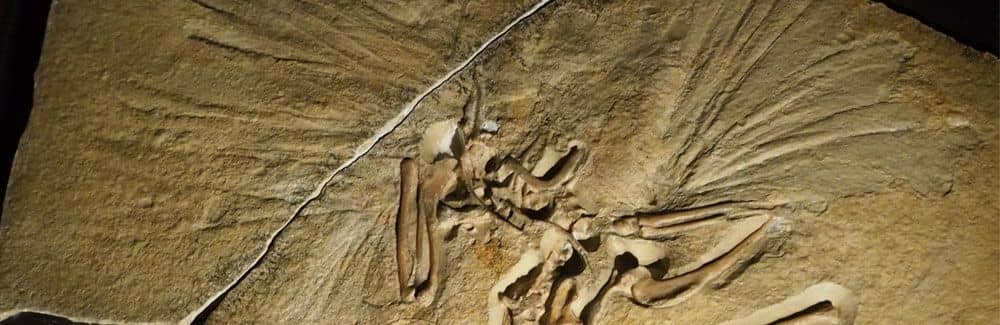
What is Archaeopteryx?
| Scientific Name (Genus) | Archaeopteryx |
| Meaning of Name |
Ancient Wing
archaio (ancient) [Greek] - pteryx (wing) [Greek] |
| Classification | Saurischia, Theropoda, Archaeopterygidae |
| Length | Approx. 50cm |
| Diet | Carnivorous (insects, small animals, etc.) |
| Era | Late Jurassic (Approx. 150 million years ago) |
| Species Name | Archaeopteryx lithographica |
| Year Described | 1861 |
| Description Paper | von Meyer, H. (1861). Archaeopterix lithographica (Vogel-Feder) und Pterodactylus von Solnhofen. Neues Jahrbuch für Mineralogie, Geognosie, Geologie und Petrefakten-Kunde. |
Let's go meet Archaeopteryx
Fossils of Archaeopteryx can be seen at the following museums.
However, exhibition contents may be subject to change. Please check the latest information yourself.
National Museum of Nature and Science (Taito-ku, Tokyo)
Fossil parts available: Full body reconstructed skeleton, Replica (Berlin specimen, etc.)
Highlights: In the "Exploring the Mystery of Dinosaurs" floor on the B1F of the Global Gallery, an exquisite replica of the most famous "Berlin Specimen" is on display. As an essential existence for discussing the evolution from dinosaurs to birds, you can carefully observe its characteristic feather traces and reptilian long tail.
Fukui Prefectural Dinosaur Museum (Katsuyama City, Fukui)
Fossil parts available: Full body skeleton (Replica), Life reconstruction model
Highlights: Displayed in the story leading from the "World of Dinosaurs" zone to "Evolution into Birds". In addition to the skeletal replica, a life reconstruction model reproducing the color and texture of feathers is also a highlight, making you imagine how this creature moved through the sky (or trees) in the past.
Gunma Museum of Natural History (Tomioka City, Gunma)
Fossil parts available: Full body skeleton (Replica)
Highlights: Introduced as a key biological link in evolution in the permanent exhibition "Age of the Earth". Elaborate exhibition methods, such as walking over specimens displayed under a glass floor (Note: layout may change due to exhibition renewal), allow you to learn the flow of evolution experientially.
Museum für Naturkunde (Berlin Natural History Museum) (Berlin, Germany)
Fossil parts available: Real fossil (Berlin Specimen)
Highlights: The real "Berlin Specimen", which is the most famous in the world and called "the most beautiful fossil", is on permanent display. Boasting a near-perfect state of preservation from the head to the wings and tail, it is a place admired by paleontology fans all over the world where you can see that figure seen in textbooks and encyclopedias with your own eyes.
Natural History Museum (London, UK)
Fossil parts available: Real fossil (London Specimen)
Highlights: It houses the "London Specimen" (Holotype), which was the first to be described as a full body skeleton. Its importance in research history is immeasurable, such as the three-dimensional preservation of the skull not found in the Berlin specimen. You can check its appearance in special areas such as the Treasures gallery or the Dinosaur gallery.
Jura Museum (Eichstätt, Germany)
Fossil parts available: Real fossil (Eichstätt Specimen, etc.)
Highlights: A museum inside an old castle, close to the Solnhofen limestone quarries where Archaeopteryx is produced. Precious real specimens unique to the local area, such as the "Eichstätt Specimen" with good skull preservation, are on display, offering discoveries different from Berlin.
Field Museum of Natural History (Chicago, USA)
Fossil parts available: Real fossil (Chicago Specimen)
Highlights: You can see the so-called "Chicago Specimen", which was opened as a permanent exhibition in 2024. It is the only real fossil that can be seen in major North American museums (as of 2025), and is one of the hottest exhibitions right now where you can observe detailed features revealed by the latest research up close.
Most of the real fossils of Archaeopteryx are housed in museums around Germany. In Japan, exquisite replica exhibitions are the main ones, but they are displayed in a very important position for knowing the process of evolution, and the environment is sufficient to learn their characteristics.