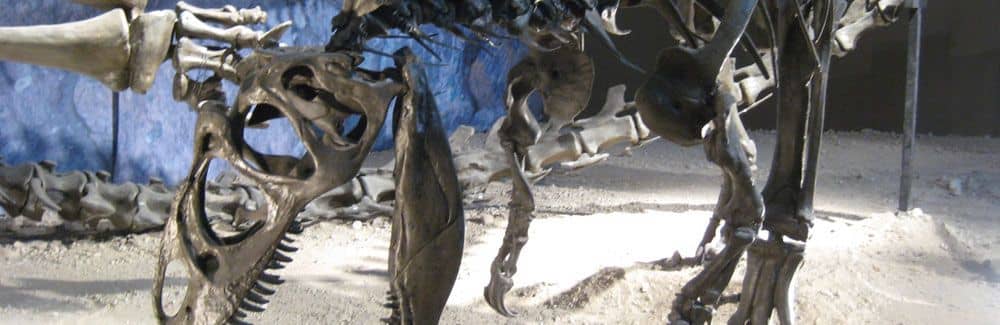
What is Allosaurus?
| Scientific Name (Genus) | Allosaurus |
| Meaning of Name |
Different Lizard
allos(different)[Greek]-saurus(lizard)[Greek] |
| Classification | Saurischia, Theropoda, Allosauridae |
| Total Length | Approx. 9-12m |
| Diet | Carnivorous |
| Period | Late Jurassic (Approx. 155 - 145 million years ago) |
| Sub-classification / Species Name |
Allosaurus fragilis
Allosaurus europaeus Allosaurus jimmadseni Allosaurus tendagurensis |
| Year of Paper Publication | 1877 |
| Genus Name Publication | Marsh, Othniel Charles (1877). Notice of new dinosaurian reptiles from the Jurassic formation. American Journal of Science and Arts, 14, 514-516. |
Let's go meet Allosaurus
Allosaurus fossils can be seen at the following museums.
However, exhibit contents may be subject to change. Please check the latest information yourself.
Museums in Japan
National Museum of Nature and Science (Taito, Tokyo)
Fossil parts viewable: Whole body reconstructed skeleton (Except for the head, about 60-70% is real fossil)
Highlights/Points of Interest: Known as the "Ogawa Allosaurus," this is the first complete dinosaur skeleton displayed in Japan. Although the skull is a replica, most of the torso and leg bones are real fossils, making it one of the most valuable dinosaur specimens viewable in Japan. It can be seen at the "History of the Earth Navigator" on the 1st floor of the Global Gallery.
Fukui Prefectural Dinosaur Museum (Katsuyama, Fukui)
Fossil parts viewable: Real whole body skeleton
Highlights/Points of Interest: An extremely well-preserved real Allosaurus specimen discovered in North America is on display. About 70% of the body consists of real bones, allowing for observation of fine bone textures. Even after the 2023 renewal, it maintains an overwhelming presence in the main area of the permanent exhibition.
Osaka Museum of Natural History (Osaka City, Osaka)
Fossil parts viewable: Whole body reconstructed skeleton (Replica)
Highlights/Points of Interest: This is a replica cast from a good specimen kept at the Natural History Museum of Utah, USA. It has been a historical exhibit since the museum opened in 1974 and can be seen in the permanent exhibition room tracing the evolution of life.
Mifune Dinosaur Museum (Mifune, Kumamoto)
Fossil parts viewable: Whole body reconstructed skeleton (Replica)
Highlights/Points of Interest: Known as the town where Japan's first carnivorous dinosaur fossil (Mifuneryu) was discovered, an Allosaurus whole body skeleton is also permanently displayed. Based on the latest research, it is displayed in a dynamic pose balancing with its tail raised.
Overseas Museums
American Museum of Natural History (New York, USA)
Fossil parts viewable: Whole body reconstructed skeleton (Partially real)
Highlights/Points of Interest: The Allosaurus displayed in the "Hall of Saurischian Dinosaurs" is shown in a dramatic pose as if eating an Apatosaurus carcass. It is a famous mount with over 100 years of history and is an essential specimen for discussing the history of dinosaur exhibits.
Natural History Museum of Utah (Utah, USA)
Fossil parts viewable: Real fossils and numerous specimens
Highlights/Points of Interest: Located near the "Cleveland-Lloyd Dinosaur Quarry" where massive amounts of Allosaurus fossils were discovered, it boasts one of the world's largest Allosaurus collections. It features powerful exhibits as if multiple individuals are forming a pack.
Denver Museum of Nature & Science (Colorado, USA)
Fossil parts viewable: Whole body skeleton (Real fossil)
Highlights/Points of Interest: In the "Prehistoric Journey" hall, a dramatic scene of an Allosaurus confronting a Stegosaurus is recreated. This Allosaurus is a highly complete real specimen and is highly regarded as an exhibit symbolizing the Jurassic ecosystem.
In particular, the "real fossils" in Japan are valuable specimens donated or purchased from overseas research institutions, offering a genuine power that cannot be experienced with replicas.