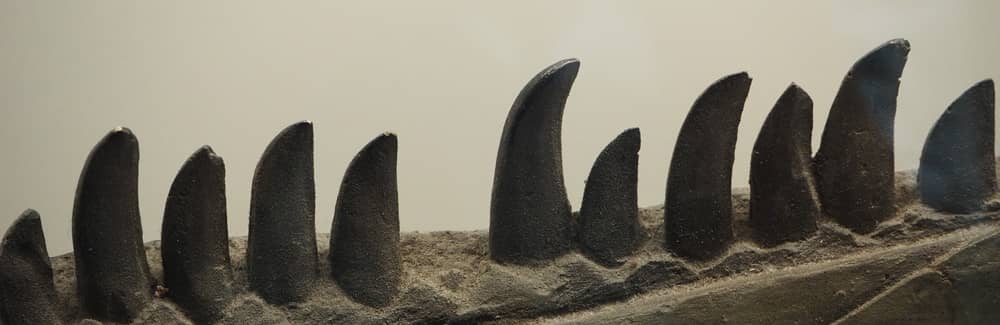
In the terrestrial ecosystems of the Mesozoic Era, theropod dinosaurs reigned at the top of the food chain. In their long evolutionary history, Allosaurus and Tyrannosaurus adapted to their respective environments and acquired extremely high predatory capabilities in two different eras: the Late Jurassic and the Late Cretaceous.
These two predators are often discussed side by side as the "strongest dinosaurs," but their anatomical features, biomechanical characteristics, and ecological niches (roles) are fundamentally different.
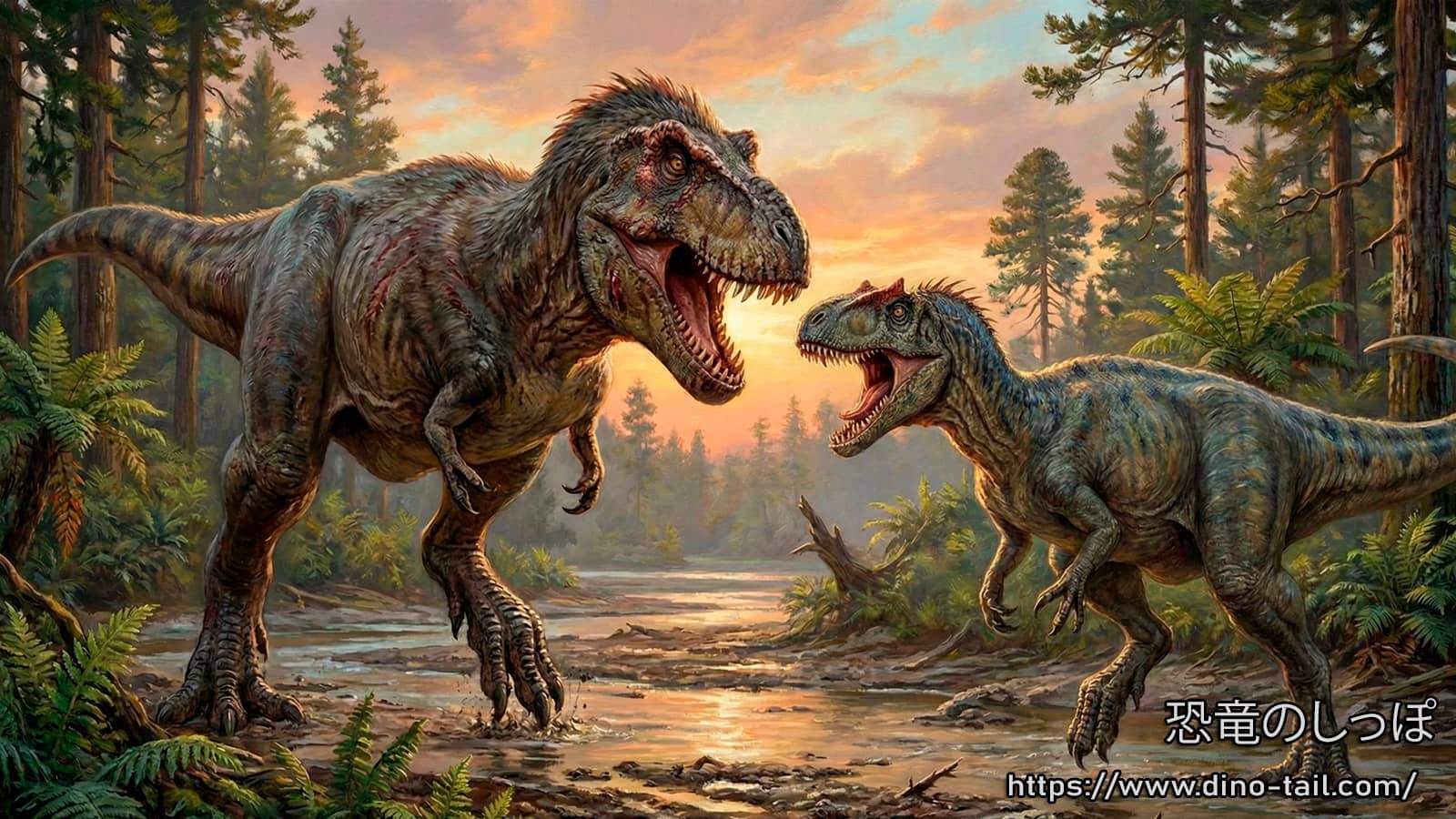
In this column, in response to the question "Which is stronger?", we will not stop at predicting the outcome of a hypothetical fight, but will thoroughly compare their "strength" as biological organisms by integrating the latest findings in skeletal morphology, musculoskeletal biomechanics, neuroanatomy, and paleopathology.
There is a long time gap of about 80 million years between the two, and they did not coexist. Allosaurus was a representative species of the Allosauroidea superfamily that dominated the Morrison Formation in North America during the Late Jurassic (about 155 to 145 million years ago), while Tyrannosaurus was the final evolutionary form of the Tyrannosauroidea superfamily that inhabited the Hell Creek Formation in North America during the Late Cretaceous (about 68 to 66 million years ago).
1. Physical Advantage in Mass Estimation and Growth Strategy
In biological conflicts and predation, Body Mass is the most basic and dominant physical quantity that determines momentum, impact force, and impact resistance. First, let's compare accurate mass estimates and their growth processes.
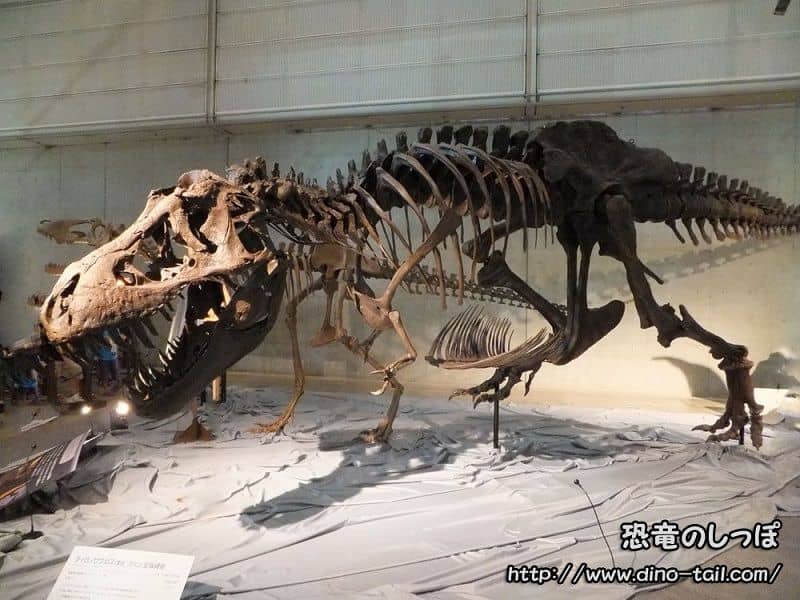
Tyrannosaurus is considered to be close to the maximum size physically attainable for a terrestrial predator. Regarding the estimated weight of adults, many methods converge in the range of 6,000 kg (6 tons) to 8,000 kg (8 tons), and analysis results suggesting that the largest individuals reached 9,000 kg to 10,000 kg (9 to 10 tons) have also been presented. The trunk of Tyrannosaurus is wide, and the curvature of the ribs is strong, giving it a barrel-shaped torso when viewed from the front, suggesting that the capacity for internal organs and muscles was extremely large.
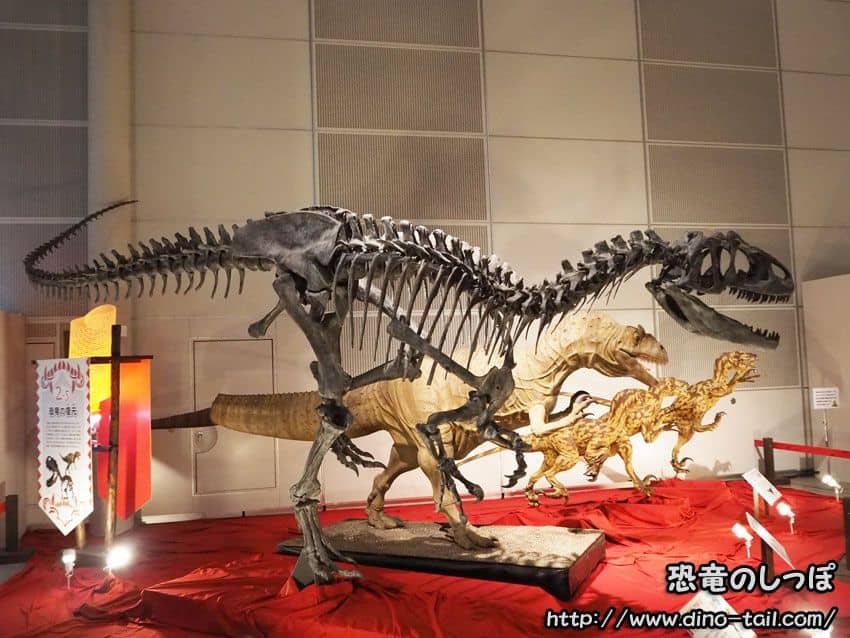
In contrast, Allosaurus reached a maximum total length of about 9.7m (although there is a theory of 12m for the largest species, the average is around 8.5m), but its weight is significantly lighter than that of Tyrannosaurus. The estimated weight of Allosaurus generally falls within the range of 1,500 kg (1.5 tons) to 2,000 kg (2 tons), and even the largest estimates rarely exceed 4,000 kg (4 tons). The skeleton of Allosaurus has a slim and lightweight structure overall. This is an adaptation to maintain agility and improve acceleration performance, but it means an overwhelming disadvantage in terms of "weight" in a physical collision.
Comparison of Body Metrics
| Comparison Item | Tyrannosaurus (T. rex) | Allosaurus (Allosaurus) | Implication of Physical Difference |
|---|---|---|---|
| Estimated Max Weight | 8,000 - 9,500 kg | 1,500 - 2,000 kg (Max 4t) | Tyrannosaurus has more than 4 times the mass of Allosaurus. |
| Total Length | 12.3 - 13.0 m | 8.5 - 9.7 m (Max 12m?) | Difference in volume (girth) is more prominent than length. |
| Hip Height | 3.7 - 4.0 m | 2.5 - 3.0 m | Tyrannosaurus looks down on its opponent. |
| Trunk Shape | Wide, Barrel-shaped, Heavy | Flat, Streamlined, Lightweight | Tyrannosaurus has high collision resistance. |
The fact shown by this data is clear. If compared to weight classes in boxing or martial arts, Tyrannosaurus is at the top of the super heavyweight class, while Allosaurus corresponds to the middle to light heavyweight class. There is an "absolute wall of mass" between the two.
2. Biomechanics of Skull and Jaw: Destruction vs Cutting
In evaluating superiority between predators or the absolute value of predatory ability, the function of the skull and jaw, which are the primary weapons for killing prey, is the most important factor.
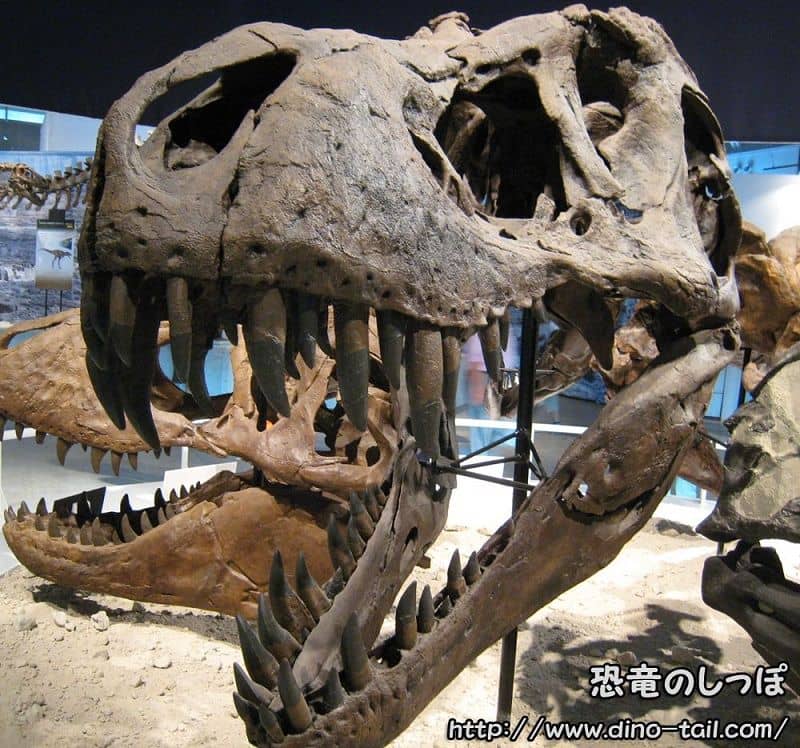
"Osteophagy (Bone Eating)" Ability of Tyrannosaurus
The skull of Tyrannosaurus is a structure optimized to exert the most powerful bite force in the history of terrestrial vertebrates. In recent studies using multi-body dynamics models, the bite force at the posterior teeth of an adult Tyrannosaurus is estimated to reach 35,000 N to 57,000 N (about 3.5 tons to 5.8 tons) . This figure far exceeds the Saltwater Crocodile (about 16,000 N), which has the strongest bite force among living animals, and is outstanding even compared to other theropods of similar size.
Tyrannosaurus teeth have a shape close to a thick cone with a D-shaped or banana-shaped cross-section. These teeth served as "stakes" to penetrate thick skin and muscle, reach bone, and shatter it, rather than slicing meat.
Allosaurus's "Hatchet" Strategy
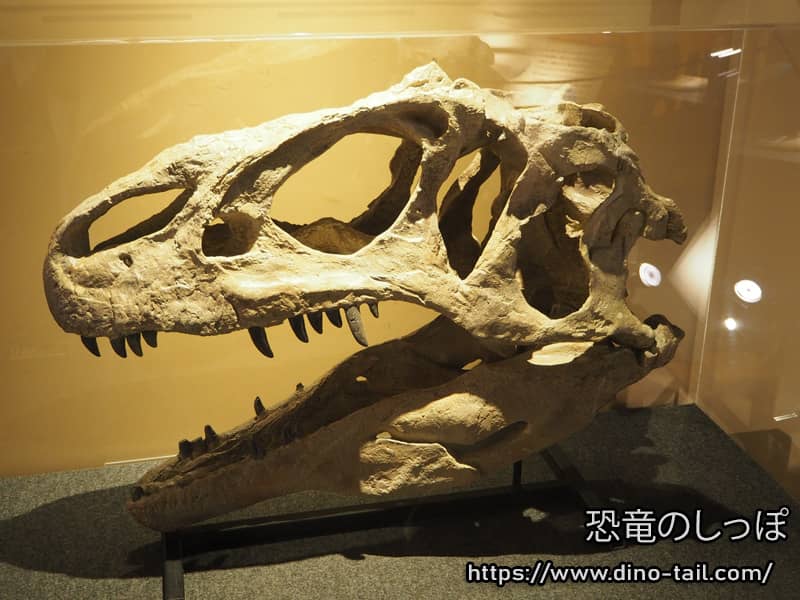
In contrast, the bite force of Allosaurus is known to be relatively low for its physique. According to Finite Element Analysis (FEA), the bite force of Allosaurus is estimated to be about 3,572 N (about 360 kg) , which is comparable to that of living lions, wolves, or medium-sized crocodiles.
At first glance, it may seem "weak," but in reality, it possesses a different attack mechanism. Although the skull of Allosaurus is not very strong against "force closing the jaw," it has been found to have abnormally high strength against "impact of swinging the upper jaw vertically." This is the so-called "Hatchet Hypothesis." It is thought that they adopted a tactic of swinging their entire head down like an axe using the powerful muscles of their neck with their mouth wide open, driving their sharp teeth into the prey. With this attack, they excelled at tactics that inflicted deep lacerations on giant prey and caused massive bleeding.
Comparison of Cranial Functions
| Functional Feature | Tyrannosaurus | Allosaurus | Impact on Combat |
|---|---|---|---|
| Bite Force | 35,000 - 57,000 N | ~3,572 N | Tyrannosaurus has overwhelming destructive power. |
| Skull Strength | High rigidity, strong against torsion | Strong against vertical impact, but possibly weak against lateral load | Tyrannosaurus has high defensive and restraining power. |
| Gape Angle | Wide | Extremely wide (Max 92°) | Allosaurus is suitable for attacking giant targets. |
| Tooth Function | Bone Crushing | Flesh Slicing | Tyrannosaurus penetrates heavy armor, Allosaurus aims for bleeding. |
3. Sensory & Neuroanatomy: Perception and Encephalization Quotient
"Strength" depends not only on physical power but also on situational awareness and sensory acuity.
Vision: Stereoscopic Vision and Rangefinding
Tyrannosaurus : The orbits face forward, and the head widens towards the back. According to visual field analysis, Tyrannosaurus's binocular vision range reaches 45 to 60 degrees, which is comparable to that of modern raptors such as hawks and owls. This excellent stereoscopic vision ability is thought to have been essential for accurately measuring the distance to prey and striking a fatal blow to a precise spot.
Allosaurus : The orbits are located relatively on the side, and the binocular range is limited to about 20 degrees. This is a value close to modern crocodiles, and stereoscopic vision ability was limited.
Smell: Ecosystem's Strongest Detector
Tyrannosaurus : The ratio of the volume of the olfactory bulb to the whole brain is among the largest of non-avian dinosaurs. It is highly likely that it had a sense of smell comparable to or better than that of living vultures and detection dogs.
Allosaurus : Although the olfactory bulb is developed, it was relatively small compared to Tyrannosaurus.
4. Motor Function and Mobility
The former common belief that "Tyrannosaurus with a huge body was sluggish" is being overturned by the latest biomechanical research.
Allosaurus : Allosaurus, which is lighter and longer-legged than Tyrannosaurus, is thought to have been a relatively fast runner. It may have been able to reach speeds of 30 km/h to a maximum of about 55 km/h.
Tyrannosaurus : A huge body exceeding 6 tons puts a tremendous load on the skeleton when running. The prevailing theory is that the maximum speed of adults was limited to about 20 km/h to 29 km/h. However, surprising research results have come out regarding "turning performance (agility)," which is important in combat.
Tyrannosaurus's torso is short and compact, and the center of mass is close to the hip joint, which is the axis of rotation. Also, the huge muscle (caudofemoralis longus) extending from the base of the tail to the thigh generated torque to rotate the body quickly. Analysis suggests that Tyrannosaurus could turn twice as fast as other theropods of the same weight.
5. Forelimb Function: Allosaurus's Hidden Weapon
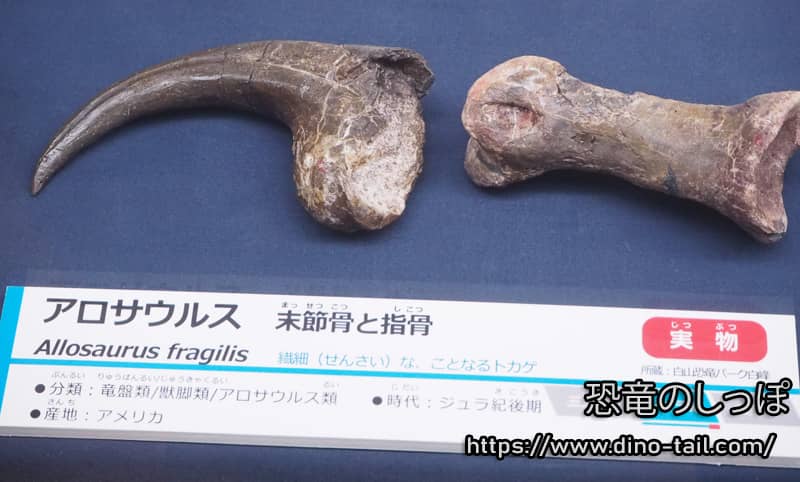
While Tyrannosaurus evolved to bet everything on its jaws, Allosaurus retained a powerful sub-weapon: its forelimbs.
Allosaurus had three fingers on its forelimbs, and the first finger (thumb) in particular was equipped with a huge claw. This claw reaches a length of about 15 cm to 20 cm with just the bone core. The range of motion was wide, allowing for holding prey. It is highly probable that Allosaurus compensated for its weak bite force by first jumping on the prey with its forelimbs, digging in its sharp claws to fix the body, and then performing a hatchet attack with its jaws.
On the other hand, Tyrannosaurus's forelimbs were extremely small and had only two fingers. These arms were almost useless in combat and were likely kept close to the body so as not to become a weak point.
6. Comprehensive Comparison Verification: What if they fought?
Based on the above academic findings, let's logically deduce the outcome based on a hypothetical scenario where the two confronted each other one-on-one on a plain.
Phase 1: Detection and Approach
Tyrannosaurus can grasp the opponent's position and distance faster and more accurately than Allosaurus due to its superior sense of smell and vision (stereoscopic vision).
Phase 2: Maneuver Warfare
Allosaurus will try to strike Tyrannosaurus's flank or rear by utilizing its speed. However, Tyrannosaurus can keep facing front according to Allosaurus's movement due to its high turning performance.
Phase 3: Engagement (Physical Collision)
For Allosaurus to win, it needs to jump into the bosom, cling to Tyrannosaurus with its forelimbs, and tear vital points such as the neck with its jaws. However, due to the weight difference (8 tons vs 2 tons), even if it grapples, the risk of being shaken off or crushed by Tyrannosaurus is high.
On the other hand, for Tyrannosaurus, the tactic is simple. "Bite."
If it captures even a part of Allosaurus's body in its mouth, the match is decided. A bite force of 50,000 Newtons easily shatters Allosaurus's lightweight skeleton.
Conclusion
Based on scientific reasoning, Tyrannosaurus would win overwhelmingly . For Allosaurus to win, it would need the luck to sever a vital point with a single blow by surprise attack, but considering Tyrannosaurus's sensory capabilities and durability, the probability is extremely low.
Allosaurus was a sophisticated predator perfectly adapted to the ecosystem of that era as the king of the Jurassic. However, Tyrannosaurus is an existence that can be said to be the ultimate of dinosaur evolution, having pushed forward gigantism, heavy armament, and high intelligence through another 80 million years of evolution from there.