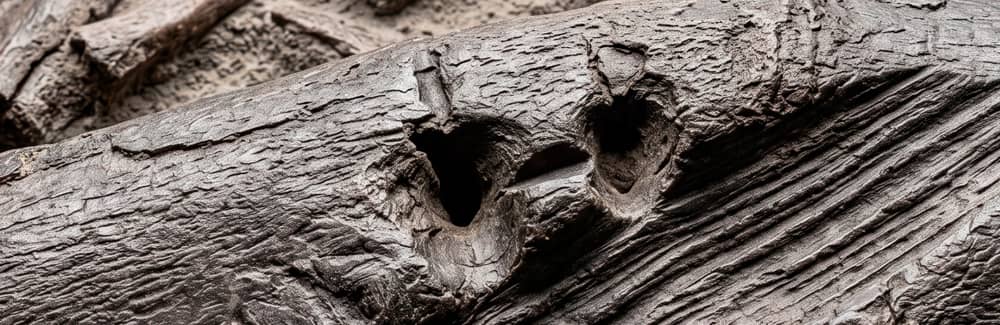
Introduction: Challenges and a New Paradigm in Trace Interpretation in Paleontology
In paleontology and paleoecology, accurately identifying the various punctures and surface damage left on the skeletal fossils of extinct vertebrates is a crucial process for reconstructing ancient food webs, predator-prey interactions, and the dynamics of entire ecosystems.
For many years, unnatural traces found on the surfaces of fossil bones have often been intuitively interpreted as "tooth traces" or "bite marks" left by carnivores. However, determining the origin of traces left in the fossil record is difficult. In reality, there are many cases where physical and chemical changes during the fossilization process, other biological factors (such as insect boring or erosion by plant roots), or simply normal anatomical structures (such as foramina for nerves and blood vessels) are mistakenly identified as predator traces.
What is Taphonomy?
It is a branch of paleontology that studies the physical, chemical, and biological processes (weathering, transport, decay, predation by other animals, etc.) an organism undergoes from the time it dies until it is discovered as a fossil in geological strata.
Such misidentification of traces goes beyond mere morphological classification errors. It runs the risk of causing incorrect assumptions about the behavior and ecological roles (niches) of ancient animals, ultimately distorting the overall picture of paleoecosystems. Based on this serious awareness, a detailed study (Siviero et al., 2026) was published on a bonebed centered around Edmontosaurus annectens, excavated from the Lance Formation (Maastrichtian) at the end of the Cretaceous period, located in northeastern Wyoming, USA.
In this report, based on this pioneering research, we will clearly explain the quantitative data obtained from screening a massive 3,013 fossil specimens, the strict redefinition of previously ambiguous tooth mark identification criteria, and the elucidation process using the latest non-destructive image analysis technology.
Geological and Taphonomic Background: The Lance Formation and Bonebeds
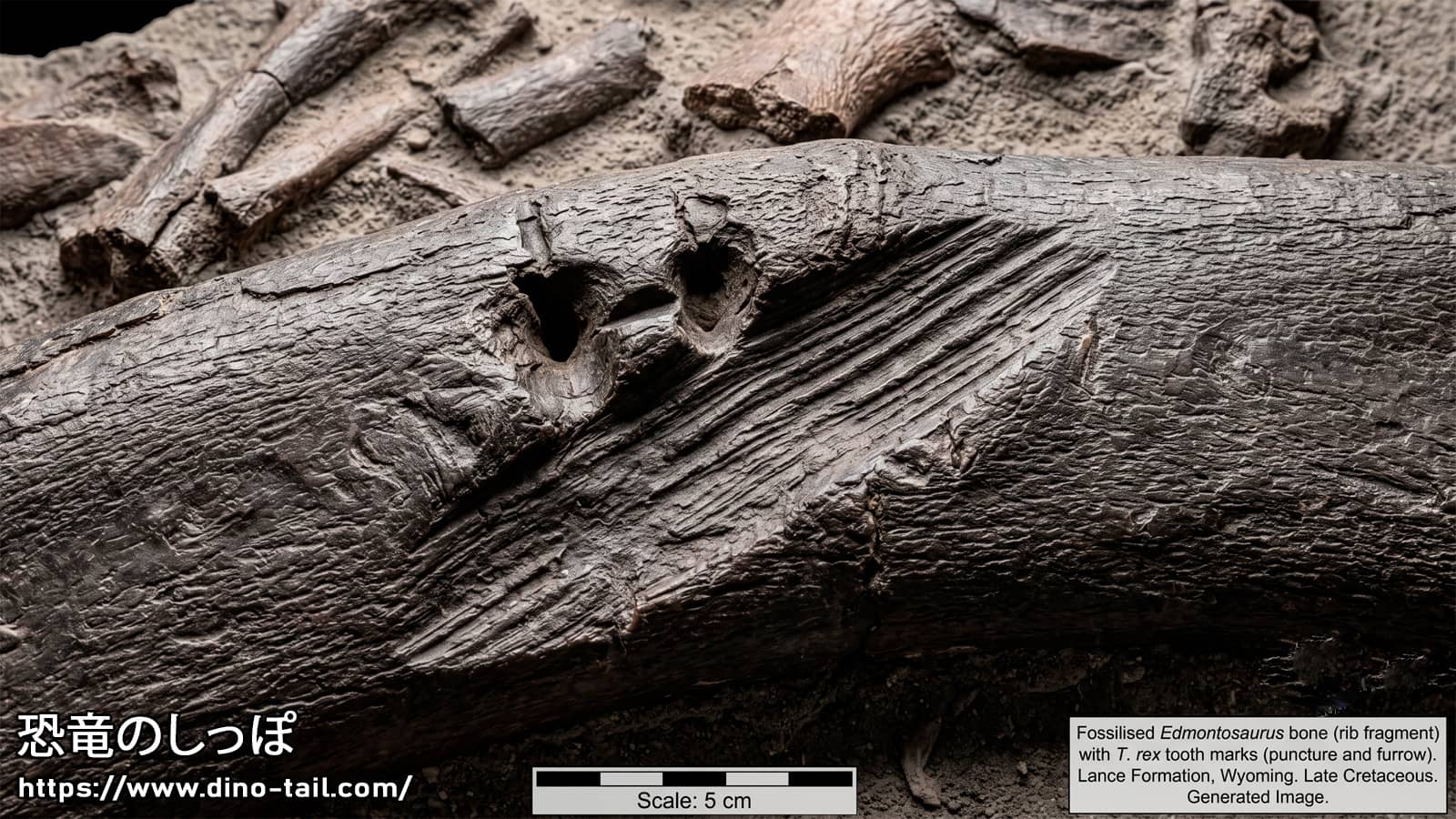
Gemini Generated Image
The fossils analyzed in this study were excavated over a period of 20 years from quarries within the Lance Formation spreading near Hanson Ranch Station (HRS) in eastern Wyoming. Formed at the end of the Cretaceous period, between approximately 72 and 66 million years ago, the Lance Formation meticulously records the rich floodplain and braided river environments of that time.
The bonebed (a geological stratum densely packed with fossils) at Hanson Ranch Station is overwhelmingly dominated by the remains of the herbivorous dinosaur Edmontosaurus annectens. The skeletons unearthed from here are highly disarticulated, and since there is no evidence of bones being washed in a specific direction by water currents, it is presumed that these remains were not transported and buried all at once. Instead, they were exposed on the surface for a long period, subjected to various biological activities and weathering, before being gently buried in mud and sand.
The most remarkable fact here is that despite examining a massive sample of 3,013 items, only 13 specimens (about 0.4% of the total) were confirmed to have punctures or lesions suspected of being "tooth traces" during the initial screening. This low frequency suggests that in the ecosystem of the time, the direct predation pressure by large theropods and the frequency of thorough carcass utilization that would destroy deep into the bone may have been much lower than previously expected.
Theoretical Framework for Tooth Trace Identification: Ichnotaxa and Morphological Criteria
In order to scientifically and objectively prove the involvement of predators and scavengers from the complex damage patterns left on bone surfaces, this study reevaluated past literature and theoretically systematized strict criteria for identifying genuine tooth traces. Tooth traces are classified into the following four basic types based on mechanical vectors and the penetration depth of the teeth.
| Tooth Trace Type | Definition and Mechanical Mechanism | Morphological Features and Depth |
|---|---|---|
| Pit | A shallow depression mark caused by direct vertical or diagonal pressure applied to the bone surface. | Does not completely penetrate cortical bone (the hard outer layer) and often has a bowl-shaped cross-section. |
| Puncture | Created when teeth deeply pierce the bone tissue due to pressure stronger than that which forms a pit. | A deep hole that completely penetrates the entire layer of cortical bone, reaching the inner cancellous bone. |
| Score | A scratch mark caused by a tooth being dragged horizontally or diagonally while in contact with the bone surface. | A shallow linear wound that does not penetrate cortical bone. It has a U-shaped or V-shaped cross-section. |
| Furrow | Similar to a score, it is caused by dragging, but it bites deeper with a stronger force. | A severely deep linear injury that completely penetrates or extensively destroys the layers of cortical bone. |
What are Ichnotaxa?
It refers to the taxonomic scientific names assigned to the "traces (footprints, burrows, bite marks, etc.)" of biological activity, rather than the fossils of the organisms themselves. In particular, the regular "striations" created when the serrated teeth (denticles) of carnivorous dinosaurs scrape against bone are finely classified under names like Knethichnus or Linichnus, and serve as evidence to identify the perpetrator.
The Complex Spectrum of Pseudopathologies and the Image Analysis Approach
During the fossilization process, bones are exposed to various factors, leaving "pseudopathologies" etched into their surfaces that can easily be mistaken for tooth traces. Examples include root traces formed when plant roots secrete acid, insect borings, tool marks created during excavation and cleaning, pathological holes from bacterial infections, and normal anatomical structures where blood vessels and nerves pass (neurovascular foramina).
To accurately differentiate between these diverse pseudopathologies and genuine tooth traces, the research team thoroughly visualized the three-dimensional internal structures using high-resolution microscopic observation, high-contrast photography via focus stacking technology, and non-destructive medical CT scans.
A Surprising Paradigm Shift in Specimen HRS05499
The most symbolic discovery in this study was the reevaluation process for specimen HRS05499 (a fossil surangular bone), which was initially screened as having "crocodile tooth traces." While linear holes aligning with a crocodile's dentition were lined up on the surface, examining the inside with a CT scan revealed that each hole merged deep within the bone, forming a single giant space (channel). This is a typical characteristic of "neurovascular foramina."
Furthermore, as a result of comparative anatomical investigation, it was discovered that this bone was not one of the abundant Edmontosaurus bones, but rather a bone from a ceratopsian called "Torosaurus latus". This dramatic reversal in identification served as a warning to the paleontological community about the dangers of intuitive conclusions relying solely on partial visual similarities.
Identification of the Apex Predator Through Quantitative Analysis
Twelve fossil specimens that were excluded as pseudopathologies and cleared the strict criteria were left with genuine tooth traces (pits, punctures, scores, and furrows).
To identify the perpetrator that left specific tooth traces, the research team precisely measured the intervals between the microscopic striations and serration marks (jagged traces) left on the fossil bones, and adopted the approach of mathematically comparing them with the "denticle (serration) density" of the teeth of various theropods discovered in the same stratum.
| Theropod Taxon | Measured Denticle Density (per 2mm) | Compatibility with Tooth Traces on Fossil Bones |
|---|---|---|
| Nanotyrannus lancensis | Density exceeding 4 (>4 / 2mm) | Physically incompatible |
| Pectinodon bakkeri | Density exceeding 4 (>4 / 2mm) | Physically incompatible |
| Acheroraptor temertyorum | Density exceeding 4 (>4 / 2mm) | Physically incompatible |
| Tyrannosaurus rex (Tyrannosaurus rex) | Exactly 2 (2 / 2mm) | Perfect Match (Confirmed) |
As a result of the measurements, the density of the notches left in the grooves of the fossil tooth traces all indicated "exactly 2 per 2mm". As the table shows, small tyrannosaurs and troodontids other than Tyrannosaurus rex all have finely packed serrations of 4 or more per 2mm, making it physically impossible for them to form these traces.
Furthermore, it was also revealed that the interval between the parallel score marks left on the forelimb bones was exactly "10mm" apart. This perfectly matches the distance between teeth (interdental distance) in the jaw of a Tyrannosaurus rex. This fact tells the story of the giant apex predator gripping the Edmontosaurus's forelimb with its powerful jaws and biting fiercely as if to strip the meat off.
Feeding Strategies of T. rex and the Fate of the Carcasses
A crucial feature common to all 12 of the identified bones with tooth traces is the complete absence of bone remodeling or signs of healing. If Tyrannosaurus frequently attacked live prey, bones with healed wounds from those that escaped should be found at a certain probability. However, the complete lack of healing marks strongly suggests that Tyrannosaurus rex actively engaged in "scavenging" behavior, consuming carcasses that were already dead and lying on the ground.
Also, the extremely low tooth mark incidence rate of only about 0.4% out of 3,013 items indicates that in the ecosystem of the time, the mass death of Edmontosaurus supplied a massive amount of carrion that far exceeded the predators' consumption capacity. Scavengers likely did not need to crush hard bones, but simply ate the easily accessible soft meat before moving on to another carcass.
Furthermore, the smooth fracture patterns concentrated on the ribs highlight a dramatic behavioral pattern in which a giant carnivore like Tyrannosaurus deliberately bit off and forcibly pried open the ribs of the rib cage using its strong jaws in order to gain immediate access to highly nutritious internal organs such as the heart and liver.
Conclusion
The greatest academic contribution of this study is that it demonstrated the danger of judging fossil wounds based solely on their superficial shapes, and established strict evaluation criteria for accurately identifying pseudopathologies using integrated methods such as CT scans and quantitative analysis of microstructures.
For the 12 genuine tooth trace specimens, based on unwavering mathematical data such as microscopic denticle density and interdental distance, they deduced that the perpetrator was the specific species Tyrannosaurus rex. The extremely low tooth trace incidence rate, the lack of healing marks, and the destruction marks on the ribs depict a scene in the late Cretaceous ecosystem where Tyrannosaurus rex fed as a scavenger.
References and Bibliography
- Identification of tooth traces from a Cretaceous (Maastrichtian) Edmontosaurus annectens bonebed in the Lance Formation, Wyoming, U.S.A. | PLOS One - Research journals, https://journals.plos.org/plosone/article?id=10.1371/journal.pone.0351939
- T. rex was likely responsible for some tooth marks on fossil bones from Cretaceous-era Wyoming | EurekAlert!, https://www.eurekalert.org/news-releases/1135306
- A T. rex bit a duck-billed dino and we can still see the teeth marks | Popular Science, https://www.popsci.com/science/t-rex-teeth-marks-dinosour-bones/
- Tyrannosaurus rex Scavenged Duck-Billed Dinosaurs in Ancient Wyoming, Bite Marks Reveal | Sci.News, https://www.sci.news/paleontology/tyrannosaurus-rex-edmontosaurus-annectens-scavenging-bite-marks-14922.html
- Full article: Analysis of pseudopathologies in Edmontosaurus annectens bones: taphonomic implications from biogenetic and diagenetic bone alterations from a Cretaceous bonebed in the Lance Formation, Wyoming - Taylor & Francis, https://www.tandfonline.com/doi/full/10.1080/02724634.2025.2600392
- (PDF) Paleoecological Information in Predator Tooth Marks - ResearchGate, https://www.researchgate.net/publication/283459834_Paleoecological_Information_in_Predator_Tooth_Marks
- REFINEMENT OF TOOTH TRACE CRITERIA THROUGH EXPERIMENTATION AND LITERATURE REVIEW | Request PDF - ResearchGate, https://www.researchgate.net/publication/321407071_REFINEMENT_OF_TOOTH_TRACE_CRITERIA_THROUGH_EXPERIMENTATION_AND_LITERATURE_REVIEW