Introduction: The Mystery of the Asteroid That Wiped Out the Dinosaurs and the Latest Research
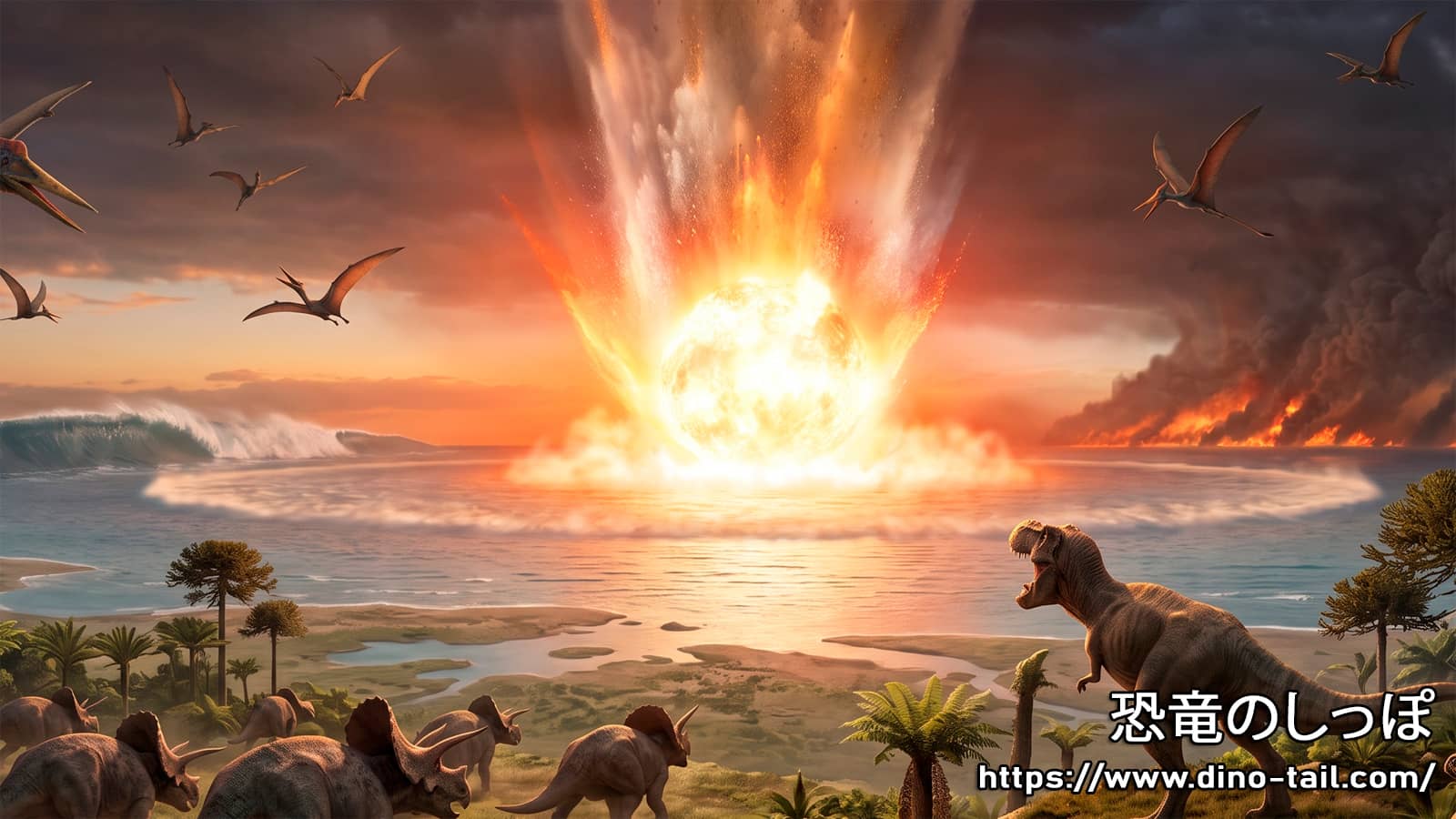
Around 66 million years ago, at the boundary between the Mesozoic Cretaceous and the Cenozoic Paleogene periods, an event occurred that wiped out about 75% of all life on Earth, including dinosaurs, pterosaurs, and ammonites. Today, it is believed that the primary cause of this mass extinction was a massive asteroid, 10 to 15 km in diameter, that crashed into the Yucatan Peninsula in Mexico (Chicxulub).
This giant meteorite impact not only caused direct destruction but also threw up a massive amount of dust that covered the atmosphere and blocked out sunlight, causing severe global cooling known as an "Impact Winter." This is considered the biggest reason why so many species went extinct.
What is the K-Pg Boundary?
It refers to the boundary between the Cretaceous (Kreide) and the Paleogene periods. Geological layers from this time reveal abnormally high concentrations of elements like iridium, which are practically non-existent on Earth, providing evidence of a giant meteorite impact.
However, despite such clear evidence, the mystery of "what the asteroid was made of and where in space it came from" remained unsolved for a long time. This is because most of the impacting meteorite evaporated instantly due to the immense energy, leaving almost no intact fragments behind.
Meanwhile, in July 2026, an international research team led by Georgy V. Makhatadze published a groundbreaking answer to this long-standing mystery in the journal Science Advances.
Analysis Method: Exploring Traces of Space with "Nickel Isotopes"
Gemini Generated Image
Because the meteorite completely evaporated and mixed with Earth's rocks, identifying the original type of meteorite from this state is extremely difficult. Therefore, the research team focused on the "isotopes" of an element called "nickel (Ni)."
What are isotopes?
They are variants of the same element that have different numbers of neutrons, resulting in slightly different weights. Depending on where in space they were formed, the ratio of these isotopes creates a unique "fingerprint-like" signature.
Nickel is an element abundant in meteorites, and compared to rocks on Earth's surface, it is found in extremely high quantities in materials originating from space. Using an ultra-high-precision mass spectrometer (MC-ICP-MS), the research team succeeded in cleanly separating and analyzing only nickel from geological samples, thereby reading the "chemical fingerprint" of the material that came from space.
Analysis Results: The True Identity of the Chicxulub Impactor is a Super-Rare "CO Chondrite"
To investigate the extent of meteorite mixing, the research team collected K-Pg boundary layer samples from five different locations in Europe. They then compared them with data from various types of meteorites.
| Sample Location | Country | Estimated Meteorite Content |
|---|---|---|
| Stevns Klint | Denmark | Approx. 5% (Strongest meteorite characteristics) |
| Caravaca | Spain | Approx. 5% |
| Fornaci | Italy | Approx. 1% |
| Frontale | Italy | Approx. 1% |
| Furlo | Italy | Approx. 0.5% (Closer to Earth rock characteristics) |
As a result of comparative analysis between the collected samples and various meteorites, it was found that the true identity of the impacting asteroid was a rare "CO chondrite (Ornans type)" among carbonaceous chondrites.
What are carbonaceous chondrites?
They are a group of primitive meteorites containing water and organic matter. The sample brought back from the asteroid Ryugu by Japan's Hayabusa2 spacecraft is also known to belong to this group (CI chondrite).
CO chondrites are "very dry" meteorites among carbonaceous chondrites, with an extremely low content of volatile components such as water and sulfur. Carbonaceous chondrites themselves make up only about 5% of all meteorites found on Earth, and CO chondrites are just a small fraction of those, making them an astronomically super-rare meteorite.
The True Culprit of Cooling Was Not the Meteorite, but "Silicate Dust"
This discovery that it was an "extremely dry meteorite" overturned the conventional wisdom regarding the climate change mechanism that triggered the extinction of the dinosaurs.
Where Did the Massive Amount of Sulfur Come From?
Until now, it was thought that the severe cooling caused by the "Impact Winter" occurred because the meteorite itself brought a massive amount of "sulfur" to Earth, which turned into sulfate aerosols in the atmosphere and blocked sunlight for a long time.
However, if the impactor was a CO chondrite containing almost no sulfur, the amount of sulfur released from the meteorite itself would be much smaller than expected. In other words, the massive amount of sulfur that caused climate change did not come from the meteorite, but from the rocks (evaporites like gypsum) in the Yucatan Peninsula of Mexico where the meteorite struck, which were vaporized by the immense energy and released into the atmosphere.
The Fine Dust That Stopped Photosynthesis (Silicate Dust)
Was sulfur aerosol the only cause of the cooling? According to the latest simulation research, that was not the case.
It has become clear that "silicate dust" kicked up from the Earth's crust by the impact played a crucial role. Because this dust was extremely fine, it remained in the stratosphere for up to 15 years. This massive veil of dust completely blocked sunlight, causing the Earth's average temperature to plummet by up to 15°C.
This discovery of a "sulfur-poor CO chondrite" strongly supports, from a chemical perspective, the latest theory that the main culprit behind the cooling and the cessation of photosynthesis (collapse of the food chain) was not the meteorite itself, but the "fine silicate dust kicked up from Earth."
Space Romance: Why Did a Rare Meteorite from the Outer Solar System Come to Earth?
The results of this research also teach us interesting facts about the formation of the solar system and the movement of celestial bodies.
Carbonaceous asteroids like CO chondrites are thought to have formed in the distant, cold regions beyond Jupiter's orbit during the early days of the solar system. Actually, all other large meteorites (those that created giant craters) that have struck Earth in the past 500 million years were rocky asteroids (S-type) born much closer to Earth (in the inner solar system), such as between Mars and Jupiter. About 80% of the meteorites that fall to Earth today are also S-type.
Despite this, the fact that a super-rare celestial body born beyond Jupiter made a pinpoint direct hit on Earth during the relatively "recent" era of 66 million years ago can be said to be an "extremely unlucky coincidence" from an astronomical perspective.
It is speculated that this asteroid remained in a safe orbit for a long time but, due to Jupiter's gravitational influence or collisions with other asteroids, it deviated from its orbit and flew towards Earth with a one-in-a-million probability.
Conclusion and Future Prospects
This research, by analyzing microscopic nickel isotopes, pinpointed the true identity of the asteroid that wiped out the dinosaurs as a super-rare "CO chondrite."
This strongly supported that the main driver of the climate change that triggered the extinction was not sulfur from the meteorite, but "silicate dust" kicked up from Earth's rocks. It succeeded in connecting an event from over 100 million years ago from microscopic atomic traces to cosmic-scale movements.
This new analytical method is expected to be highly useful in the future for investigating the causes of meteorite impacts and mass extinctions that occurred in other eras.
References
- Dinosaurs May Have Been Wiped Out by 'Oddball' Space Rock | Sci.News, https://www.sci.news/space/chicxulub-c0-chondrite-14927.html
- The origin of Cretaceous - Semantic Scholar, https://pdfs.semanticscholar.org/aa18/9299366726d6d8da73cb5b36a905933a6ecb.pdf
- Researchers Identify Class Of Oddball Meteorite That Killed Earth's Dinosaurs - Astrobiology, https://astrobiology.com/2026/07/20/researchers-identify-class-of-oddball-meteorite-that-killed-earths-dinosaurs/
- The origin of Cretaceous-Palaeogene impactor revealed by nickel isotopes - PMC - NIH, https://pmc.ncbi.nlm.nih.gov/articles/PMC13378546/
- Chicxulub impact winter sustained by fine silicate dust | Request PDF - ResearchGate, https://www.researchgate.net/publication/375088454_Chicxulub_impact_winter_sustained_by_fine_silicate_dust
- Ruthenium isotopes show the Chicxulub impactor was a carbonaceous-type asteroid, https://gardenia-buffalo-679m.squarespace.com/s/62_FischerGoddeetal_2024_Science.pdf