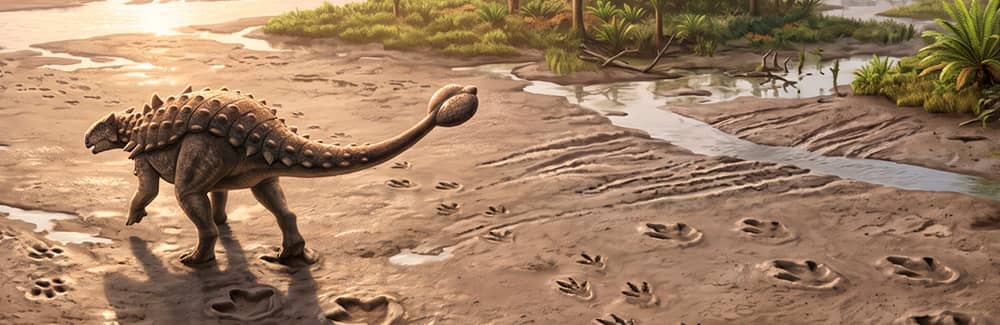
Introduction: The "Gap" in the Mid-Cretaceous Fossil Record and Discoveries via Trace Fossils
The fossil record of the North American continent has played a crucial role in unraveling the history and geographical distribution of dinosaurs during the Mesozoic Cretaceous period. In particular, the western part of North America during the Late Cretaceous (about 84 to 66 million years ago) was home to many ceratopsians, ornithopods, theropods, and thyreophorans (ankylosaurs), indicating the existence of a rich terrestrial ecosystem.
However, in the strata of the preceding "Mid-Cretaceous" (about 100 to 84 million years ago), there existed a "fossil gap" (Ghost lineage / Fossil gap) where the skeletal records of certain dinosaurs were noticeably absent.
Among thyreophorans, skeletal fossils of the "Ankylosauridae," which possess a bony tail club, had not been found at all from this Mid-Cretaceous North America. Therefore, the theory that they had once disappeared from North America and later migrated back from the Asian continent had been supported for a long time.
However, large-scale trackways measuring 100 meters, overturning previous theories, were discovered in the strata of Tumbler Ridge in British Columbia and northwestern Alberta, Canada. Investigations by an international joint research team revealed that these were the footprints of an ankylosaurid with a "tridactyl (three-toed) hind limb," and they were formally described in 2025 as a new ichnospecies, "Ruopodosaurus clava." Here, we explain the ecosystem of that time as revealed by this footprint fossil.
Features of the New Footprint Fossil: Ruopodosaurus clava
Gemini Generated Image
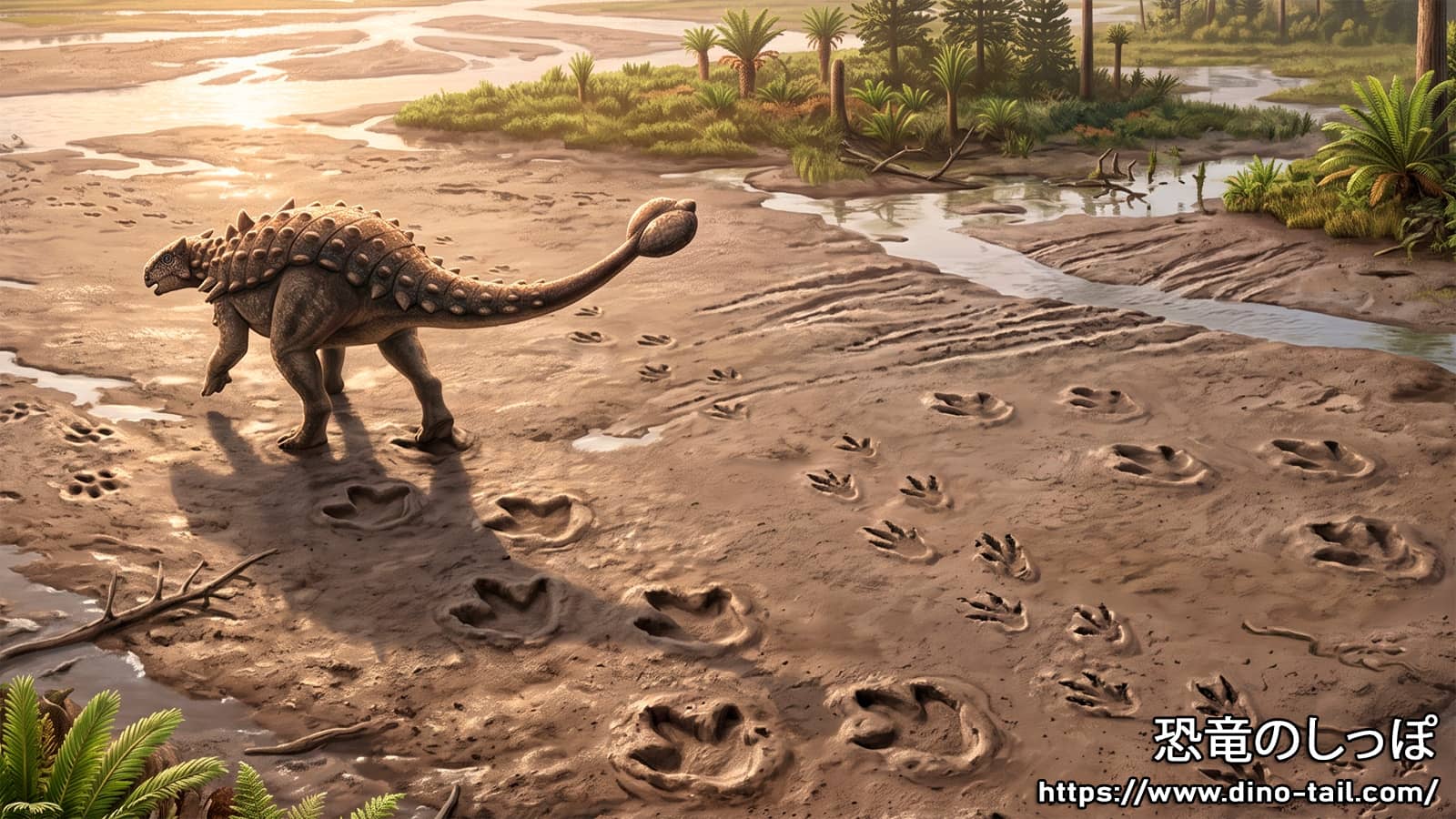
The genus name Ruopodosaurus means "crumbling footprint lizard," named after the friable terrain of the discovery site. The specific name clava means "club" in Latin, indicating that the dinosaur that left the footprints possessed the tail club characteristic of Ankylosauridae.
A detailed examination of the footprint shape shows that the hind limb had distinct "three toes," and the tip of each toe was a blunt triangular or U-shape to support a heavy weight. The forelimb had five toes curved in a crescent shape. These features perfectly match the skeletal structure of ankylosaurids discovered in China from the same period.
The total length of this dinosaur, estimated from the width of the footprints and the stride, was about 5 to 6 meters. Although smaller than the giant Ankylosaurus that appeared in later eras, it is thought to have possessed sufficiently strong armor as a "walking tank."
| Ichnotaxon | Presumed Trackmaker | Pes Digits | Manus Digits | Morphological Features of Digits | Occurrence Period in North America |
|---|---|---|---|---|---|
| Tetrapodosaurus borealis | Nodosauridae | Tetradactyl | Pentadactyl | Slightly elongated, acutely angled tips | Early to Mid-Cretaceous |
| Ruopodosaurus clava | Ankylosauridae | Tridactyl | Pentadactyl | Blunt triangular or U-shaped tips | Mid-Cretaceous (Cenomanian) |
Why Were Only "Footprints" Left Behind and No "Bones"?
The greatest significance of the discovery of Ruopodosaurus footprints is that it proved beyond doubt that ankylosaurids inhabited North America during the Mid-Cretaceous. They had not temporarily gone extinct from North America.
So why was not a single bone fossil found for 16 million years? The answer lay in the relationship between the "environment" where they lived and the preservability of fossils.
Taphonomic Bias (Preservation bias during fossilization):
During the process from a creature's death to fossilization, some things are easily preserved while others are not, depending on environmental conditions. This is called taphonomic bias. The fact that clear footprints remain is absolute proof that the animal was certainly in that place, even if the skeleton did not survive.
Western Canada at the time was a lowland delta plain with braided rivers and vegetated wetlands (floodplains). For footprints to be preserved, the mud on the ground must be neither too soft nor too hard. This region had a cycle of water receding and moderate drying, which was the perfect environment for footprint molds to remain.
On the other hand, in wetlands rich in plants, soil and water tend to become highly acidic as plants decompose. When a dinosaur dies in such an environment, the bones made of calcium carbonate dissolve rapidly. Furthermore, frequent floods would wash the bones apart, making the probability of bone fossils remaining intact extremely low. In other words, the reason no bones were found was not because "they were extinct," but because "it was an environment where bones easily dissolved."
Coexistence and "Niche Partitioning" of Two Armored Dinosaurs
Another noteworthy discovery in this study is that footprints of the four-toed Nodosauridae and the three-toed Ankylosauridae (Ruopodosaurus) were found together from the same floodplain environment.
As an ecological principle, two species with exactly the same lifestyle cannot coexist in the same place over the long term (competitive exclusion principle). The fact that these heavily armored, giant herbivorous dinosaurs could coexist in the same region (sympatric coexistence) indicates that there was clear "niche partitioning" (habitat or dietary separation) between them.
Browsers and Grazers:
The Nodosauridae had relatively narrow snouts and were "browsers" (selective foragers) that picked specific ferns and other plants. On the other hand, the Ankylosauridae had wide snouts and are thought to have been "grazers" (non-selective foragers) that indiscriminately cropped low-lying plants close to the ground.
Looking at the distribution of footprints, it has also been pointed out that while Nodosauridae preferred broad wetlands, Ankylosauridae may have favored specific environments, such as those slightly further inland. These differences in diet and subtle differences in habitat enabled their coexistence.
Survival Struggle with Predators and Giant Crocodiles
Looking at the entire continuous surface of the 100-meter scale trackways reveals just how diversely populated the floodplain of that time was.
| Taxonomic Group | Main Ichnotaxa / Traces | Ecological Role | Remarks |
|---|---|---|---|
| Ankylosauridae | Ruopodosaurus clava | Grazer of low vegetation | New species, possesses a bony tail club |
| Nodosauridae | Tetrapodosaurus borealis | Browser | Four-toed hind limb, flexible tail |
| Theropoda (Tyrannosauridae) | Parallel trackways of multiple individuals | Apex Predator | Pack hunting, suggestion of sociality |
| Giant Crocodilians | Swim traces (scratching the water bottom) | Aquatic apex predator | Body length 9-12m, possible Deinosuchus ancestor |
| Aves (Birds) | Paxavipes babcockensis | Small coastal foragers | Ecological niche similar to shorebirds |
From the same area, footprints of three tyrannosaurids walking simultaneously in the same direction have been discovered. This indicates the possibility that they hunted in packs rather than alone. The presence of such predators is thought to have exerted evolutionary pressure on the heavy armoring and the development of tail clubs in Ankylosauridae. The footprints also suggest the possibility that Ruopodosaurus did not only wander alone but sometimes formed herds to counter predators.
Furthermore, it is noteworthy that swim traces (claw scratch marks) of a giant crocodile estimated to reach 9 to 12 meters in length were found alongside ankylosaur footprints in strata indicating the remains of a shallow lake. Even heavily armed ankylosaurs faced the danger of surprise attacks from giant crocodiles lurking in the water when drinking. Footprint fossils realistically depict such a tense environment.
Trace Fossils Open New Avenues in Dinosaur Research
The discovery of Ruopodosaurus in Canada beautifully filled the "gap" caused by the lack of skeletal fossils, bringing a historic turning point to Mid-Cretaceous dinosaur ecology.
In recent years, new methods have been introduced, such as searching not only for footprint depressions but also using the upheavals of surrounding mud pushed out when the foot stepped in as an indicator. Trace fossils such as footprints serve as a precious record proving that life certainly existed and was active there, even in environments where bones dissolve.
References
- First tail-club dinosaur tracks found in Canadian Rockies | Courthouse News Service, https://www.courthousenews.com/first-tail-club-dinosaur-tracks-found-in-canadian-rockies/
- 100-Million-Year-Old Footprints of Tail-Clubbed Armored Dinosaurs Discovered in Canada, https://www.sci.news/paleontology/ruopodosaurus-clava-footprints-13824.html
- これまでの定説を覆す発見 世界で初めて見つかった3本指の恐竜の化石 - NewSphere, https://newsphere.jp/popular/20250422-02/
- Mysterious 3-Toed Footprints in Canada Reveal New Ankylosaur Species - Science Alert, https://www.sciencealert.com/mysterious-3-toed-footprints-in-canada-reveal-new-ankylosaur-species
- Tracking Giant Cretaceous Crocodiles and Tiny Ankylosaurs North of Tumbler Ridge, https://www.trmf.ca/news/tracking-giant-cretaceous-crocodiles-and-tiny-ankylosaurs-north-of-tumbler-ridge