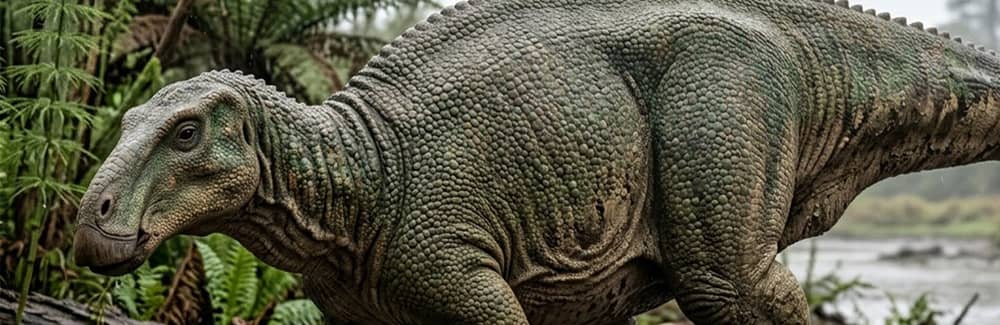
A new genus and species of iguanodontian, "Paludohadros proudlovii" (Paludohadros proudlovii), has been discovered and named from the Early Cretaceous strata (Weald Clay Formation) in southern England.
This fossil, which had been thought to be a "juvenile Iguanodon" or "Mantellisaurus" in the collections of the Natural History Museum in London for 25 years since its excavation in 2001, has revealed the following facts through the latest CT scan investigation:
- Identification of a new species after 25 years: Micro-CT scanning revealed the features of the teeth and jaws hidden in hard rock, proving it to be a new species of early Hadrosauroidea.
- The true identity of "Big Iggy": The 5-meter-long specimen was estimated to be a young, still-growing individual, and a large herbivorous dinosaur that would reach 8 to 10 meters in total length as an adult.
- Direct relationship with Baryonyx: It was unearthed just 100 meters away from the discovery site of the famous carnivorous dinosaur Baryonyx, and Baryonyx teeth were also found near its skeleton.
This page details the background of the discovery and physical characteristics of Paludohadros, as well as its systematic significance that rewrites the evolutionary history of dinosaurs in the UK.
Paper Overview and Background of New Species Description
Gemini Generated Image
On October 26, 2026, a new genus and species of iguanodontian, "Paludohadros proudlovii" (Paludohadros proudlovii), was described in the academic paleontology journal "Journal of Systematic Palaeontology" from the Weald Clay Formation, an Early Cretaceous stratum in southern England.
This research was conducted by an international collaborative research team led by Ricardo J. Sakamoto, a doctoral researcher at the Natural History Museum in London (NHMUK) and the University of São Paulo (USP) in Brazil, along with Dr. Jeremy Lockwood of the University of Portsmouth, Professor Paul Barrett of the Natural History Museum, and Professor Susannah Maidment of the museum and the University of Birmingham. Taxonomically, it belongs to the Ornithischia, Ornithopoda, and Iguanodontia, and is positioned as a "basal Hadrosauroidea" located at the early stage of the lineage leading to the duck-billed dinosaurs (Hadrosauridae) that flourished later in the Late Cretaceous.
Origin of the scientific name: "Swamp hadrosaur"
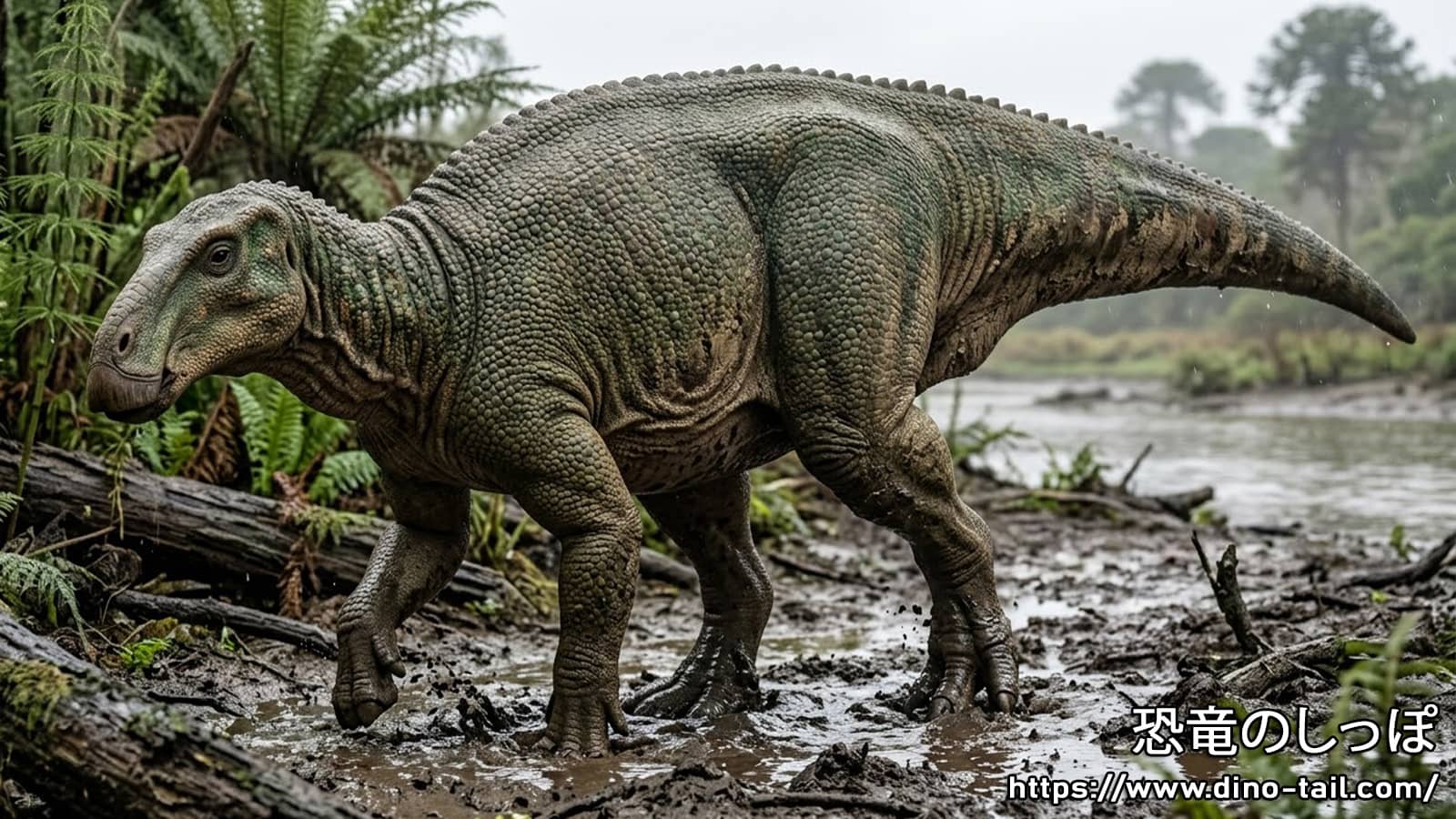
The genus name "Paludohadros" is a combination of the Latin word "palūs," meaning "swamp" or "marsh," and the ancient Greek word "hadrós," meaning "stout" or "thick," which is often used in the scientific names of hadrosaurids. It means "swamp hadrosaur." This name is derived from two facts: the Weald Clay Formation during the Barremian stage of the Early Cretaceous (about 125 million years ago) was a muddy swampland, and the excavation site, Smokejacks Pit, is still a very muddy place today.
Meanwhile, the specific name "proudlovii" honors the late William (Will) Proudlove, former manager of the Ewhurst Brickworks (formerly Smokejacks Brickworks) near Ockley in Surrey, where the fossil was found. Mr. Proudlove strongly supported fossil investigations at the mining site but passed away suddenly at the young age of 35 in 2000, just before this specimen was excavated. It was named to honor his immense contribution to natural history research.
| Item | Detailed Data |
|---|---|
| Scientific Name | Paludohadros proudlovii |
| Journal / Publication Date | Journal of Systematic Palaeontology (Published October 26, 2026) |
| Taxonomic Position | Superorder Dinosauria, Order Ornithischia, Clade Ornithopoda, Clade Iguanodontia, Superfamily Hadrosauroidea (Basal lineage) |
| Holotype Specimen | NHMUK PV R 16396 (Partial skull, lower jaw, vertebrae, ribs, right pectoral girdle, most of both forelimbs, right ischium, parts of both hindlimbs, caudal vertebrae, etc.) |
| Referred Specimens | Four humeri and four tibiae from Smokejacks (reported in the 1950s), a large left surangular from the Isle of Wight (NHMUK PV R 105a) |
| Discovery Site / Stratum | Smokejacks Pit, near Ockley, Surrey, southern England (Upper Weald Clay Formation) |
| Age | Early Cretaceous, Barremian stage (approx. 125 million years ago) |
| Estimated Size / Growth Stage | The holotype is a young individual (subadult) with a total length of about 5m and an estimated weight of 1.5 to 2.0 tons. Adults are estimated to have reached 8 to 10m in total length. |
Specimen History and Breaking Away from the "Wastebasket Taxon": Breakthrough by Micro-CT
The reference holotype specimen of Paludohadros (specimen number: NHMUK PV R 16396) was discovered on July 22, 2001, by Geoff Toye during a field survey by the Geologists' Association. After a two-week excavation effort supported by the Natural History Museum in London, it was donated to the museum. However, this fossil sat in the museum's storage for a quarter of a century without being recognized as a new species. Initially upon discovery in 2001 and in a 2008 study, it was treated as a "juvenile Iguanodon," and further classified as the closely related "Mantellisaurus" in a 2021 research review.
Why did it go unrecognized as a new species for 25 years? Behind this is the problem of "wastebasket taxa" that deeply persisted in British paleontology from the 19th to the 20th century.
What is a wastebasket taxon?
It is the practice of lumping together fossils with unclear features or specimens that have not been sufficiently compared and investigated into an already known, famous species. For many years, fossils of large herbivorous dinosaurs (ornithopods) found in the Wealden Group of the UK have been mechanically assigned to just two species: the robustly built "Iguanodon bernissartensis" or the more slender "Mantellisaurus atherfieldensis." As a result, minute differences in bone shape were dismissed as "individual variation" or "age differences," hiding the true diversity of species.
Non-destructive Investigation by Micro-CT Scan and Integration of Past Specimens
Over the past decade, a research team from the Natural History Museum in London and the University of Portsmouth has been carrying out a project to re-examine previously collected iguanodontian specimens in detail from scratch in order to review this "only two species" established theory. When Sakamoto and his team reinvestigated this specimen (NHMUK PV R 16396), some of the important parts of the skull were still buried in siderite, a very hard iron-rich rock. Trying to scrape off the rock with tools would have posed a high risk of damaging the fragile skull fossil.
Therefore, the research team, led by Brett Clark, the museum's imaging expert, introduced high-resolution X-ray micro-CT scanning. With this technology, they successfully removed only the rock digitally without damaging the fossil, reconstructing in 3D the fine skull parts hidden inside and new teeth (replacement teeth) that had not yet erupted from the gums.
Furthermore, with the features of Paludohadros now clear, it was discovered that four humeri and four tibiae found in the same quarry and reported in papers in 1953 and 1956 were also fossils of Paludohadros. In addition, a part of the lower jawbone (surangular: NHMUK PV R 105a) of a much larger individual previously found on the Isle of Wight was identified as the same species, linking together museum specimens that had been collected more than 70 years ago.
Anatomical Features of Paludohadros and Elucidation of Its Growth Stage
Observations inside the skull using micro-CT and precise measurements of the bones throughout the body identified unique features that distinguish Paludohadros from other iguanodontians. These features range widely from the jaw mechanism for grinding plants to the bones of the limbs for walking on muddy ground.
What is an Autapomorphy?
It refers to a unique feature acquired independently during evolution by a specific group or species of organisms, which is not seen in other species. In paleontology, whether these "autapomorphies" or a "unique combination of features" can be confirmed in a fossil is the most important criterion for it to be recognized as a new genus or species.
| Part | Morphological features seen in Paludohadros | Taxonomic importance and functional role |
|---|---|---|
| Lower jaw teeth (Dentary teeth) | Equipped with two secondary vertical ridges and several fine subsidiary ridges on the inner (lingual) surface of the tooth. | Unique identifying feature. Unlike Iguanodon and Mantellisaurus, which have only one secondary ridge, this adaptation increased the surface area of the tooth to improve the efficiency of grinding tough plant fibers. |
| Bone at the back of the lower jaw (Surangular) | Has an upwardly projecting process (lateral process) and is separated by a shallow groove shifting outwards from the edge of the anterior process. | Autapomorphy. A structure that changed the attachment of the muscles that close the jaw and the "leverage action," generating powerful biting force. |
| Forehead bone (Frontal) | The underside (surface closer to the brain) is bisected by a curved vertical ridge, creating an hourglass-like outline when the left and right sides are put together. | Comparative identifying feature. Clearly distinguished from Comptonatus and Mantellisaurus, which lack this underside ridge and have a smooth surface. |
| Upper arm bone (Humerus) | The process for muscle attachment (deltopectoral crest) is strongly bent inward, and there is a ridge extending toward the torso on the inner articular surface near the elbow. | Unique identifying feature. An adaptation to firmly support body weight with the front legs and withstand the load when walking on all fours. |
| Pelvic bone (Ischium) | The shaft of the bone curves backwards and downwards, with a widely expanded "boot-like" process at the tip. There is a characteristic ridge projecting outwards at the base. | Autapomorphy. Indicates unique development of the muscles around the pelvis and those pulling the hind legs backward. |
| Shin bone (Tibia) | Conspicuous bony bumps (tuberosities) are present on the medial and lateral sides of the upper end near the knee joint. | Unique identifying feature. Functions as a place for strong attachment of knee ligaments, a structure that supported movement in muddy wetlands. |
Advanced Mastication Capabilities and Adaptation to Quadrupedalism
What is particularly noteworthy about the physical features of Paludohadros is the simultaneous appearance of "evolution of plant-crushing abilities" and "adaptation to quadrupedal walking." On the inside of the teeth in the lower jaw, in addition to the main thick ridge (primary ridge) in the center, there are two secondary ridges and multiple fine ridges. Compared to Iguanodon, which only has one secondary ridge, the grinding surface of the teeth has become more complex. It is thought that this, in conjunction with the unique process of the surangular at the back of the lower jaw, allowed it to forcefully grind tough ferns and conifer leaves growing in the wetlands. In addition, the humerus of the front leg and the tibia of the hind leg have well-developed processes for strong attachment of muscles and ligaments, making it suitable for walking and supporting its heavy body in slushy mud swamps.
The Holotype is a Growing Youth! Adults Reached a Gigantic Size of 8-10m
As a result of examining the growth stage of the bones, the holotype specimen (NHMUK PV R 16396) had reached a total length of about 5 meters and an estimated weight of 1.5 to 2.0 tons (a size comparable to modern rhinos or large hippos) at the time of death. However, because the parts of the spine (neural arches and centra) were not yet fully fused, and based on the surface texture of the bone and internal tissue structure, it was proven to be a young individual (subadult or juvenile) still actively growing.
Surprisingly, the thigh bone (femur) length of this young individual had already reached 63 cm. This already exceeds the femur of an adult Mantellisaurus (57 cm). Furthermore, combining this with the fact that the lower jawbone of Paludohadros found on the Isle of Wight (NHMUK PV R 105a) belonged to a much larger individual than the holotype, it was concluded that a fully grown Paludohadros would have grown to about twice the size of the holotype, reaching a total length of 8 to 10 meters.
Phylogenetic Analysis and Paleoecology: Convergent Evolution of the Back Sail and the Relationship with Baryonyx
To investigate where Paludohadros sits on the evolutionary branching (phylogenetic tree) of dinosaurs, the research team performed a phylogenetic analysis using the latest data. As a result, extremely important discoveries were brought to light regarding the evolution and ecosystems of dinosaurs in the Early Cretaceous of the UK.
Sister-group Relationship with Istiorachis and Convergent Evolution of the "Back Sail"
The analysis revealed that Paludohadros belongs to the earliest branching group of the Hadrosauroidea, and is the closest relative (sister taxon) to "Istiorachis" (Istiorachis macarthurae), an iguanodontian with a sail on its back that was just announced from the Isle of Wight in 2025. Furthermore, these two species, along with Kukufeldia from the UK and Xuwulong from China, form a cohesive group of early Hadrosauroidea.
This discovery significantly rewrites the evolutionary positioning of Istiorachis. When Istiorachis was first announced in 2025, there was debate that it might be closely related to Ouranosaurus from North Africa due to the shape of its "back sail" made of elongated spinal processes. However, as a result of reanalysis including Paludohadros, it was shown that Istiorachis is phylogenetically distant from Ouranosaurus and is the direct sister taxon to Paludohadros.
What is Convergent Evolution?
It is a phenomenon where phylogenetically distinct groups (organisms distantly related to each other) independently evolve very similar body shapes for purposes such as adaptation to similar environments or display (appealing to mates). This phylogenetic analysis strongly corroborated that the "back sails" seen in Ouranosaurus, Hypselospinus, Morelladon, and Istiorachis were not inherited from a single ancestor, but were features that evolved separately (convergent evolution) in multiple lineages.
Differences in Environment Between the Weald Clay Formation and Wessex Formation
Paludohadros is the first and only iguanodontian formally named from the Weald Clay Formation. Interestingly, there is almost no overlap in the species of iguanodontians that lived in this Weald Clay Formation and the Wessex Formation on the Isle of Wight, which is considered to be a stratum from roughly the same period (about 125 million years ago). Diverse species such as Brighstoneus, Comptonatus, Istiorachis, and Mantellisaurus have been found in the Wessex Formation, but only Paludohadros has been confirmed in the Weald Clay Formation (the only commonality is a single lower jawbone found on the Isle of Wight).
Regarding this difference, the research team points out the possibility that there was a slight time gap in when the two strata were deposited, as well as the possibility that "niche partitioning" occurred due to differences in the environment at the time. While the Wessex Formation was a warm, slightly dry plain where forest fires and floods occurred frequently, the Weald Clay Formation was an environment of year-round muddy wetlands and shallow lakes covered with conifer forests and ferns, suggesting that separate dinosaurs specialized for each environment lived there.
Direct Connection with the Large Theropod Baryonyx
From a paleoecological perspective, what is attracting the most attention is the relationship with the famous large carnivorous dinosaur (theropod) "Baryonyx walkeri" (Baryonyx walkeri). The holotype specimen of Paludohadros was dug out from the exact same stratum horizon just about 100 meters west of where the holotype specimen of Baryonyx was discovered in 1983. Furthermore, when Paludohadros was excavated in 2001, two shed teeth of Baryonyx were found right next to its skeleton, strongly suggesting that the carcass of Paludohadros was eaten by a Baryonyx.
Baryonyx fossils are famous for having bones of a young iguanodontian dissolved by stomach acid, along with scales of an ancient fish (Scheenstia), found in the area where the stomach would have been, as its "last meal." With the revelation that the iguanodontian living in the same place and at the same time was Paludohadros, the direct food chain connection of "eating and being eaten" between Baryonyx and Paludohadros has come into sharp focus.
Reactions from Prominent Paleontologists and the Academic Community
Immediately after the publication of the paper on October 26, 2026, this research became a huge topic of conversation among paleontologists around the world. From the comments and discussions of researchers, we can see important significance beyond just the discovery of a new species.
Professor Maidment's New Hypothesis on the True Identity of "Big Iggy"
Professor Susannah Maidment, the corresponding author of this study, raised a very interesting issue with this announcement. For many years, among researchers and at excavation sites in the UK, fossils of large, robust iguanodontians found in the Wealden Group were commonly called "Big Iggy" (a large Iguanodon bernissartensis) to distinguish them from the smaller, slender Mantellisaurus.
However, because it was revealed that Paludohadros, found in the Weald Clay Formation this time, reached a total length of 5 meters while still a young individual, and would grow into a giant of 8 to 10 meters in total length as an adult, Professor Maidment proposed, "Could the true identity of the dinosaur long believed to be 'Big Iggy' (a large Iguanodon) in the Weald Clay Formation actually have been an adult Paludohadros, not an Iguanodon?" Also, regarding the relationship with Baryonyx, she stated a realistic scenario: "While we can't be certain which species the bones in the Baryonyx's stomach belong to, it may have been scavenging the carcass of a young Paludohadros, or perhaps hunting them if given the opportunity."
Re-evaluation of "Museum Dark Data" and Reactions from Researchers Worldwide
Co-author Professor Paul Barrett welcomed Paludohadros as a "fantastic addition to the Wealden fauna," and lead author Ricardo Sakamoto expressed his aspirations, saying, "As part of my PhD research, I want to comprehensively review the entire collection of iguanodontians housed at the Natural History Museum in London and uncover even more new dinosaur species that have gone unnoticed." The successive discoveries of new dinosaur species in the UK in recent years (Brighstoneus in 2021, Comptonatus in 2024, Istiorachis in 2025, and Paludohadros in 2026) prove how effective projects are that re-examine past specimens sitting in museum storage (dark data) using the latest technology.
Furthermore, prominent researchers around the world, including Dr. Thomas Holtz of the University of Maryland, Dr. Jim Kirkland, the Utah State Paleontologist and a leading expert on North American Lower Cretaceous ornithopods, and Dr. Darren Naish of the University of Southampton, immediately offered positive reactions. At the same time, as new genera become independent one after another, a new research challenge has been highlighted: the need to "strictly redefine Iguanodon bernissartensis itself, which has long served as a catch-all for 'large ornithopods,' using modern standards."
| Researcher Name / Affiliation | Role / Area of Expertise | Main Views on the Paludohadros Paper and Academic Significance |
|---|---|---|
| Professor Susannah Maidment (Natural History Museum, London / University of Birmingham) |
Corresponding Author Taxonomy and evolution of Ornithischians |
Proposed the possibility that this species, reaching 5m as a young individual, is the true identity of the dinosaur long called "Big Iggy" in the Weald Clay Formation. Pointed out the potential for predation on juveniles or scavenging of carcasses by Baryonyx. |
| Professor Paul Barrett (Natural History Museum, London) |
Co-author Evolution and paleoecology of dinosaurs in general |
Welcomed the diversification of Wealden Group dinosaurs. Emphasized that re-investigating museum collection specimens (dark data) is dramatically improving the precision of dinosaur classification as a whole. |
| Ricardo J. Sakamoto (Natural History Museum, London / University of São Paulo) |
Lead Author Systematics of Iguanodontians |
Reported the identification of a new species from a specimen unidentified for 25 years. Following the integration of specimens from the 1950s and the Isle of Wight, he anticipates discovering even more new species through a comprehensive review of the museum's entire iguanodontian collection. |
| Dr. Thomas R. Holtz Jr. (University of Maryland) |
Prominent External Researcher World authority on dinosaur systematics |
Promptly reported and spread the news on the day of publication as a "new genus and species of early-diverging Hadrosauroidea." Internationally communicated the importance of European specimens in the early evolution of the Hadrosauroidea. |
| Dr. Jim Kirkland (Utah Geological Survey) |
Prominent External Researcher Authority on Early Cretaceous ornithopods |
Shared the description paper with the North American and international communities. Suggested that it will serve as an important reference point when comparing the dinosaur faunas of the European Wealden Group and North American strata (such as the Cedar Mountain Formation). |
| Dr. Darren Naish (University of Southampton) |
Prominent External Researcher British dinosaur fauna / Vertebrate evolution |
Shared this research and supported the model that the diversity of large herbivorous dinosaurs in the Early Cretaceous of the UK far exceeded the traditional "only two species" framework. |
Conclusion: Perspectives on Ornithopod Evolution Research Brought by the Description of Paludohadros
The announcement of Paludohadros proudlovii not only added one new species of dinosaur but also brought a major shift in Early Cretaceous dinosaur research. By applying micro-CT scanning to the specimen excavated in 2001 that was covered in hard rock, crucial features of the teeth and jaws were revealed, establishing the fossil—which had been considered a "juvenile Iguanodon" or "Mantellisaurus" for 25 years—as a unique genus. At the same time, the identity of leg and arm bones reported 70 years ago was resolved all at once, proving once again the importance of the approach of re-evaluating historical specimens sitting in museums with the latest technology.
Furthermore, knowing that Paludohadros is a sister taxon to the sail-backed Istiorachis and forms the earliest group of Hadrosauroidea corroborated that the "back sail" in ornithopods evolved independently (convergent evolution) in multiple lineages. And the vivid ecological connection with the carnivorous dinosaur Baryonyx found just 100 meters away, along with the new perspective surrounding the true identity of "Big Iggy," paints a more realistic picture than ever before of the ecosystem that spread across the muddy wetlands of the UK 125 million years ago. As the re-examination of the entire collection at the Natural History Museum in London progresses, the evolutionary story leading to the duck-billed dinosaurs will undoubtedly be unraveled in even greater detail.
References & Bibliography
- [2026] Paludohadros proudlovii • A New iguanodontian Dinosaur, http://novataxa.blogspot.com/2026/10/paludohadros.html
- Scientists Discover a New Dinosaur Species Hiding in Plain Sight, https://scitechdaily.com/scientists-discover-a-new-dinosaur-species-hiding-in-plain-sight-for-25-years/
- A new iguanodontian dinosaur from the Weald Clay Formation, https://www.tandfonline.com/doi/pdf/10.1080/14772019.2026.2726221
- Paludohadros proudlovii: New Early Cretaceous Iguanodontian, https://crvscience.com/news/paludohadros-proudlovii-dinosaur-surrey
- New UK dinosaur discovered in London's Natural History Museum, https://www.discoverwildlife.com/dinosaurs/paludohadros-proudlovii-discovery
- Scientists Discover a New Dinosaur That Was "Hiding" in a London, https://www.zmescience.com/science/new-british-dinosaur-museum-discovery/
- New species of dinosaur named in honour of Surrey man | ITV News, https://www.itv.com/news/meridian/2026-10-27/new-species-of-dinosaur-named-in-honour-of-surrey-man