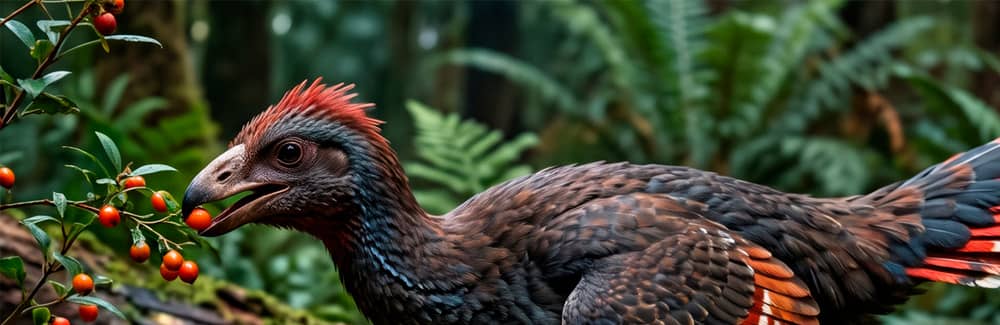
A new genus and species of dinosaur, "Infernogallus jamesi," has been discovered in latest Cretaceous strata of North America, offering groundbreaking insights into dinosaur diets and plant evolution.
Nicknamed the "Hell chicken," this turkey-sized oviraptorosaur provides remarkable evidence that non-avian dinosaurs evolved specialized adaptations for eating fruit:
- A Historic Discovery Over 100 Years in the Making: Confirmation of the first nearly complete, articulated skull and lower jaw in the history of caenagnathid research
- Unique "Fore-and-Aft Sliding" Chewing: Elucidation of a sophisticated jaw mechanism that slid the lower jaw back and forth like specialized modern parrots to pulp fruit flesh and strip it from seeds
- Coevolution with Fruit and the Extinction Mystery: While it flourished alongside the diversification of angiosperm fruits, its specialization for fresh fruit may have sealed its fate during the "impact winter" triggered by the asteroid strike
In this article, we provide an accessible explanation of the secrets of the Infernogallus skull revealed by state-of-the-art CT scans and 3D kinematic modeling, as well as the latest paleoecological debates surrounding frugivory in dinosaurs.
Research Background and the Discovery of the New Genus and Species "Infernogallus jamesi"
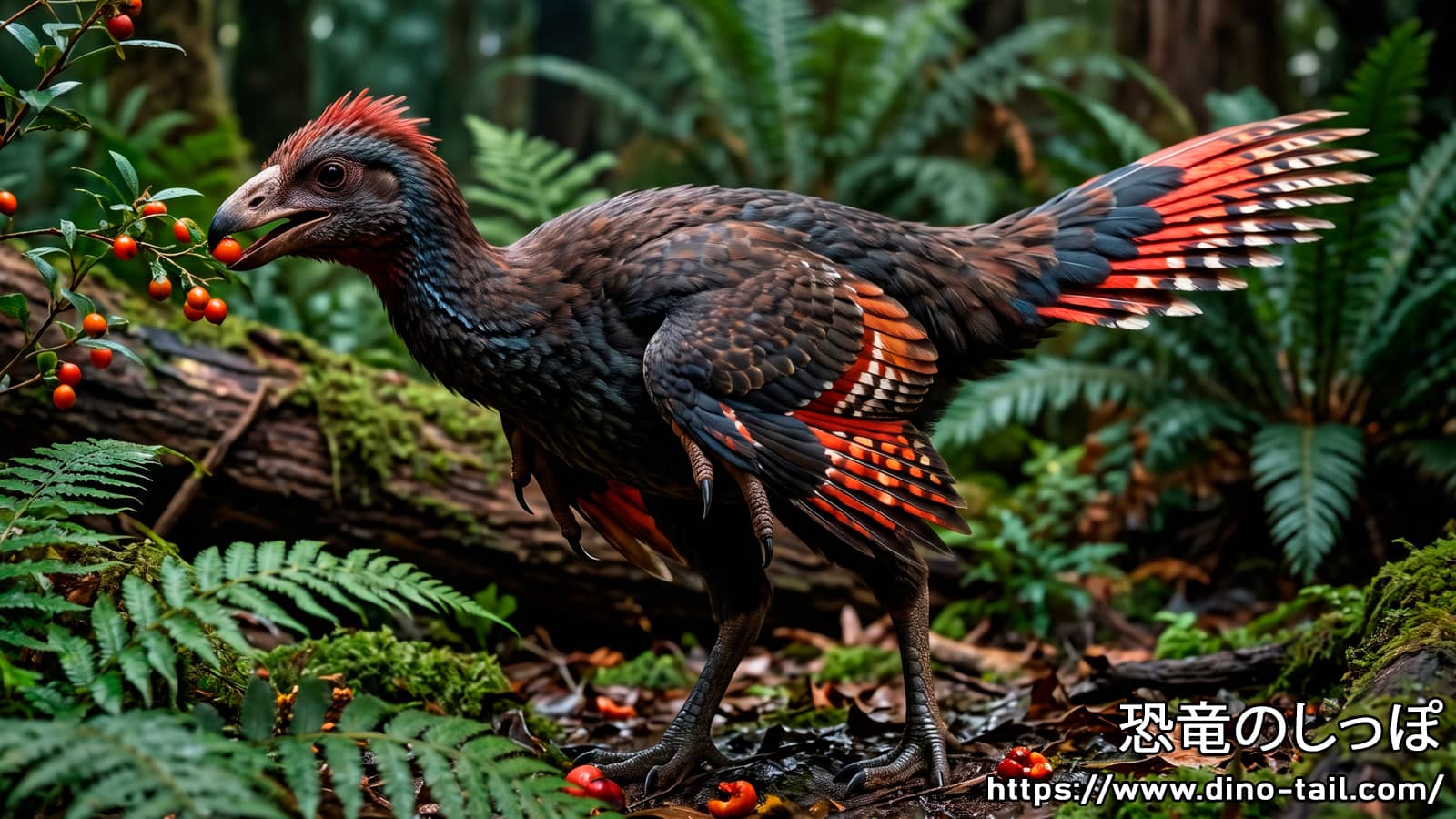
Gemini Generated Image
The Cretaceous period is known as an era when flowering and fruiting plants ("angiosperms") spread explosively, accompanied by a major diversification of herbivorous dinosaurs. Surprisingly, however, no conclusive evidence had ever been found showing that non-avian dinosaurs directly evolved anatomical structures to feed on the soft, fleshy fruits of angiosperms.
This major gap in paleontology has now been filled by a research team led by Dr. Gregory Funston of Stony Brook University, along with researchers from the Royal Ontario Museum (ROM) and the North Dakota Geological Survey (including Dr. Clint Boyd, Dr. Philip Currie, and Dr. David Evans). In a study published in the journal Nature Communications on October 10, 2026, the team formally described a new genus and species of caenagnathid oviraptorosaur (subfamily Caenagnathinae), "Infernogallus jamesi," based on five fossil specimens discovered in the Hell Creek Formation of North America, which dates to the very end of the Cretaceous (late Maastrichtian, approximately 68 to 66 million years ago).
The genus name "Infernogallus" combines the Latin words "Inferno" (hell) and "gallus" (chicken/rooster), meaning "Hell chicken"—a nod to both the Hell Creek Formation where the fossils were found and its turkey-sized, bird-like build. The specific name "jamesi" honors James William Boyd, the grandfather of co-author Dr. Clint Boyd, who inspired him to pursue a career in paleontology.
The First "Nearly Complete Skull" in Over a Century of Research
Caenagnathidae, the family to which Infernogallus belongs, is a group of theropods characterized by toothless, beak-like lower jaws, slender limbs, and bird-like bones lightened by air sacs (pneumatization). Because their bones are extremely thin and fragile, they usually shatter and scatter during fossilization. For over 100 years since research on this group began, not a single nearly complete, articulated skull—with bones still connected in their original positions—had ever been found.
However, the holotype specimen (ROM VP 65050), excavated in Garfield County, Montana, USA, in July 2011 and now housed and displayed at the Royal Ontario Museum, preserved the first "nearly complete articulated skull and lower jaw" in caenagnathid history. Furthermore, it was a miraculously preserved partial skeleton that included an articulated series of cervical and dorsal vertebrae, gastralia (belly ribs), the right shoulder girdle and forelimb, part of the pelvis, and part of the right hindlimb.
Not a Juvenile of a Large Species, but a "Small-Bodied Adult"
Measuring about 1.5 meters in total length with an estimated body mass of around 12 kilograms (range: 9–15 kg), Infernogallus is among the smallest members of Caenagnathidae. Because the same Hell Creek Formation was home to the giant caenagnathid Anzu wyliei (weighing around 300 kg) and the medium-sized Eoneophron infernalis (weighing around 80 kg), researchers needed to verify whether this small fossil was simply a juvenile of a larger species.
What Are "Osteohistology" and the External Fundamental System (EFS)?
When dinosaur bones are thinly sliced and examined under a polarized light microscope, researchers can observe "Lines of Arrested Growth (LAGs)," which mark annual pauses in growth much like tree rings. Furthermore, in the outermost layer of bone in fully grown adults whose growth has nearly ceased, closely packed growth lines form a structure called the "External Fundamental System (EFS)." Cross-sections of the femur (thigh bone) of Infernogallus clearly revealed multiple LAGs along with a distinct EFS, proving that it was a mature "adult individual" at least 6 to 7 years old at the time of death.
| Item | Detailed Data, Specimen, and Anatomical Information |
|---|---|
| Scientific Name (Taxon) | Infernogallus jamesi Funston et al., 2026 (Theropoda, Oviraptorosauria, Caenagnathidae, Caenagnathinae) |
| Meaning of Name | Genus: Latin Inferno (hell) + gallus (chicken). Species: Named in honor of James William Boyd |
| Formation & Age | Hell Creek Formation, USA (Late Cretaceous, late Maastrichtian: approx. 68–66 million years ago) |
| Localities | Garfield County, Montana; Meade County, South Dakota; Bowman County, North Dakota |
| Holotype Specimen | ROM VP 65050: Nearly complete articulated skull and mandible, cervical and dorsal vertebrae, gastralia, right pectoral girdle and forelimb, partial pelvis, right hindlimb |
| Paratype Specimens (4) | ROM VP 64193 (fused left and right dentaries), ROM VP 64194 (compound bone around left jaw joint), ROM VP 88690 (left and right pterygoids), NDGS 4351 (fused dentaries) |
| Estimated Body Size | Total length: approx. 1.5 m / Femur length: 18.5 cm / Estimated body mass: approx. 12 kg (range: 9–15 kg) |
| Osteohistological Age | Multiple Lines of Arrested Growth (LAGs) and an External Fundamental System (EFS) confirmed in femur cross-section; mature adult aged 6–7+ years at death |
| Diagnostic Hindlimb Features | Well-developed muscle attachment ridge on the femur (accessory trochanteric crest) and a short, strongly projecting cnemial crest on the upper tibia (shin bone) |
Unique Structure and Function of the Skull, Palate, and Lower Jaw
Because the discovered skull had been laterally compressed in the rock strata, the research team used high-resolution micro-CT scans to digitally segment each individual bone. Referencing 3D data from undeformed paratype specimens, they precisely retrodeformed the skull on a computer to restore its original three-dimensional shape. The results revealed a cranial architecture that overturns conventional wisdom about theropod skulls.
1. Enormous Eyes and an Extremely Reduced Temporal Fenestra
In side view, the most striking feature of the skull is that the circular orbit (eye socket) is enormous—occupying about 40% of the basal skull length—while the opening behind it, known as the "infratemporal fenestra," is drastically reduced.
In closely related Asian oviraptorids (such as Citipati), the infratemporal fenestra occupies 29% of the skull's length and 48% of its height, providing ample space around it for powerful jaw-closing muscles (the temporal adductor group). In Infernogallus, however, the infratemporal fenestra is shrunk to just 11% of the skull's length and 12.5% of its height, and the squamosal bone at the upper rear of the skull has completely lost the depressions and crests for muscle attachment. Instead, the jugal bone supporting the bottom of the eye expanded into a broad plate connecting directly to the squamosal behind it, while a large disc-like quadratojugal bone surrounded the ear opening (external acoustic meatus) in a unique reinforcing structure.
2. Enlargement of the Palate and Reinforcement of Pterygoideus Muscles
While the vertical jaw-closing muscles at the back of the skull were reduced, the bones and muscles of the roof of the mouth (the palate) were massively developed.
A structure formed by the maxilla and palate bones—the "maxillovomerine process"—projected prominently downward into the oral cavity, while the "pterygoid" bone behind it flared outward like a wide horizontal shelf. This pterygoid shelf featured deep depressions and a robust foundation to house the "pterygoideus muscle group," massive muscles responsible for pulling the lower jaw forward and backward.
3. Mortar-Like Beak, Powerful Tongue, and Sliding Jaw Joint
The toothless lower jaw, with its left and right halves completely fused together, forms an upturned beak at the tip reminiscent of a parrot or turtle. Its occlusal (biting) surface is lined with complex ridges and grooves, and when the mouth closed, the maxillovomerine process hanging from the palate fit snugly into a deep central trough in the lower jaw.
Additionally, the inner floor of the lower jaw bears a distinct W-shaped scar where the tongue-moving muscle (M. genioglossus) attached, indicating that Infernogallus possessed a thick, muscular tongue capable of deftly manipulating food inside the mouth. Furthermore, the jaw joint (the articulation between the quadrate and articular bones) consisted of a rounded, rail-like ridge fitting into a saddle-shaped groove, allowing the entire lower jaw to slide extensively fore and aft.
Muscle Reorganization and the "Fore-and-Aft Sliding" Chewing Mechanism
The research team reconstructed the jaw musculature onto the 3D skull model of Infernogallus and conducted statistical analyses comparing it with Tyrannosaurus, Allosaurus, Dromaeosaurus, therizinosaurs (Erlikosaurus), oviraptorids (Citipati), and modern birds.
The results revealed that whereas nearly all other theropods—including carnivorous dinosaurs and typical oviraptorids—specialized in generating strong vertical (orthal) jaw-closing forces, Infernogallus used its expanded pterygoideus muscles to maximize horizontal (fore-and-aft) jaw forces.
The Four Steps of Propalinal (Fore-and-Aft Sliding) Chewing:
Reconstructed via 3D kinematic modeling, the feeding motion of Infernogallus (propalinal motion) operated through four coordinated steps:
Step 1 (Opening the Mouth): The depressor mandibulae muscle, running from the back of the skull to the rear tip of the lower jaw, contracts to lower the mandible and open the mouth.
Step 2 (Protracting the Lower Jaw): With the mouth open, the powerful pterygoideus muscles on the palate contract, sliding the entire lower jaw forward along the rail-like jaw joint.
Step 3 (Shifting the Line of Pull): As the lower jaw moves forward, the orientation of the temporal adductor muscles descending from the upper skull tilts backward and upward.
Step 4 (Retraction and Grinding): The protracted lower jaw is pulled obliquely upward and backward. Through this sliding motion, food is trapped between the jagged ridges and grooves of the lower jaw and the downwardly projecting palate process, where it is pulped and ground with the assistance of the muscular tongue.
Striking Convergent Evolution with Modern "Fruit-Eating Parrots"
Comparing these changes in jaw musculature and mechanics with living birds revealed a striking case of convergent evolution. The evolutionary transition from the tall, box-like skull of oviraptorids to the low, elongated, fore-and-aft sliding skull of Infernogallus mirrors the exact evolutionary pathway seen in modern parrots—from generalist seed- and nut-cracking parrots (like African grey parrots) to the specialized fruit-eating "Pesquet's parrot (also known as the Dracula parrot, Psittrichas fulgidus)" of New Guinea.
Pesquet's parrot feeds almost exclusively on soft fruits such as figs. Rather than cracking hard seeds, it uses a feeding technique called "deflushing" to pulp the soft flesh in its mouth and strip it away from the hard seeds. Using a process of elimination, the research team also tested and ruled out other potential diets:
- Why It Was Not a Hard-Seed Cracker or Carnivore: Because its vertical bite force was very weak, its jaws were ill-suited for cracking hard nuts and seeds or shearing through meat and bone.
- Why Tough Leaves and Ferns Were Not Its Staple Diet: Digesting fibrous, tough foliage requires either teeth to finely shred plant matter, swallowed stones ("gastroliths") to grind food in a muscular gizzard, or a long digestive tract (a voluminous belly) to ferment plant fiber. However, Infernogallus completely lacked both teeth and gastroliths, and its torso was short and compact with no room for a long fermenting gut.
The only food source that satisfies all of these anatomical constraints—something soft enough to be crushed with weak bite forces, nutrient-rich and easily digestible without gastroliths or a long gut, yet requiring oral processing to strip flesh away from a hard pit before swallowing—is the angiosperm "drupe" (stone fruit), where soft flesh surrounds a hard pit much like modern peaches or cherries.
| Comparison Item | Infernogallus jamesi | Oviraptoridae (e.g., Citipati) | Therizinosauridae (e.g., Erlikosaurus) | Modern Pesquet's Parrot (Psittrichas fulgidus) |
|---|---|---|---|---|
| Skull & Jaw Shape | Huge orbit, tiny infratemporal fenestra, low and elongated toothless beak | Tall, box-like skull, large infratemporal fenestra, short and deep jaw | Elongated skull, beak at the tip followed by numerous small leaf-shaped teeth | Lower, more elongated skull and hooked beak compared to typical parrots |
| Primary Muscle Force Direction | Dominated by fore-and-aft (horizontal) forces via pterygoideus muscles | Dominated by vertical (orthal) forces via temporal adductor muscles | Relatively weak vertical biting motion | Increased fore-and-aft forces via expanded pterygoideus muscles |
| Jaw Motion & Feeding | Extensive fore-and-aft sliding along rail-like jaw joints | Primarily powerful vertical crushing and shearing | Simple vertical cropping of foliage | Beak kinesis and fore-and-aft mandibular sliding for pulp processing |
| Vertical Bite Force | Low (specialized for pulping and stripping soft tissues) | High (adapted for crushing hard nuts, seeds, and tough plants) | Low (specialized for plucking soft leaves) | Lower than in typical seed-cracking parrots |
| Gastroliths & Torso Size | No gastroliths; short torso (lacks a long fermenting gut) | No gastroliths (relies on powerful oral crushing) | Massive pelvis and abdominal cavity (houses a long fermenting gut) | Does not crush seeds in the gizzard; rapidly digests soft fruit pulp |
| Inferred Primary Diet | Frugivory (fruit deflushing) and soft plant tissues | Tough plants, nuts, seeds, and omnivory | Soft leaves and shoots (browser) | Specialized frugivory (pulps fruit flesh and discards seeds) |
Coevolution with Angiosperm Fruit Diversification and the K-Pg Extinction Paradox
When the research team investigated the evolutionary history of Caenagnathidae using statistical models that estimate divergence times (Bayesian phylogenetic analysis), they found that the group's evolution closely matched the timeline of angiosperm fruit evolution.
Caenagnathidae is estimated to have originated during the Aptian to Albian stages of the Early Cretaceous (approximately 118 to 107 million years ago)—just 3 to 10 million years after the first fossil "drupes" (fleshy stone fruits) appeared on Earth. Indeed, examination of fossils of Microvenator celer, the most basal caenagnathid living in North America during that time, revealed that it already possessed early pterygoid features similar to those of Infernogallus.
Furthermore, from the late Santonian to early Campanian stages of the Late Cretaceous (around 85 to 80 million years ago), fruit diversity and fruit size increased significantly across the Northern Hemisphere (Laurasia). At this exact time, the subfamily "Caenagnathinae" (the group including Infernogallus and Anzu), equipped with complex occlusal ridges and advanced fore-and-aft jaw sliding, emerged and rapidly diversified. Because Infernogallus likely stripped the flesh from large-pitted fruits and spat out the pits, researchers infer that it acted as a "seed disperser" when eating small-seeded berries, while functioning as a pure "pulp consumer" when feeding on larger stone fruits.
Niche Partitioning Among Three Species in the Hell Creek Ecosystem
This discovery demonstrates that just before the asteroid impact, the North American Hell Creek Formation was home to at least three distinctly sized species of caenagnathids coexisting in the same environment: the small-bodied Infernogallus (approx. 12 kg), the medium-sized Eoneophron (approx. 80 kg), and the giant Anzu (approx. 300 kg). This "niche partitioning"—dividing up feeding heights and types of fruits or plants according to body size—strongly supports the view that dinosaurs maintained rich ecological diversity right up to their final moments.
| Taxon (Scientific Name) | Formation, Age & Region | Evolutionary Grade / Clade | Estimated Mass | Anatomical & Paleoecological Significance |
|---|---|---|---|---|
| Microvenator celer | Cloverly Formation (Early Cretaceous: approx. 118–107 Ma, North America) | Basalmost Caenagnathidae | Small | Diverged shortly after the appearance of early drupes; already possessed early pterygoid adaptations similar to Infernogallus. |
| Chirostenotes pergracilis | Dinosaur Park Formation (Late Cretaceous, Campanian, Canada) | Caenagnathinae | Approx. 50 kg | Medium-sized species that flourished after fruit diversification; its rounded jaw tip closely resembles that of Infernogallus. |
| Caenagnathus collinsi | Dinosaur Park Formation (Late Cretaceous, Campanian, Canada) | Caenagnathinae | Approx. 100 kg | Large species that coexisted with Chirostenotes and partitioned food resources through differences in lower jaw shape. |
| Gigantoraptor erlianensis | Iren Dabasu Formation (Late Cretaceous, Inner Mongolia, China) | Basal Caenagnathidae | Approx. 1,500–1,800+ kg | Largest species in the group; demonstrates that the caenagnathid jaw mechanism functioned across a more than 100-fold difference in body mass. |
| Infernogallus jamesi | Hell Creek Formation (Latest Cretaceous: approx. 68–66 Ma, USA) | Caenagnathinae | Approx. 12 kg (9–15 kg) | Smallest known adult in the group; preserves the first nearly complete skull, demonstrating fruit pulp processing via fore-and-aft jaw sliding. |
| Eoneophron infernalis | Hell Creek Formation (Latest Cretaceous: approx. 68–66 Ma, USA) | Caenagnathinae | Approx. 78–80 kg | Medium-sized species that coexisted alongside Infernogallus and Anzu in the Hell Creek ecosystem. |
| Anzu wyliei | Hell Creek Formation (Latest Cretaceous: approx. 68–66 Ma, USA) | Caenagnathinae | Approx. 202–342 kg (approx. 300 kg) | Largest caenagnathid in the Hell Creek ecosystem, forming a clear size gradient with small and medium species. |
Why Didn't It Survive? The Extinction Paradox of 66 Million Years Ago

The discovery of Infernogallus also casts new light on the criteria for survival during the asteroid impact 66 million years ago (the K-Pg boundary). Until now, the shared traits thought to have allowed modern birds to survive the mass extinction included "small body size," "high bird-like metabolism and growth rates," "a toothless beak," and "a non-carnivorous diet." Even though Infernogallus met every single one of these criteria, it still went extinct.
Why the "Impact Winter" and Seed Banks Determined Life or Death:
During the "impact winter," when massive amounts of dust and soot from the asteroid strike blanketed the sky and blocked out sunlight, plant photosynthesis ground to a halt and forests around the world withered away. Under these extreme conditions, "seed-eating (granivorous) birds" that could dig up and crack open hard seeds lying dormant in the soil for years (the soil seed bank) were able to survive through the dark years when no plants could grow. In contrast, dinosaurs like Infernogallus that specialized in fresh, seasonally ripening soft fruits completely lost their food supply the moment the forests collapsed and stopped bearing fruit.
In other words, Dr. Funston and his colleagues conclude that the very "specialization for fruit-eating" that allowed caenagnathids to seize the opportunity of spreading angiosperms and flourish during the Late Cretaceous became an inescapable "evolutionary trap" when global catastrophe struck.
Critical Evaluation of the Frugivory Hypothesis and a Comprehensive Interpretation
While the announcement of a "fruit-eating dinosaur" by Dr. Funston's team generated widespread excitement, cautious counterarguments have also been raised from the perspectives of paleoecology, paleobotany, and paleoclimate. Paleontologist Dr. Nick Longrich of the University of Bath, UK, and others have raised four main questions regarding the idea that fruit was the primary staple of caenagnathids:
- Body Size and Shared Jaw Anatomy Across Giant Species (Allometry): Most modern fruit-eating birds (such as toucans and Pesquet's parrot) and bats weigh less than 1 kilogram. At 12 kilograms, Infernogallus is already larger than nearly all of them, and it would be impossible to sustain giants with the exact same lower jaw structure—such as Anzu (approx. 300 kg) or Gigantoraptor (over 1.5 tons)—on small fruits alone. Critics point out that the reason relatives spanning a more than 100-fold difference in body mass all shared the same jaw design is more likely because it was adapted for general "herbivory (consuming leaves, stems, shoots, roots, etc.)," which works at any body size.
- Terrestrial Build Unable to Climb Trees: Because most fruits grow high up in the tree canopy on slender branches, modern frugivores are almost exclusively flying birds and bats, or agile tree-climbing primates and marsupials (indeed, the Hell Creek Formation has yielded fossils of Glasbius, a small arboreal marsupial with teeth suited for fruit-eating). In contrast, with its short forelimbs and long cursorial hindlimbs built for running, Infernogallus was a strictly ground-dwelling dinosaur that could not climb out onto thin branches to harvest fruit.
- Winter Cold and the Composition of Ancient Forests: The North American and Mongolian habitats where Infernogallus and its relatives lived were situated at relatively northern latitudes (around 41° to 52° N) at the time. Rather than tropical rainforests producing fruit year-round, these regions experienced temperate to subarctic climates with cold winters when plants went dormant. Moreover, the forests were dominated by conifers like Metasequoia and pines, or wind-dispersed relatives of plane trees (Platanaceae), making it unlikely that an animal could survive the winter relying solely on fruit.
- Alternative Explanations for the Lack of Gastroliths: Ceratopsians (like Triceratops) and hadrosaurs (duck-billed dinosaurs) also ate tough plants without using gastroliths, because they thoroughly ground up plant matter inside their mouths. Similarly, the jaws of Infernogallus can be interpreted as having been used not just for fruit, but also—like tortoises and herbivorous waterfowl—to finely pulp and grind "soft aquatic plants, young leaves, shoots, and underground tubers (root vegetables)" right in the mouth.
| Evaluation Point | Specialized Frugivory Hypothesis (Funston et al., 2026) | General / Selective Herbivory Hypothesis (Critique by Longrich, 2026, etc.) |
|---|---|---|
| Jaw Muscles & Motion | Fore-and-aft sliding driven by enlarged pterygoideus muscles and weak bite force match the "fruit deflushing" mechanism of Pesquet's parrot. | Lacks a movable upper beak hinge; ridges and fore-and-aft sliding are closer to how tortoises and herbivorous ducks grind leaves, stems, and roots. |
| Lack of Gastroliths | With no gastroliths and a short torso, easily digestible, nutrient-rich soft fruits were essential rather than fibrous leaves. | Ceratopsians and hadrosaurs also lack gastroliths; thorough oral grinding compensated for the absence of gizzard stones. |
| Body Size (Size Range) | At approx. 12 kg, Infernogallus is small enough to occupy a small-to-medium terrestrial frugivore niche. | Frugivory cannot explain the massive body sizes of Anzu (300 kg) or Gigantoraptor (1.5 t), which share the same jaw anatomy. |
| Locomotion & Foraging Site | Used its long legs to roam widely across the forest floor, foraging on low-hanging berries and fallen fruit. | Strictly terrestrial and unable to climb, so canopy fruit was out of reach (arboreal small mammals were better suited for frugivory). |
| Ancient Flora & Seasonality | The origin and diversification of Caenagnathidae coincide precisely with the appearance and enlargement of angiosperm drupes. | Habitats were seasonal, conifer-rich environments where fruit disappeared in winter, making year-round reliance on fruit impossible. |
Conclusion: The Theropod Jaw as a "Multi-Functional Food Processor"
Synthesizing both perspectives with the latest cranial analyses brings a more three-dimensional picture of Infernogallus into focus.
First and foremost, the skull of Infernogallus proves beyond doubt for the first time that non-avian theropods had moved beyond simple "gulping" or "up-and-down biting," evolving sophisticated "oral processing (chewing and pulping food inside the mouth)" rivaling that of mammals and specialized birds.
Considering the seasonal environment of the Late Cretaceous, it is most natural to view the jaw of Infernogallus not as an organ restricted to eating nothing but fruit 365 days a year, but rather as a "multi-functional food processor capable of pulping a variety of nutritious, soft plant tissues and fruits." From spring through autumn, when fruits were in season, Infernogallus undoubtedly sought out sweet, nutrient-rich angiosperm fruits (drupes and berries) as well as fleshy Ginkgo seeds, deftly using its sliding jaw and muscular tongue to strip and pulp the flesh. Then, during the fruitless winter months or in conifer-dominated forests, it likely used the very same grinding mechanism to mash soft young leaves, buds, aquatic plants, and underground tubers into a fine paste—overcoming its lack of gastroliths and a long gut to survive the winter.
It was precisely because of this versatile system for thorough oral grinding that Caenagnathidae was able to diversify into herbivorous and omnivorous dinosaurs of vastly different sizes—from the 12-kilogram Infernogallus to the 1.5-ton-plus Gigantoraptor—and continue thriving right up to the final moments of the Cretaceous period.
References & Citations
- Fruit-eating adaptations in a Late Cretaceous oviraptorosaur (Theropoda) - ResearchGate, https://www.researchgate.net/publication/415548160_Fruit-eating_adaptations_in_a_Late_Cretaceous_oviraptorosaur_Theropoda
- Meet The 'Hell Chicken', a Dinosaur With an Extremely Rare Type of Diet - ScienceAlert, https://www.sciencealert.com/meet-the-hell-chicken-a-dinosaur-with-an-extremely-rare-type-of-diet
- This Turkey-Sized "Hell Chicken" Lived Alongside T. rex and Ate Fruit - The Daily Galaxy, https://dailygalaxy.com/2026/11/hell-chicken-first-fruit-eating-dinosaur/
- Small, Chicken-Like Dinosaur May Have Had a Jaw Built for Fruit - Sci.News, https://www.sci.news/paleontology/infernogallus-jamesi-15128.html
- Rare fossil discovery reveals new dinosaur species that were specialized fruit-eaters - EurekAlert!, https://www.eurekalert.org/news-releases/1149430
- Meet the Hell Chicken: New Dinosaur Was Built to Eat Fruit - FossilGuy.com, https://www.fossilguy.com/news/hell-chicken-infernogallus-fruit-eating-dinosaur/index.htm
- Infernogallus jamesi Fossil on Display at Royal Ontario Museum - Everything Dinosaur, https://blog.everythingdinosaur.com/blog/_archives/2026/11/11/infernogallus-jamesi-fossil-on-display-at-royal-ontario-museum.html
- Were Caenagnathid Theropods Fruit-Eaters? Probably not. - Nick Longrich, https://www.nicklongrich.com/blog/were-caenagnathid-theropods-fruit-eaters-probably-not