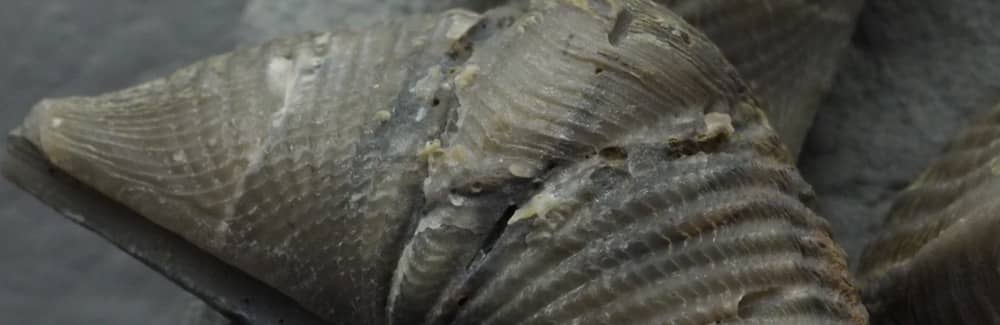
About Mucrospirifer
| Scientific Name (Genus) | Mucrospirifer |
| Meaning of Name |
Spirifer with a sharp point (sword tip)
mucro (sharp point) [Latin] - Spirifer (genus Spirifer) |
| Classification | Phylum Brachiopoda, Class Rhynchonellata, Order Spiriferida, Family Mucrospiriferidae |
| Period | Early Devonian to Late Devonian (approx. 419 to 359 million years ago / particularly thrived in the Middle Devonian) |
| Habitat | Shallow seas worldwide, including North America, Europe, Asia, and South America |
| Sub-classification / Species Name |
Mucrospirifer mucronatus (Type species) Mucrospirifer arkonensis Mucrospirifer thedfordensis Mucrospirifer prolificus Mucrospirifer latus, etc. |
| Year of Description | 1931 |
Mucrospirifer: The "Butterfly Shell" that Graced the Devonian Seas
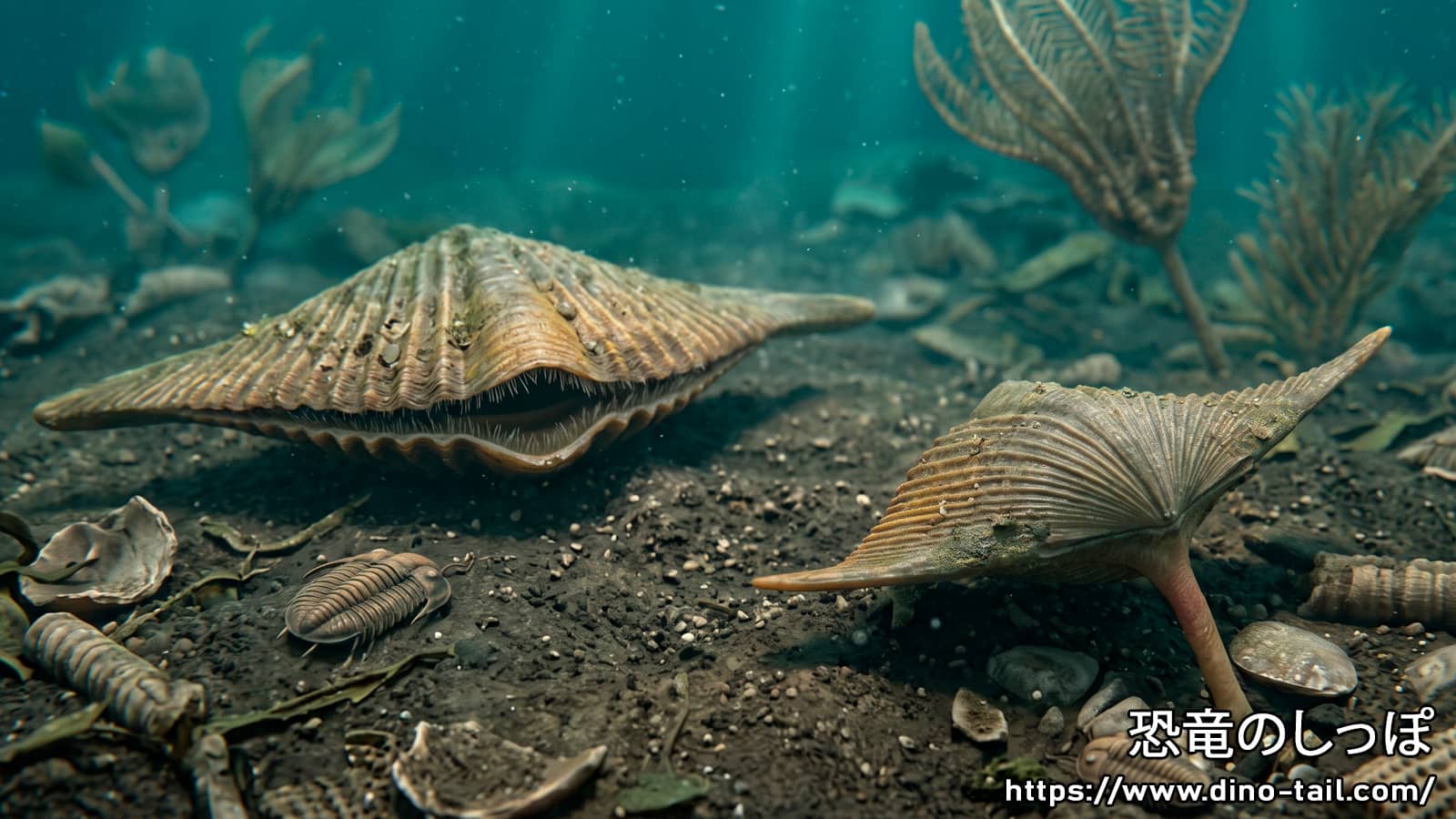
A leading recent view suggests that spiriferids "attached themselves with a pedicle during their youth (juvenile stage), but as they grew larger (adult stage), the pedicle degenerated and disappeared, allowing them to live completely free (unattached)". The individual on the right is depicted with a pedicle to represent the juvenile stage.
In the shallow seas of the Paleozoic Devonian period, a group known as the "Spiriferida" order boasted overwhelming prosperity as creatures that fed by filtering plankton and organic matter on the seabed. Among them, Mucrospirifer has a beautiful shell that extends extremely to the left and right, resembling a butterfly spreading its wings, a swallow's wings, or a kite. For this reason, it is widely and affectionately known as the "butterfly shell" among paleontological circles and fossil enthusiasts in the West.
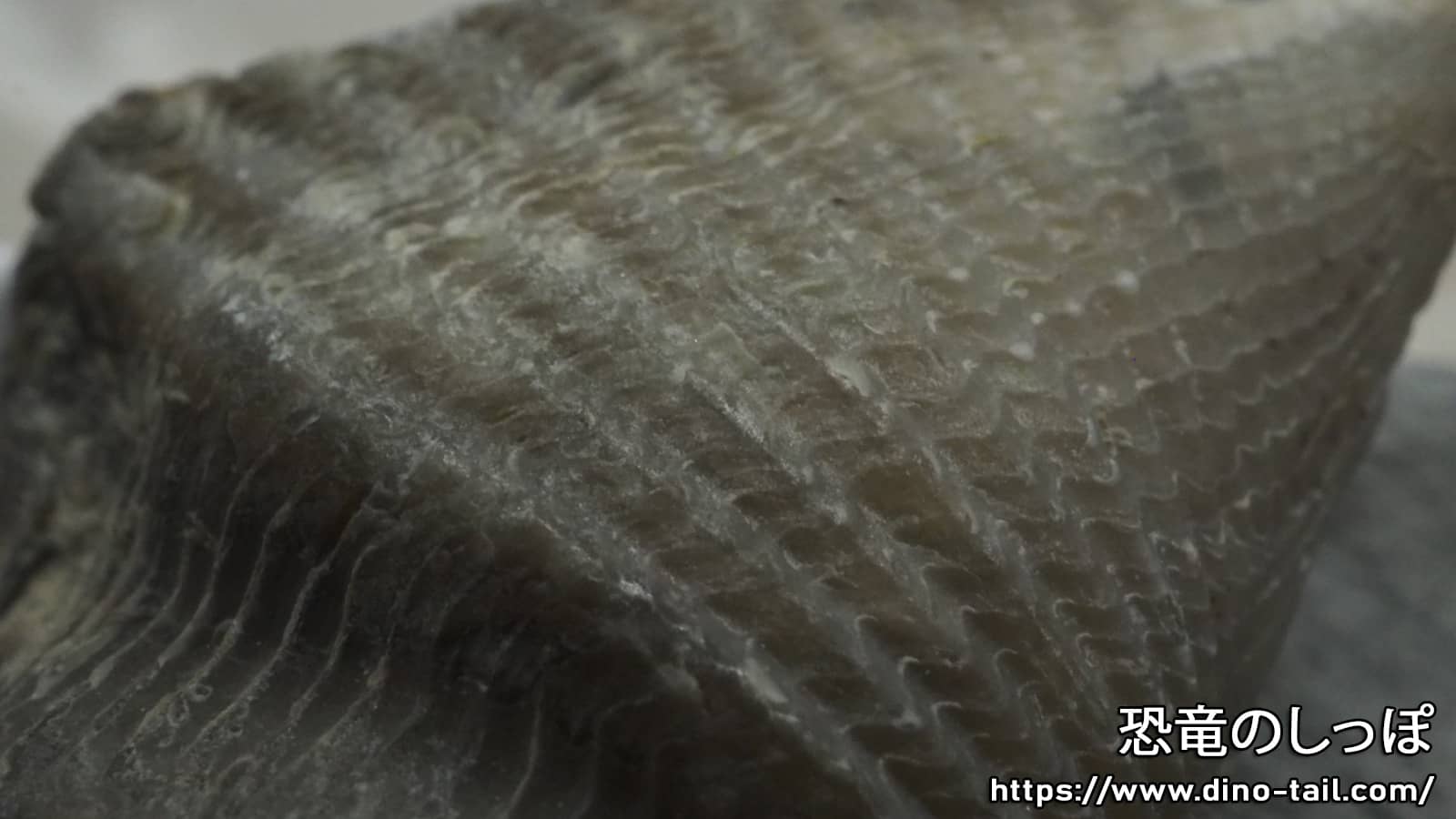
Fine radial streaks (ribs) and growth lines
My Collection
The width of the shell is usually 2 to 5 centimeters (typically about 2.5 to 4 centimeters). Its most prominent feature is the hinge line where the two shells meet, which extends long and straight, with both ends protruding sharply like thorns or sword tips. Additionally, a distinct single groove and fold run down the center of the shell, with fine radial streaks (ribs) and growth lines neatly arranged on the left and right.
At first glance, it looks exactly like "bivalves" such as clams or hard clams, but it is actually a creature from a completely different group. Mucrospirifer belongs to a phylum called "brachiopods" (Brachiopoda), which reached its golden age in the seas of the Paleozoic era.
The Difference Between Bivalves and Brachiopods, and the "Spiral Structure" Inside the Shell
While bivalves (Phylum Mollusca) like clams have shells on the "left and right sides" of their bodies, brachiopods have two differently shaped shells on the "dorsal and ventral sides (top and bottom)". Furthermore, inside the shells of Mucrospirifer and its relatives (spiriferids), there was a spring-like spiral skeletal structure (brachidium) made of calcareous material to support the "lophophore", an organ used to filter food from the water. This spiraling skeleton coiled multiple times in a conical shape toward the tips of the elongated lateral wings, occupying most of the internal space of the shell.
The "Snowshoe Strategy" to Avoid Sinking in the Muddy Sea
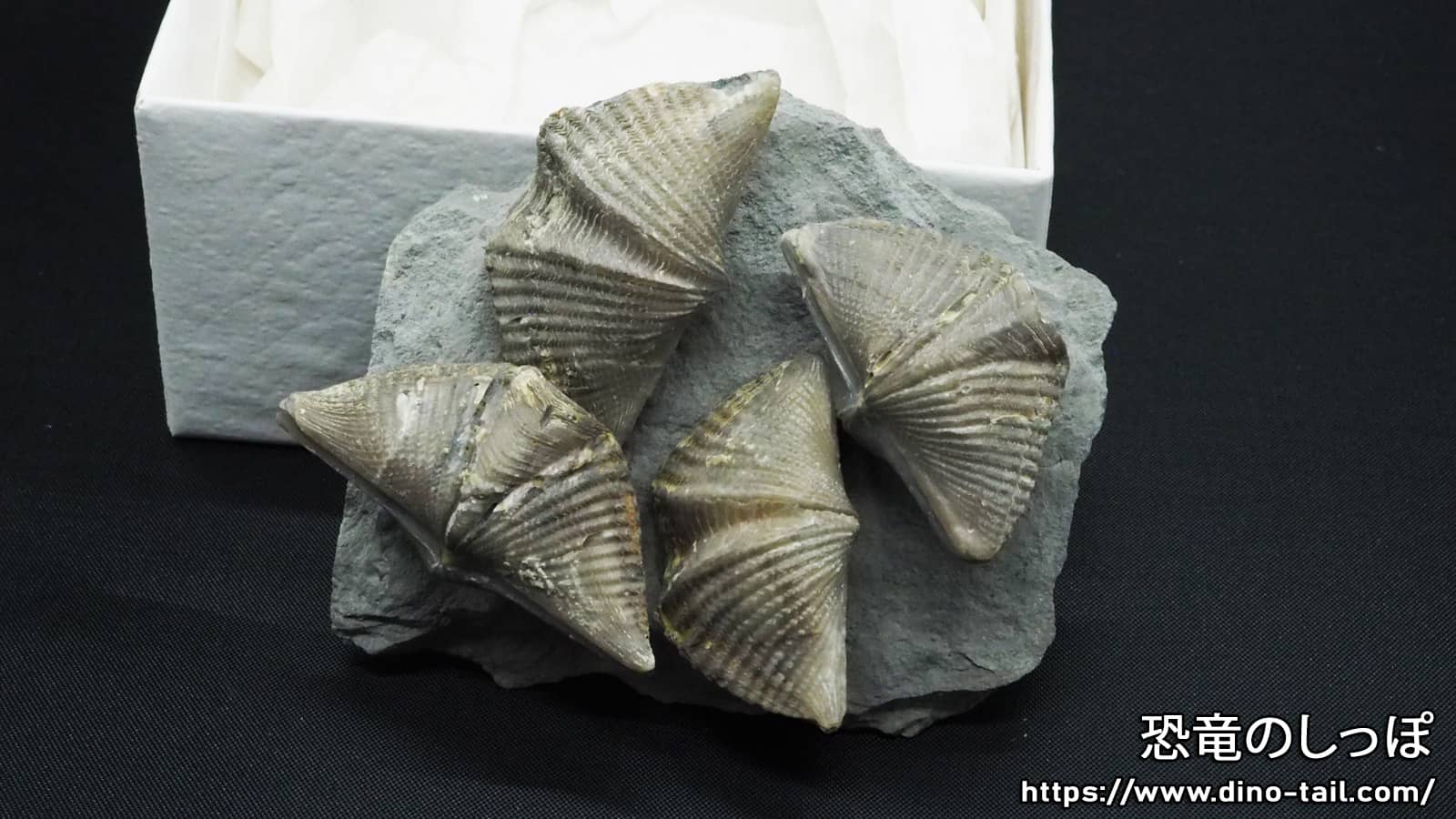
Silica Shale, Sylvania, Ohio, USA.
My Collection
Why did Mucrospirifer evolve into such a laterally extended shape? The reason lies hidden in the seabed environment where they lived.
Mucrospirifer fossils are found in abundance worldwide in shallow marine strata characterized by accumulated mud from the Middle Devonian period (approx. 393 to 382 million years ago), such as the Hamilton Group in New York and the Silica Shale in Ohio, USA. The soft, water-logged muddy seabed was a very troublesome place for shelled creatures. If left as they were, they would sink deep into the mud under the weight of their own shells, and mud would enter through the gaps when they opened their shells to breathe or eat, causing them to suffocate.
Therefore, the adaptation Mucrospirifer evolved was the "snowshoe strategy", based on the same principle as the snowshoes worn when walking on snow. By expanding the area of their shells greatly to the left and right, they increased their contact area with the mud, distributing their body weight to prevent them from sinking into it.
During their juvenile stage, they lived comfortably without being buried in the mud by anchoring themselves to dead coral or bryozoan fragments on the seabed using a stalk-like appendage called a "pedicle". Recent studies have also revealed that as they grew larger (adult stage), this pedicle degenerated and disappeared.
"Direction of Water Flow" and Automatic Filtration System Overturned by Modern Science
The question of how Mucrospirifer took seawater into its shell (inhalant current) and where it expelled the water after filtering out the food (exhalant current) has been debated among paleontologists for over half a century.
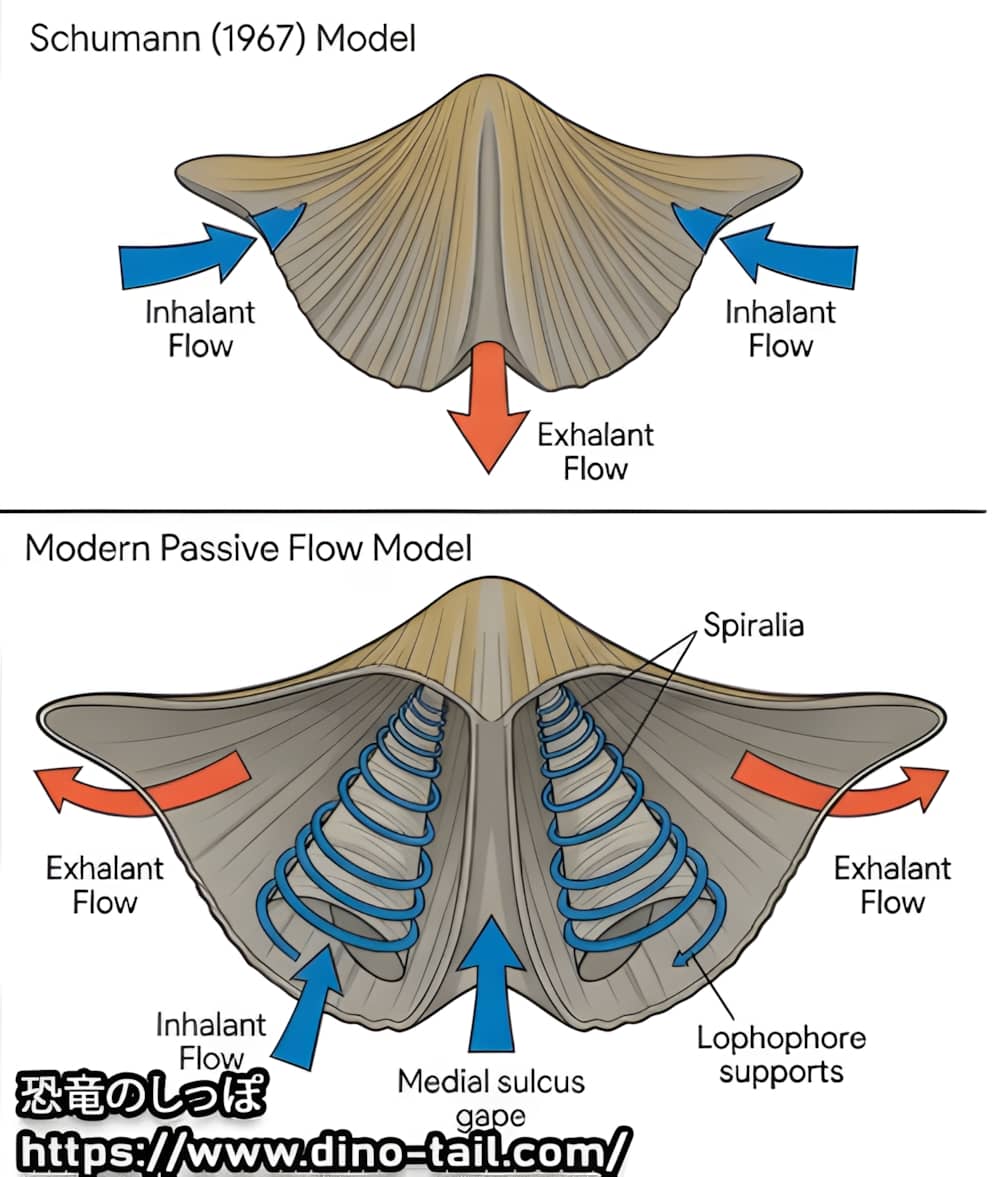
In 1967, German paleontologist Dietrich Schumann focused on the position of Cornulites, small conical tube-building symbiotic organisms that lived attached to the surface of Mucrospirifer shells. Based on their arrangement, he proposed a model in which "seawater was sucked in from the tips of both lateral wings and expelled from the central groove." This model was long treated as the established theory in paleontology.
However, entering the late 2000s, this established theory would be overturned. Following a re-examination of the water flow based on the orientation of internal brachidia by Manceñido and Gourvennec in 2008, a research group led by Yuta Shiino of Japan conducted water tank experiments using precise models and computational fluid dynamics simulations between 2009 and 2010. They unraveled the ingenious "passive filtration system" of the spiriferids.
Creating Vortices Without Using Energy! An Amazing Fluid Dynamics Mechanism
According to the latest research, the direction of the water flow was exactly the opposite of the former established theory. When the gentle ocean currents hit the shell of Mucrospirifer, a natural water pressure difference was created between the deeply recessed "central groove" and the "lateral wings". This mechanism ensured that "seawater was automatically sucked into the shell from the central groove" without the creature having to actively draw the water in. Furthermore, as the water entering from the center flowed along the inner surface of the shell, it automatically generated a "spiral vortex flow" heading toward the tips of the lateral wings. The axis of rotation of this vortex perfectly matched the orientation of the spring-like brachidia inside the shell. By appropriately regulating the momentum of the vortex, they efficiently filtered out food, and finally, "expelled the water from both ends of the laterally extended wings".
In short, the extremely long wings and deep central groove of Mucrospirifer served not only as snowshoes to prevent sinking into the mud, but also as a fluid dynamic design. This design separated the inhaled water from the exhaled water at a distance to prevent the "waste of re-inhaling already filtered water", while efficiently generating vortices inside the shell using only natural water currents.
From North America to China: A Naming Drama 90 Years in the Making
Although Mucrospirifer is famous enough to represent the Devonian strata of North America, it actually took 90 years from the time its first discovery was reported in 1841 until it was given the genus name "Mucrospirifer". Moreover, the stage where this genus name was born was not North America, but across the ocean in China (Beijing) at the time.
It all started in 1841, during a large-scale natural history and paleontological survey being conducted in New York, USA. Paleontologist Timothy Abbott Conrad, who led the survey, described these long-winged fossils found in the Devonian strata of New York as a new species of the genus Delthyris, Delthyris mucronata. The specific name "mucronata" means "having a sharp point (sword tip)" in Latin, describing the sharply pointed, thorn-like tips of both wings.
Later, in the 1860s, it was moved to the genus Spirifer by Elkanah Billings of Canada and James Hall of the United States, and was called Spirifer mucronatus for about 70 years. At the time, the genus Spirifer had become a sort of "wastebasket taxon" where any brachiopod with a similar appearance was dumped.
It was American paleontologist Amadeus William Grabau who realized that this group was a special lineage that had undergone its own unique evolution. In 1902, Grabau, along with Hervey Woodburn Shimer, examined the strata of Thedford, Ontario, Canada in detail. They discovered that needle-like elongated types (arkonensis) were found in the lower strata, while rounded, stocky types (thedfordensis) were found in the upper strata. They also found that tracing the growth lines on the shells of the stocky types revealed traces that they possessed long, thin spines when they were juveniles.
Grabau, who later moved his base of activities to Beijing, China, undertook the writing of the monumental work "Palaeontologia Sinica," which compiled Devonian brachiopods found in places like Yunnan Province in southern China. In this 545-page monograph published in 1931, while organizing the classification of spiriferids, he established the group he had once thoroughly studied in North America as an independent genus. Thus, he created the new genus Mucrospirifer, using the species described by Conrad in New York in 1841 as the standard (type species). Furthermore, the unorganized species that Grabau had left in Michigan, USA, were re-examined by Erwin Stumm of the University of Michigan in 1956, and John Tillman and others in 1964, establishing the stable classification we use today.
Millions of Years of "Coordinated Stasis" and Global Migration
Mucrospirifer also plays an important role as a model organism in modern "macroevolutionary theory". In 1995, paleontologists Carlton Brett and Gordon Baird proposed the phenomenon of "Coordinated Stasis" in Paleozoic marine ecosystems. In this phenomenon, 70-85% of species maintain a stable community with almost no morphological change over long periods of millions of years, and then collectively undergo a rapid turnover at a specific boundary.
The most representative example of this is considered to be the "Hamilton Fauna", which lasted for about 4 to 5 million years during the Middle Devonian. The flagship species symbolizing this ecosystem was the type species of Mucrospirifer (M. mucronatus). While this species maintained almost the same form and lifestyle for millions of years in the seas of New York, the center of its habitat, new species continuously emerged in small, isolated populations on the periphery of its habitat (such as Ontario and Michigan) as they adapted to environmental changes.
| Species Name (Scientific Name) | Main Discovery Sites / Strata | Shell Characteristics and Paleoecological Significance |
|---|---|---|
| Mucrospirifer mucronatus | New York (Hamilton Group), Ohio, etc., USA. | The type species serving as the standard for the genus. A representative species of the Hamilton Fauna that thrived almost unchanged for millions of years. |
| Mucrospirifer arkonensis | Ontario (Arkona Shale), Canada; Ohio, USA, etc. | An ultra-wide type where the shell's width is extremely broad compared to its length, with wing tips extending slenderly like needles. |
| Mucrospirifer thedfordensis | Ontario (Widder Formation), Canada, etc. | An evolved type that has long, thin spines when young but grows into a stocky, rounded shape with anteroposterior thickness upon maturing. |
| Mucrospirifer prolificus | Ohio and Michigan (Silica Formation), USA | A prolific species characterizing the Silica Shale formation, with many exceptionally well-preserved fossils found. |
| Mucrospirifer latus | Michigan (Traverse Group), USA | A species identified by Grabau and redescribed by Stumm in 1956. A representative species adapted to the calm waters around coral reefs. |
| Mucrospirifer consobrinus | New York (Moscow Formation), USA | An usually rare species that experienced an explosive population bloom (epibole) across different environments during a specific short period. |
In the latter half of the Middle Devonian, the stable ecosystem of North America came to an end due to global sea-level fluctuations and changes in ocean currents (such as the Taghanic Bioevent). However, the relatives of Mucrospirifer rode these oceanic shifts across the Atlantic region, expanding their distribution to seas worldwide, including Europe, Russia, China, Alaska, and even South America. Thus, the "butterfly shells" that swept across the Devonian seas brought their long history to a close due to environmental changes and the mass extinction that occurred at the end of the Devonian period (approx. 359 million years ago).