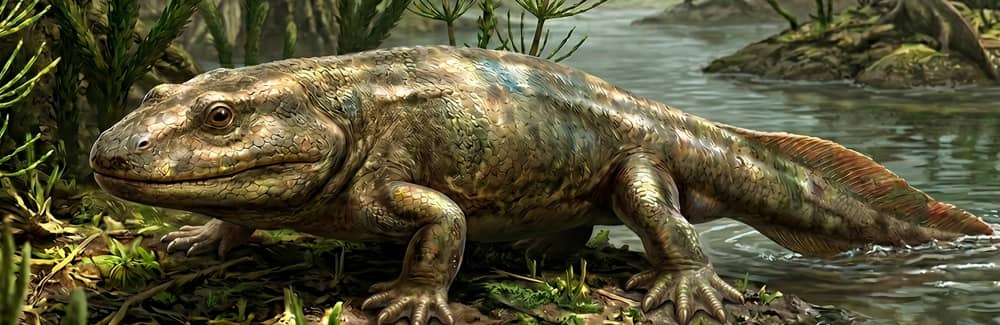
About Ichthyostega
| Scientific Name (Genus) | Ichthyostega |
| Meaning of Name |
Fish roof
ichthús(fish)[Ancient Greek] - stégē(roof)[Ancient Greek] |
| Classification | Sarcopterygii, Stegocephalia, Ichthyostegidae |
| Period | Late Devonian (approx. 370 - 362 million years ago / Famennian) |
| Habitat | Present-day East Greenland |
| Sub-classification / Species Name |
Ichthyostega stensioei Ichthyostega watsoni Ichthyostega eigili Ichthyostega kochi |
| Year of Paper Publication | 1932 |
The "Missing Link" Symbolizing the Terrestrialization of Vertebrates
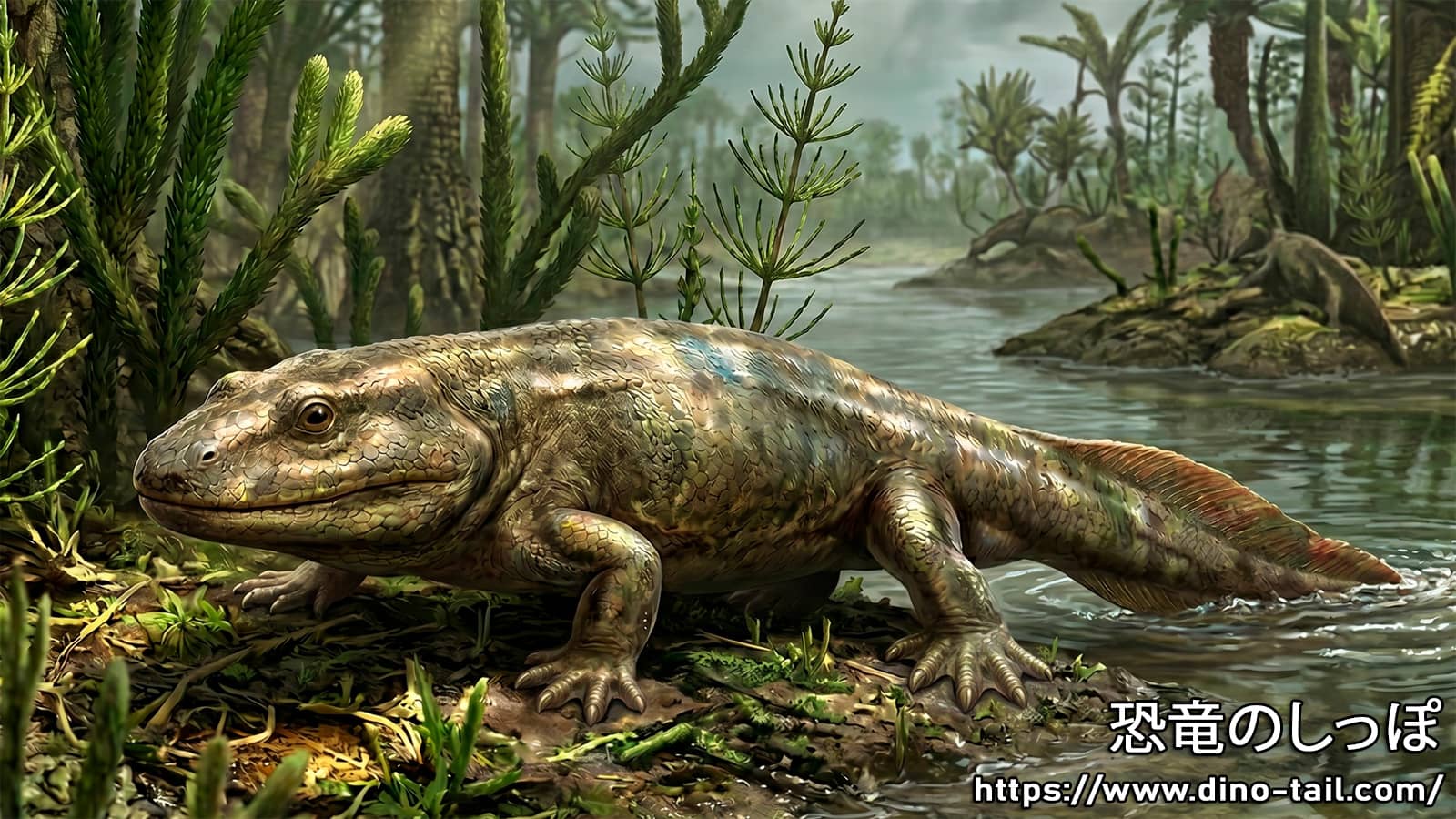
The process by which vertebrates transitioned from the hydrosphere to the terrestrial sphere is one of the most dramatic and complex evolutionary turning points in the history of life. As a creature symbolizing this transition period, Ichthyostega has long played a central role in the fields of paleontology and evolutionary biology.
Its name, derived from the Ancient Greek "ichthús" (fish) and "stégē" (roof), aptly symbolizes its evolutionarily mosaic nature: a fish-like dermal bone pattern of the skull and a robust skeleton enabling terrestrial locomotion.
Since its discovery, this genus has been treated as a textbook "missing link" connecting fish and tetrapods. However, recent studies using high-resolution CT scans and 3D biomechanical simulations have revealed that its anatomical features are far more specialized than initially expected and do not fit into a simple linear evolution model.
History of Discovery and Research
Ichthyostega was discovered by the young Swedish paleontologist Gunnar Säve-Söderbergh during the Danish East Greenland expeditions led by Lauge Koch between 1929 and 1931. He astutely recognized that these fossils were much older than any previously known Carboniferous tetrapods and retained fish-like characteristics, and described them in 1932.
Skull Anatomy and Unique Hearing
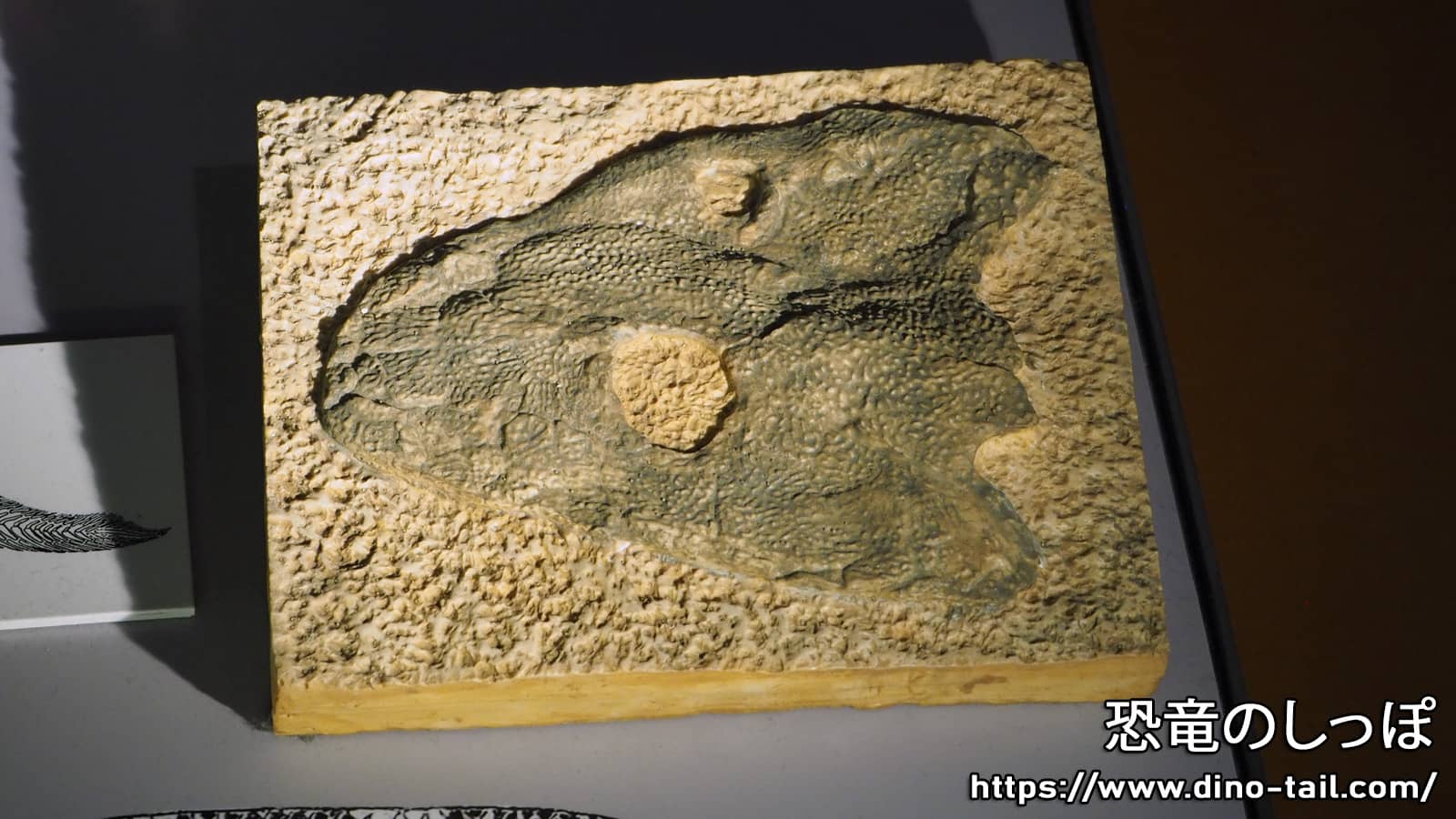
The skull of Ichthyostega exhibits a characteristic morphology seen in the transition from sarcopterygians to tetrapods. The skull is flat and low, with the orbits (eye sockets) positioned close to the top of the head, suggesting an ambush predator lifestyle like modern crocodiles or hippopotamuses, watching their surroundings with only their eyes above the water surface.
In addition, their teeth are called "labyrinthodont," featuring a structure in which the enamel is intricately folded inward. These powerful teeth were an adaptation to prevent captured prey from escaping, a characteristic inherited from early sarcopterygians.
Even more surprisingly, recent research has revealed that the ear structure of Ichthyostega was extremely unique. They had a large, bone-enclosed space (otic chamber) within the skull and likely used a distinct lamellar stapes to function as an underwater sound transducer, transmitting "underwater vibrations" rather than airborne sounds to the inner ear via the resonance of air sacs.
Overlapping Giant Ribs and Seven Digits
The spine and ribs of Ichthyostega exhibit an extremely unusual morphology among early tetrapods. There is a clear regional differentiation into cervical, thoracic, lumbar, sacral, and caudal regions, suggesting adaptation to "up-and-down (dorsoventral)" flexion like a seal, rather than fish-like "lateral undulation."
One of the most notable features is its massive ribs. The ribs from the thoracic to the lumbar region were broad and heavily overlapped with the posterior ribs. This structure played a role in protecting internal organs from gravity in a terrestrial environment where buoyancy was lost and dramatically increased the rigidity of the torso, but at the same time, it physically restricted lateral flexion.
Furthermore, a reinvestigation in the 1990s revealed that Ichthyostega had seven digits on its hind limbs. This is called polydactyly, and along with the contemporary Acanthostega (which had eight), it proves that the number of digits was not fixed at five in the early evolution of limbs, unlike modern tetrapods.
Refutation of "Walking" and the Crutching Model
It was once thought that Ichthyostega walked on land by alternately moving its four limbs like a salamander. However, this conventional wisdom was overturned by an examination of joint range of motion using a 3D skeletal model in 2012.
Their shoulders and hip joints had fatal limitations, making twisting movements of the limbs along the long axis (pronation) nearly impossible. In particular, the hind limbs were fixed at a constant angle to the ground, preventing them from placing the soles of their feet flat on the ground.
Therefore, it is speculated that Ichthyostega's mode of locomotion was not walking, but rather a "crutching" motion similar to modern mudskippers or seals. They would thrust both forelimbs forward simultaneously to push off the ground and pull their bodies up. At this time, the hind limbs did not support their weight but trailed behind, dragging on the ground as stabilizers.
Changes in Life History with Growth and Reasons for Terrestrialization
Analysis of the fossil record reveals that Ichthyostega underwent dramatic life history changes as it grew. Juveniles were fully aquatic, and their limbs functioned as rudders for swimming. However, it is thought that as they grew into adults, their humeri became more robust and they became able to lock their shoulder joints, thereby acquiring the ability to lift their heavy bodies out of the water.
Regarding why Ichthyostega acquired the ability to go on land, several hypotheses have been proposed, such as "basking" to increase metabolism using air temperatures higher than water temperatures, "avoidance" of giant aquatic predators (like the sarcopterygian Hyneria), or "breeding activities" in shallow waters.
They were not fully adapted to terrestrialization but rather creatures that underwent remarkable specialization, finding their own solutions during a harsh transitional period. Ichthyostega represents a crucial and distinct chapter in the grand narrative of tetrapod evolution.