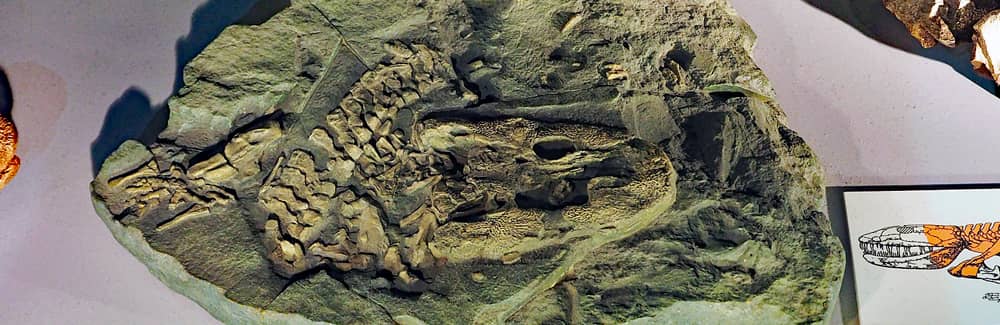
About Acanthostega
| Scientific Name (Genus) | Acanthostega |
| Classification | Early tetrapod |
| Period | Late Devonian (about 365 million years ago / Famennian stage) |
| Habitat | Present-day eastern Greenland |
| Total Length | About 60 cm (24 in) |
| Sub-classification / Species Name | Acanthostega gunnari |
Insights into the Evolutionary History of Tetrapods
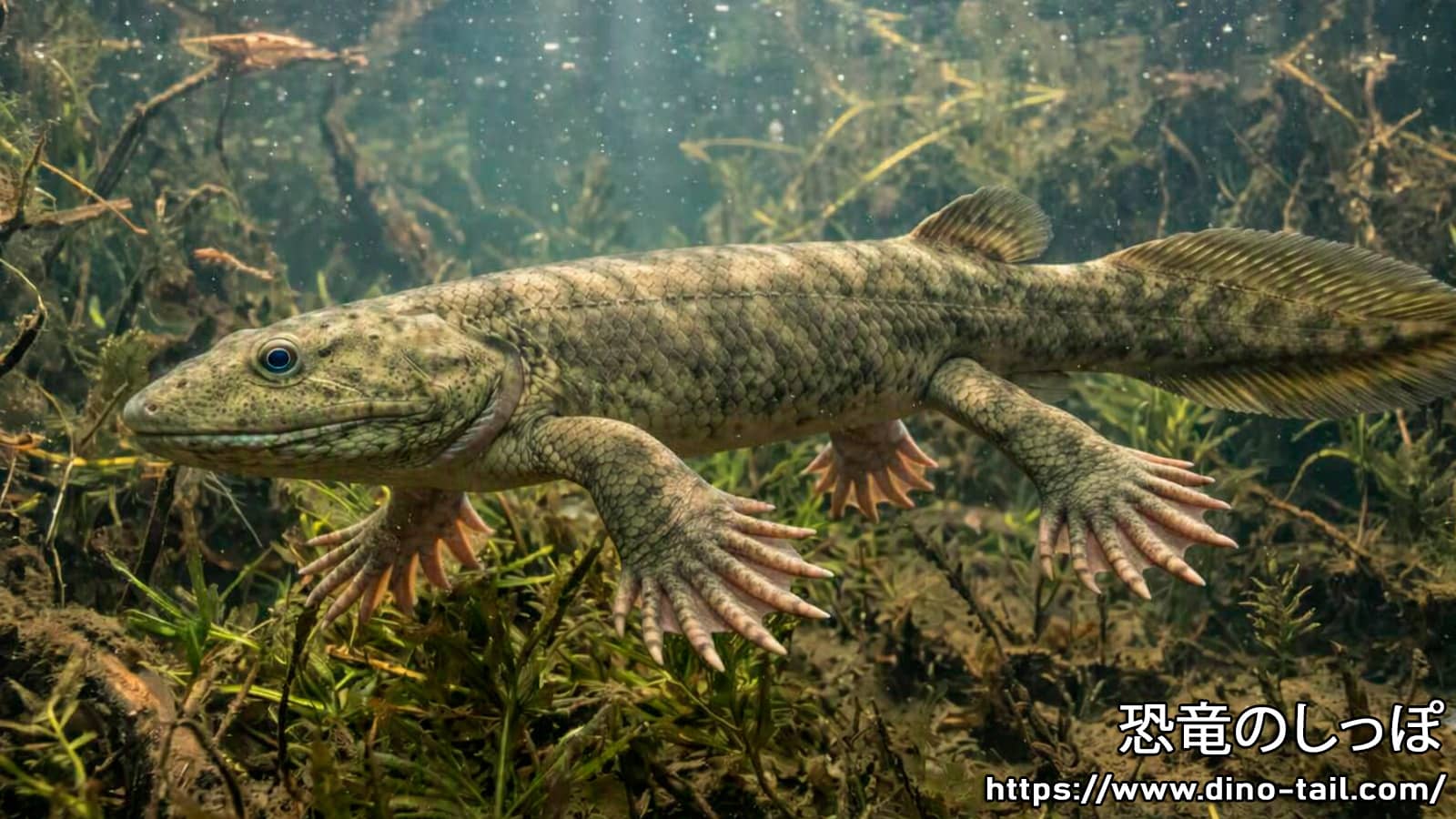
Acanthostega is an important and iconic creature in the evolutionary history of vertebrates, living in the Late Devonian period about 365 million years ago. First discovered in eastern Greenland in 1932, its full picture became clear after a 1987 expedition excavated numerous nearly complete full-body skeletons.
In the paleontological community, it has long been believed that "under the drying environment of the Devonian, fins evolved into limbs to escape drought or in search of new food on land, and they moved onto land."
However, a detailed study of the Acanthostega skeleton fundamentally overturned this scenario. Although Acanthostega had digits and limbs, their morphology was not for supporting body weight against gravity on land, but for navigating through underwater obstacles in swamps thick with aquatic plants, proving that it was a fully aquatic animal that spent almost its entire life in water.
With this discovery, the view that "limbs evolved for walking on land" was rejected, establishing the new understanding that "limbs and digits were first acquired as adaptive organs in water."
Acanthostega: A Skeleton Adapted for a Fully Aquatic Life
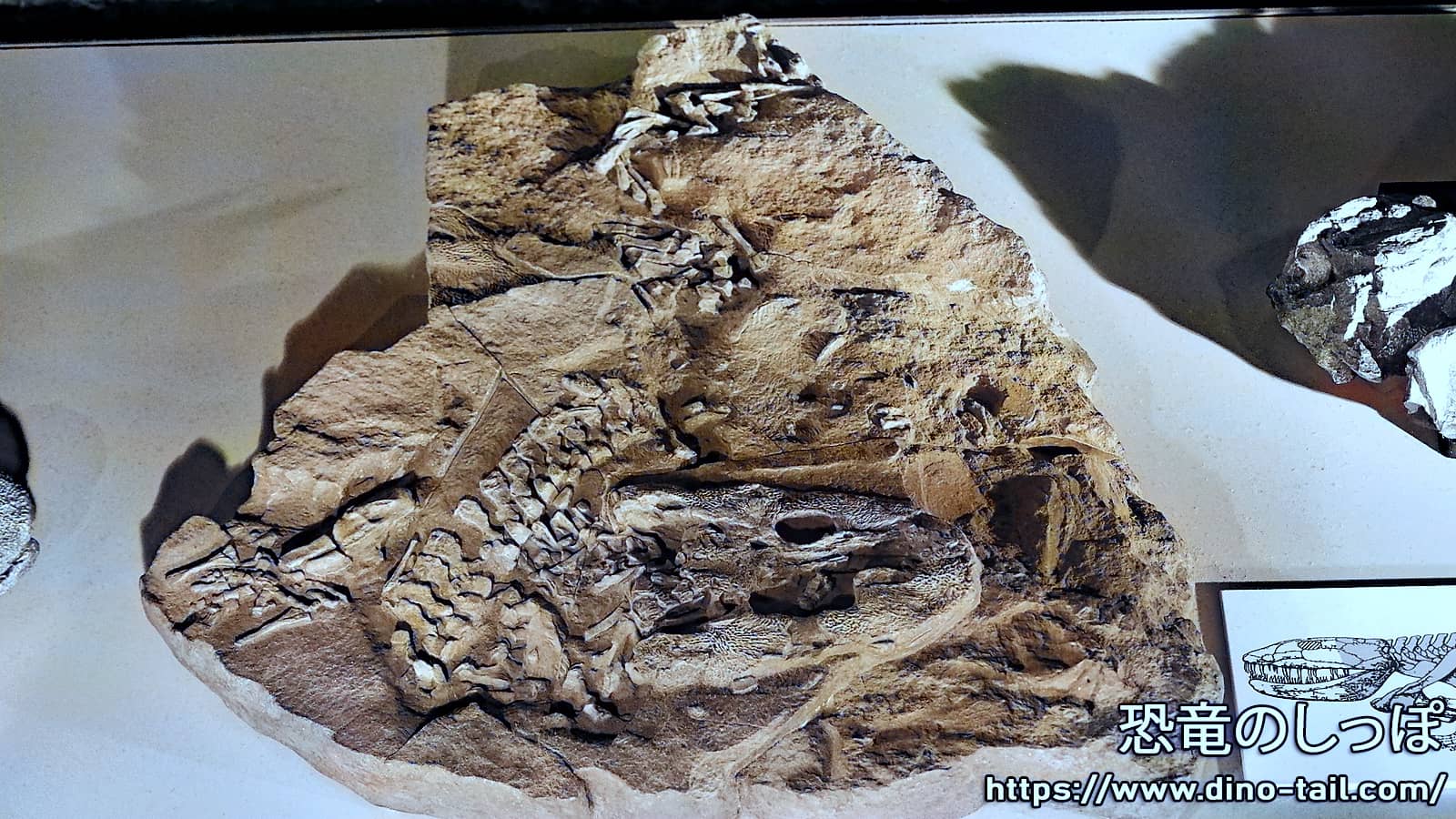
Acanthostega was about 60 centimeters long, making it relatively small among tetrapods of the same era. Its skeleton was a combination of fish-like ancestral features and new tetrapod-like features.
Its skull was very flat, and the external nostrils were located near the edge of the mouth. In addition, its lateral line organ, which senses vibrations in the water, was well-developed, indicating that it was active mainly underwater or at the water's edge and was adapted to obtaining underwater information.
Interestingly, the "stapes," a bone that evolved from what fish used to support their jaws, was shaped like a giant butterfly and was not connected to an eardrum for hearing airborne sounds like modern land animals. It is thought that the stapes at this time was used to support the tube of the spiracle, a respiratory organ, or to sense low vibrations from the ground.
Jaws that Acquired a Terrestrial "Bite"
Despite being a fully aquatic animal, Acanthostega's feeding mechanism was unique.
Hunting Methods Revealed by Skull Stress Analysis
Many aquatic vertebrates, such as fish, use "suction feeding," sucking in prey along with water. However, the latest simulations (finite element analysis) have demonstrated that the suture lines in Acanthostega's skull are structured to withstand the forces generated when "biting" prey directly. Even while in the water, they had already acquired the technique of preying by biting directly, much like terrestrial animals, at the water's edge or in shallows.
Acanthostega: Differences from the Contemporary Ichthyostega
At the same time in Greenland, another famous early tetrapod, Ichthyostega, also lived. Once often confused as a single evolutionary process, it is now clear that they had completely different ecologies.
| Comparison Item | Acanthostega | Ichthyostega |
|---|---|---|
| Skeleton Robustness | Relatively small and gracile skeleton. Cannot support gravity. | Extremely massive and muscular skeleton. Can lift the body. |
| Number of Digits | 8 on forelimbs, 8 on hindlimbs | 7 on hindlimbs (forelimbs unknown) |
| Ribs and Ribcage | Short and flat. Cannot protect internal organs under gravity. | Broad and overlapping like roof tiles, forming a strong corset. |
| Locomotion | Fully aquatic. Swims with paddle-like limbs and undulating tail. | Semi-aquatic in mud and shallows. Crutch-walking, dragging the body with forelimbs. |
| Growth and Adaptation | Retains aquatic adaptation even as it grows (paedomorphic). | Develops gravity-supporting ability on land as it grows. |
While Ichthyostega pioneered a semi-aquatic lifestyle by dragging itself across mud using its strong rib corset and forelimbs, Acanthostega remained in the aquatic environment, specializing in the niche of ambush predation at the water's edge. Early tetrapods did not follow a single straight line, but went down different paths, repeatedly trying out various evolutionary adaptations.
Eight Digits and the Evolution of "Polydactyly"
Acanthostega had eight digits on both its fore and hind limbs.
It proved that the number of digits was not fixed in early tetrapods, and that "polydactyly" was common during this experimental phase of evolution. These broad limbs with numerous digits were optimized not as legs for walking, but as powerful "paddles" for navigating through muddy and weed-choked wetlands.
It is thought that the number of digits stabilized at five for land animals, including humans today, after the Carboniferous period that followed.
The End-Devonian Mass Extinction
Immediately after the era when Acanthostega lived, the Earth suffered a massive environmental upheaval and mass extinction known as the "Hangenberg Event." This extinction event wiped out primitive, aquatic-specialized lineages like Acanthostega.
However, more derived lineages with greater terrestrial adaptability survived this extinction and went on to evolve into the masters of terrestrial ecosystems, including later reptiles and mammals. Acanthostega remains one of the most important fossils, continuing to inspire many researchers by illustrating just how complex the process of life's transition from water to land truly was.