In the history of paleontology, the question "Did Tyrannosaurus rex have feathers on its body surface?" was not just a matter of appearance, but a very important theme for unraveling the mysteries of dinosaur thermoregulation, growth, and evolution.
In the past, it was thought that all dinosaurs were covered in scales like modern reptiles. However, since the late 1990s, "feathered dinosaurs" have been discovered one after another in China, greatly changing this common sense. The theory that "perhaps Tyrannosaurus was also fluffy like a bird?" took the world by storm.
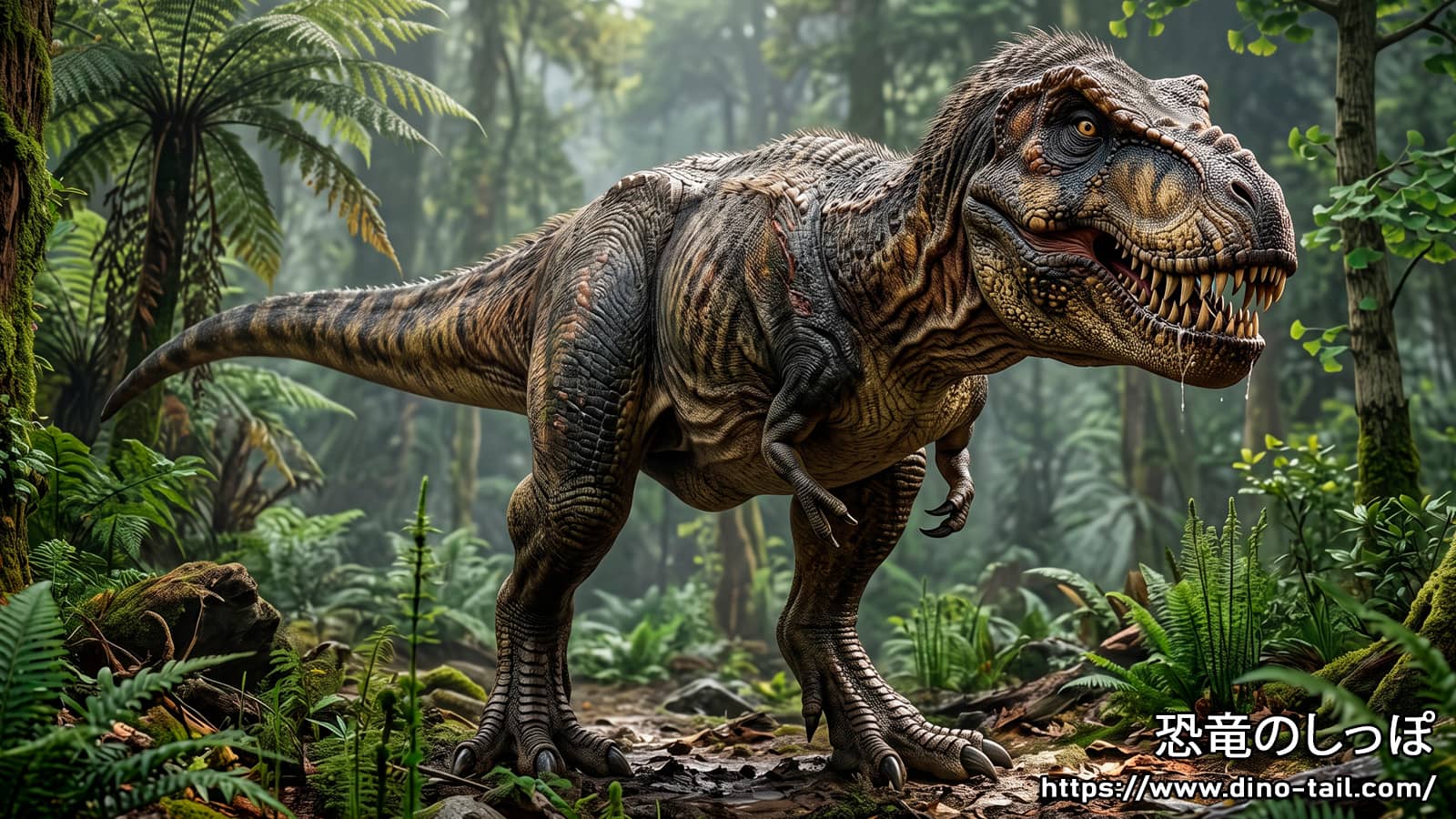
by Gemini
In this column, we will explain in an easy-to-understand manner how the "Tyrannosaurus feather debate" began and what conclusions the latest science has reached.
The Discovery of "Feathered Dinosaurs" and the Beginning of the Debate
The conclusive evidence for the idea that dinosaurs had feathers was a small theropod dinosaur called "Sinosauropteryx" discovered in Chinese strata in 1996.
Measuring about 68 cm to 1.2 m, the dinosaur Sinosauropteryx had fiber-like "proto-feathers" preserved densely along the contours of its neck, back, and tail. This showed that feathers were not just for flying birds, but were acquired by flightless dinosaurs "to keep warm" or "to appeal to mates". Since Sinosauropteryx is a distant relative of Tyrannosaurus, paleontologists began to debate around this time, "Could it be that Tyrannosaurus also had feathers?"
Feathers Found in Tyrannosaur Relatives!
After that, evidence that the direct ancestors of Tyrannosaurus also had feathers was finally found one after another. In 2004, traces of feathers were found on a small dinosaur called "Dilong".
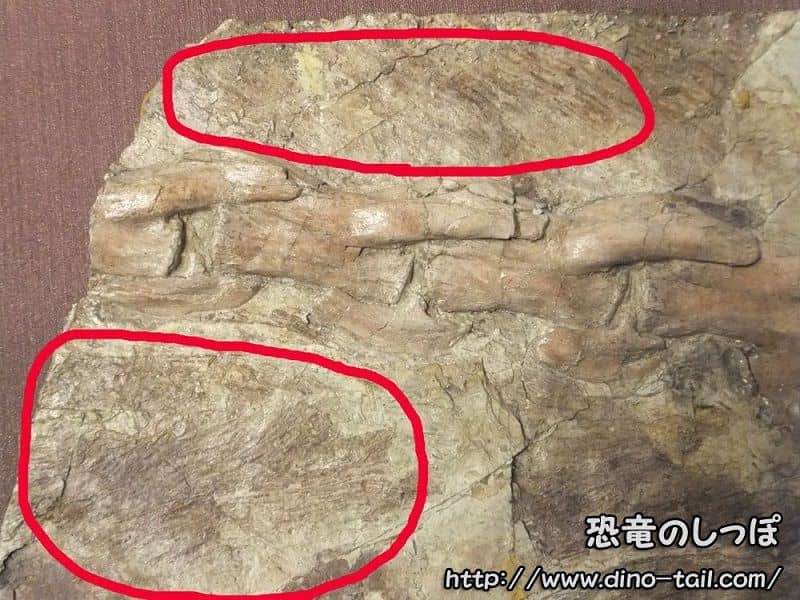
Inside the red line
What surprised the world even more was "Yutyrannus" discovered in 2012. Yutyrannus was a large carnivorous dinosaur belonging to the Tyrannosauroidea, reaching a total length of about 9 meters and a weight of 1.4 tons, but it had long feathers densely growing all over its body.
With this discovery, the theory that "perhaps the giant Tyrannosaurus rex was also a fluffy figure covered in feathers all over its body" spread rapidly. Many of you may remember that feathered Tyrannosauruses began to be depicted in many dinosaur picture books, TV programs, and toys.
2017 Discovery: Giant Tyrannosaurus Had "Scales"
As the "fully feathered Tyrannosaurus theory" was booming, a study published in 2017 (by Dr. Bell's team) brought a new ripple to this debate. The research team thoroughly examined skin fossils of Tyrannosaurus and its close relatives (such as Albertosaurus).
As a result, fine reticulated "scales" were clearly preserved over a wide area, including the neck, belly, pelvis, and tail of Tyrannosaurus, and no trace of feathers was found at all.
Main skin traces of Tyrannosauridae
| Dinosaur Name | Where skin traces were found | Scale characteristics |
|---|---|---|
| Tyrannosaurus (T. rex) |
Neck, pelvis, tail | Small scales of a few millimeters are densely packed in a mosaic pattern. No traces of feathers. |
| Gorgosaurus (G. libratus) |
Underside of the tail | Dense circular small scales about 3.6 millimeters in diameter. |
| Albertosaurus (A. sarcophagus) |
Near the belly | Slightly larger conical scales are mixed in the gaps between fine scales. |
| Tarbosaurus (T. bataar) |
Chest, legs | Small round scales are arranged like petals. |
This study revealed that while older ancestors like Yutyrannus had feathers, derived groups in the Late Cretaceous like Tyrannosaurus rex reverted back to scaly skin during the process of evolution.
Why Did Giant Tyrannosaurus Lose Its Feathers?
Why did Tyrannosaurus go out of its way to lose the feathers its ancestors had? The reason lies in two challenges: "heat" and "climate".
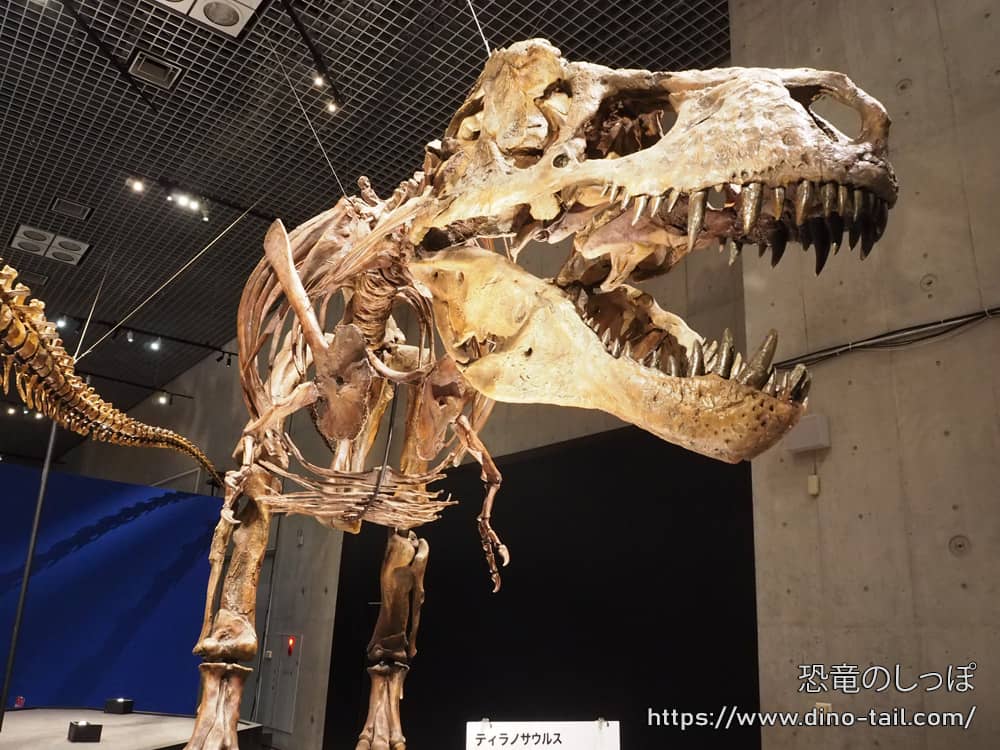
Body Gigantism and the Risk of "Heatstroke"
The larger an animal gets, the harder it becomes to release its internal heat to the outside. If a Tyrannosaurus, weighing up to 8 to 10 tons, had vigorously moved around wearing a thick coat of feathers like Yutyrannus, it would have trapped too much heat inside its body, resulting in a fatal heatstroke.
What is Gigantothermy?
The mechanism by which the body grows so large that internal heat is difficult to escape, resulting in the ability to maintain a constant high body temperature, is called "gigantothermy". According to a 2026 study that examined fossil components (isotopes), the body temperature of Tyrannosaurus was found to be about 36.3°C, maintaining a body temperature as high as humans. For a giant animal with a body temperature exceeding 35°C and a total length of over 10m, "feathers" that hindered heat dissipation were dangerous.
Differences in the "Climate" of Their Habitat
Another reason is the climate. The place where the feathered Yutyrannus lived (the Yixian Formation in China) had a cool climate with an average temperature around 10°C, and there was even a possibility of snow in winter. Therefore, the heat-retaining function of feathers was useful.
On the other hand, the place where Tyrannosaurus rex lived (the Hell Creek Formation in North America) was a warm and humid climate with an average temperature of about 17.8°C to over 20°C. For a Tyrannosaurus with a giant body in a warm place, feathers were a hindrance to living.
Since the environment in which they lived was different, the traces of feathers found in Yutyrannus did not serve as evidence for the Tyrannosaurus feather theory.
The True Identity of "Scales" Revealed from Bird's Feet
Here, a question arises. The mystery is, "After evolving complex feathers once, how did it revert back to scales like those of ancient reptiles?" This mystery was unraveled by research at the cellular level.
Evolutionary Developmental Biology (Evo-Devo)
A discipline that studies the combination of "evolution" of organisms and the mechanism of "development" from egg to adult. By investigating the functions of genes and other factors, it elucidates how the body structure has changed.
In a study published in 2018, it was found that the scales on the feet of birds such as chickens were not inherited directly from ancient reptiles, but were "things that stopped gene activity during development and collapsed flat to form a scale-like shape instead of becoming feathers". In other words, the scales on bird's feet were "modified feathers".
It is speculated that the scales of Tyrannosaurus were the same, and that they did not revert to the scales of ancient reptiles, but were highly likely "feathers that stopped growing halfway".
Did Its Appearance Change During the Growth Process?
It is highly likely that adult Tyrannosaurus did not have feathers, but current research does not believe that they were "completely featherless throughout their entire lives".
When a Tyrannosaurus was young (childhood), its body was still small, so it was highly likely covered in down feathers to prevent body heat from escaping. However, as their bodies rapidly grew from around age 14, it is thought that most of the feathers fell out and changed into scaly skin to prevent heatstroke. This is an adaptation similar to how modern baby elephants have hair and lose it when they become adults.
Also, even as adults, they might have retained sparse feathers (like elephant hair) on their heads or backs to protect their backs from direct sunlight or for display to mates.
Conclusion: The Latest Appearance of Tyrannosaurus
Years of debate, new discoveries, and cutting-edge research technologies have led to the following image of Tyrannosaurus:
"Adult Tyrannosaurus were not covered in feathers all over their bodies like birds, but were warm-blooded predators with skin like elephants or rhinos, largely covered in fine scales (modified feathers)."
The paleontological question "Did they have feathers?" is linked to various studies such as physics (heat calculations) and genetics (evolutionary developmental biology), bringing out the realistic appearance of extinct creatures. The Tyrannosaurus feather debate is an interesting subject that allows us to feel how science progresses, not just in paleontology.