About Zuul
| Scientific Name (Genus) | Zuul |
| Meaning of Name |
Named after "Zuul the Gatekeeper," a monster in the film Ghostbusters
Species name crurivastator: Destroyer of shins (Latin crus [shin] + vastator [destroyer]) |
| Classification | Ornithischia, Thyreophora, Ankylosauria (Ankylosauridae, Ankylosaurinae, Ankylosaurini) |
| Total Length | Approx. 6 m (estimates range around 6–6.5 m since the limb bones have not been found) |
| Estimated Weight | Approx. 2.5 tons (comparable to a modern white rhinoceros; estimated range approx. 1.4–4 tons) |
| Diet | Herbivorous |
| Period | Late Cretaceous, Campanian (approx. 76.2–75.2 million years ago) |
| Main Locality | Montana, USA (Judith River Formation, Coal Ridge Member) |
| Sub-classification / Species Name | Zuul crurivastator (monotypic genus) |
| Year of Paper Publication | 2017 |
| Genus Name Publication |
A new ankylosaurine dinosaur from the Judith River Formation of Montana, USA, based on an exceptional skeleton with soft tissue preservation.
Royal Society Open Science, 4(5): 161086. by Arbour, Victoria M.; Evans, David C. 2017. |
North America's Finest Preservation and a Movie-Inspired Name
Zuul (Zuul crurivastator) was a large armored dinosaur (ankylosaur) that inhabited western North America during the Late Cretaceous (approx. 76.2–75.2 million years ago). It was described as a new genus and species in 2017 by Victoria Arbour and David Evans of the Royal Ontario Museum (ROM) in Canada.
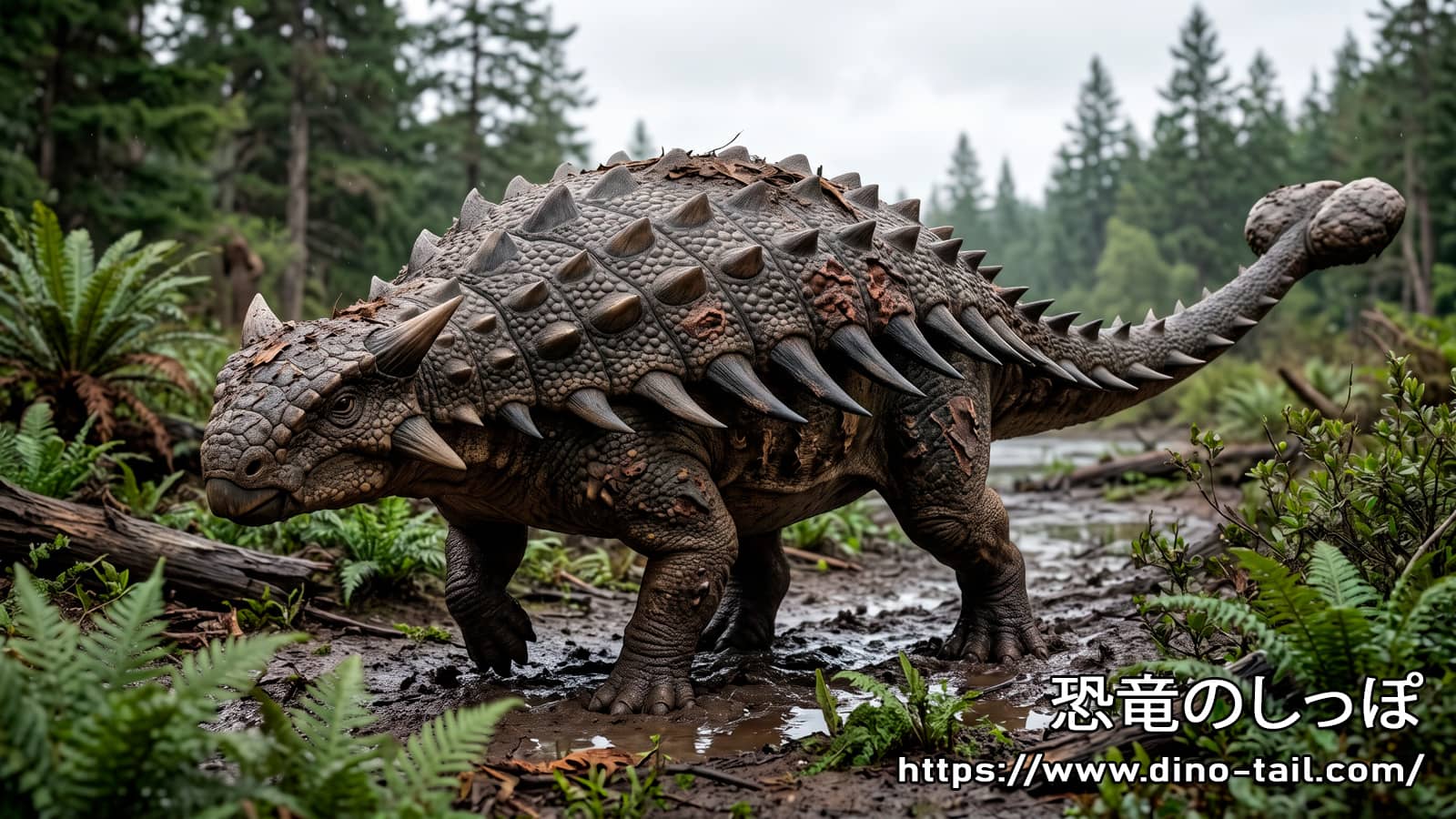
The holotype specimen of Zuul (catalog number: ROM 75860) holds an extraordinary place in modern dinosaur research. Previously known ankylosaurin fossils were mostly fragmentary—consisting of just a skull or just a tail—making Zuul the first ankylosaurin specimen ever found with both a complete skull and a complete tail club from the same individual. Beyond the bones, it preserves armor plates (osteoderms) and spikes in their original life positions, skin impressions, and even the keratin sheaths that covered the spikes, making it the most complete North American ankylosaurid fossil ever discovered.
Its discovery happened purely by chance. On May 16, 2014, a commercial fossil excavation company in northern Montana was using heavy machinery to strip away more than 12 meters of rock to uncover a tyrannosaurid skeleton (thought to be Gorgosaurus) when a skid-steer bucket struck Zuul's tail club embedded in hard sandstone. Because it lay buried so deep underground, it had completely escaped surface weathering—preserving a miraculous state of completeness that, left to natural erosion, would not have surfaced for thousands of years.
The Ghostbusters Monster and the "Destroyer of Shins"
The genus name "Zuul" comes from "Zuul, the Gatekeeper of Gozer" (commonly known as the Terror Dog), a monster featured in the 1984 hit film Ghostbusters. The dinosaur was named for its short, rounded snout and prominent horns projecting behind its eyes, which bore a striking resemblance to the movie creature. Actor and co-writer Dan Aykroyd enthusiastically approved the name and even appeared in the museum's official announcement video to celebrate the discovery.
Meanwhile, the species name "crurivastator" means "destroyer of shins" in Latin, inspired by the image of the dinosaur swinging its tail club to smash the shins of bipedal tyrannosaurs. Ironically, five years after its naming, research by the very scientists who named it revealed that the primary evolutionary driver behind the tail club was likely not defense against carnivorous dinosaurs, but fierce combat between members of the same species.
When first discovered, the commercial excavation crew nicknamed the specimen "Sherman" and promoted it as a "99% complete skeleton," though in reality the forelimb and hindlimb bones are missing. Consequently, the Royal Ontario Museum's size estimate of about 6 meters in length and 2.5 tons in weight (roughly the size of a modern white rhinoceros) is calculated from comparisons with close relatives, and some sources cite wider ranges of around 6.5 meters and 1.4–4 tons.
From Head to Tail Tip: The Anatomy of Zuul
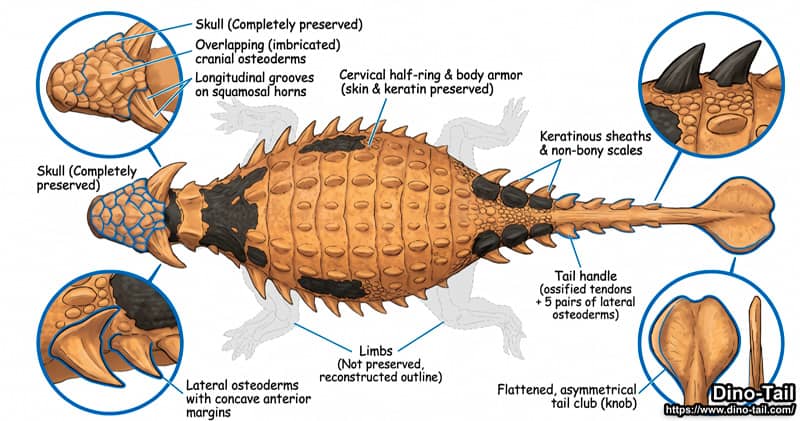
Viewed from above, Zuul's skull has a trapezoidal outline, measuring about 50 cm along its dorsal length and reaching a maximum width of about 41.5 cm across the squamosal horns. Aside from three massive specimens of Ankylosaurus itself, this is one of the largest ankylosaurine skulls ever recovered from Late Cretaceous western North America (Laramidia), indicating that Zuul was a fully grown adult.
The skull roof is densely covered in mosaic-like cranial armor plates (caputegulae), and bony "eyelids" (palpebral osteoderms) are preserved in their life positions above both eye sockets. Even along the underside of the lower jaw (the throat region), a neat row of square ossicles is framed on the inner side by delicate, petal-like arrangements of tiny bony nodules less than 6 mm in diameter.
Four Diagnostic Traits That Set Zuul Apart
The research team identified four unique diagnostic features (autapomorphies) that clearly distinguish Zuul from all other known ankylosaurids.
| Anatomical Region | Unique Feature of Zuul |
|---|---|
| Skull Roof Osteoderms | The caputegulae from the forehead to the snout overlap like roof tiles (imbricated), with raised, sharply pointed rear edges. |
| Rear Skull Horns (Squamosal Horns) | The pyramidal horns projecting from the upper back corners of the skull bear deep longitudinal grooves running from base to tip along their outer surfaces. |
| Lateral Spikes Along the Tail Handle | The osteoderms flanking the tail club's handle have strongly concave front edges that are longer than their rear edges, creating distinctive blade-like tips swept sharply backward. |
| Extremely Flat Tail Club Knob | The tail club knob is remarkably flattened vertically, with a height-to-length ratio of just 0.15 (under 0.20), compared with 0.30–0.50 in most other ankylosaurids. |
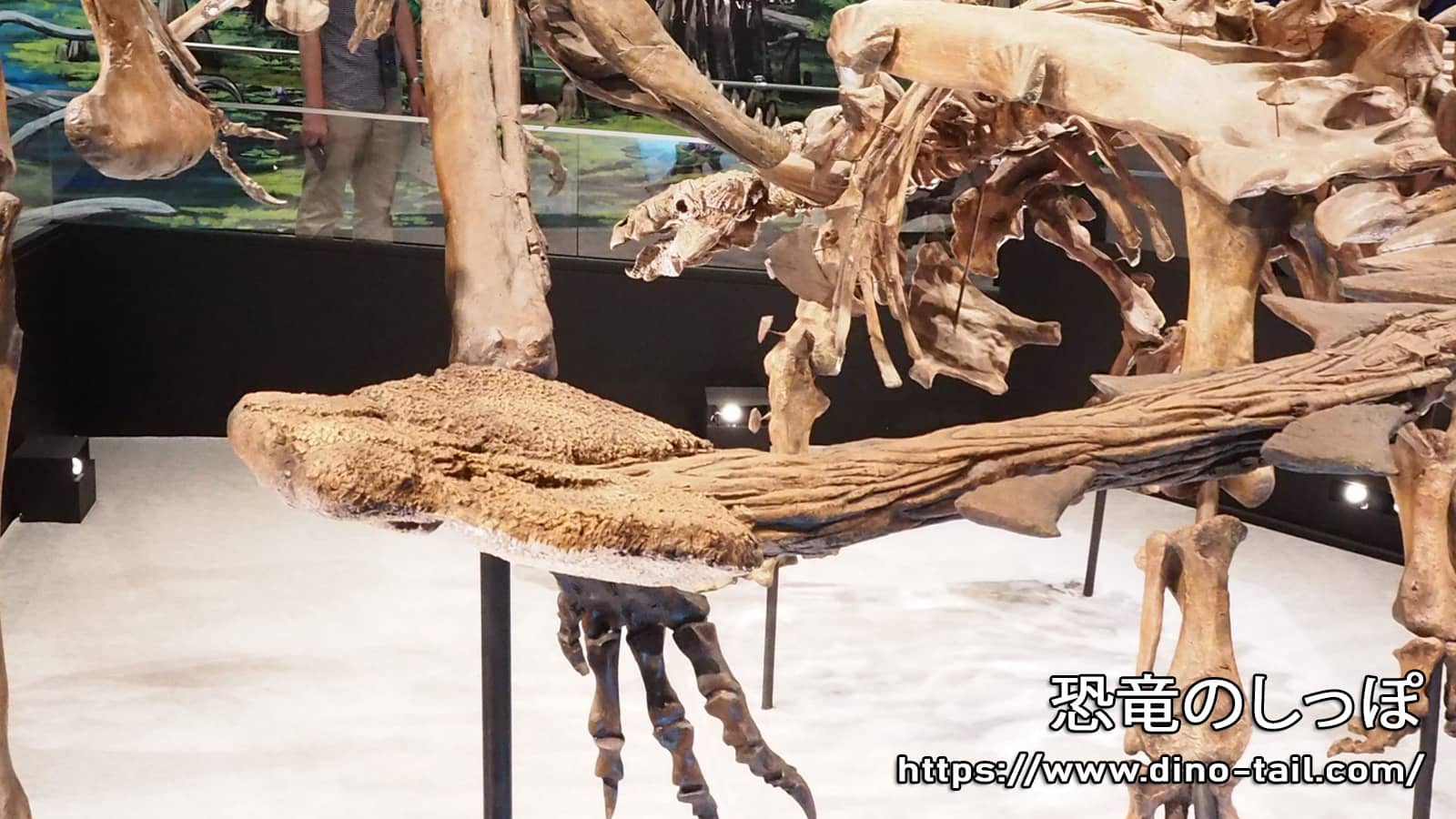
The preservation of the tail is equally breathtaking. The fossilized tail alone measures 287 cm (with an estimated total life length of about 3 meters), and the stiffened "handle" plus terminal "knob" together span over 210 cm—the longest tail club ever recorded for a North American ankylosaurid. Inside the handle, at least 13 caudal vertebrae interlock tightly in a V-shaped pattern, reinforced by bundles of ossified tendons to form a rigid rod capable of withstanding the tremendous forces of swinging a heavy bone hammer.
In addition, eight pairs of lateral osteoderms remain preserved in situ along the base and handle of the tail—including five pairs directly along the handle, a first for any North American ankylosaurine. The terminal knob measures 52.5 cm long, 36.8 cm wide, and 8 cm high, and shows pronounced asymmetry: the left major osteoderm (40.2 cm) is 5 cm longer than the right (35.2 cm). A similar asymmetry is seen in the Mongolian relative Tarchia, sparking debate over whether repeated impact forces influenced bone growth.
"Dinosaur Mummy"-Level Soft Tissue and the Mystery of the Keratin Sheaths
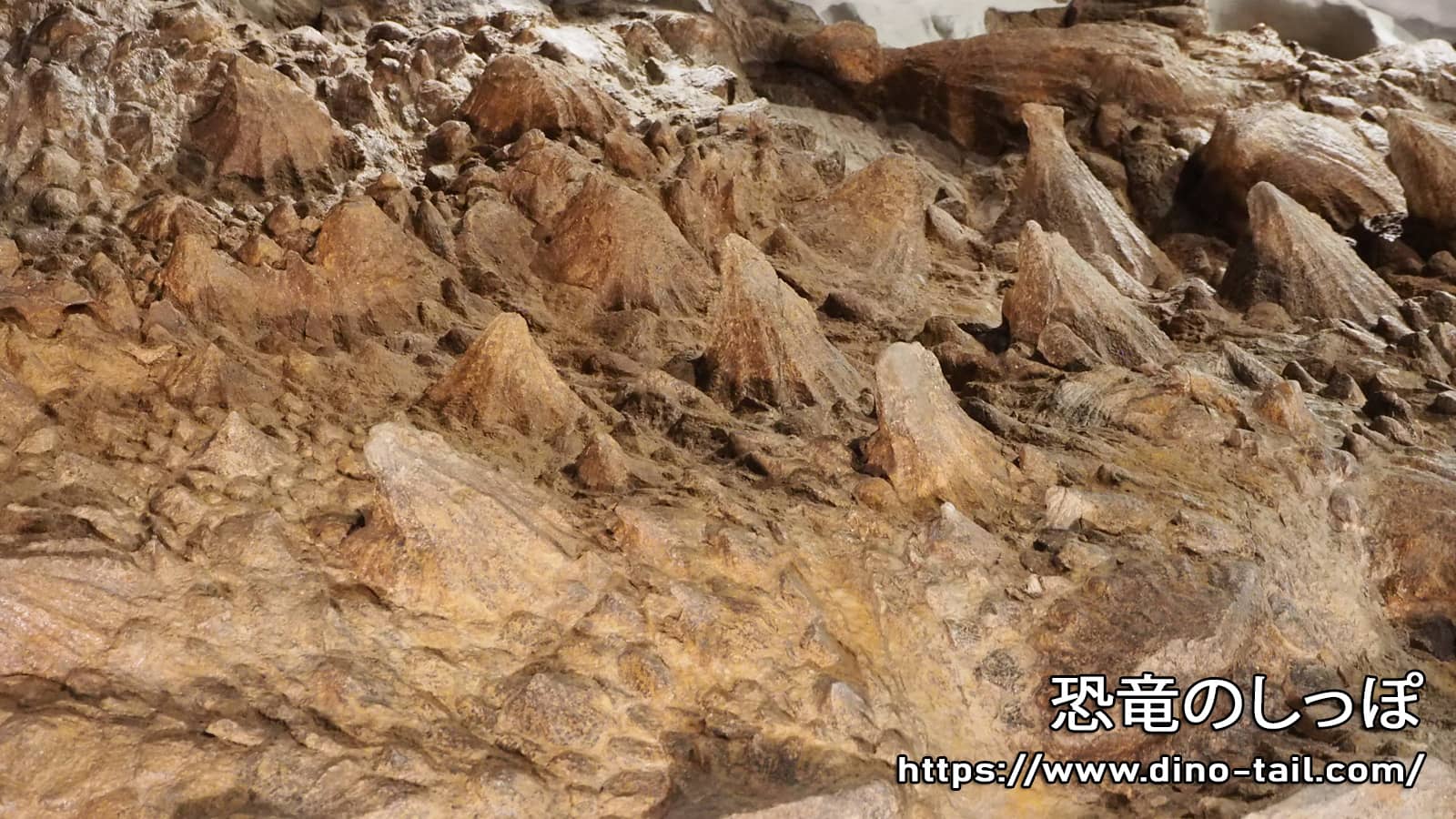
Coating the spikes of Zuul's tail and torso is a thin dark-gray to black film clearly distinct from the reddish-brown bone beneath. Scientists interpret this layer as the remains of the keratin sheaths that covered the bony cores in life. On the spikes near the base of the tail, these keratin sheaths extend 1–2 cm beyond the bone tips, making the spikes sharper and more dramatic, and even preserve deep vertical grooves and layered textures resembling the base of modern cattle horns.
Even more astonishingly, between the tail spikes lie three-dimensionally preserved epidermal scales (including large scales 5–6.5 cm in diameter) that lack any bony core. Preliminary ultraviolet fluorescence imaging and biochemical analyses have been conducted to determine whether this dark film still contains original organic molecules such as proteins, or whether microbial activity during burial replaced them with clay minerals. As of 2026, a final chemical verdict has yet to be reached, making Zuul a major focus of future molecular paleontology.
Flank Injuries That Overturned Conventional Wisdom: Was the Tail Club Built for Duels?
When the initial paper on Zuul's skull and tail was published in 2017, the massive rock block encasing the torso and pelvis remained unprepared. Weighing roughly 16.8 tons (37,000 pounds)—far exceeding the load limit of the museum's floor—the block underwent major preparation starting in 2018 at Research Casting International (RCI), a specialized facility in Canada.
Because Zuul had been buried upside down (belly up), technicians first exposed the ventral (rib) side, made a precision silicone mold, and trimmed away excess rock using a custom steel frame and wire saw to reduce the weight to about 6.8 tons before carefully flipping the block with a heavy crane. Skilled preparators then used needle-like tools to remove rock millimeter by millimeter, revealing the back and flank armor, spikes, and skin impressions almost completely intact in their natural arrangement.
Healed Broken Spikes Concentrated on Both Flanks
After studying the newly prepared torso block, Arbour, Lindsay Zanno, and Evans published a landmark paper in the Royal Society journal Biology Letters in December 2022 that reshaped our understanding of armored dinosaurs.
Along both flanks of Zuul's rear torso and hips, the team discovered multiple sharp spike-like osteoderms that had been broken during life and subsequently healed. Moreover, while the broken bone tips on the right flank had smoothed over but were not yet fully re-covered by keratin sheaths, the fractured and gouged bone on the left flank had been completely enclosed by regrown keratin. These differing stages of healing prove that Zuul survived multiple violent blows over the course of its lifetime.
Statistical analyses confirmed that these injuries were not randomly scattered across the body, but were tightly clustered on the left and right flanks (chi-square test p = 0.0039; runs test p = 0.0016).
Why did the researchers conclude these wounds came from rival Zuul individuals swinging their tail clubs rather than from tyrannosaur attacks? Three main lines of evidence support this conclusion:
- Exact Match With Tail-Swing Mechanics: Ankylosaurid tails had very limited vertical movement and instead swept horizontally through an arc of about 100 degrees. At that height and trajectory, blows land squarely on the flanks and hips of an opponent of the same size. A large tail club could deliver over 14,000 newtons of impact force—easily enough to fracture bone.
- Contrast With Predator Attack Patterns: Bites from tall tyrannosaurs would be expected to occur randomly across the upper back, neck, and body. Repeatedly targeting only the heavily armored flanks of an adult matches not predation, but ritualized intraspecific combat—like the flank-striking duels of modern bison and giraffes, which test strength while minimizing fatal injury.
- Evolutionary History and Close Relatives: Nodosaurids coexisted with the very same large predators yet never evolved tail clubs. Furthermore, across ankylosaurs as a whole, tail club size shows no clear correlation with the body mass of contemporary large theropods.
Adding to this new picture, in April 2025 researchers reported the world's first ankylosaurid footprints (Ruopodosaurus clava) from 100–94-million-year-old strata in British Columbia, Canada, showing multiple individuals walking side by side in the same direction. Once stereotyped as solitary, sluggish "walking tanks," armored dinosaurs are now emerging as socially complex animals that competed fiercely for territory and mates.
Scientific Note: Was Defense Against Predators Ruled Out?
As the researchers themselves emphasize, this hypothesis does not mean tail clubs were never used for defense against carnivorous dinosaurs. When attacked, a powerful tail club was undoubtedly an effective weapon for fending off predators. The key point is that sexual selection (competition among members of the same species) was likely the primary evolutionary force driving the club's origin and enlargement.
Although it is tempting to imagine breeding-season males dueling like modern deer or cattle, there is currently no direct skeletal evidence to determine whether the holotype specimen (ROM 75860) was male or female.
Diet and Paleoenvironment
Zuul's teeth are small and leaf-shaped, bearing 12–14 serrations (denticles) along their margins. In the left lower jaw, researchers even found teeth worn down so heavily that every denticle had been completely ground away.
Ankylosaurs were once thought to be capable only of simple up-and-down chewing, but 2023 biomechanical modeling (finite element analysis) revealed that derived ankylosaurids like Zuul used a complex two-phase chewing motion, closing their jaws and then drawing them backward to grind plant matter. Even so, their bite force was relatively modest; they are thought to have used their wide, toothless beaks to bulk-crop ferns, soft herbs, and low shrubs within 1 meter of the ground, relying on microbial fermentation in their massive guts for digestion.
The Montana Wetlands of 76 Million Years Ago and Their Inhabitants
The Judith River Formation (Coal Ridge Member) where Zuul lived was a lush landscape of rivers, wetlands, and estuaries formed along the shifting shoreline of the Western Interior Seaway, which bisected North America at the time. Fossils of tyrannosaurids, hadrosaurids, ceratopsians, turtles, crocodilians, and plant leaves have all been recovered from the very same quarry as Zuul.
| Group | Major Coexisting Species (Judith River Formation) | Relationship & Niche Partitioning With Zuul |
|---|---|---|
| Large Carnivorous Dinosaurs | Gorgosaurus, Daspletosaurus | Primary potential predators, though attacking a fully armored adult Zuul would have carried high risk. |
| Nodosaurid Ankylosaurs | Edmontonia | Also armored dinosaurs, but avoided competition through niche partitioning: Edmontonia used stronger bites on tougher plants, while Zuul ate softer low-lying vegetation. |
| Ceratopsians | Spiclypeus, Mercuriceratops, Furcatoceratops | Fed at similar low heights, but used powerful shearing dental batteries to slice tough fibrous vegetation. |
| Hadrosaurids | Corythosaurus and others | Avoided direct competition by reaching higher foliage—even rearing onto their hind legs—and grinding food with complex dental batteries. |
| Aquatic & Semi-Aquatic Reptiles | Giant crocodilian Deinosuchus, Champsosaurus, various turtles | Shared the estuarine and wetland waterways; the 10-meter-class Deinosuchus may have posed a threat when Zuul drank or crossed rivers. |
Why Was It Found Upside Down? The "Bloat-and-Float" Scenario
More than 70% of North American ankylosaur fossils are discovered lying upside down (belly up), a puzzle that had intrigued paleontologists since the 1930s. A 2018 hydrodynamic simulation study (Mallon et al.) provided strong support for the "bloat-and-float" model.
When a Zuul died near a river or estuary, decomposition gases inflated its carcass and buoyed it to the surface. Because the heavy bony armor was concentrated on its back, gravity pulled the dorsal side downward, flipping the floating body upside down in the water. As the carcass drifted downstream, the exposed limbs were lost to decay and scavengers; eventually, the body snagged in a river logjam and was rapidly buried in iron-rich sand, preserving the skin and keratin sheaths of its back and tail in extraordinary detail.
Close Relatives and Exhibition History: From World Premiere in Japan to Permanent Display
Phylogenetic analyses place Zuul within the tribe Ankylosaurini of the family Ankylosauridae, showing particularly close affinities to Dyoplosaurus and Scolosaurus from Alberta's Dinosaur Park Formation in Canada. Together, they document a dynamic evolutionary history in which multiple armored dinosaur species rapidly diversified and succeeded one another across northern Laramidia between roughly 77 and 75.2 million years ago.
| Compared Taxon | Region & Time Period | Key Differences & Similarities With Zuul |
|---|---|---|
| Dyoplosaurus | Alberta, Canada (approx. 77 million years ago) |
Candidate closest sister taxon in phylogenetic analyses. Shares bony eyelids, but Zuul has a ~10% larger skull and a flatter tail club knob. |
| Euoplocephalus | Alberta, Canada (Campanian) |
Initially misidentified as a new species of this genus upon discovery. However, Zuul has more posteriorly projecting squamosal horns and sparser postorbital osteoderms, placing it in a distinct lineage. |
| Ankylosaurus | Western North America (End-Cretaceous) |
Much larger overall, with nostrils shifted strongly backward and downward (whereas Zuul's face forward and anterolaterally), and lacking longitudinal grooves on its squamosal horns. |
World-First Integrated Display at "Dinosaur Expo 2023" and Permanent Gallery
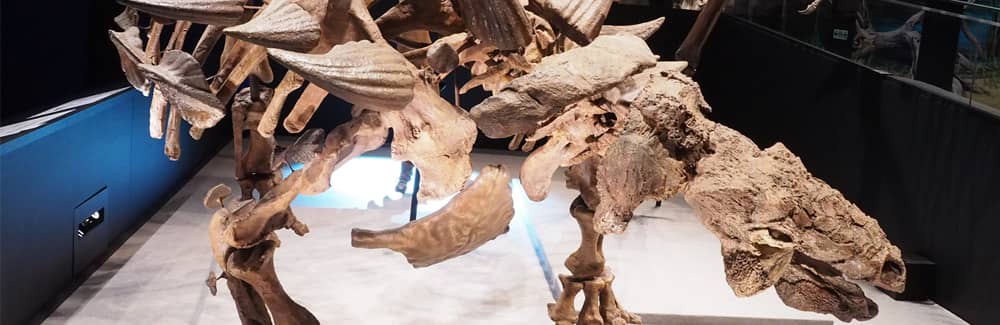
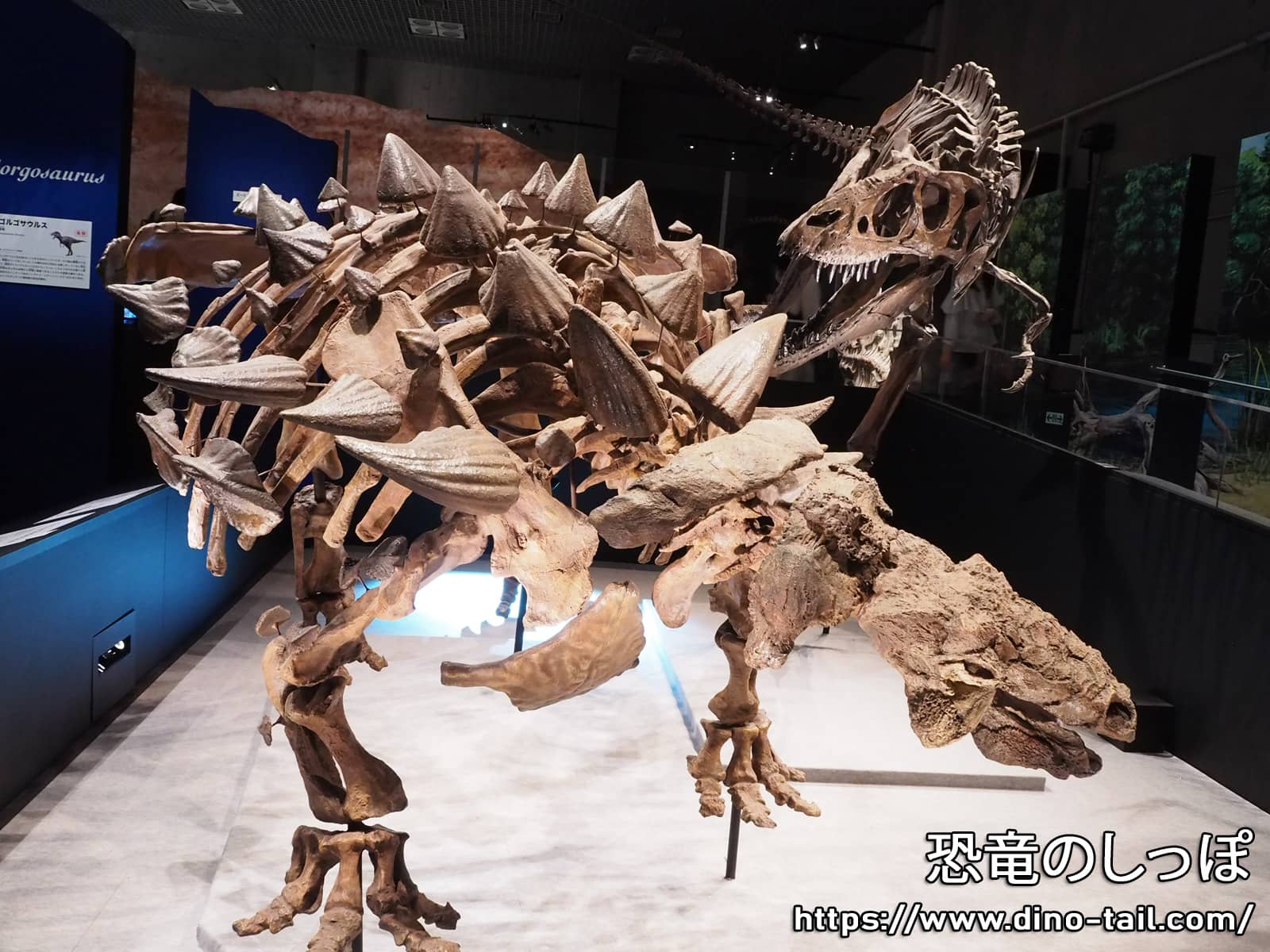
Zuul's real fossil is also beloved by dinosaur fans in Japan. At the special exhibition "Dinosaur Expo 2023," held in Tokyo and Osaka in 2023, the original fossil was exhibited outside its home at Canada's Royal Ontario Museum for the very first time. Even more remarkably, the Japanese exhibition was the first in the world to display the real skull, torso, and tail fossils aligned in a single line in their natural anatomical order. Following its triumphant return to Canada, Zuul became the centerpiece of the Royal Ontario Museum's newly expanded permanent dinosaur gallery in December 2025.
| Period | Venue / Exhibition | Highlights & Significance |
|---|---|---|
| Dec 2018 – May 2019 | Royal Ontario Museum (Toronto, Canada) Special Exhibition | World debut of the real skull and tail club alongside co-occurring turtle, crocodilian, and plant fossils and a life-sized model. |
| Mar – Sep 2023 | Special Exhibition "Dinosaur Expo 2023" (National Museum of Nature and Science / Osaka Museum of Natural History) | First exhibition of the real fossil outside Canada, featuring the world's first integrated inline display of the real skull, torso, and tail plus a mounted skeletal face-off with Gorgosaurus. |
| Feb – Mar 2024 | Royal Ontario Museum Homecoming Exhibition | Special return exhibition celebrating the success of the Japanese tour. |
| Dec 2025 – Present | Royal Ontario Museum Dinosaur Gallery (Permanent) | Permanent installation in the expanded gallery, showcasing a life-sized Zuul vs. Gorgosaurus diorama alongside the real skulls of both species. |
Many exciting research avenues remain open, including a full osteological description of the internal torso skeleton, high-resolution CT imaging of the skull interior (brain endocast and complex nasal passages), and definitive chemical identification of the dark soft-tissue film. Truly a time capsule from the Cretaceous, Zuul will continue to be one of the most important specimens for unlocking the evolution and biology of armored dinosaurs.