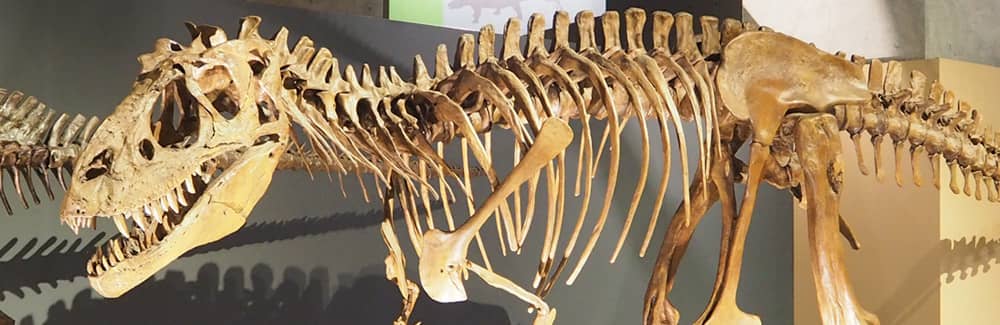
About Gorgosaurus
| Scientific Name (Genus) | Gorgosaurus |
| Meaning of Name |
Dreadful lizard
gorgos (dreadful) [Greek] - saurus (lizard) [Greek] |
| Classification | Saurischia, Theropoda (Tyrannosauridae, Albertosaurinae) |
| Total Length | Approx. 8 - 9.3m |
| Diet | Carnivorous |
| Period | Late Cretaceous (Campanian: approx. 76.5 - 75 million years ago) |
| Sub-classification / Species Name | Gorgosaurus libratus (Type species) |
| Year of Paper Publication | 1914 |
| Genus Name Publication |
On a new genus and species of carnivorous dinosaur from the Belly River Formation of Alberta, with a description of the skull of Stephanosaurus marginatus from the same horizon.
The Ottawa Naturalist. 28: 13-21. Lambe, Lawrence M. 1914. |
Gorgosaurus, Ruler of Cretaceous North America
Gorgosaurus was a large carnivorous dinosaur that lived in western North America (then the continent of Laramidia) during the Late Cretaceous period. Classified as a member of the tyrannosaur family, it reigned at the top of the ecosystem at the time.
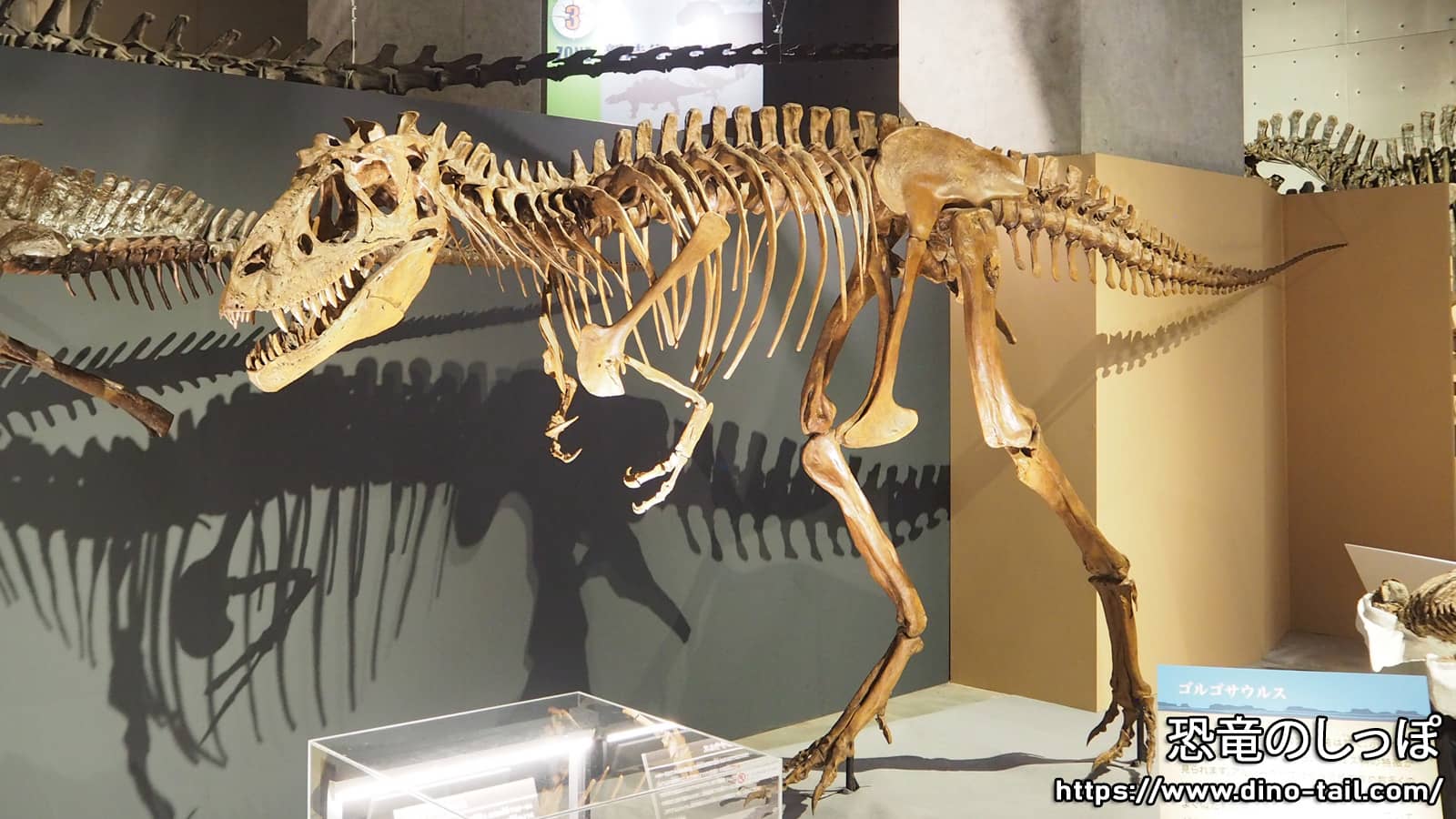
Its name means "dreadful lizard" in Greek. It is estimated to have reached a length of about 8 to 9.3 meters and a weight of about 2.5 to 3.5 tons. It had the characteristic body structure of the Tyrannosauridae family: a massive head, powerful jaws and sharp teeth, and extremely short two-fingered forelimbs.
Many giant herbivorous dinosaurs, such as hadrosaurs and ceratopsians, lived in the same area during the same period, and it is thought that Gorgosaurus preyed on them. Many well-preserved fossils, including complete skeletons and skulls, have been found in Canada, providing important clues for studying dinosaur growth, diseases, and brain structure.
Differences from Its Close Relative, Albertosaurus
For many years, there has been debate over whether Gorgosaurus is the same species (synonym) as its close relative, Albertosaurus. Both have relatively slender builds, long legs, and are adapted for moving quickly.
In biological classification, if a different name has been given but it turns out to be the same species, the later name is called a "synonym."
However, recent detailed studies of their skulls have revealed clear differences. The most obvious difference is the shape of the eye socket (orbit). While Albertosaurus has a keyhole-shaped eye socket, Gorgosaurus has a perfectly circular one. Also, Albertosaurus lived slightly later in time. Today, they are treated as separate genera of dinosaurs.
| Features | Gorgosaurus | Albertosaurus |
|---|---|---|
| Shape of the eye socket (orbit) | Perfectly circular | Keyhole-shaped (elongated downwards) |
| Period | Campanian (approx. 76 million years ago) | Maastrichtian (approx. 70 million years ago) |
Covered in Scales Instead of Feathers?
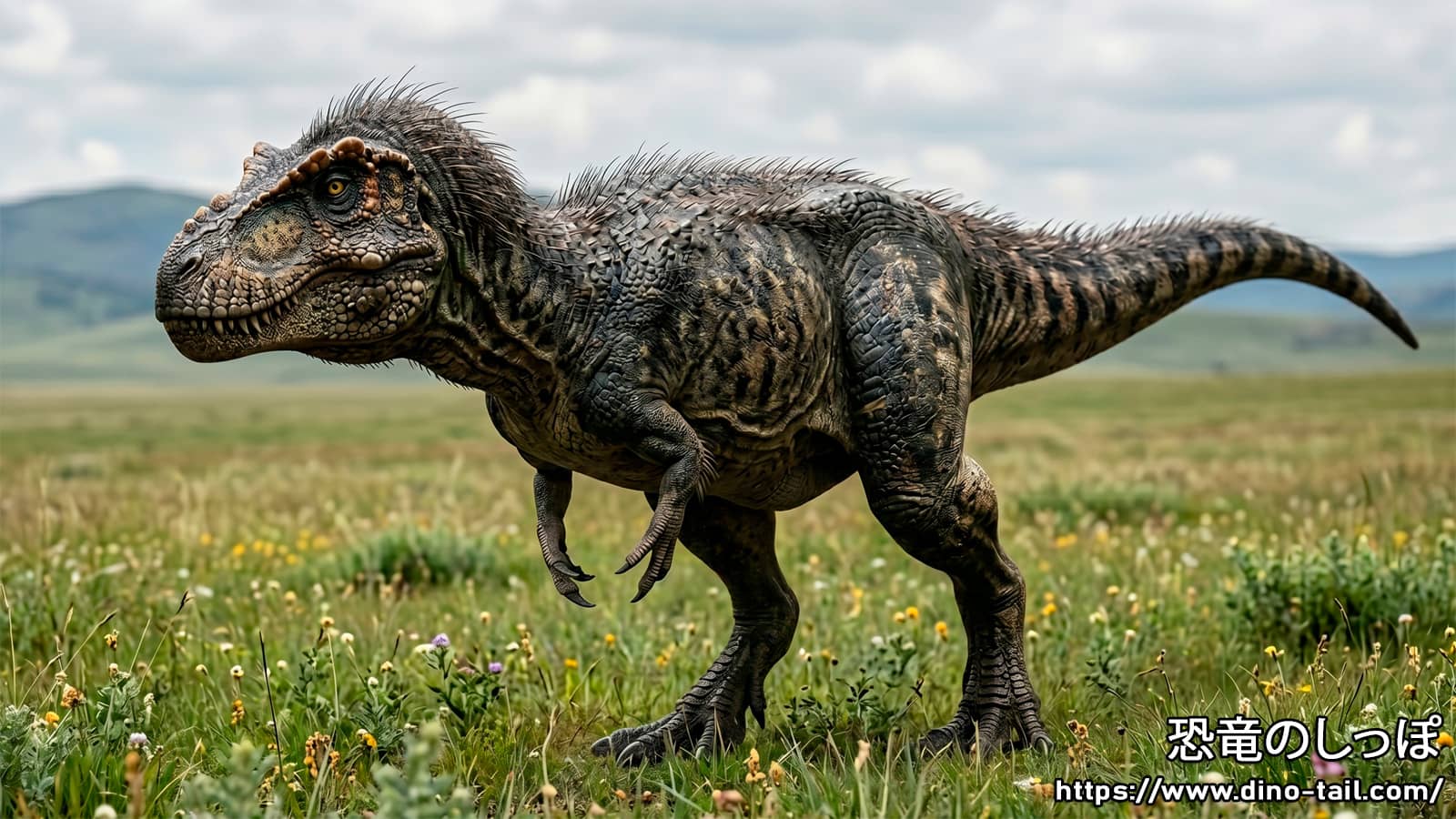
Since the discovery of feathered early tyrannosauroids (such as Yutyrannus) in China, the theory that "large tyrannosaurids might also have been covered in feathers" spread.
However, detailed examination of Gorgosaurus skin fossils revealed that its body was covered with very fine "scales," not feathers. When animals become large, heat tends to build up inside their bodies. Therefore, it is thought that they lost their feathers during evolution to make it easier to release heat.
There is also interesting research regarding the "extremely short forelimbs" characteristic of the tyrannosaurid family. It was found that even a juvenile Gorgosaurus weighing only about 330 kg already had short forelimbs, just like the adults. This indicates that their forelimbs did not become shorter as they grew, but rather that they had chosen an evolutionary path from birth to make their forelimbs smaller in order to develop a larger head and jaws.
Gorgosaurus's Diet Revealed by Stomach Contents

Gorgosaurus discovered in the Dinosaur Park Formation, Alberta, Canada
In 2023, a discovery that made history in paleontology was reported. The fossil of the last prey eaten was found inside the "stomach" of a 5 to 7-year-old juvenile Gorgosaurus (weighing about 330 kg) discovered in Canada. This was the first time in the world that the stomach contents of a tyrannosaurid were found intact.
Inside the stomach were the leg bones of two juvenile small feathered dinosaurs (oviraptorosaurs). Interestingly, there were no head or torso bones; it was found that it selectively ate only the "hind legs," which were the meatiest and most nutritious parts.
Adult Gorgosaurus used their powerful jaws to crush and eat the bones of giant herbivorous dinosaurs weighing over a ton. However, when they were young, with slender bodies and weaker jaws, they ran swiftly to hunt small dinosaurs.
It is a term indicating "what it eats," "where it lives," and "what role it plays" in the natural world. It is thought that Gorgosaurus avoided competition over limited food by changing their prey between adulthood and youth.
A Harsh Life and the "Dinosaur Brain Tumor"
Gorgosaurus fossils bear numerous traces (signs of disease and injury) showing how fiercely and harshly they lived. Bite marks on the face from fights with rivals, and healed fractures in ribs and leg bones are frequently found.
What is especially surprising is that the world's first "brain tumor" in a dinosaur was found in a fossil discovered in the United States in 1997. A golf ball-sized bony mass (tumor) was preserved inside the skull.
This tumor must have been compressing the brain. Because of this, it is thought that this Gorgosaurus had lost its sense of balance or became unable to move properly. In fact, this individual had severe bone fractures all over its body, including its shoulders and legs. It is presumed that due to the brain tumor, it repeatedly fell and failed in hunting, surviving while battered and bruised.
Reconstructing Brain Shape with the Latest CT Scans
In recent studies, efforts have been made to CT scan the skulls of Gorgosaurus and reconstruct the shape of the space where the brain was housed (the braincase) as 3D data.
It is a reconstruction of the shape and size of the brain, made by taking a cast of the internal cavity (braincase) of a fossilized skull.
Examining multiple Gorgosaurus at different growth stages revealed that while the brain fit perfectly inside the skull during youth, in adulthood, the growth of the brain could not keep up with the growth of the skull, leaving a gap. Furthermore, it has been found that the reconstructed shape of the brain had a strange "mosaic-like" form, mixing primitive reptilian features like a crocodile's with advanced features like a bird's.
Gorgosaurus can be said to be one of the most precious dinosaurs in Earth's history, teaching us how dinosaurs grew and how they reigned at the top of the ecosystem.