
About Velafrons
| Scientific Name (Genus) | Velafrons |
| Meaning of Name |
Sailed forehead
Velum (sail) [Latin] - Frons (forehead) [Latin] |
| Classification | Ornithischia, Ornithopoda, Hadrosauridae (Lambeosaurinae) |
| Total Length | Approx. 7.6m (subadult) - 10m (estimated adult) |
| Diet | Herbivorous |
| Period | Late Cretaceous (Campanian, approx. 73.5-72.74 million years ago) |
| Sub-classification/Species | Velafrons coahuilensis |
| Year of Paper Publication | 2007 |
| Genus Name Publication |
Gates, T. A., et al. (2007).
Velafrons coahuilensis, a new lambeosaurine hadrosaurid (Dinosauria: Ornithopoda) from the Late Campanian Cerro del Pueblo Formation, Coahuila, Mexico. Journal of Vertebrate Paleontology, 27(4), 917-930. |
"Sailed Forehead" Discovered in Mexico
Velafrons is a hadrosaurid dinosaur described in Coahuila, Mexico, in 2007. The genus name means "sail" (Velum) and "forehead" (Frons) in Latin, derived from the fan-like crest on top of its head.
It was the first new genus of hadrosaur to be named in North America in about 70 years, making it an important discovery that sheds light on the ecosystem of "Southern Laramidia," which had previously been shrouded in mystery.
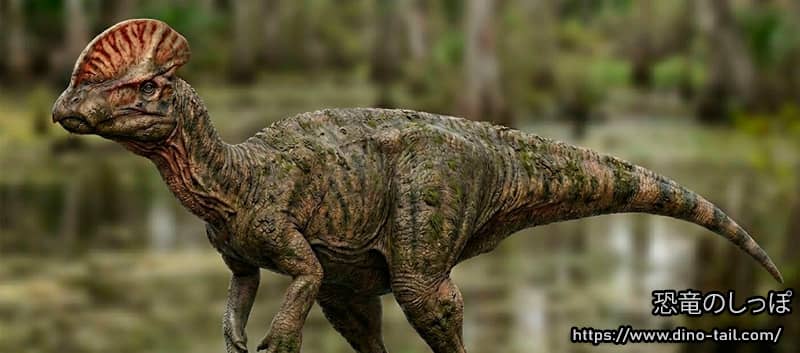
Named for its characteristic "sail" on the head
Velafrons belongs to the subfamily Lambeosaurinae and is closely related to groups like Corythosaurus and Hypacrosaurus, which lived in northern North America. Similarities are seen in the skull structure, especially the shape of the crest formed by the premaxilla and nasal bones, but Velafrons is a unique genus that underwent its own evolution.
Giant Despite Being a Child? Amazing Growth Strategy
The discovered holotype specimen of Velafrons (CPC-59) has very interesting features. From the state of the skull sutures and the development of the crest, it has been determined that this individual was a "subadult" (child), not yet a fully grown adult.
But what is surprising is its size. Even at this "child" stage, it reached a total length of about 7.6 meters. This is already close to adult size for related species in northern North America.
From this, it is estimated that adult Velafrons were large dinosaurs reaching 9 to 10 meters in length. They may have adopted a growth strategy of increasing body size before developing head ornaments to counter predators (such as tyrannosaurids) in the ecosystem of that time.
Life in Ancient Estuaries and Wetlands
The "Cerro del Pueblo Formation" where Velafrons was found was a humid environment facing the sea during the Late Cretaceous. At that time, Coahuila is thought to have been covered with vast deltas and estuaries, with rich vegetation similar to modern mangroves.
Found alongside fossils of oysters and snails, Velafrons may have been a "beach dweller" that preferred waterside areas and ate nutrient-rich plants.
Coexistence with Other Dinosaurs
Another hadrosaur, "Latirhinus," has also been found in the same formation. While Latirhinus had a wide nose suitable for eating low-lying plants, Velafrons is thought to have selectively eaten higher plants. In this way, different types of dinosaurs coexisted in the same environment through "niche partitioning," separating their food sources and feeding grounds.
Latest Research: Coexistence with Ceratopsians
For a long time, it was thought that the giant-horned ceratopsian "Coahuilaceratops" also lived in the same era as Velafrons.
However, latest research published in July 2024 revealed that the formation where Coahuilaceratops was found is the "Cerro Huerta Formation," which is about 2 to 2.5 million years younger than Velafrons. In other words,
Velafrons and Coahuilaceratops did not coexist
.
Role of the Crest
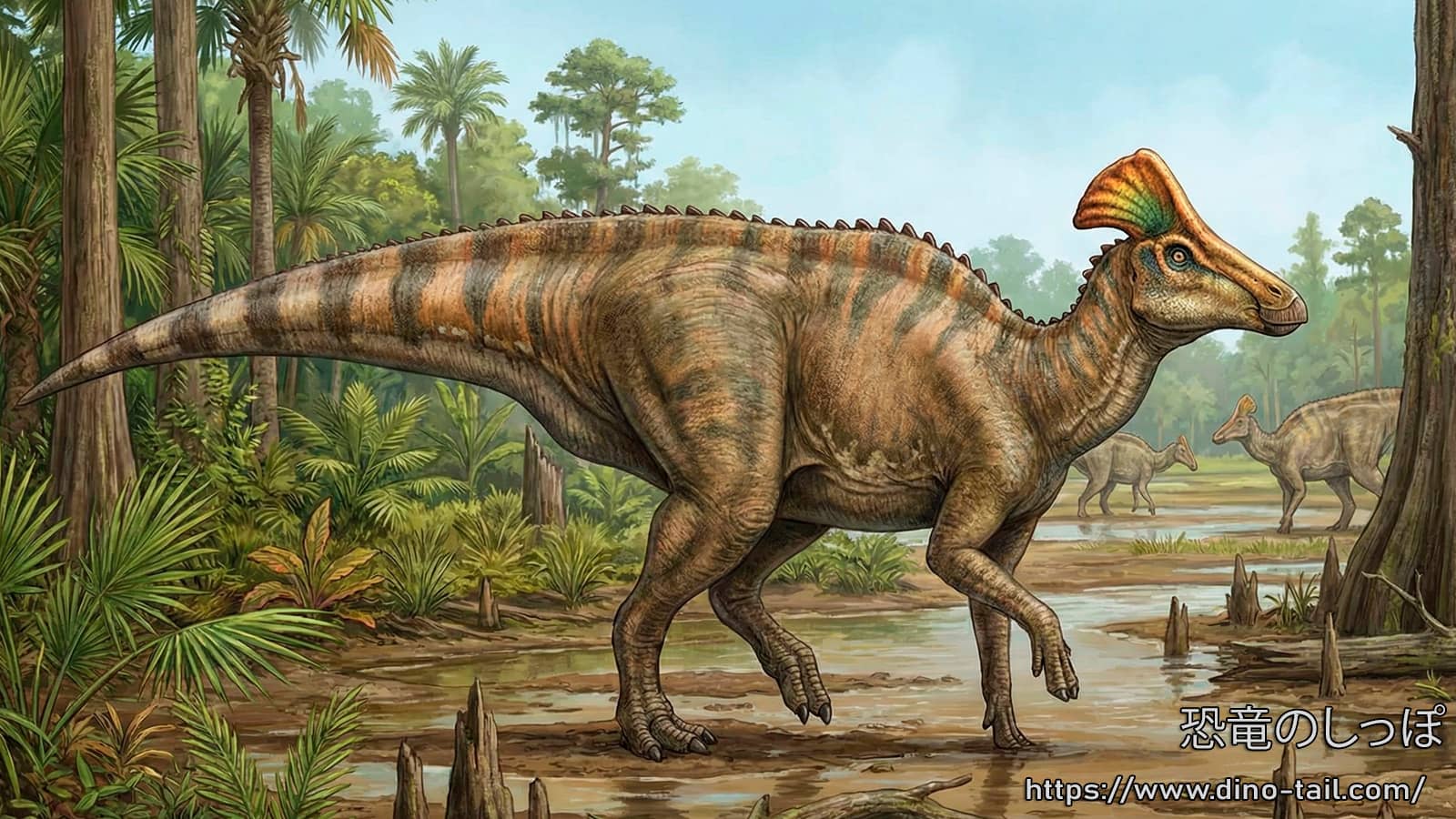
Like other Lambeosaurines, the crest of Velafrons was hollow and contained nasal passages. It is thought to have had two main roles.
- Sound Resonance: Echoing sound inside the crest to produce loud, low-frequency calls for communicating with distant companions.
- Visual Display: The sail-like shape on the forehead was used for identification among peers and for appealing to the opposite sex in adults.
Since the holotype specimen is a subadult, we await future discoveries to know exactly what shape of crest a fully grown adult Velafrons possessed.