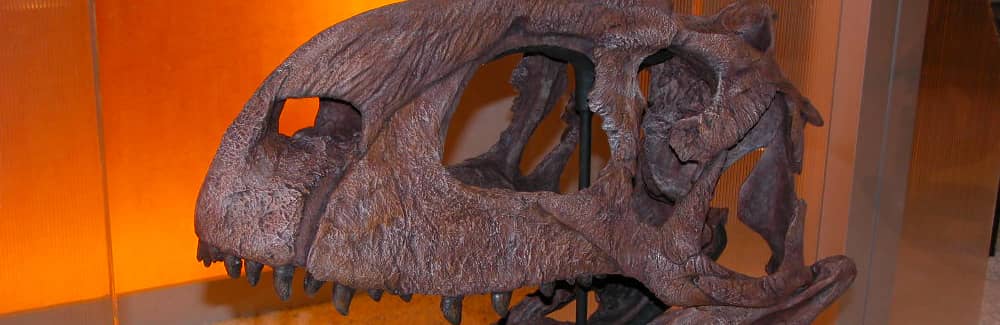
What is Rajasaurus?
| Scientific Name (Genus) | Rajasaurus |
| Meaning of Name |
King Lizard
Raja (King) [Sanskrit] - saurus (Lizard) [Greek] |
| Classification | Saurischia, Theropoda, Abelisauridae |
| Total Length | Approx. 6.6m - 9m |
| Diet | Carnivorous |
| Period | Late Cretaceous (Maastrichtian, approx. 67 million years ago) |
| Sub-classification/Species | Rajasaurus narmadensis |
| Year of Description | 2003 |
| Paper Describing Genus | Wilson, J.A., Sereno, P.C., Srivastava, S., et al. (2003). A new abelisaurid (Dinosauria, Theropoda) from the Lameta Formation (Cretaceous, Maastrichtian) of India. |
The "King" of Narmada
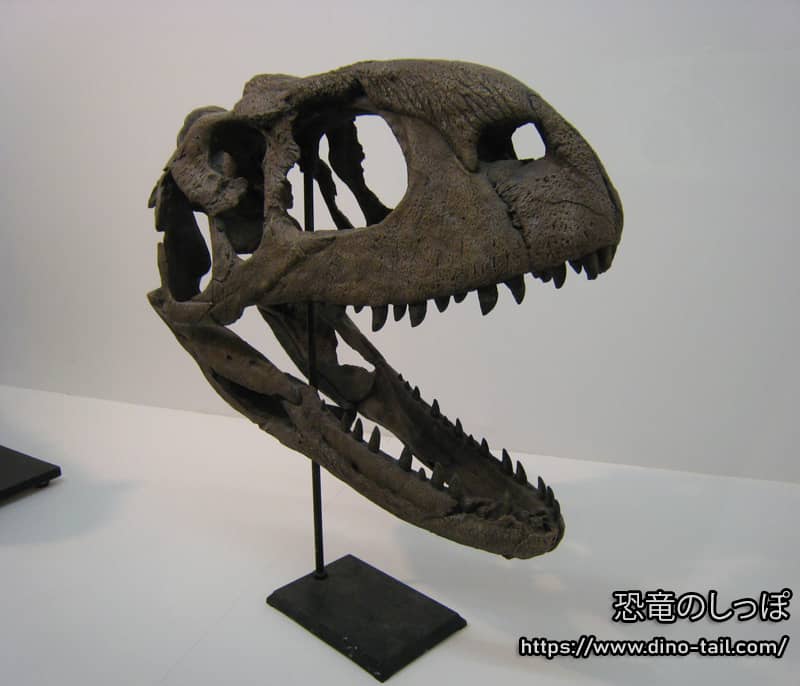
Rajasaurus, formally described in 2003, is the first carnivorous dinosaur from India for which the skull has been reconstructed. Its name "Raja" means "King" in Sanskrit, and true to its name, it is thought to have reigned at the top of the ecosystem in the Indian subcontinent during the Late Cretaceous.

Its most distinctive feature is a single, low, rounded horn on the top of its head (frontal and nasal bones). This horn may have been used for intraspecific display or in head-butting contests.
The skull was extremely robust, and the bone on top of the head (frontal bone) was remarkably thickened. This is a characteristic of abelisaurids, thought to be a structure to support powerful jaw muscles and withstand the impact of biting prey.
According to the latest research (2016), its total length is estimated to be about 6.6 meters, with a weight of 700kg to 1.1 tons. Although previously thought to be over 9 meters, even with a relatively smaller size, it had a very robust build and remained a powerful predator.
Discovery and Description: A Monument in Indian Dinosaur Research
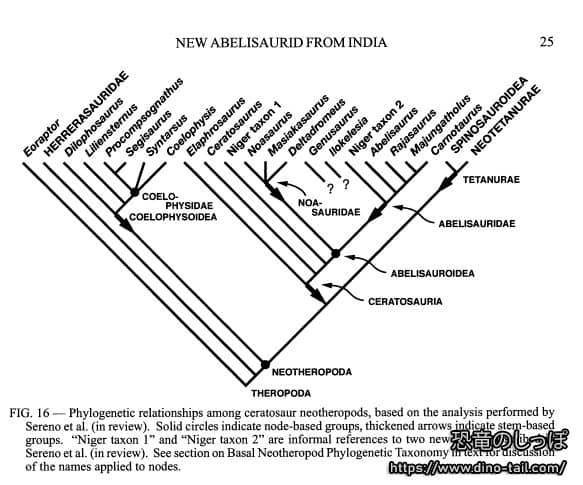
Source: A new abelisaurid (Dinosauria, Theropoda) from the Lameta Formation (Cretaceous, Maastrichtian) of India.(2003)
Rajasaurus fossils were excavated between 1982 and 1984 by Suresh Srivastava of the Geological Survey of India (GSI) in Rahioli village, Gujarat state, western India. However, it took about 20 years for these fossils to be formally described as a new species.
In 2001, Dr. Paul Sereno and Dr. Jeffrey Wilson from the United States visited India and re-examined the fossils in collaboration with GSI. As a result, it was discovered that the scattered bones belonged to a single individual and represented a new genus and species different from any known dinosaur.
This discovery was a monumental turning point in Indian dinosaur research, which had long been fragmented and taxonomically confusing. Some fossils previously known as "Indosuchus" or "Lametasaurus" are now organized as being related to Rajasaurus.
Paleoenvironment and Ecology: Gondwana Continent
About 67 million years ago, when Rajasaurus lived, India was an "island continent" that had separated from Gondwana and was moving north towards Eurasia. In this isolated environment, Rajasaurus underwent unique evolution.
Interestingly, it is known that Rajasaurus's closest relative is Majungasaurus from the distant island of Madagascar. This serves as biological evidence that India and Madagascar were once connected by land, and remained connected longer than with Africa or South America.
At that time, India was in the midst of massive volcanic activity known as the Deccan Traps. In a turbulent environment with falling volcanic ash, Rajasaurus is thought to have preyed on giant sauropods such as Isisaurus. It likely specialized in ambush hunting, using its powerful neck and jaws to bite onto prey and inflict fatal wounds.
Another type of abelisaurid, Rahiolisaurus, has also been found in the same formation. Rahiolisaurus had a more slender build, and likely engaged in "niche partitioning" with the robust Rajasaurus, targeting different prey or living in different habitats.