About Nodosaurus
| Scientific Name (Genus) | Nodosaurus |
| Meaning of Name |
Knobbed lizard
nodus (knot, knob) [Latin] - saurus (lizard) [Greek] |
| Classification | Ornithischia, Thyreophora (Ankylosauria, Nodosauridae) |
| Total Length | Approx. 4 - 6m |
| Diet | Herbivorous |
| Period | Late Cretaceous (approx. 99.7 - 86.3 million years ago) |
| Sub-classification / Species Name | Nodosaurus textilis |
| Year of Paper Publication | 1889 |
| Genus Name Publication | Marsh, Othniel Charles (1889). Notice of new American Dinosauria. The American Journal of Science, series 3 37: 331-336. |
"Knobbed Lizard" and Passive Defense
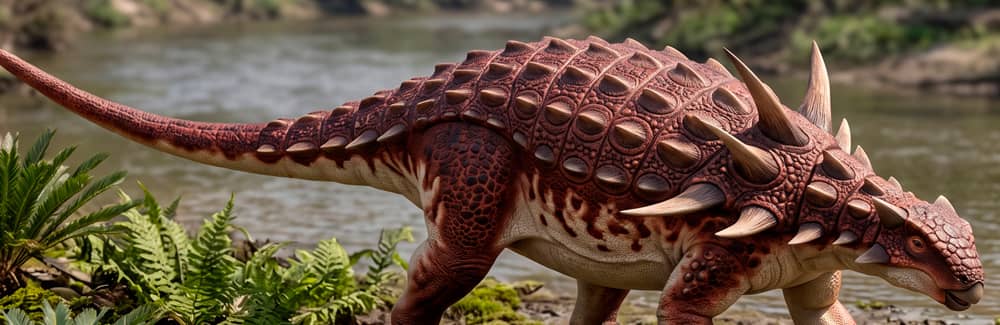
Nodosaurus was an armored herbivorous dinosaur that lived on the North American continent during the Late Cretaceous period. It is estimated to have weighed up to 3.5 to 3.9 tons. The "knobs" (nodules) from which its name is derived were arranged regularly on the sturdy bony plates (osteoderms) covering its entire back, and spike-like projections were also developed on its sides.
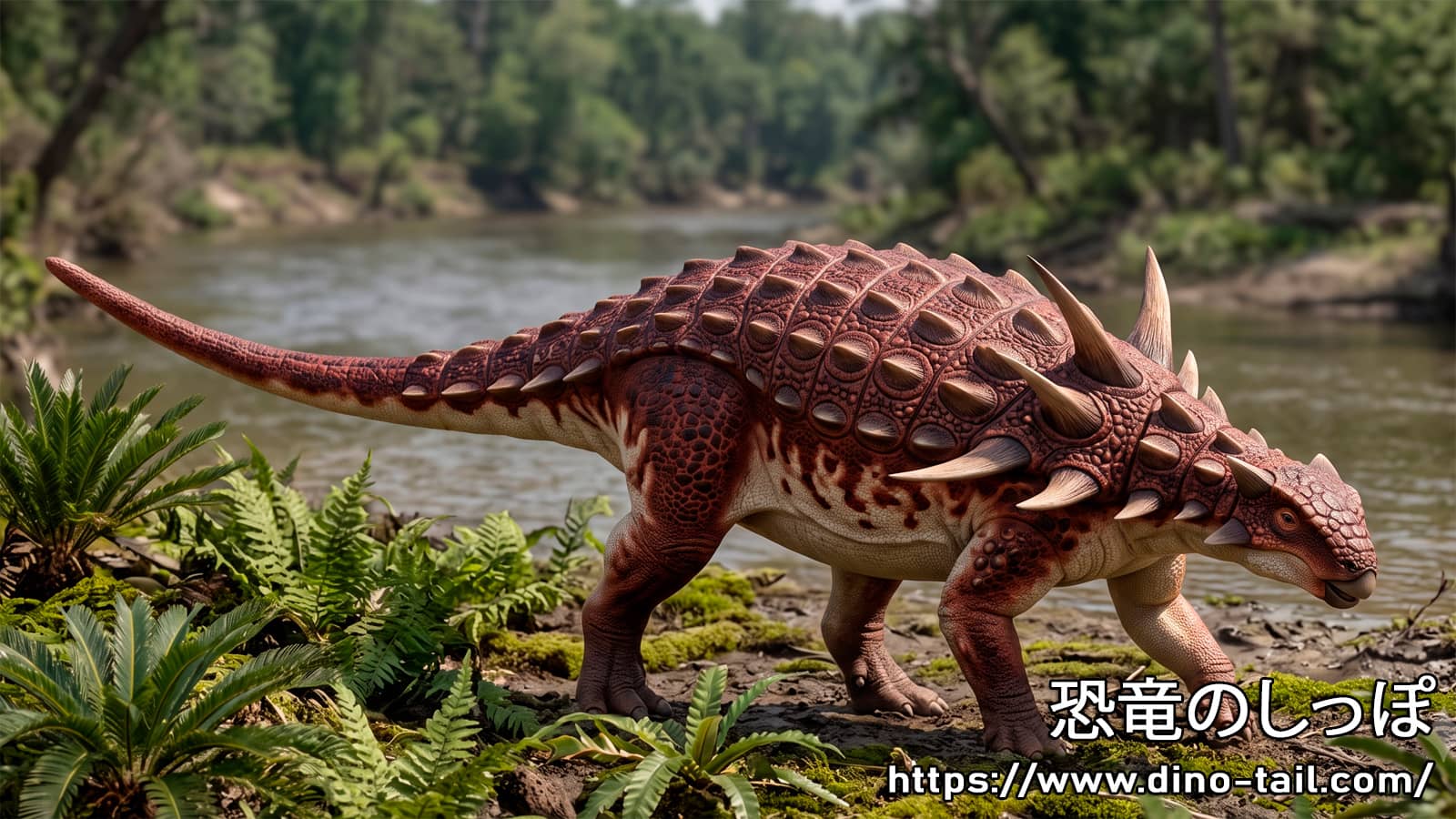
What distinguishes it greatly from Ankylosaurus, a fellow armored dinosaur (ankylosaur), is that it did not have a bony hammer (tail club) at the tip of its tail.
While Ankylosaurus swung its hammer to attack predators, Nodosaurus, with its short legs and heavy body, found it difficult to either run away or fight back. Therefore, when attacked by carnivorous dinosaurs, it is thought to have adopted a "passive defensive posture" by lowering its posture extremely close to the ground, much like modern armadillos or hedgehogs, to hide its soft, unarmored belly.
History of Nodosaurus Discovery and the "Bone Wars"
Nodosaurus fossils were first discovered in Wyoming, USA, in 1881 by fossil collector William Harlow Reed. This era was in the midst of a fierce competition known as the "Bone Wars," where famous American paleontologists O.C. Marsh and E.D. Cope fiercely competed to find new fossils.
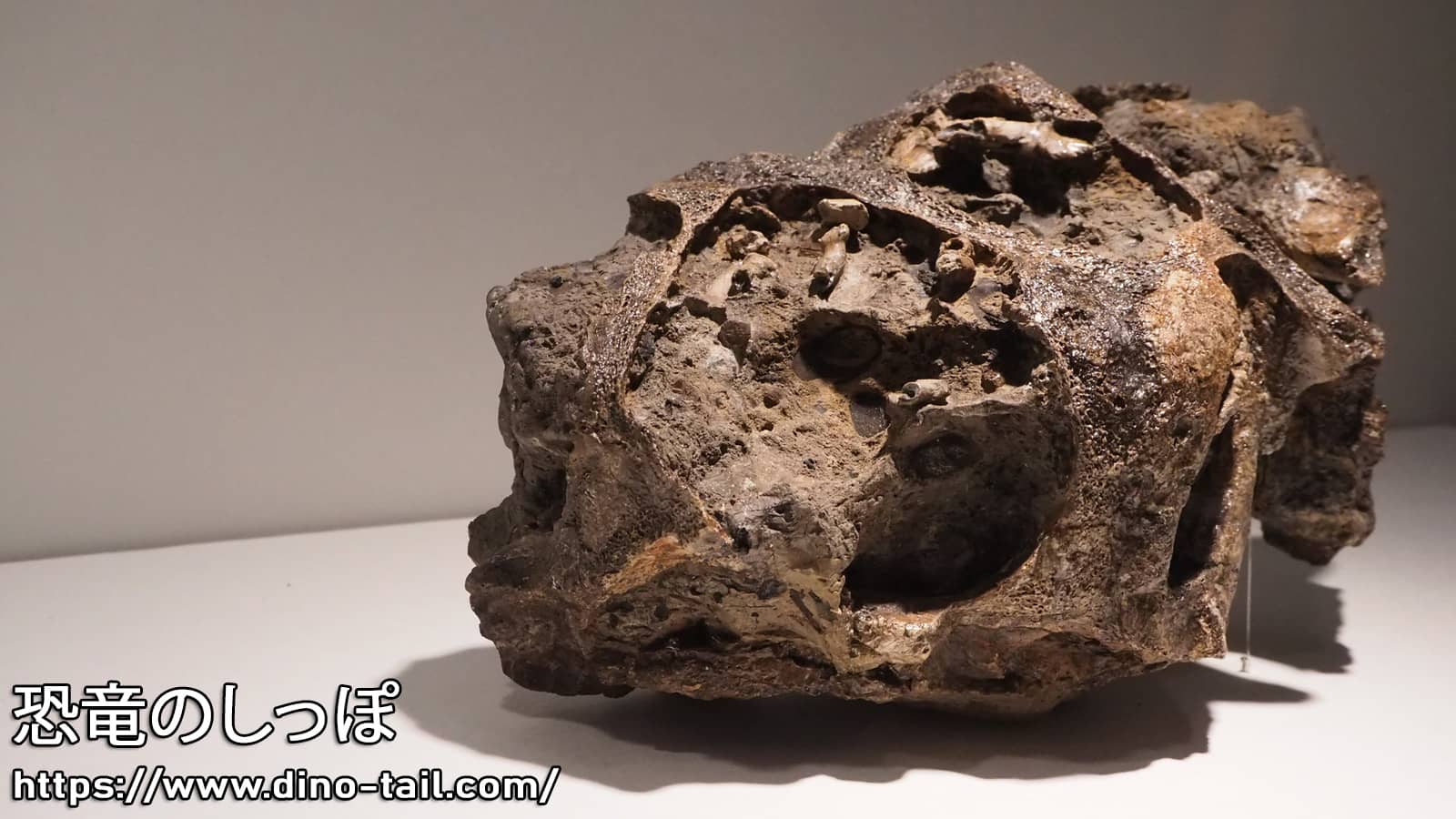
Unfortunately, the excavated "holotype (type specimen)" did not include a skull, consisting only of torso and tail bones, and numerous armor plates. Nevertheless, the magnificent, regularly arranged armor left a strong impression on scholars at the time.
💡 What is a Holotype?
It is the "one-of-a-kind specimen in the world" designated as the standard when naming a new biological species. It serves as the "original model" to confirm whether it is a new species or not.
A Picky Herbivorous Dinosaur
Although the skull of Nodosaurus itself has not been found, fossils of close relatives (Nodosauridae) indicate that its snout was narrow and pointed. This indicates that it was a "selective feeder (picky eater)," selectively eating only the delicious and nutritious parts of soft ferns and shrubs close to the ground.
If it happened to eat hard plants, it is thought to have swallowed "gastroliths" (stomach stones) like birds, taking its time to ferment and digest them in its massive intestines. Because its preferred plant height and tastes were different from other herbivorous dinosaurs (those that ate tall plants or small, fast-running dinosaurs), they were able to coexist successfully without competing for food.
💡 Niche Partitioning
The "role" or "place" a living thing holds in an ecosystem is called a niche. The act of multiple animals avoiding conflict and living together by slightly shifting the types of food they eat or the times they are active is called "niche partitioning."
Fossils Drifting in the Sea
Nodosaurid dinosaurs have a strange characteristic: their fossils are often found in geological strata formed in the sea (marine strata). Why are they found in the sea when they were supposed to live on land?
The reason is explained by a phenomenon called "Bloat and Float." After a Nodosaurus living near a river or coast died, it was washed out to sea by floods. The carcass, wrapped in hard armor, would bob on the sea surface like a balloon as putrefaction gases accumulated in its stomach. Then, after drifting for a long time, the gas would escape, and it would sink to the seabed upside down, with its heavy back armor facing down, where it became fossilized.
💡 Taphonomy
It is the science that deduces and studies how living things become fossils and survive to the present day after they die (the processes of carcass movement, putrefaction, burial, etc.).
Colors Revealed by the Miraculous Fossil "Borealopelta"
What decisively determined the appearance of nodosaurid dinosaurs was the fossil of a close relative, "Borealopelta," discovered in Canada in 2011.
This fossil was preserved in an almost miraculous state, with its skin, scales, and even its "last meal (stomach contents)" remaining in three dimensions.
As a result of scientists analyzing this fossilized skin, pigment components were discovered, revealing its color when it was alive.
It had a protective coloration (camouflage) called "countershading," where the back side was reddish-brown and the color faded towards the belly.
Like modern elephants and rhinos, animals that are large and strong do not need camouflage patterns because they have no natural enemies. However, the fact that even Borealopelta (and nodosaurids), with their entire bodies covered in heavy armor and weighing over 1 ton, needed camouflage to blend into the scenery tells a story of how severe the threat of carnivorous dinosaurs (giant theropods) was at the time.
💡 Countershading
It is a form of camouflage that cancels out the "belly shadow" created when sunlight hits from above by having a lighter color from the start, making the body look flat and blending into the scenery. It is seen in many modern animals such as sharks, penguins, and deer.
Nodosaurids Also Existed in Japan
Nodosaurid dinosaurs were thought to have lived primarily on the North American continent, but in recent years, fossils have been discovered one after another in Japan as well.
In 1995, Japan's first nodosaurid skull fossil was discovered in the strata of Yubari City, Hokkaido. This discovery provided decisive evidence that at some point during the Cretaceous period, they migrated en masse from North America to East Asia via the Bering Land Bridge and other land connections.
Furthermore, in 2025, multiple fossilized teeth of armored dinosaurs were discovered in the "Mitsuse Formation (approx. 80 million years ago)" in Nagasaki City, Nagasaki Prefecture. There are clear differences in how these teeth were worn down, strongly suggesting that "multiple different types of armored dinosaurs coexisted in the same place at the same time." These precious fossils are exhibited and open to the public at the Mikasa City Museum (Hokkaido) and the Nagasaki City Dinosaur Museum, teaching us the richness of Japan's dinosaur era.