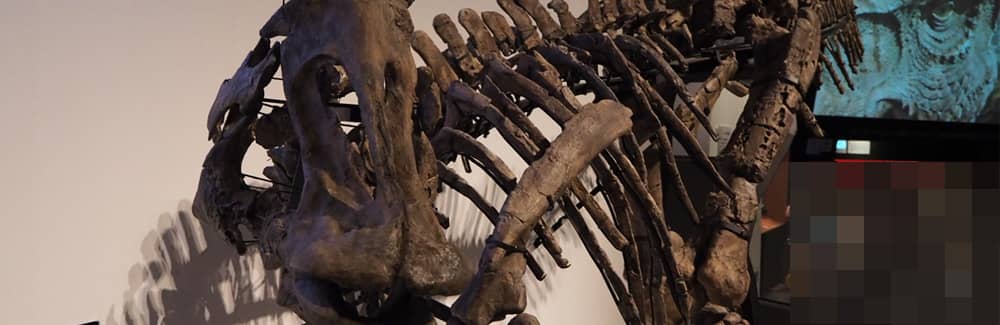
About Kamuysaurus
| Scientific Name (Genus) | Kamuysaurus |
| Meaning of Name |
Japanese Dragon God
kamuy (god) [Ainu] - saurus (lizard) [Latin] - japonicus (Japanese) [Latin] |
| Classification | Ornithischia, Ornithopoda, Hadrosauridae, Saurolophinae |
| Total Length | Approx. 8m |
| Diet | Herbivorous |
| Period | Late Cretaceous (approx. 72.1 - 70.6 million years ago) |
| Sub-classification / Species Name | Kamuysaurus japonicus |
| Year of Paper Publication | 2019 |
| Genus Name Publication |
A New Hadrosaurine (Dinosauria: Hadrosauridae) from the Marine Deposits of the Late Cretaceous Hakobuchi Formation, Yezo Group, Japan.
Scientific Reports, 9(1): 12389
Yoshitsugu Kobayashi et al. 2019. |
A Turning Point in Japanese Dinosaur Research
During the late Cretaceous period of the Mesozoic era, hadrosaurid dinosaurs with highly developed chewing organs (dental battery structure) flourished over a wide area of the Northern Hemisphere. However, in East Asia, including the Japanese archipelago, only fragmentary bone pieces and fossilized teeth had been found until now, making it difficult to understand their complete picture.
The turning point for hadrosaurid research in East Asia was the discovery of "Kamuysaurus japonicus" as a nearly complete full skeleton from the Hobetsu area of Mukawa Town, Hokkaido. This discovery became extremely important material for elucidating the evolutionary history of dinosaurs in the Pacific Rim region, which had been a blank slate.
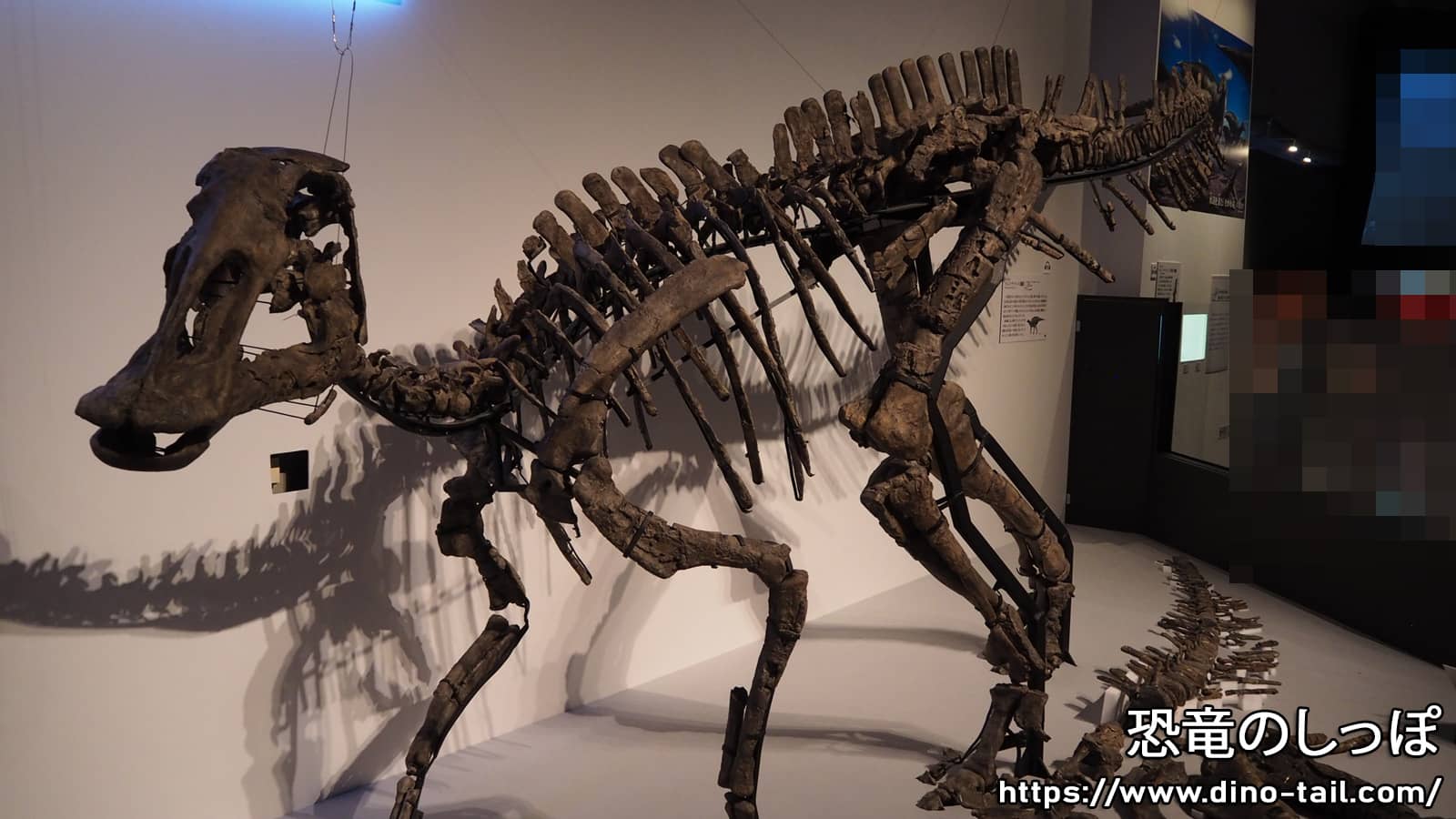
Its length in life reached about 8 meters, and analysis of bone tissue revealed that this individual was a mature adult at least 9 years old. Flexibly switching between bipedal and quadrupedal walking, its weight is estimated to have reached up to 5.3 tons.
In addition, from the structure of the parietal bone, it has been suggested that a thin, flat "crest" like that of its close relative Brachylophosaurus may have existed from the snout (mouth) to the top of the head.
Historical Discovery and the Wall of Preparation
The story of the discovery of Kamuysaurus began with a fossilized caudal vertebra found by amateur fossil collector Yoshiyuki Horita along a stream in Mukawa Town (formerly Hobetsu Town) in 2003. Initially, it was rare for a terrestrial dinosaur to be excavated from a marine stratum, and no one expected a full skeleton to be sleeping deep within that bedrock.
About 10 years later, in 2013, full-scale excavation surveys led by Professor Yoshitsugu Kobayashi of Hokkaido University began, and it turned out to be the largest "full skeleton" ever found in Japan, with about 80% of the entire body preserved.
However, the road to research was not smooth. Most of the fossils were encased in extremely hard "calcareous nodules," and the preparation (cleaning) work for the fragile dental battery, which could break with the slightest vibration, was extremely difficult. It is said that it took about two years just to extract a single tooth fossil through millimeter-scale scraping work under a microscope.
Even before it was given a formal scientific name, it was widely known by the nickname "Mukawaryu" (Mukawa Dragon) after its discovery site, the local Mukawa Town, and it is still widely beloved by the local community and media today.
Why from a Marine Stratum? The "Bloat and Float" Hypothesis
Why was the complete skeleton of Kamuysaurus, which lived on land, found in a stratum deposited on the seabed of the continental shelf (Hakobuchi Formation of the Yezo Group)?
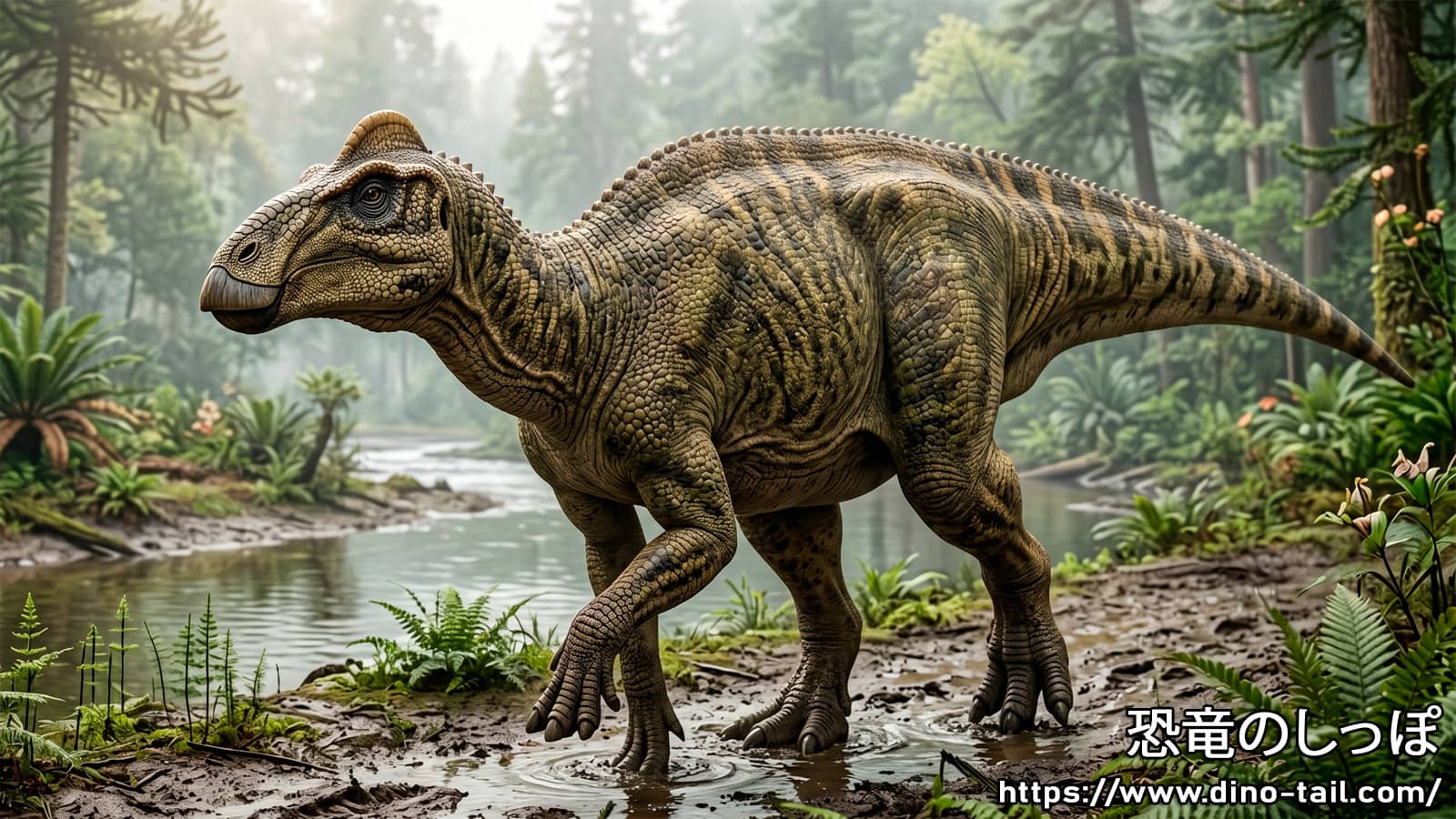
It is known that it had a crest on its head
by gemini,2026.
Unraveling this mystery is a model called "Bloat and Float." When a carcass is washed out to sea by rising river waters, it drifts on the ocean surface for a while due to decomposition gases generated inside the body. It is thought that it sank to the seabed after the gas escaped.
Fossils of marine organisms such as mosasaurs, sea turtles, and ammonites have also been excavated from this marine stratum. Traces of erosion caused by organisms after sinking to the seabed have also been found on the bones of Kamuysaurus.
Furthermore, in the latest research, pollen of various plants and bivalve fossils have been discovered from the surrounding area, proving that the coastal area of East Asia at that time was a warm environment with extremely rich and diverse vegetation. The hypothesis that early hadrosaurids used the coastline as their living habitat has also been proposed.
The Secret of "Cancellous Bone" Supporting the Giant Kamuysaurus
In the 2020s, the internal structure of Kamuysaurus bones was analyzed using high-resolution CT scans.
As a result, it was discovered that hadrosaurs supported their heavy bodies in a fundamentally different way from mammals. While mammals make their bones "thicker" to withstand gravity, dinosaurs adopted a unique adaptive strategy of increasing the proportion of spongy "cancellous bone" inside the bones.
Due to this "load-bearing adaptation with weight reduction," large dinosaurs like Kamuysaurus were able to walk on land while suppressing their own weight. This breakthrough explains the fundamental mechanism by which the Hadrosauridae was able to flourish worldwide during the Late Cretaceous period.
Coexistence with Yamatosaurus and the Evolutionary Mosaic
Another academic ripple effect brought about by the discovery of Kamuysaurus is the comparative study with "Yamatosaurus," which was described as a new species on Awaji Island, Hyogo Prefecture in 2021.
Yamatosaurus retains the characteristics of early hadrosaurids, but it was proven that it coexisted in Asia at the same time - the Maastrichtian age - with the highly evolved Kamuysaurus.
It is thought that while Kamuysaurus flourished in the rich and open coastal environment of the north (Hokkaido), the closed or special environmental zone in the south (around Awaji Island) functioned as a refugium (safe haven) for the older lineage, Yamatosaurus, to survive. The Japanese fossil record shows that evolution was not simply replacing older species with new ones, but constructing a complex ecological mosaic.