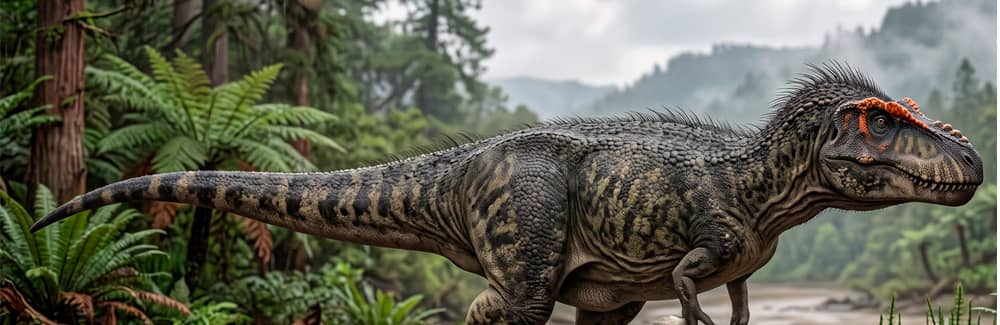
In vertebrate paleontology, the North American continent (Laramidia) during the Late Cretaceous period of the Mesozoic era is an extremely important stage where the Tyrannosauridae underwent remarkable adaptation as apex predators. For a long time, it has been recognized that two distinct lineages, the gracile "Albertosaurinae" and the robust "Tyrannosaurinae," coexisted in the geological formations of Alberta, Canada.
However, the latest paper published on October 2, 2026, reports the discovery of a new genus and species of dinosaur, "Tromerosaurus solumons," which shakes the boundaries between these two subfamilies.
- Evidence of Mosaic Evolution: It possesses features of a gracile body and a robust skull within a single skeleton.
- Reevaluation of a Historical Specimen: A fossil previously considered "the largest adult Gorgosaurus" turned out to be the new species Tromerosaurus.
- A Paradigm Shift in Evolution: The evolutionary speed of tyrannosaurids was much faster than conventionally thought.
On this page, we will explain the morphological characteristics of this groundbreaking new genus and species, as well as its ripple effects overturning conventional dinosaur growth models (ontogeny).
Origin of Taxonomic Naming and Cultural/Literary Background
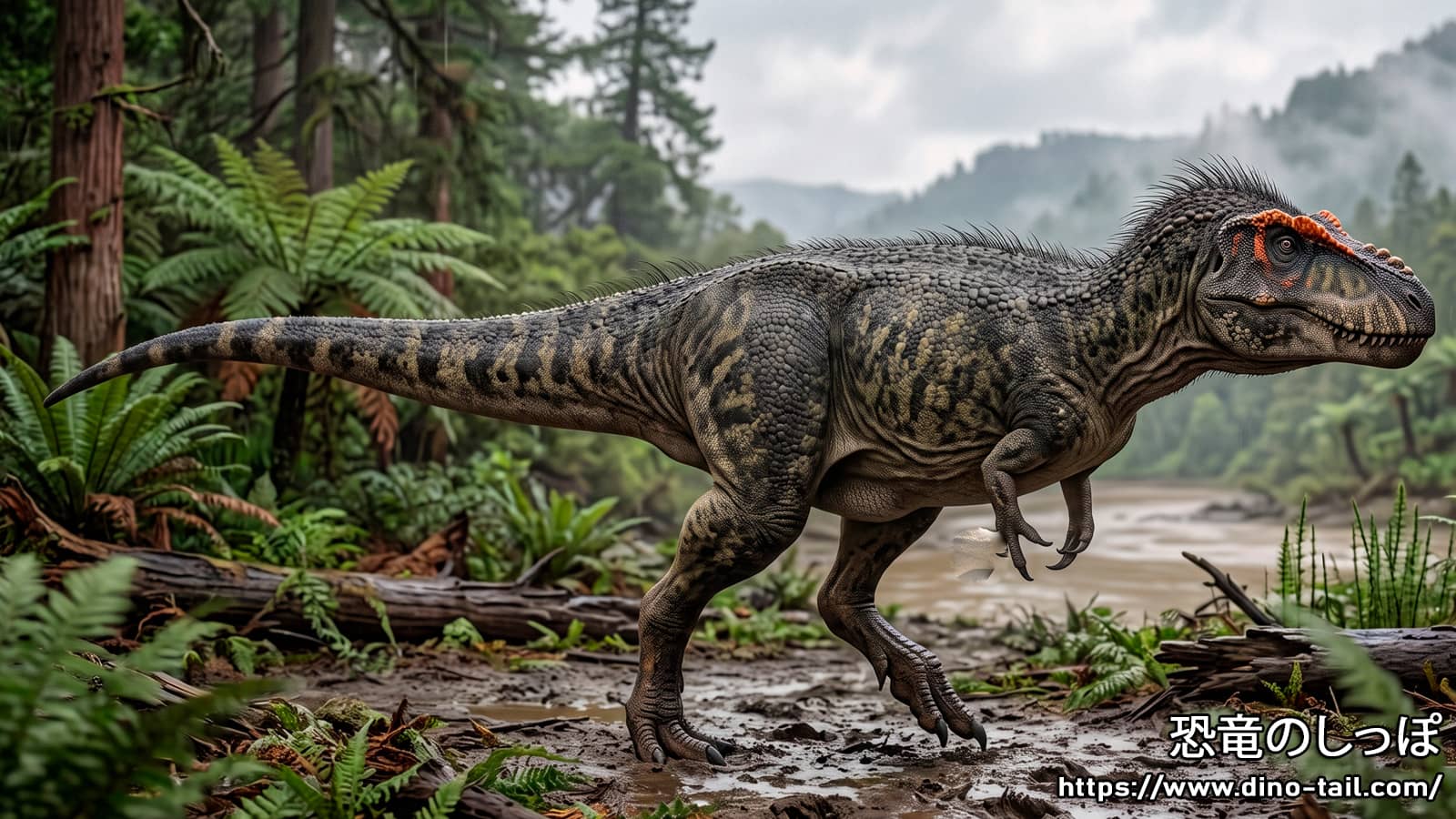
Gemini Generated Image
The newly named "Tromerosaurus solumons" embodies not only anatomical features but also a literary homage in its scientific name.
The genus name, "Tromerosaurus," is a combination of the ancient Greek words "tromerós" (terrible, terrifying) and "saûros" (lizard). This genus name expresses that Tromerosaurus possesses a mixture of features from both the albertosaurine Gorgosaurus (meaning: fierce lizard) and the tyrannosaurine Daspletosaurus (meaning: frightful lizard).
What is Mosaic Evolution:
A pattern of evolution in which certain parts of an organism rapidly change to new features while other parts retain older, ancestral traits. In the case of Tromerosaurus, it possesses "ancestral and gracile postcranial features (characteristic of Albertosaurinae)" and "new, robust cranial features (characteristic of Tyrannosaurinae)" simultaneously.
The specific name, "solumons," is derived from the Latin words "solus" (lonely, alone) and "mons" (mountain). Its primary meaning refers to the osteological feature where the hornlet (cornual process) on the lacrimal bone projects like a shelf, completely isolated from its surroundings.
Simultaneously, this name holds two significant cultural meanings. One is an homage to the dragon "Smaug" and his lair, the "Lonely Mountain," featured in the fantasy novel "The Hobbit." This is because the horns on the head of a giant theropod evoke the traditional image of a dragon. The other is a tribute to Mr. Solumon Solomon, an educator of the Blackfoot Nation, the indigenous people of the land where the fossil was discovered.
Geological Age and Stratigraphic Distribution
Fossils of Tromerosaurus were discovered from the geological formations collectively known as the "Belly River Group," which spread across southern Alberta, Canada. Specifically, they come from strata ranging from the upper part of the Oldman Formation to the lower part of the overlying Dinosaur Park Formation.
According to the latest radiometric dating techniques, the era when Tromerosaurus lived has been identified as a relatively narrow timeframe of approximately 76.72 to 76.35 million years ago, during the Campanian stage of the Late Cretaceous epoch of the Mesozoic era. At that time, southern Alberta was a very fertile plain crisscrossed by numerous rivers, with lush vegetation supporting herbivorous dinosaurs under a warm and humid climate.
| Formation Name | Paleoenvironment and Features | Estimated Age (Million Years Ago) | Significance of the Discovered Fossils |
|---|---|---|---|
| Dinosaur Park Formation (Lower) | Meandering rivers and coastal plains with mud and silt deposits. | Approx. 76.50 – 76.30 | Shows high biodiversity. Yielded the referred specimen of Tromerosaurus (formerly Gorgosaurus). |
| Oldman Formation (Upper) | Predominantly sandstone, vast inland floodplains, and braided rivers. | Approx. 76.70 – 76.50 | Yielded the holotype specimen (UALVP 52981), which serves as the standard for Tromerosaurus. |
History of Specimen Discovery and Ripple Effects of Taxonomic Reevaluation
The discovery of a new species is not always made solely through newly excavated fossils. The research on Tromerosaurus presented stronger scientific evidence by reevaluating existing specimens that had been classified as a "different dinosaur" in museum collections for many years. This became a classic example illustrating the "difficulty of classification" due to the changing appearance of dinosaurs as they grow (ontogeny).
Discovery of the Holotype
The holotype specimen (UALVP 52981), which serves as the reference standard for Tromerosaurus, was discovered in 2010 in the eastern part of Dinosaur Provincial Park, Alberta. It was subsequently excavated by a research team from the University of Alberta, and extensive preparation work was undertaken to remove the rock.
Initially, because of its robust skeleton, this specimen was tentatively identified as a relative of "Daspletosaurus" without sufficient debate. However, a precise examination of the skull revealed gracile features and unique shapes not found in Daspletosaurus, confirming it as a new genus and species.
The "Reallocation of Existing Specimens" that Shocked the Academic World
With the characteristics of the holotype clarified, the research team re-examined specimens housed in other museums. As a result, the following specimens were identified as Tromerosaurus.
| Specimen Number (Institution) | Classification Status | Previous Identification (Old Class.) | Preserved Parts and Scientific Significance |
|---|---|---|---|
| UALVP 52981 | Holotype | Daspletosaurus | Majority of the skull, hind limbs, etc. Exceptionally well-preserved. The standard for the new species. |
| TMP 1994.012.0602 | Referred Specimen | Gorgosaurus | A massive specimen long considered the "largest adult Gorgosaurus." Includes the skull and almost complete hind limbs. |
| TMP 1995.005.0001 | Referred Specimen | Gorgosaurus | Partial skeleton of a small subadult (growing towards adulthood). Contributed to the comparison of growth stages. |
| TMP 1985.011.0003 | Tentative Referred Specimen | Albertosaurus (now Gorgosaurus) | Upper jaw bone of a small juvenile. |
The "Largest Gorgosaurus Individual" is Another Dinosaur?:
What shocked the paleontological community the most in this study was the revelation that the Royal Tyrrell Museum of Palaeontology specimen "TMP 1994.012.0602" was actually Tromerosaurus. For decades, this specimen had been used as data in academic papers worldwide as the "end point (maximum growth)" for calculating the growth curve and bite force of Gorgosaurus. With this fact overturned, paleontologists have to recalculate the growth model of Gorgosaurus built over the past several decades.
Comparative Anatomy: A Bridge Between Two Subfamilies
Tromerosaurus is an intermediate to large-sized bipedal predator estimated to have reached approximately 7 to 9 meters in length and up to roughly 2 tons in weight as an adult.
Its greatest singularity lies in the fact that it possesses characteristics of both the "gracile and fast Albertosaurinae" and the "robust and powerful-biting Tyrannosaurinae"—lineages that were supposed to be deeply separated on the phylogenetic tree—within a single skeleton.
Peculiarities of the Skull (Cranial Skeleton)
The snout (rostrum) occupies more than 60% of the entire skull length, showing proportions typical of the slender Albertosaurinae. However, its details reveal many features trending towards the Tyrannosaurinae.
- Maxillary Fenestra: Notably elongated horizontally compared to Gorgosaurus (Albertosaurinae), serving as a strong defining feature of this genus.
- Tooth Count: The upper jaw has 13 to 15 teeth, similar to Gorgosaurus (Albertosaurinae), but the mechanical shape of the lower jaw bone itself exhibits properties intermediate between Gorgosaurus and Daspletosaurus (Tyrannosaurinae).
- Isolated Lacrimal Horn: The horn-like projection in front of the eye is completely isolated from its base by a shelf-like structure extending from the back of the bone. It is highly likely that this functioned for visual communication among peers (such as species recognition).
- Laterally Broadened Head Shape: The back of the head is widely expanded laterally. This is an adaptation to enhance binocular vision (stereopsis) and to attach massive jaw muscles, a feature characteristic of Tyrannosaurinae.
Adaptations of the Body (Postcranial Skeleton)
Despite the mixed tyrannosaurine features in the skull, the postcranial skeleton from the neck down retains typical albertosaurine proportions.
For example, Albertosaurinae maintain a ratio where the length of the femur (thigh bone) is greater than the length of the skull. This contrasts with Tyrannosaurinae, where the head enlarged to become longer than the femur. Additionally, the shin bones and other lower leg elements are elongated, suggesting that Tromerosaurus was a "running specialist" adapted for speed and agility.
Phylogenetic Controversy and the Speed of Evolution
When the research team reconstructed the evolutionary history (phylogenetic tree) of the Tyrannosauridae based on the latest findings, an unusual situation occurred where the phylogenetic position of Tromerosaurus polarized depending on the "statistical calculation method" used.
- Maximum Parsimony (method minimizing trait changes): Tromerosaurus was positioned as "the earliest member of Albertosaurinae."
- Bayesian Inference (method using probabilistic models of evolution): Tromerosaurus was positioned as "the earliest member of Tyrannosaurinae (sister group to Albertosaurinae)."
This discrepancy in calculation results is not a flaw in the software used, but rather reflects the biological reality of its "mosaic evolution," possessing traits of both.
Traditionally, it was thought that tyrannosaurid species underwent slow morphological changes. However, these analysis results prove that in the period immediately after the split between Albertosaurinae and Tyrannosaurinae, their respective characteristics were acquired at an "astonishing speed." The discovery of Tromerosaurus demonstrates that at the evolutionary divergence point, the ancestors of both were strikingly similar in appearance.
Campanian Paleoecosystem and Niche Partitioning
Previously, to avoid excessive competition among apex predators in the ecosystem, a model was widely supported suggesting that only two genera—one robust predator (e.g., Daspletosaurus) and one gracile predator (e.g., Gorgosaurus)—coexisted in a given region. However, the discovery of Tromerosaurus revealed that there was a time when three genera of large tyrannosaurids coexisted simultaneously in southern Alberta.
| Dinosaur Group | Representative Genera/Species | Ecological Role |
|---|---|---|
| Ornithopoda (Hadrosaurids, etc.) | Corythosaurus, Gryposaurus, Lambeosaurus | Formed massive herds and became primary prey for tyrannosaurids. |
| Marginocephalia (Ceratopsians, etc.) | Centrosaurus, Chasmosaurus, Styracosaurus | Heavily armored herbivorous dinosaurs with powerful horns and frills. |
| Pachycephalosauria (Bone-headed dinosaurs) | Stegoceras, Sphaerotholus | Relatively small to medium-sized, agile herbivorous dinosaurs. |
It is known that Tromerosaurus inhabited the same river basins as the robust Daspletosaurus. It is believed that a "niche partitioning (ecological separation)" based on prey preference was functioning: Tromerosaurus selectively hunted mobile hadrosaurids (Ornithopoda) utilizing its long legs, while Daspletosaurus, with its immense bite force, targeted heavily armored ceratopsians (Marginocephalia).
Comprehensive Conclusion
The discovery of Tromerosaurus solumons goes beyond a mere report of a new species; it has brought multiple new insights to the paleontology of Tyrannosauridae.
- It serves as evidence of "mosaic evolution," possessing traits of both Albertosaurinae and Tyrannosaurinae, demonstrating that the evolutionary speed of tyrannosaurids was faster than previously thought.
- Because the massive specimen previously considered the standard for adult Gorgosaurus has been reallocated to Tromerosaurus solumons, a fundamental recalculation of the Gorgosaurus growth models used over the past decades has become inevitable.
- It revealed that large tyrannosaurids in Campanian North America had achieved high diversity and geographical niche partitioning, exceeding the traditionally accepted "two-genus coexistence" model.
Tromerosaurus will undoubtedly continue to play a crucial role in unraveling "how the apex predators of Late Cretaceous North America adapted to their environment and how rapidly they evolved."
References & Bibliography
- New tyrannosaur: Tromerosaurus from Alberta - Dinosaurs - Tiefenzeit, https://tiefenzeit.com/en/artikel/new-tyrannosaur-tromerosaurus
- TROMEROSAURUS - DinoChecker dinosaur archive, http://www.dinochecker.com/dinosaurs/TROMEROSAURUS
- Tromerosaurus solumons Provides Insight into Tyrannosaur Family, https://blog.everythingdinosaur.com/blog/_archives/2026/10/05/remarkable-new-tyrannosaur-highlights-an-evolutionary-puzzle.html
- Tromerosaurus - Wikipedia, https://en.wikipedia.org/wiki/Tromerosaurus
- Meet Tromerosaurus solumons — a newly named tyrannosaur from, https://www.facebook.com/61585708087539/posts/meet-tromerosaurus-solumons-a-newly-named-tyrannosaur-from-late-cretaceous-alber/122139075405190269/
- A new albertosaurine from the Oldman Formation, Alberta, Canada, illuminates ambiguity between albertosaurine and tyrannosaurine characteristics