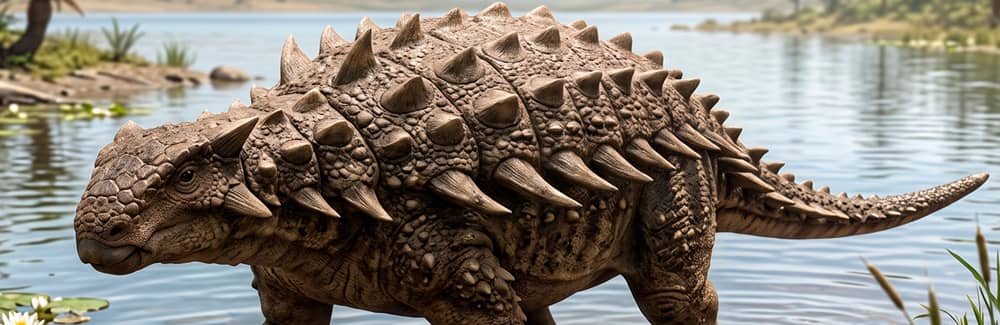
From Yubari City, Hokkaido, a new genus and species of armored dinosaur, "Nipponopelta yezoensis", has been discovered. It is the first armored dinosaur to be formally given a scientific name in Japan.
This dinosaur, revealed from a calcareous matrix through state-of-the-art non-destructive testing (CT scanning), has brought about discoveries that will be engraved in the history of Japanese paleontology:
- Surprising phylogenetic relationships: It is directly closely related to derived nodosaurids of North America, rather than neighboring species in Asia.
- Epic migration route: Evidence that heavily armored dinosaurs also made grand intercontinental migrations across the Bering Land Bridge.
- Adaptation to coastal areas: An ecological model that unravels the reason it was found in marine strata inhabited by ammonites.
On this page, we will explain in detail the evolution and ecology of the armored dinosaur that lived in Japan during the Late Cretaceous.
Late Cretaceous Thyreophorans and the Lineage of Armored Dinosaur Discoveries in Japan
Gemini Generated Image
Among dinosaurs, the ankylosaurs (Ankylosauria), belonging to the ornithischian clade Thyreophora, which developed robust osteoderm armor on their body surface, are known as important herbivorous dinosaurs that made up the Late Cretaceous terrestrial ecosystems. In their evolutionary history, ankylosaurs mainly branched into two lineages. One is the Ankylosauridae, characterized by a bony hammer (tail club) at the tip of the tail and a broad, flat skull. The other is the Nodosauridae, which lacks a tail club but instead developed strong spike-like armor around the shoulders and neck, and possesses a relatively elongated skull.
From a biogeographical perspective, fossil records show that nodosaurids had a wide distribution range, including North America, Europe, South America, and even Antarctica. However, the fossil record of nodosaurids in the Asian continent has been extremely limited. For a long time, it was thought that the main ankylosaur niches in Asia were occupied by basal lineages and Ankylosauridae, and Late Cretaceous Asian nodosaurids were only fragmentarily known from taxa like Dongyangopelta and Taohelong in China.
The discovery filling this paleobiogeographical void is the new genus and species of nodosaurid dinosaur described in Japan, "Nipponopelta yezoensis". Based on partial skeletal elements, including the posterior skull, preserved in a single concretion from Yubari City, Hokkaido, this species was formally described and named in the academic journal "Cretaceous Research" in August 2026. This discovery goes beyond the milestone of being the first formally named ankylosaur from Japan; it provides crucial clues to unraveling the puzzle of how Asian ankylosaurs evolved and migrated.
| Locality (Prefecture/City) | Geological Age | Fossil Elements | Significance and Remarks |
|---|---|---|---|
| Yubari, Hokkaido | Late Cretaceous (~96 to 94 million years ago) | Posterior skull, atlas, isolated teeth (11-12 pieces), etc. | Nipponopelta yezoensis. The first named ankylosaur in Japan, and the second nodosaurid in Asia to preserve skull elements. |
| Mifune, Kumamoto | Late Cretaceous (~90 million years ago) | Tooth (1 piece) | From the Mifune Group. Solid evidence of armored dinosaurs from one of Japan's leading dinosaur fossil sites. |
| Nagasaki, Nagasaki | Late Cretaceous (~81 million years ago) | Tooth (1 piece) | From the Mitsuse Formation. Indicates the presence of thyreophorans in western Japan near the end of the Cretaceous. |
| Tamba, Hyogo | Early Cretaceous (~110 million years ago) | Tooth (1 piece) | From the Sasayama Group. Part of the dinosaur fauna of the Japanese archipelago during the Early Cretaceous. |
| Toyama, Toyama | Early Cretaceous (~120 million years ago) | Footprints | Only footprint records, without skeletal elements, but important as traces of movement. |
| Katsuyama, Fukui | Early Cretaceous (~120 million years ago) | Skeletal elements and teeth | From the Kitadani Formation. Records of basal ankylosaurs at Japan's largest dinosaur excavation site. |
As Table 1 shows, the fossil record of armored dinosaurs in Japan had long heavily relied on isolated teeth and footprints. Among them, the Nipponopelta fossil, which includes skull elements, provides detailed anatomical information on Japanese armored dinosaurs.
Geological Background: The Hikagenosawa Formation of the Yezo Group and the Cretaceous Greenhouse Climate
The strata in Hokkaido where the Nipponopelta fossil was found are marine sediments called the Hikagenosawa Formation of the Yezo Group, formed during the Cretaceous period. The geological age is identified as the Cenomanian stage (about 96 to 94 million years ago), early in the Late Cretaceous.
The Cretaceous Greenhouse Climate and Marine Transgression:
During this period, the Earth reached the peak of a greenhouse climate with extremely high atmospheric carbon dioxide concentrations, resulting in an exceptionally warm environment with no ice sheets at the poles. Along with this, a global sea-level rise occurred, forming the vast "Western Interior Seaway" in the central part of the North American continent, connecting the Gulf of Mexico to the Arctic Ocean. Most of the present-day Japanese archipelago was also a shallow sea located on the eastern edge of the Asian continent, and the Yezo Group was deposited under such marine conditions.
The Yezo Group is world-famous for its abundant fossils of marine life such as ammonites, mosasaurs, and plesiosaurs, but fossils of terrestrial dinosaurs that made up the land ecosystems are also sporadically found. For example, a new genus and species of therizinosaurid, Paralitherizinosaurus japonicus, has also been reported. The background to finding terrestrial dinosaurs in marine strata involves complex taphonomic processes, such as carcasses washing out from rivers into the ocean, which holds significant meaning in unraveling the ecology of Nipponopelta.
Discovery and Research History: The 30-Year Journey of the Yubari Concretion
It took over 30 years and technological innovation for the Nipponopelta specimen to receive a scientific name.
Initial Discovery and Housing at the Mikasa City Museum
The holotype specimen (MCM A522) was discovered on June 25, 1995, by amateur fossil enthusiast Eiji Goto. The discovery site was the bank of the Omakizawa River, a tributary of the Shuparo River flowing through Yubari City, Hokkaido. While searching for marine reptile fossils, Mr. Goto found a calcareous concretion that had eroded from an outcrop of the Hikagenosawa Formation and become a floatstone, and realized that a skeleton of an unknown vertebrate was preserved inside. The specimen was promptly donated to the Mikasa City Museum, leading to full-scale research.
What is a Concretion?
It is a hard, compact mass of rock formed by the rapid precipitation and aggregation of mineral components in water (such as calcium carbonate) around a nucleus, like biological remains. It acts like a time capsule, preserving fossils in three dimensions and in very good condition down to the details. Many of Japan's excellent dinosaur fossils are found in this concretion state.
Initial Description in 2005 and Taxonomic Limitations
In 2005, the first detailed descriptive paper on this specimen was published through joint research by Dr. Hiroshi Hayakawa, Dr. Makoto Manabe, and Dr. Kenneth Carpenter. This research identified the fossil as a thyreophoran ankylosaur belonging to the Nodosauridae.
However, there was a fatal wall with the physical preparation techniques at the time. Many of the crucial parts bearing the specimen's anatomical characteristics remained buried deep within the hard calcareous matrix. To avoid the risk of destroying the fossil, further preparation was abandoned, and as a result, autapomorphies (unique derived traits) sufficient to clearly distinguish the genus and species could not be found. Therefore, it was merely reported as an "indeterminate nodosaurid genus and species."
Breakthrough via Non-Destructive Testing (CT Scanning)
The situation improved in 2021. An international research team led by Shumpei Otabe of Hokkaido University introduced high-resolution 3D computed tomography (micro-CT scanning) to visualize the internal structure three-dimensionally without destroying the specimen.
Through this advanced non-destructive approach, hidden features sealed deep within the calcareous matrix—which had been impossible to observe before—were digitally reconstructed, including part of the lower jaw, two perfectly preserved complete tooth crowns, and neuroanatomical elements like the left inner ear (semicircular canals) inside the skull. These data provided enough evidence to establish a new genus and species, leading to its formal description in the academic journal "Cretaceous Research" in August 2026.
Classification and Scientific Name: Proposal of Nipponopelta yezoensis
Etymology of the Scientific Name
The newly proposed scientific name, Nipponopelta yezoensis, symbolizes the historical and geographical identity of Japan and Hokkaido, where it was discovered.
The genus name Nipponopelta is a compound word of the Japanese word "Nippon" (Japan) and the ancient Greek word "péltē" (small shield). Meaning "Shield of Japan," it signifies that this is the first formally named ankylosaur from Japan. The specific name yezoensis adds the Latin suffix "-ensis" (originating from) to "Yezo," the ancient name for Hokkaido, the fossil's discovery site.
Taxonomic Hierarchy
- Superorder: Dinosauria
- Order: Ornithischia
- Clade: Thyreophora
- Suborder: Ankylosauria
- Family: Nodosauridae
- Genus: Nipponopelta
- Species: Nipponopelta yezoensis
Anatomical Features and Morphology-Based Autapomorphies
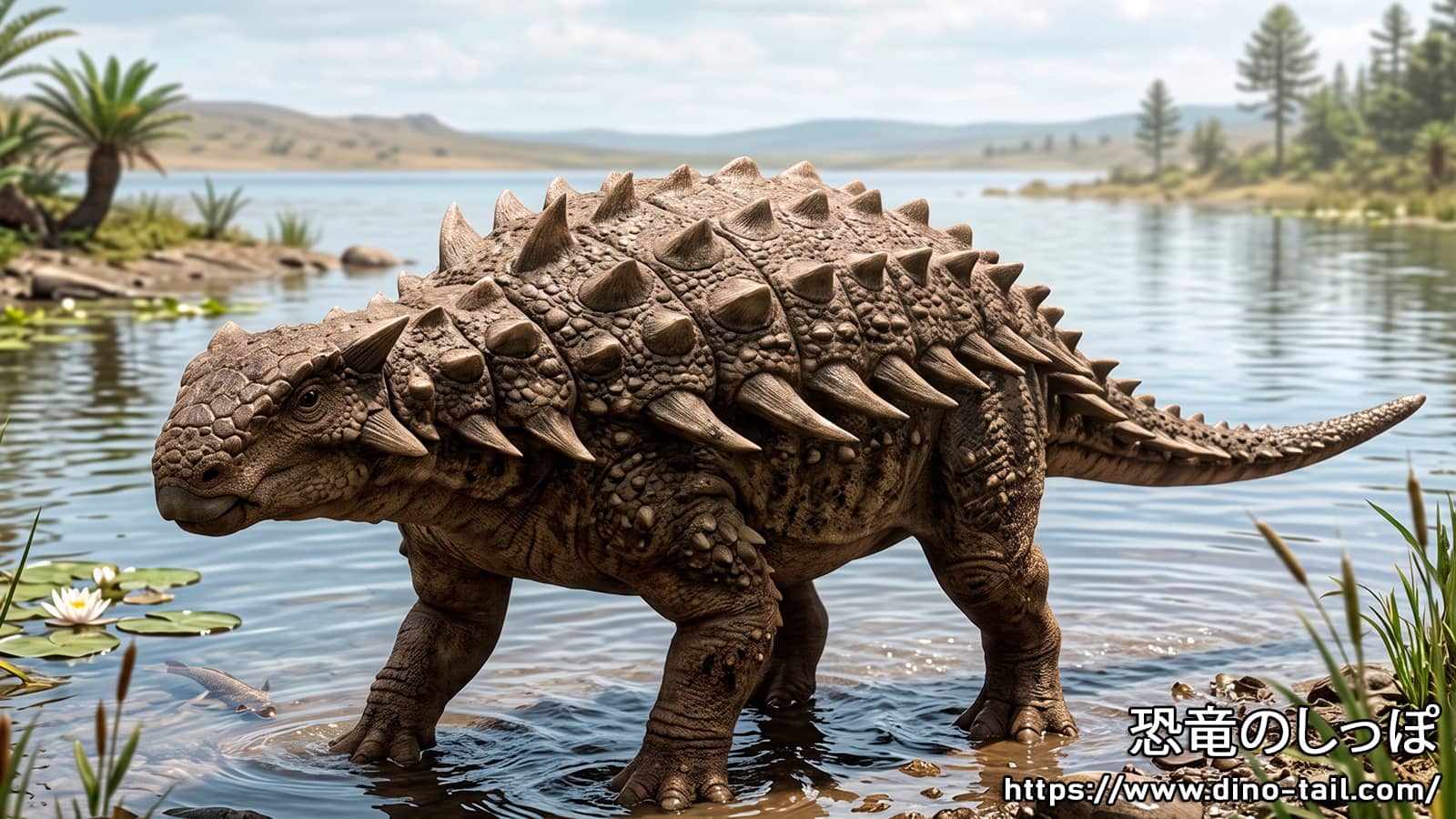
Based on the size of the skull and other elements, Nipponopelta is estimated to have been a medium-sized nodosaurid reaching about 5 meters in length. It was a heavily built, quadrupedal herbivorous dinosaur, thought to have been covered in robust bony armor and spike-like projections from its back to its tail.
Dentition and Advanced Adaptation of the Masticatory Organs
In the holotype specimen, about 11 to 12 isolated or detached teeth were preserved mixed in. Furthermore, two intact tooth crowns completely preserved within the matrix were identified by CT scanning.
Nipponopelta's teeth are relatively large compared to the overall size of its skull, and present a laterally compressed, palmate (leaf-like) shape. A shelf-like "cingulum" is developed on the side of the tooth crown, and multiple vertical grooves can be seen on the surface. These structures confirm that Nipponopelta had advanced masticatory adaptations for efficiently shearing (chopping up) highly fibrous ferns and early angiosperms.
Paleoneuroanatomy: Behavioral Patterns Suggested by the Inner Ear Structure (Semicircular Canals)
One of the greatest achievements of the CT scanning was the digital reconstruction of the left inner ear (semicircular canals) structure. Nipponopelta is only the second Asian nodosaurid in history to have its inner ear structure confirmed.
The semicircular canals are the organs that control an animal's sense of balance. It was found that Nipponopelta's semicircular canals tend to be relatively short and have a simple structure.
This suggests that they did not have an agile lifestyle requiring an advanced sense of balance, but rather had a relatively sluggish, slow-moving behavioral pattern. In other words, neuroanatomically, it supports an ecological model where, instead of quickly fleeing from predators like carnivorous dinosaurs, they survived attacks by lying flat on the ground and taking a defensive posture, taking advantage of their strong armor.
Phylogenetic Analysis: Deep Nesting within North American Taxa
What drew the most attention in the paleontological community in the descriptive paper was the phylogenetic placement of Nipponopelta.
Generally, dinosaur fossils found in Japan are often closely related to dinosaur groups on the Asian continent, but the phylogenetic analysis of Nipponopelta presented surprising results that overturned conventional wisdom.
Sister-Group Relationship with Derived North American Taxa
As a result of the analysis, Nipponopelta was located in a position phylogenetically distant from Asian taxa such as China's Dongyangopelta, and was placed deep within the phylogenetic tree of more evolved, derived nodosaurids.
Surprisingly, the taxon that formed the closest sister-group relationship with Nipponopelta was Pawpawsaurus, which was found in North America (Texas).
| Taxon / Clade Name | Locality | Summary of Phylogenetic Placement |
|---|---|---|
| Basal groups like Dongyangopelta | Asia | Early diverging groups of Nodosauridae. Distant direct phylogenetic relationship with Nipponopelta. |
| Taohelong | Asia | Relatively close to derived groups, but not the sister group to Nipponopelta among Asian species. |
| Edmontonia + Denversaurus Clade | North America | The most derived group of nodosaurids representing North America. |
| Pawpawsaurus | North America | A nodosaurid from Texas that forms a direct sister-group relationship with Nipponopelta. |
| Nipponopelta | Asia (Japan) | Nested deep within the North American clade, forming a sister group with Pawpawsaurus. |
This result presents the fascinating fact that "despite being a Japanese armored dinosaur, its closest relatives were not its fellow species on the Asian continent, but highly evolved nodosaurids that lived in North America and Europe."
Paleobiogeography and Dispersal Models: Migration Routes in the Late Cretaceous
The fact that Nipponopelta is deeply connected to derived nodosaurids of North America serves as powerful material for reconstructing the dispersal patterns of dinosaurs during the Cretaceous.
The Earth during the Late Cretaceous had remarkably high sea levels, but the eastern edge of the Asian continent and the northwestern part of the North American continent (Laramidia) were intermittently connected by land via the "Bering Land Bridge" in the area corresponding to the current Bering Strait. While it was well known that tyrannosaurids and ceratopsids (horned dinosaurs) migrated between continents using this route, it has now been suggested that heavily armored nodosaurids, which were often thought to have relatively low mobility, also used this vast migration route to disperse across continents.
Paleoecology and Taphonomy: The Coastal Hypothesis
Why was the fossil of Nipponopelta, a terrestrial herbivorous dinosaur, found in a marine stratum inhabited by ammonites?
Transport to the Ocean and "Bloat and Float"
The fact that the back of the skull and the first cervical vertebra were preserved in articulation in the holotype specimen indicates that Nipponopelta's remains did not completely skeletonize and fall apart on land before scattering into the sea.
What is Bloat and Float?
It is a process where, after a dead animal's remains wash out from a river into the sea, gases generated by internal putrefaction build up, causing the carcass to temporarily inflate and drift on the ocean surface. Because nodosaurids carry heavy armor on their backs, their center of gravity is biased toward the dorsal side. Thus, when the gas escapes and they sink to the seabed, they physically tend to land in a supine (belly-up) posture.
In the case of Nipponopelta as well, the fact that the isolated teeth were concentrated and fell into the dorsal side of the skull clearly tells the story of it sinking to the seabed in a supine position.
Adaptation to Coastal and Estuarine Environments
Nodosaurid fossils tend to be found in "marine strata" at an extremely high frequency compared to Ankylosauridae. The research team proposed that nodosaurids like Nipponopelta preferred to live in humid, richly vegetated terrestrial environments along the coast or around estuaries, rather than in dry inland environments.
This ecological characteristic of "preferring coastal areas" is believed to be the driving force that allowed them to widely disperse between Asia and North America across the Bering Land Bridge, using the coastal vegetation belts that stretched along the sea as a "green corridor."
References and Bibliography
- 日本初の鎧竜に名前がついた、夕張の頭骨は「ニッポノペルタ, https://zawatto.com/news/nipponopelta-yezoensis-yubari-yoroiryu-2026/
- Nipponopelta: The first Japanese ankylosaur - Total Dino, https://www.totaldino.com/dino/nipponopelta
- New Species of Armored Dinosaur Identified in Japan | Sci.News, https://www.sci.news/paleontology/nipponopelta-yezoensis-15014.html
- 日本発「新種の装甲恐竜」を発見、北海道で見つかった化石から判明, https://nazology.kusuguru.co.jp/archives/199032
- Scientists Just Identified Japan's First-Ever Armored Dinosaur, https://dailygalaxy.com/2026/08/first-armored-dinosaur-found-hidden-skull/
- A new nodosaurid ankylosaur (Dinosauria: Ornithischia) from the, https://www.researchgate.net/publication/413252367_A_new_nodosaurid_ankylosaur_Dinosauria_Ornithischia_from_the_Upper_Cretaceous_Hikagenosawa_Formation_in_Japan_reveals_dispersal_pattern_of_Asian_nodosaurid_ankylosaurs
- 日本最古のヨロイ竜類の歯化石の発見について - 福井県立恐竜博物館, https://www.dinosaur.pref.fukui.jp/research/201711ankylo/
- Nipponopelta yezoensis, Japan's First Definitive Ankylosaur, https://blog.everythingdinosaur.com/blog/_archives/2026/08/30/nipponopelta-yezoensis-the-first-definitive-ankylosaur-from-japan.html