A Discovery Overturning the Ecosystem of Southern Gondwana
In July 2026, a research paper on a new species of dinosaur excavated from Zimbabwe in southern Africa was published in the prestigious paleontological journal "Journal of Systematic Palaeontology".
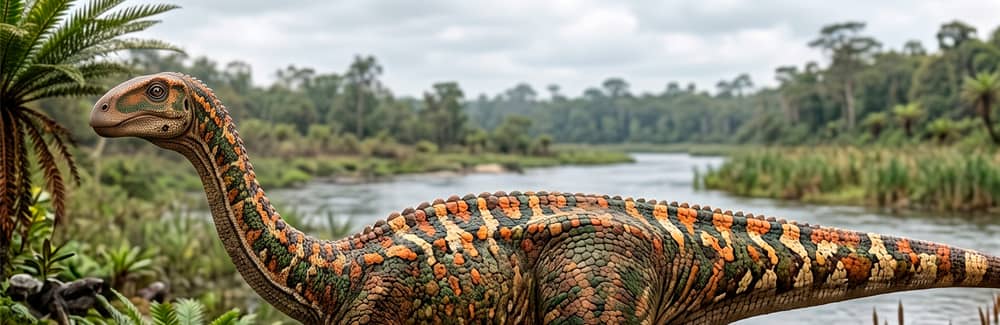
Named by an international research team from the UK, South Africa, Zimbabwe, and others, this new species is an early sauropodomorph dinosaur and was named Musango matusadonaensis. The genus name "Musango" means "dwelling in the bush" in the local Shona language, derived from the place name on the shores of Lake Kariba where the fossil was discovered. It is the fifth dinosaur officially named from Zimbabwe in history.
Until now, it was thought that similar dinosaurs lived in southern Africa around 210 million years ago (Late Triassic) (a homogeneous ecosystem). However, the discovery of Musango provided evidence that the ecosystem at the time was diverse and had regional characteristics.
The Excavated Stratum and the Harsh Natural Environment of the Time
Musango fossils were excavated from the "Pebbly Arkose Formation," a stratum exposed on the southern shore of Lake Kariba in northern Zimbabwe.
Detailed examination of the stratum's components and tracks left by invertebrates revealed that this area at the time was a dynamic floodplain where the flow of rivers changed significantly. It had distinct dry and wet seasons; a harsh environment that was flooded during the wet season and dried up during the dry season. On the other hand, a rich waterside ecosystem seems to have been formed.
Accurate Age Revealed by Radiometric Dating:
For a long time, it was considered difficult to determine the exact age of Zimbabwe's strata. However, in recent studies, "radiometric dating" using uranium and lead isotopes was conducted, revealing that the stratum where Musango was found was deposited about 209.2 million years ago (Norian stage of the Late Triassic). This has made it possible to know with higher accuracy the ecosystem just before the supercontinent Pangea began to split.
| Stratum Name | Estimated Geological Age | Main Characteristics and Fossils |
|---|---|---|
| Batoka Basalt | Early Jurassic | Vast basaltic lava. Indicates active volcanic activity. |
| Forest Sandstone Formation | Early Jurassic | Desert stratum. Primitive sauropods like Vulcanodon have been discovered. |
| Pebbly Arkose Formation | Late Triassic (Norian) | Floodplain stratum. Diverse dinosaurs like Musango and Musankwa have been discovered. |
A "Fully Bipedal" Dinosaur with a Smart Physique
Gemini Generated Image
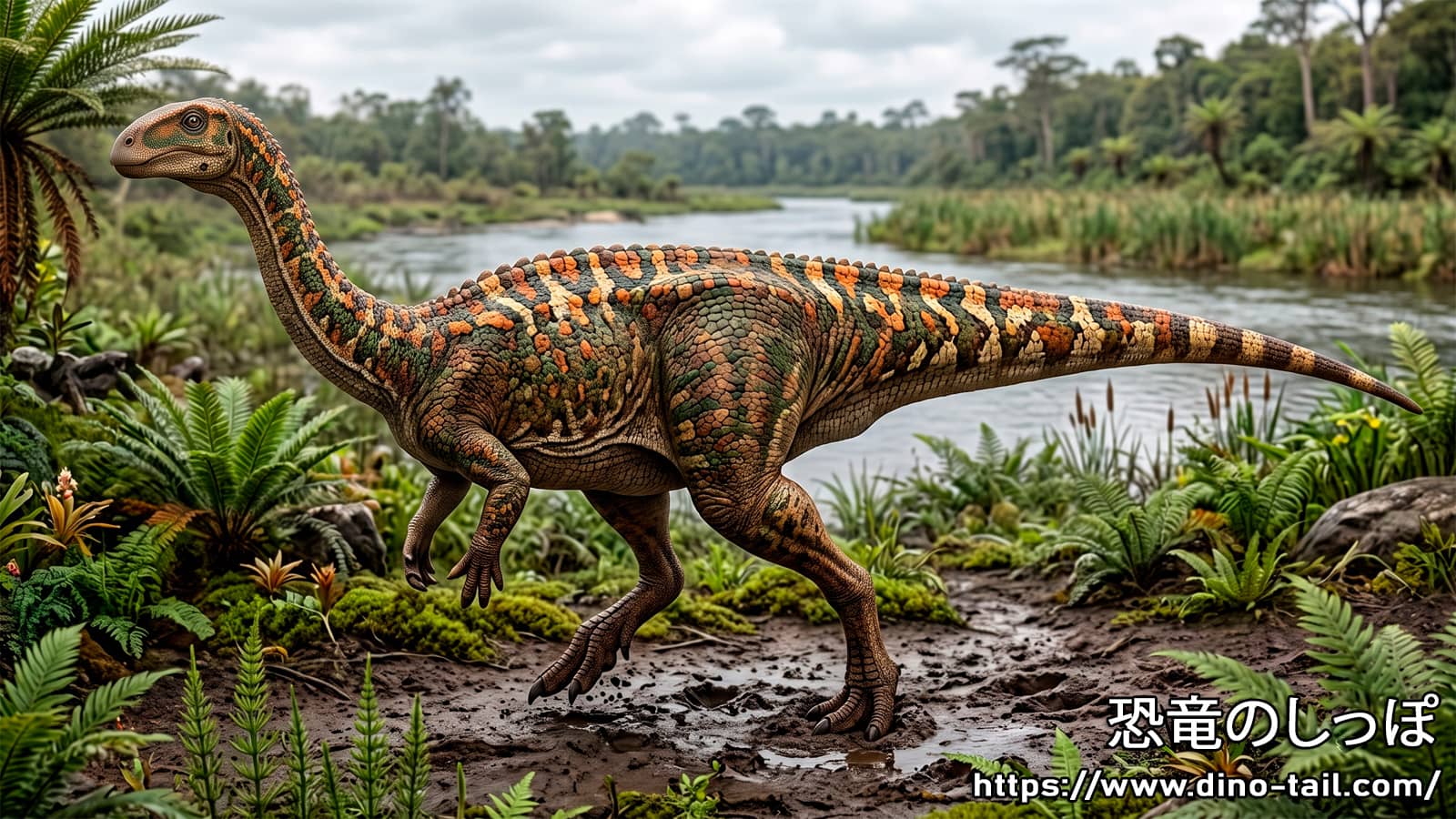
The discovered holotype specimen (the reference fossil) did not include the skull or femur, but parts of the spine, tail bones, pelvis, and hind legs were found together.
What was characteristic was the structure of the ilium (part of the pelvic bone). Depressions and ridges indicating strong muscle attachment were well-developed, showing that it had a solid structure for powerfully moving its hind legs (a traction mechanism such as the caudofemoralis muscle).
Accurate weight estimation is difficult without a femur, but calculated from the thickness of the remaining bones, the weight was estimated to be about 222 kg. The total length inferred from closely related dinosaurs is about 4.5 meters.
While the giant sauropods (like Brachiosaurus) that appeared in later eras walked on four log-like legs, Musango, an early sauropodomorph, is thought to have been an obligate bipedal (always walking on two legs) dinosaur that maintained a relatively lightweight physique and was agile.
Distant Relatives and Close Rivals
Through phylogenetic analysis using vast amounts of data, Musango was found to belong to a group called the "Unaysauridae". This group of dinosaurs is specific to regions that were once connected by land as the Gondwana continent, such as Brazil and India. They began to have longer necks to eat leaves growing high on trees, and had a body structure that increased stability when walking on two legs.
Sister-like Dinosaurs Living in the Same Place
What drew the most attention in the study was that Musango had a very close, sister-like relationship with "Musankwa (Musankwa sanyatiensis)" discovered from the same stratum.
Musankwa was a large dinosaur weighing over 400 kg. The fact that two closely related yet differently sized dinosaurs coexisted in the same place at the same time indicates a high possibility that they successfully shared food and living spaces (niche partitioning) to avoid direct conflict.
| Dinosaur Name | Region Discovered | Main Characteristics |
|---|---|---|
| Unaysaurus | Brazil | Representative of the Unaysauridae. Small and walked on two legs. |
| Macrocollum | Brazil | Had an extremely long neck, adapted to eating plants in high places. |
| Musankwa | Zimbabwe | Large species weighing over 400kg. Lived in the same place as Musango. |
| Musango | Zimbabwe | Lightweight bipedal species. |
An "8-Year-Old Growth Record" and "Amazing Recovery Power" Told by Bones
To investigate the age and growth speed of the dinosaur, a "bone histology" study was conducted by slicing Musango's leg bone (fibula) thinly and observing it under a microscope.
Lines of Arrested Growth Engraved Like Tree Rings:
The cross-section of a dinosaur's bone leaves lines called "LAGs (Lines of Arrested Growth)" when growth temporarily stops, such as at the turn of seasons. By counting these lines like tree rings, we can estimate how old the dinosaur lived to be.
As a result of the analysis, it was found that this Musango had reached at least 8 years old at the time of death. More importantly, it was confirmed from the tissue that the bone growth speed had already slowed down at 8 years old, approaching adult size.
This means that the Unaysaurid sauropodomorphs of the Late Triassic had not yet acquired the mechanism of later giant sauropods to continue growing over decades.
Traces of Overcoming Severe Injury (Paleopathology)
Another surprising discovery is that the skeleton retained traces of suffering a severe trauma (injury) or infection, and subsequently recovering from it.
Surviving for a long time in a harsh wild environment despite a potentially fatal injury suggests that the rich natural environment along the river allowed it to secure food without moving long distances. It is also attracting attention as evidence showing the possibility that early sauropodomorphs had a strong immune system and high metabolism like modern birds and mammals.
Zimbabwe's "Big Five" and Future Research
Until now, it was thought that "the same kinds of Triassic dinosaurs lived everywhere in southern Africa." However, as a result of examining Musango's fossil in detail, it became clear that there are no common species between the dinosaurs of Zimbabwe and those of South Africa.
Even within the supercontinent Pangea, animals were not able to move freely, but were blocked by large valleys (rift valleys) or differences in climate, and evolved independently in their respective regions. "The ecosystem at the time was a mosaic of small areas with different characteristics," the researchers say.
| Scientific Name | Geological Age | Characteristics |
|---|---|---|
| Megapnosaurus | Early Jurassic | Small carnivorous dinosaur. Believed to have moved in packs. |
| Vulcanodon | Early Jurassic | Primitive sauropod. Retains the appearance of when they started walking on four legs. |
| Mbiresaurus | Late Triassic | One of the oldest dinosaurs in Africa. |
| Musankwa | Late Triassic | Large early sauropodomorph weighing over 400kg. |
| Musango | Late Triassic | Lightweight bipedal dinosaur. Had strong vitality to recover from injuries. |
The discovery and study of Musango is only the "tip of the iceberg" of the paleontological potential held by the land of Zimbabwe. The research team has already reported that they have other unnamed fossils in storage, and future investigations will undoubtedly further unravel the mystery of the process by which dinosaurs came to dominate the Earth.
References and Bibliography
- A new sauropodomorph dinosaur from the Pebbly Arkose Formation (Upper Triassic: Norian) of Kariba, Zimbabwe - Taylor & Francis, https://www.tandfonline.com/doi/full/10.1080/14772019.2026.2678610
- New Species of Triassic Dinosaur Discovered on Shores of Zimbabwe's Lake Kariba, https://www.sci.news/paleontology/musango-matusadonaensis-14955.html
- Scientists discover new dinosaur species in Zimbabwe | APAnews - African Press Agency, https://apanews.net/scientists-discover-new-dinosaur-species-in-zimbabwe/
- Musango matusadonaensis - Newly Described Sauropodomorph - Everything Dinosaur Blog, https://blog.everythingdinosaur.com/blog/_archives/2026/07/29/musango-matusadonaensis-from-zimbabwe.html