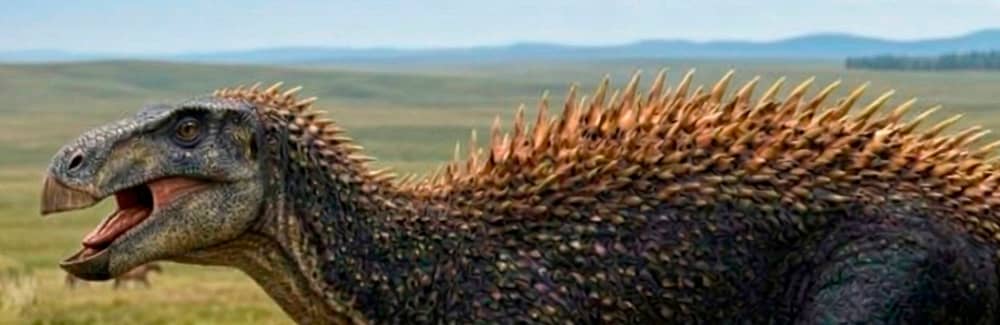
From the Jehol Biota in China comes an astonishing discovery that overturns previous images of dinosaurs. It is a new species of iguanodontian, "Haolong dongi."
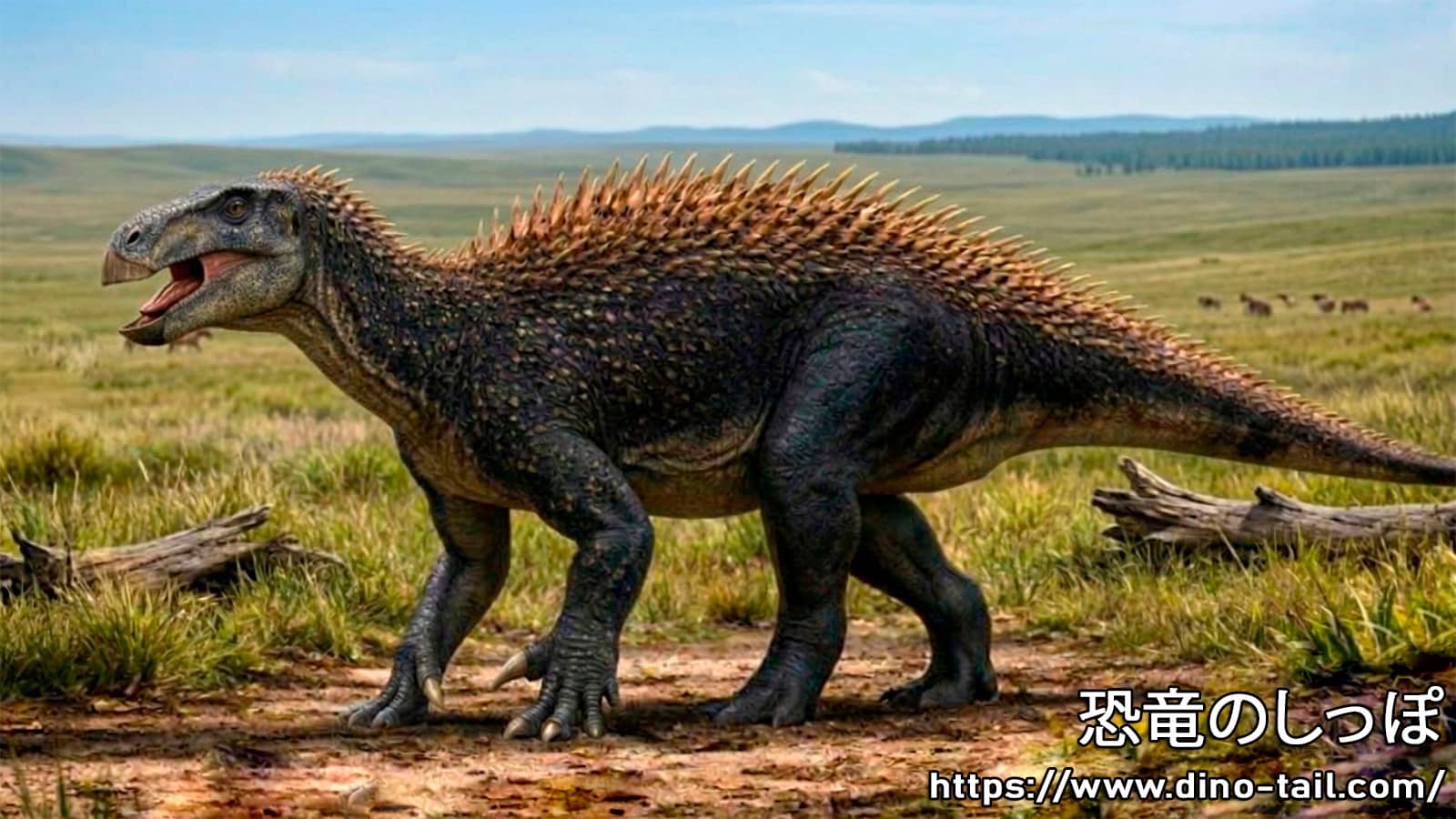
Announced in February 2026, this dinosaur differed from the traditional image of iguanodontians by being equipped with "hollow cutaneous spikes" all over its body.
- Unique cutaneous spikes: Hollow, cylindrical keratinous spikes scattered over the body like a porcupine.
- Miraculous preservation: A fossil with cellular-level microstructures preserved down to the cell nuclei.
- New defense strategies: Potential roles against predators, in thermoregulation, or as sensory organs.
On this page, we explain in detail the unique skin structure of Haolong dongi, which conveys 125 million-year-old cellular structures to the present, and its impact on the evolutionary history of dinosaurs, incorporating the latest research findings.
Introduction: A Discovery That Overturns Existing Knowledge
The research findings published on February 6, 2026, in the academic journal Nature Ecology & Evolution fundamentally overturned existing knowledge about the integumentary system of dinosaurs.
A new species of iguanodontian, "Haolong dongi," discovered in the Lower Cretaceous strata (about 125 million years ago) in northeastern China, was revealed through cellular-level microstructural analysis to possess "hollow cutaneous spikes," a feature never before confirmed in any dinosaur fossil.
This report comprehensively explains the details of this innovative discovery, the preservation state of the specimen, its histological characteristics, and its significance in the evolutionary history of dinosaurs.
Geological Background and Specimen Overview
Gemini Generated Image
The holotype specimen of Haolong dongi (AGM 16793) was excavated from the Yixian Formation of the Jehol Group, distributed in Liaoning Province, China. This region is world-renowned for the "Jehol Biota," an area with exceptionally well-preserved fossils, where numerous important discoveries such as feathered dinosaurs, early birds, mammals, and angiosperms have been made.
Depositional Environment and Taphonomy of the Yixian Formation
Northeastern China during the Early Cretaceous, where Haolong lived, was a lake and swamp region with active volcanism. The sediments consisted of fine volcanic ash and silt, creating an ideal preservation environment where carcasses were rapidly buried, protecting them from oxygen decomposition and damage by scavengers.
What is authigenic mineralization:
A notable aspect of the Haolong specimen is the preservation mode of its soft tissues. Usually, dinosaur skin is left mostly as impressions (molds), but in the case of Haolong, a phenomenon called "authigenic mineralization" occurred, where the microstructures down to the nuclei inside the cells were replaced and mineralized by calcium phosphate. This rare preservation state has made it possible to directly observe biological information at the cellular level from 125 million years ago.
Morphological Features of the Holotype Specimen
The discovered individual is a nearly complete skeleton measuring approximately 2.45 m (8 feet) in total length, unearthed in an articulated state. Histological analysis of the bones and the closure status of the neurocentral sutures indicate that this individual was still a juvenile at the time of death.
| Item | Detail Data |
|---|---|
| Scientific Name | Haolong dongi |
| Specimen Number | AGM 16793 (Holotype) |
| Discovery Site | Liaoning Province, China (Yixian Formation) |
| Period | Early Cretaceous (approx. 125 Ma) |
| Total Length | Approx. 2.45 m |
| Growth Stage | Juvenile |
| Classification | Ornithischia, Iguanodontia (basal hadrosauroid) |
Taxonomic Status and Phylogeny
The name Haolong dongi was given as a dedication to Dr. Dong Zhiming, a pioneer of Chinese paleontology. The genus name "Haolong" means "Spiny Dragon" in Chinese, symbolizing its unique integumentary structure.
Positioning within Iguanodontia
As a result of phylogenetic analysis, it was revealed that Haolong is positioned as a basal hadrosauroid within the Iguanodontia, close to the lineage of the Hadrosauridae (commonly known as "duck-billed dinosaurs") that flourished later in the Late Cretaceous.
Previously, based on the study of "mummified" specimens, the skin of the Hadrosauroidea was thought to consist mainly of non-overlapping, polygon-shaped tubercle-like scales. However, the discovery of Haolong suggests that during the early evolutionary stages of this group, there were species equipped with highly complex and aggressive defensive armaments reminiscent of modern mammals like porcupines.
Detailed Analysis of the Integumentary System: Three Types of Appendages
The entire body of Haolong was covered with three main types of integumentary structures, varying by region. These structures demonstrate a diversity that overturns the traditional concept of "monotonous scaly skin" in dinosaur imagery.
1. Imbricating Scales on the Tail (Scutate Scales)
At the distal end of the tail, large, mutually overlapping "scutate scales" were confirmed. These scales take an imbricating arrangement, similar to the scales of modern lizards and snakes, where the front and rear scales overlap. Since the overlapping of scales tends to disappear in later hadrosaurs, the tail of Haolong shows a more ancestral or uniquely evolved form of armor, which is thought to have played a role in increasing physical defense without hindering the movement of the tail.
2. Tuberculate Scales on the Neck and Trunk
From the neck to the trunk, a basement layer was formed by small, non-overlapping "tuberculate scales." These scales were arranged irregularly, functioning as "basement scales" that protected the whole body while maintaining the skin's flexibility. The thickness of the stratum corneum is measured at about 90 μm, which is close to the value of the stratum corneum in the scales of modern crocodiles and birds.
3. Hollow Cutaneous Spikes
The "cutaneous spikes," which are the most prominent feature of this species, grew scattered among the scales on the neck, back, and flanks. They vary in size, ranging from a minimum of about 2 mm to a maximum of 44.2 mm (about 1.7 inches). Cross-sectional analysis revealed that these spikes are "cylindrical" with a hollow or porous internal structure. Furthermore, they are composed of keratin derived from the skin, rather than bony tissue (osteoderms), making them developmentally completely different from the armor plates of ankylosaurs.
| Cutaneous Appendage Type | Location | Structural Features | Estimated Function |
|---|---|---|---|
| Scutate Scales | Tail | Imbricating, shield-like | Physical protection, ensuring flexibility |
| Tuberculate Scales | Neck and Trunk | Small, non-overlapping, irregular | Basic skin protection |
| Spikes | Entire body (between scales) | Hollow, cylindrical, keratinous | Defense, thermoregulation, sensory reception |
Histological and Cellular-Level Findings
The most shocking data provided by the Haolong fossil is its fine histological structure. High-resolution X-ray micro-CT scanning and observation of histological sections have recreated a "skin anatomy" of an organism from over 100 million years ago.
From the histological sections of the cutaneous spikes, the following layer structures were confirmed:
- Stratum Corneum: The highly keratinized layer forming the outermost layer.
- Pluristratified Epidermis: A layer of living cells beneath the stratum corneum. Here, "keratinocytes," the cells that produce keratin, are preserved along with their cell nuclei.
- Dermal Pulp: A porous core in the center of the spike. In life, blood vessels and nerves are presumed to have passed through here, supporting the growth of the spike.
Such cellular-level preservation has opened an unprecedented window into understanding the physiology, metabolism, and growth processes of dinosaurs. In particular, it has been pointed out that analyzing the shape and density of the cell nuclei could potentially allow researchers to estimate Haolong's growth rate and genome size in the future.
Functional Morphology and Adaptive Strategies
Why did Haolong dongi evolve such unique weaponry? The research team has proposed hypotheses from three perspectives: defense, thermoregulation, and sensory reception.
Defense Mechanism: Countermeasure Against Predators
The most prominent theory is an adaptation to predation pressure in the ecosystem of the time. The Yixian Formation was inhabited by many small to medium-sized theropods (e.g., therizinosaurs, dromaeosaurs, and early tyrannosaurs). Many small predators employ tactics of swallowing prey whole or biting off specific parts. Sharp, hollow spikes scattered all over the body, like those of a porcupine, would have acted as a strong deterrent against predators carelessly biting into Haolong. Also, the fact that the Haolong specimen was a juvenile suggests the possibility that these spikes were "juvenile-specific armor" intended to increase the survival rate during a particularly vulnerable growth stage.
Physiological Function: Aid in Thermoregulation
The second hypothesis is a thermoregulatory function by increasing surface area. It is known that this region during the Early Cretaceous was relatively cool, with an average temperature of about 10°C (50°F). The hollow structure, being lightweight while increasing surface area, may have contributed to heat absorption from sunlight or the release of excess body heat. While Yutyrannus, a large dinosaur from the same period, kept warm with thick feathers, Haolong may have adapted to the environment using a different method: spikes.
Sensory Function: Potential as Mechanoreceptors
The research team also mentions the possibility that these spikes functioned as sensory organs (mechanoreception). Some modern snakes sense surrounding vibrations through bristle-like structures on their body surface. It has been speculated that Haolong's spikes also played the role of "sensors" to detect air vibrations caused by the approach of predators or while moving through dense vegetation and forests.
Evolutionary Significance and Conclusion: Beyond the Scale vs. Feather Dichotomy
The discovery of Haolong dongi has fundamentally changed how we perceive the "evolution of skin" across the entire dinosaur family tree. Previously, the body surface of dinosaurs was often discussed in a simple dichotomy: ornithischians with scales and some theropods with feathers. However, Haolong's spikes are the result of an independent evolutionary path, structurally distinct from both feathers and the spikes of modern lizards.
| Comparison Target | Differences from Haolong's Cutaneous Spikes |
|---|---|
| Protofeathers | Feathers have a branching structure, whereas Haolong's spikes are single and cylindrical. Their internal structures are also different. |
| Ankylosaurus Armor Plates | While they are bony tissues (dermal bone), Haolong's spikes are keratin derived from the epidermis. |
| Modern Lizard Spikes | They are simply pointed skin scales and do not have the complex hollow structure or internal pulp layer seen in Haolong. |
Filamentous or bristle-like structures in ornithischians have been previously reported in dinosaurs like Kulindadromeus and Psittacosaurus. While Haolong shares commonalities with these, it is decisively unique in having "hollow spikes scattered all over its body." This confirms that even within ornithischians, the evolution of the integument proceeded independently and in a highly complex manner across multiple lineages.
Conclusion and Future Research Directions
The discovery of Haolong dongi has once again demonstrated the importance of "soft tissue preservation" in paleontology. The fact that such a surprise was hidden within the 200-year history of iguanodontian research tells us that we have only grasped a fragment of the true nature of dinosaurs.
In the future, the discovery of adult specimens is awaited to know whether these spikes seen in juveniles fall off as they grow or evolve into more robust armor. Furthermore, if the analysis of melanosomes progresses, its body color and patterns will be revealed.
Haolong dongi has pushed the limits of the biological diversity and adaptive capabilities of dinosaurs. Through chemical analysis and further high-resolution imaging, the story of this 125 million-year-old "spiny dragon" will become even clearer.
References and Bibliography
- A dinosaur with spikes exhibiting unprecedented properties ... - CNRS, https://www.cnrs.fr/en/press/dinosaur-spikes-exhibiting-unprecedented-properties-discovered-china
- Paleontologists Unearth New Dinosaur Species with Never-Before ..., https://www.sci.news/paleontology/haolong-dongi-14545.html
- Haolong dongi: Newly unearthed fossil gives scientists unprecedented look at dinosaur skin, https://www.independent.co.uk/news/science/dinosaur-fossil-skin-haolong-dongi-b2916538.html
- Cellular-level preservation of cutaneous spikes in an Early Cretaceous iguanodontian dinosaur | Request PDF - ResearchGate
- This 125 Million-Year-Old Dinosaur Had Spikes Like a Porcupine - SciTechDaily, https://scitechdaily.com/this-125-million-year-old-dinosaur-had-spikes-like-a-porcupine/