Introduction: Continuity of Evolution into Birds and New Discoveries
Over the past few decades, remarkable progress in paleontology has fundamentally overturned our understanding of the evolutionary process from dinosaurs to birds. Archaeopteryx was once considered the sole symbol of the origin of birds and the evolution of flight, but today, it is proven that many non-avian dinosaurs possessed complex feathers, and some even had the ability to glide or perform limited powered flight.
In June 2026, a research team led by Xing Xu of the Institute of Vertebrate Paleontology and Paleoanthropology (IVPP), Chinese Academy of Sciences, reported the discovery of a new genus and species of small theropod with extremely unique morphology, Changzhousaurus sinensis, in the academic journal "Vertebrata PalAsiatica".
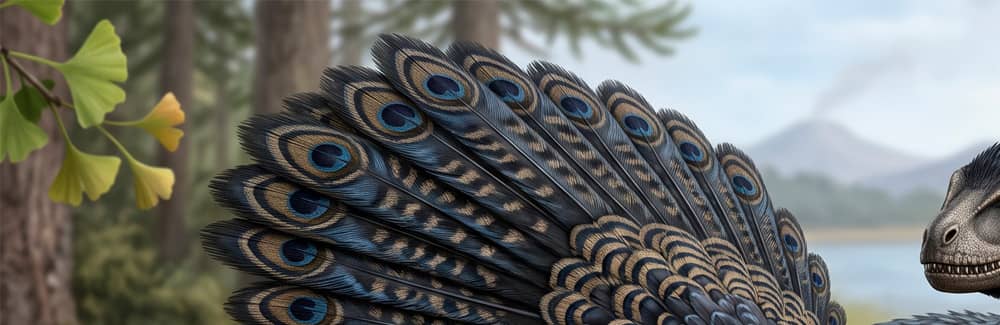
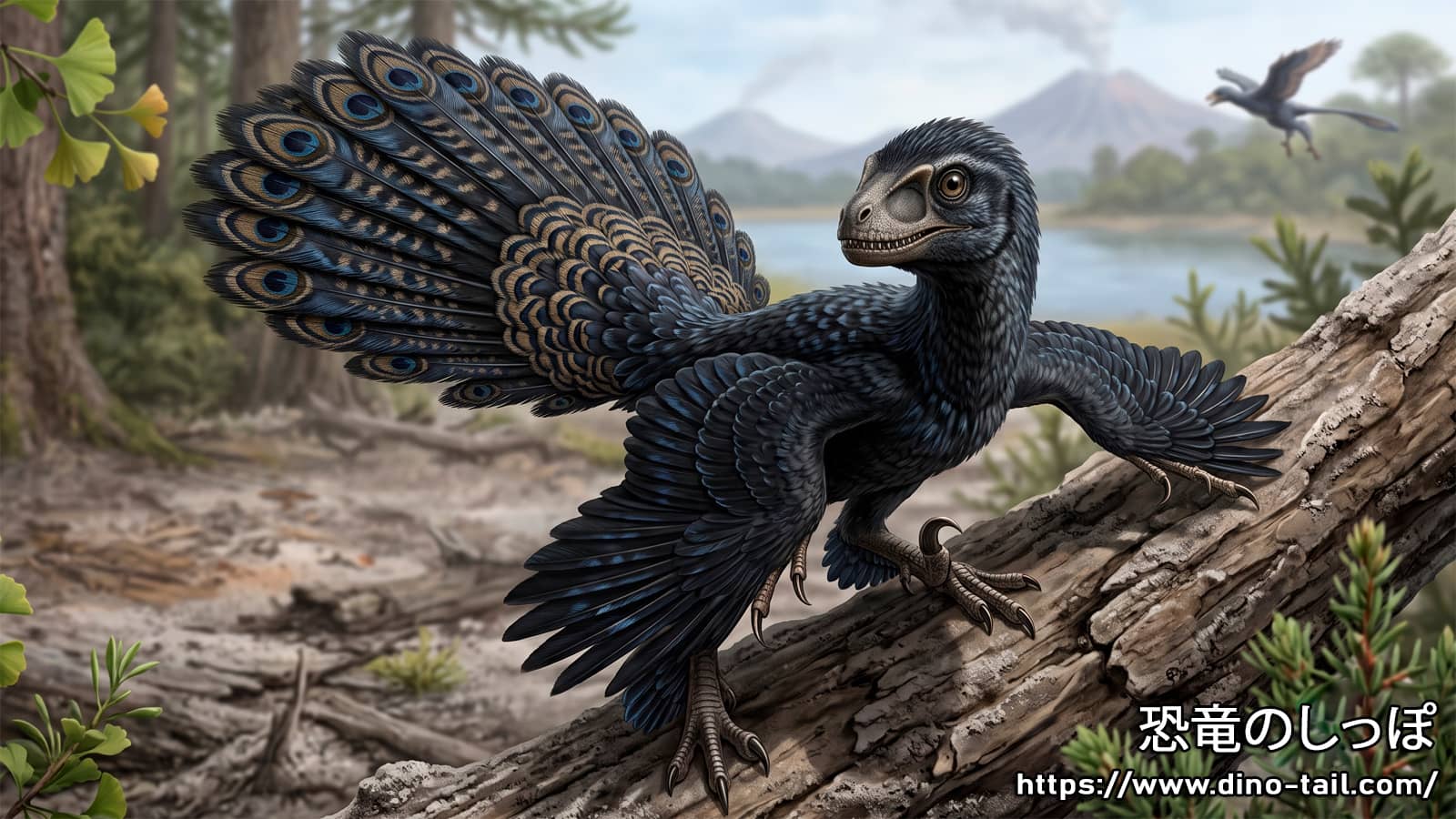
This "four-winged" dinosaur, which combines short forelimbs with disproportionately giant wings, hindlimb wings, and long tail feathers reminiscent of a peacock, demonstrates that the evolution of dinosaurs closely related to early birds (Pennaraptora) was more complex than previously assumed.
Geological Background and Paleoecology
Gemini Generated Image
The fossil of Changzhousaurus was excavated from the Jiufotang Formation located in Jianchang County, Liaoning Province, China. This formation was deposited during the Aptian stage of the Early Cretaceous period (about 120 million years ago) and is one of the important layers that make up the world-famous "Jehol Biota".
Depositional Environment of the Jiufotang Formation
The area around Liaoning Province at that time was an environment where volcanic activity and lakes were closely intertwined. The climate was transitioning to a warm and humid state, but climate changes such as cooling and seasonal droughts occurred frequently.
"Taphonomy" that brought about miraculous preservation:
Fine volcanic ash brought by frequent volcanic activity rapidly buried the carcasses of organisms that sank in the anoxic mud at the bottom of the lake. This unique fossilization process (taphonomy) was the biggest factor in forming a "Lagerstätte" (a fossil site with exceptionally good preservation) that preserves soft tissues and delicate feather traces in extremely high resolution.
Coexisting Flora and Fauna
The ecosystem of the Jiufotang Formation was composed of a wide variety of biological groups. Plants such as ginkgoes and ferns still dominated, but early angiosperms (flowering plants) were also beginning to advance. The airspace and canopy were dominated by a diverse range of archosaurs.
| Group | Representative Genus | Ecological Features and Notes |
|---|---|---|
| Early Birds | Jeholornis | A seed eater about the size of a turkey. Retains basal morphology. |
| Sapeornis | A large glider with a wingspan reaching 1.4m. Frugivorous and arboreal. | |
| Longipteryx | A piscivorous enantiornithine with long jaws. | |
| Confuciusornis | A bird with a horny beak. | |
| Non-avian Theropods | Microraptor | A small predator with four wings, covered in black feathers with blue structural coloration. |
| Sinotyrannus | A large proceratosaurid predator reaching a total length of about 7m. |
Discovery and Taxonomic Positioning
The holotype of Changzhousaurus sinensis was excavated with its entire skeleton articulated, and is currently housed in the Lande Museum of Natural History in Hebei Province, China.
Origin of the Name and Growth Stage
The genus name "Changzhousaurus" is derived from Changzhou City, Jiangsu Province, an eastern Chinese city actively promoting the popularization of paleontology. The species name "sinensis" means "of China" in Latin.
The total skeletal length of the holotype specimen is approximately 34 centimeters, and its weight is estimated to be about 200 grams, making it one of the smallest known non-avian theropods. Analysis of the degree of bone fusion revealed that the individual died at a "subadult" stage, not having reached full maturity.
Skeletal Morphology: Embodiment of Extreme Mosaic Evolution
The skeleton of Changzhousaurus exhibits a "mosaic evolution" in which features seen in Troodontidae, Dromaeosauridae, and Oviraptorosauria are complexly mixed.
From Skull to Limbs
The skull is small and has heterogeneous dentition (front teeth are closely packed without serrations, rear teeth are robust with serrations), suggesting it preyed on a wide range of prey, from insects to small vertebrates.
The very small number of caudal vertebrae (22) is also characteristic, sharing a common trend with the shortening of the tail (evolution into a pygostyle) seen in later birds.
The second toe of the foot has a "sickle claw" typical of Dromaeosauridae, and the claws of the hands and feet clearly preserved traces of long horny sheaths from when it was alive. This is thought to have functioned as a powerful predatory tool or a tool for climbing trees.
Integumentary System: Four-Winged Structure and Peacock-like Tail Feathers
The greatest academic value of Changzhousaurus lies in the extremely well-preserved traces of feathers covering its entire body.
Vast Forelimb Wings and Microraptor-like Hindlimb Wings
The most notable feature is the giant wings formed on the forelimbs. The primary flight feathers on the forelimbs reach a length of about 12 centimeters. For an animal with a body length of only 34 centimeters, this length is extraordinary, providing a vast wing area that more than compensates for the short forelimb bones.
Furthermore, it possessed well-developed feathers on its hindlimbs reaching up to 60 millimeters, and it is thought that, like Microraptor, the forelimbs and hindlimbs formed a "four-winged" biplane-like gliding surface.
Long Tail Feathers Reminiscent of a Peacock
At the tip of the tail, about 16 extremely elongated tail feathers spread out in a fan shape. The maximum length of these tail feathers reaches about four times the length of the femur, strongly reminiscent of the decorative tail feathers of modern peacocks. It is very unique that despite the skeleton of the tail being short, the feathers alone developed so long.
Complexity of Evolution and Four Challenges
Xing Xu, who led the research, points out that this "extraordinary" discovery presents four fundamental challenges to current paleontology.
- 1. Difficulty in constructing phylogenetic trees: Because features are mixed in a mosaic pattern, classification (calculation of a phylogenetic tree) into which group it belongs is very difficult. Also, the possibility that feathers were simply lost during the fossilization process (preservational artifacts) must be considered.
- 2. Decoupling of wing area and bone length: Conventionally, it was thought that wing area evolved in proportion to the length of arm bones. However, Changzhousaurus shows the fact that "the arm bones are short, but the feathers alone are abnormally long," proving that bone growth and feather growth evolved independently.
- 3. Estimation of flight behavior and habitat: While the giant front and hind wings are thought to have been useful for gliding, it is speculated that the long peacock-like tail feathers functioned strongly not only for aerodynamics but also as displays (appealing to the opposite sex) during the breeding season.
- 4. Reconsidering the definition of "bird" and "feather": Generally, a "bird" is recognized as an "animal that has feathers and flies." However, as "non-avian dinosaurs" with highly advanced bird-like feathers like Changzhousaurus are found, the gap between scientific classification and general perception is widening.
Conclusion and Future Prospects
The discovery of Changzhousaurus sinensis proved that an unusual small theropod with extremely long peacock-like tail feathers and giant wings inhabited the lake regions of northern China during the Early Cretaceous.
The structure shown by this species is solid evidence of "decoupling," where the evolution of wing area and skeletal length proceed independently, and is an important key to exploring the origin and evolution of dinosaur flight. In the future, further excavation of fossils with such transitional morphologies and an interdisciplinary approach integrating developmental biology and other fields will be the driving force in unraveling the great mystery of life history: the evolution into birds.
The holotype specimen is scheduled to be officially open to the public at the "China Dinosaur Museum" in Changzhou City, Jiangsu Province, in the future.
References and Bibliography
- Changzhousaurus: Giant Wings Despite Short Arms | Total Dino, https://www.totaldino.com/dino/changzhousaurus
- New Feathered Dinosaur from China Had Peacock-Like Tail | Sci.News, https://www.sci.news/paleontology/changzhousaurus-sinensis-14868.html
- Chinese Scientists Discover New Feathered Dinosaur Species, https://english.cas.cn/newsroom/cas-in-media/202606/t20260622_1174374.shtml
- 最新录用 - 古脊椎动物学报, https://www.vertpala.ac.cn/CN/article/showNewArticle.do
- Changzhousaurus - Wikipedia, https://en.wikipedia.org/wiki/Changzhousaurus
- Jiufotang Formation - Wikipedia, https://en.wikipedia.org/wiki/Jiufotang_Formation