
About Archelon
| Scientific Name (Genus) | Archelon |
| Meaning of Name | Ruling turtle, or primitive turtle (species name ischyros means "mighty, powerful") |
| Classification | Reptilia, Testudines, Cryptodira, Protostegidae |
| Total Length | Approx. 3.5-4.6m (Width approx. 4.0-4.9m, Estimated weight 2.2-3.2t) |
| Diet | Carnivorous (formerly thought to be omnivorous) |
| Period | Late Cretaceous Campanian (approx. 80.5 to 72 million years ago) |
| Sub-classification / Species Name | Archelon ischyros |
| Year of Paper Publication | 1896 |
| Genus Name Publication |
Archelon ischyros: a new gigantic cryptodire testudinate from the Fort Pierre Cretaceous of South Dakota.
American Journal of Science, 4th Series 2(12) Wieland, G. R. 1896. |
Characteristics: The Largest Sea Turtle in History
Archelon was the largest sea turtle in history, living in the "Western Interior Seaway," a vast inland sea that divided the North American continent from north to south during the Late Cretaceous period.

Even at the time of the discovery of the first specimen (Type specimen: YPM 3000) in 1895, it reached 3.52 meters in length. However, the largest complete skeleton specimen in history, "Brigitta," discovered in South Dakota, USA in 1992 and currently housed in the Natural History Museum Vienna, Austria, reaches a total length of about 4.6 meters, a width of about 4.0 to 4.9 meters across its extended front flippers, and an estimated weight of 2.2 to 3.2 tons. The skull of a large individual alone reached up to 100 centimeters (1 meter), boasting more than twice the length and nearly 3.5 to 5 times the mass of the leatherback turtle, the largest extant sea turtle (length approx. 2 meters, max weight approx. 650 kilograms).
Lightweight "Leathery Carapace" and Heavy "Star-shaped Plastron"
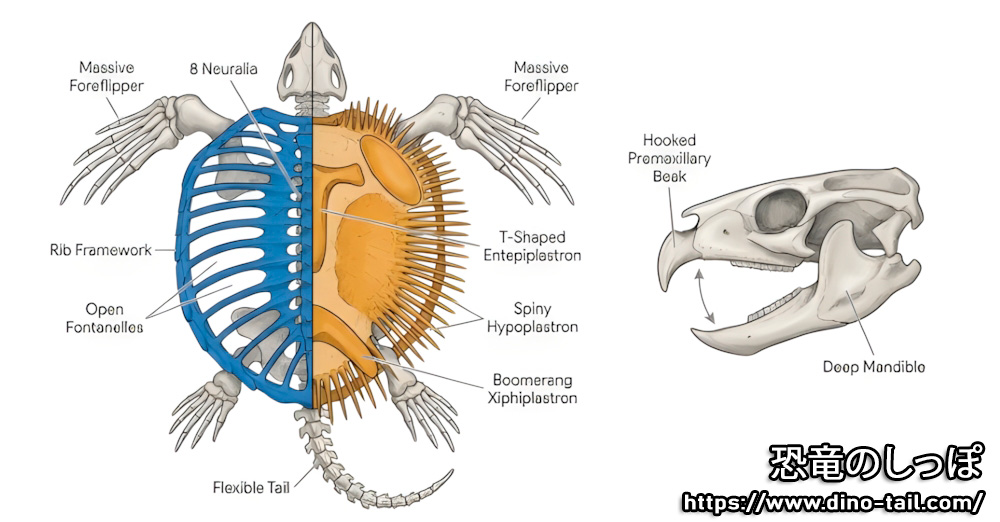
Left side (blue): Dorsal carapace, Right side (red): Ventral plastron
The secret to Archelon's massive size lies in its unique shell structure, which evolved completely differently on its back (carapace) and belly (plastron). The carapace on its back had completely lost the heavy, hard solid bone plates and surface scales (scutes) seen in common turtles. Instead, the ossification of the ribs was reduced, leaving large gaps (fontanelles) between the bones, and it is thought that a thick, tough leathery skin was stretched over this lightweight frame. Furthermore, the carapace bones themselves were a spongy, lightweight tissue similar to that of dolphins (cetaceans) and ichthyosaurs, helping to adjust the buoyancy of its over 2-ton body and save energy for swimming.
On the other hand, the "plastron" covering its belly was, in stark contrast to the carapace, extremely thick and heavy, reaching a maximum length of 2.1 meters. The plastron was strongly reinforced by four star-shaped groups of bones with radiating spikes. Particularly around the rear "hypoplastron," a total of 54 sharp spikes were lined up. This structure of "making the back as light as possible and the belly thick and sturdy" worked as "ballast" to stabilize its center of gravity when swimming in the open ocean, and also functioned as a shield to support its huge body when resting on the muddy seabed and to protect it from large predators attacking from below.

Additionally, its clawless forelimbs had evolved into huge paddle-like shapes, generating strong propulsion. While it usually cruised leisurely in the open ocean, it is estimated that in emergencies when fleeing from predators, it could achieve high-speed swimming reaching 30 to 35 kilometers per hour. Its tail, consisting of about 18 bones, could also be bent nearly 90 degrees horizontally, serving as a "rudder" for changing direction.
Comparison with Other Extinct Giant Turtles
Throughout Earth's history, there have been several other giant turtles besides Archelon. For example, the freshwater turtle "Stupendemys (Stupendemys geographicus)," which lived in the rivers and wetlands of South America about 5 million years ago (Late Miocene of the Neogene), had a carapace length alone that reached a maximum of 3.3 meters, surpassing Archelon (carapace length approx. 1.9 to 2.2 meters) in "carapace length" alone.
Furthermore, the largest sea turtle in Europe, "Leviathanochelys (Leviathanochelys aenigmatica)," reported from Late Cretaceous strata in Spain in 2022, reached an estimated total length of about 3.7 meters and an estimated weight of about 2 tons. Its pelvic width of about 88.9 centimeters slightly exceeded Archelon's pelvic width (81 centimeters). This discovery indicates that the gigantism of sea turtles in the Late Cretaceous seas occurred independently in separate marine regions and distinct lineages, namely North America and Europe. However, in terms of comprehensive total length (4.6 meters) including the long head, tail, and huge flippers, and estimated weight (max 3.2 tons), Archelon still holds the record as the "largest turtle in history."
| Species Name (Scientific Name) | Taxonomic Group / Habitat Environment | Period / Region | Total Length (Max Estimated) | Carapace Length / Pelvis Width | Estimated Weight |
|---|---|---|---|---|---|
| Archelon (Archelon ischyros) |
Protostegidae (Shallow sea to open ocean) |
Late Cretaceous (North America) |
4.6 m (Width 4.0-4.9m) |
Carapace length approx. 1.9-2.2 m Pelvis width 81.0 cm |
2.2-3.2 t |
| Leviathanochelys (Leviathanochelys aenigmatica) |
Basal Chelonioidea (Open ocean) |
Late Cretaceous (Europe, Spain) |
Approx. 3.7 m | Carapace is partially preserved Pelvis width 88.9 cm |
Approx. 2.0 t |
| Protostega (Protostega gigas) |
Protostegidae (Shallow sea to open ocean) |
Late Cretaceous (North America) |
Approx. 3.0-3.4 m (Width 4.7 m) |
Carapace is lightweight/reduced | Approx. 1.5 t |
| Stupendemys (Stupendemys geographicus) |
Pleurodira (Freshwater, large rivers) |
Late Miocene (South America) |
Approx. 3.5-4.0 m | Carapace length max 3.3 m (Width 2.2 m) |
Approx. 1.25 t (Some estimates >2t) |
| Leatherback Sea Turtle (Largest extant species) (Dermochelys coriacea) |
Dermochelyidae (Open ocean) |
Extant (Global oceans) |
Approx. 2.0 m | Carapace length approx. 1.5-1.8 m | Max approx. 0.65 t (650 kg) |
Relationship with Leatherback Turtles: The Identical Appearance is a Result of "Convergent Evolution"
Due to similarities such as the reduction of a bony shell and being covered with leathery skin, it was once thought that the "Protostegidae" family, to which Archelon belongs, was a direct ancestor or a very close relative of modern leatherback turtles (Dermochelyidae).
However, recent precise analyses of the interior of skulls using micro-CT scans and molecular clock research using DNA are overturning this view. The latest phylogenetic analyses reveal that Protostegidae is an entirely distinct, ancient lineage (stem Chelonioidea, or independent basal cryptodires) that independently ventured into the sea during the Late Jurassic to Early Cretaceous, long before the divergence of modern sea turtles (Cheloniidae and Dermochelyidae).
In other words, the strikingly similar features seen in Archelon and modern leatherback turtles are not due to a direct parent-child relationship. Instead, they are prime examples of "convergent evolution," where different turtle lineages evolved independently at different times to adapt to the same lifestyle of "growing huge in the vast open ocean and swimming around at high speeds," resulting in very similar traits.
Astonishing Growth Speed and "Gigantothermy"
The similarities between Archelon and leatherback turtles go beyond just the appearance of their shells. Research examining the microscopic structure (bone histology) of their bones has revealed that Archelon and its relative Protostega did not grow slowly like typical sea turtles. Instead, just like modern leatherback turtles, they possessed specialized bone tissue (fibrolamellar bone) richly supplied with vascular networks, indicating astonishingly rapid growth during their juvenile stages. The surface of Archelon's limb bones even preserves "stretch marks" showing rapid expansion and elongation of the bones, suggesting they may have reached maturity size within 10 years of hatching.
Such rapid bone growth is evidence of highly active internal energy metabolism. It is presumed that Archelon, like modern leatherbacks, had acquired "gigantothermy," maintaining a body temperature higher than the surrounding seawater due to its massive body and the heat generated by muscle movement. This would have allowed them to remain active even in the cooling northern seas of the Late Cretaceous.
[Glossary]
・Convergent Evolution: A phenomenon in which phylogenetically different groups (distant relatives or different types of creatures) independently evolve very similar body shapes and functions as a result of adapting to similar environments or lifestyles.
・Gigantothermy: A mechanism in which a very large body size reduces the "surface area to volume ratio," making it harder for heat generated internally by muscle movement to escape, allowing the animal to stably maintain a higher body temperature than the surrounding water or air.
Powerful Beak and Ecology: A Hunter Who Ruled from Surface to Seabed

Archelon's skull was elongated, and while it had no teeth, the tip of its upper jaw featured a massive beak curved into a sharp hook, like that of an eagle or hawk. Moreover, the angle where the left and right lower jawbones met was extremely narrow and acute (under 25 degrees), with the fused tip forming a highly thick and heavy structure. It is known that by "striking down like a hammer" with this heavy lower jaw against a sturdy V-shaped palate at the back of the upper jaw, it could exert tremendous crushing power. Furthermore, its nostrils (external nares) opened upwards at a high position on the front of its skull, an arrangement perfectly suited for breathing by keeping its body submerged and bringing only the top of its head slightly above the water's surface.
While there were previously theories that it was omnivorous, eating seaweed as well, or that it fed solely on soft-bodied creatures like jellyfish, the latest research suggests it was a pure carnivore that utilized various underwater resources from the surface down to the seabed.
When swimming near the surface or in mid-water, it used its sharp hooked beak to catch slippery prey such as jellyfish, squid (belemnites), swimming ammonites, nautiluses, and large fish. When descending to the seabed, it is speculated that it stabilized its body on the muddy bottom using its thick, heavy plastron and crawled around, striking down with its hammer-like lower jaw to crush and eat giant bivalves (Inoceramus) and hard-shelled crustaceans.
Doubts about the "Seabed Hibernation (Brumation) Theory"
The largest specimen "Brigitta" in the Natural History Museum Vienna is estimated to have been an old individual that lived to be about 100 years old, based on its bone growth records. Because this fossil was found buried in mud on the seabed, a hypothesis was once proposed that it "died while burying itself in the seabed mud to hibernate (brumation in ectotherms) like some freshwater turtles."
However, strong doubts are now cast upon this "long-term seabed hibernation theory." A massive Archelon with high metabolism and gigantothermy, which relied on lung respiration, would have needed to surface frequently to breathe to avoid drowning. It is considered physiologically impossible for it to have remained completely submerged and dormant in the mud for long periods. Therefore, it is considered more reasonable to interpret that "Brigitta" was not buried alive during hibernation, but rather, after the individual died of old age or other causes and sank to the seabed, it was quickly covered by the fine mud of the Pierre Shale formation and preserved as a fossil.
Survival Competition in the Western Interior Seaway and the Mystery of Extinction
Fossils of Archelon have been discovered in the "Pierre Shale" formation of the Late Cretaceous, which spreads across South Dakota, Wyoming, and North Dakota in the United States. Although fossils classified as different species (Archelon marshii and Archelon copei) existed in the early days of research, subsequent re-evaluations reclassified them into the genera Protostega and Kansasstega, respectively. Therefore, only the type species Archelon ischyros is currently recognized as the single species of the genus Archelon.
The northern Western Interior Seaway where Archelon lived was a sea that nurtured a rich ecosystem, but it was also fraught with unprecedentedly dangerous apex predators in Earth's history. It was inhabited by giant marine lizards called Mosasaurs (such as Tylosaurus and Hainosaurus) reaching 10 to 15 meters in length, plesiosaurs, the ferocious large shark Cretoxyrhina, the giant carnivorous fish Xiphactinus reaching 5 to 6 meters, and diving, toothed seabirds like Hesperornis along the coasts. While an adult Archelon's massive body of over 4 meters was its greatest defense, the fact that its back was covered not by a hard bony shell but by leathery skin meant that it could not escape unscathed from attacks by super-large predators like Mosasaurs.
Complex Environmental Changes and the Process of Extinction
Archelon's fossil record is concentrated in strata from about 80.5 to 72 million years ago (late Campanian to early Maastrichtian), and it is believed they disappeared before the mass extinction event at the end of the Cretaceous about 66 million years ago (although it is pointed out they might simply be missing from the fossil record due to the erosion of newer strata). The extinction of Archelon, which had achieved high levels of open-ocean adaptation, is thought to have been driven by three complex factors:
The first was the "shrinkage of the Western Interior Seaway (marine regression)." The vast inland sea traversing North America gradually shrank and became shallower due to orogenic movements and sea-level fluctuations, causing the loss of Archelon's primary habitats and feeding grounds.
The second was "rapid climate cooling and drop in seawater temperature." Global cooling progressed toward the end of the Cretaceous, and it is estimated that the average water temperature in the northern inland sea where Archelon lived dropped to 7-12°C. While adult Archelons could withstand some cold due to gigantothermy, tiny, newly hatched babies (juveniles) lacked the ability to retain body heat, and the drop in terrestrial temperatures at their nesting sites also dealt a severe blow to egg hatching rates.
The third was the "high mortality rate of eggs and juveniles." No matter how proudly they boasted a 3-ton body in the ocean, Archelon, being a reptile, had to come ashore on sandy beaches to lay eggs. As the available coastlines for nesting were limited by the shrinking inland sea, predation on eggs and hatchlings by terrestrial dinosaurs, mammals, and birds intensified. Furthermore, defenseless juveniles immediately after entering the sea were exposed to intense predation pressure from Mosasaurs, large fish, and sharks, leading to the belief that they could no longer maintain their population.
Archelon's Description Paper and the Drama of Type Specimen "YPM 3000"

Source: Archelon ischyros: a new gigantic cryptodire testudinate from the Fort Pierre Cretaceous of South Dakota. American Journal of Science, 4th Series 2(12) Wieland, G. R. 1896.
Archelon fossils were first discovered in 1895.
American paleontologist George Reber Wieland excavated a nearly complete skeleton (Specimen number: YPM 3000, total length 3.52 meters), though lacking a skull, from the Pierre Shale formation exposed along the Cheyenne River in Custer County, South Dakota. The following year, in 1896, Wieland described this giant sea turtle as a new genus and species, "Archelon ischyros," in his paper "Archelon ischyros: a new gigantic cryptodire testudinate from the Fort Pierre Cretaceous of South Dakota." Furthermore, in 1897, Wieland himself discovered a second specimen containing a well-preserved skull and lower jaw (total length approx. 3 meters) from strata in the same region, and reported detailed skull and pelvic structures in a 1900 paper.
Type Specimen "YPM 3000" That Survived with One Leg
The first specimen (Type specimen: YPM 3000), housed in the Yale Peabody Museum of Natural History, bears vivid traces telling the story of the fierce survival competition in the Cretaceous seas. In this skeleton, the tip of the right hind flipper is completely missing, and furthermore, the remaining right leg bones show traces of growth arresting, deformation, and healing of the wound (hypoplasia).
This proves that the bone was not lost during the fossilization process. Instead, when this individual was still young, it suffered a fatal injury—its right hind flipper being bitten off by a seabird, Mosasaur, or giant fish Xiphactinus (or perhaps crushed by another large adult on the nesting beach). Despite this, it healed the wound and miraculously survived for many years, growing to adulthood (3.52 meters) with only one hind leg. In Japan, huge complete skeleton replicas are on permanent display at the National Museum of Nature and Science and the Fukui Prefectural Dinosaur Museum. Additionally, a life-size reconstructed sculpture is installed at the Kushimoto Marine Park in Wakayama Prefecture, allowing visitors to experience the overwhelming scale of Archelon, which survived the ancient seas, up close.