About Yangchuanosaurus
| Scientific Name (Genus) | Yangchuanosaurus |
| Meaning of Name |
Yongchuan lizard
Yongchuan [place name] - saurus (lizard) [Greek] |
| Classification | Saurischia, Theropoda (Allosauroidea, Metriacanthosauridae) |
| Total Length | Approx. 8m - 11m (Estimated weight: approx. 1.4t - 3.5t) |
| Diet | Carnivorous |
| Period | Middle Jurassic (approx. 168.3 to 163.5 million years ago) |
| Sub-classification / Species Name |
Yangchuanosaurus shangyouensis (Type species)
* Y. magnus, once considered a separate species, is now considered a large individual of the same species. |
| Year of Paper Publication | 1978 |
| Genus Name Publication |
A new carnosaur from Yongchuan County, Sichuan Province.
Ke Xue Tong Bao. 23. by Dong Zhiming & Zhang Yihong, Li Xuanmin, and Zhou Shiwu. 1978. |
Yangchuanosaurus: Discovery History and Taxonomic Revision
Yangchuanosaurus is a large carnivorous dinosaur that lived in East Asia (around present-day Sichuan Province and Chongqing City, China) during the Middle Jurassic period. Multiple well-preserved complete skeletons, including the skull, have been found, showing that it reigned as the apex predator of the ecosystem in Asia at that time.
Accidental Discovery at a Dam Construction Site
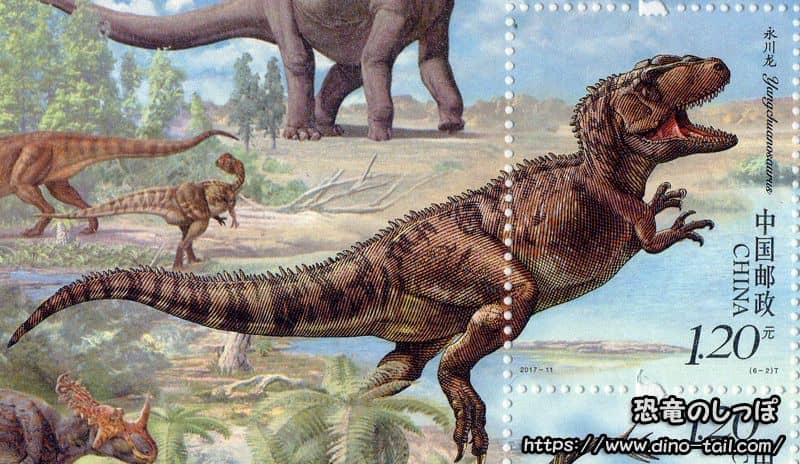
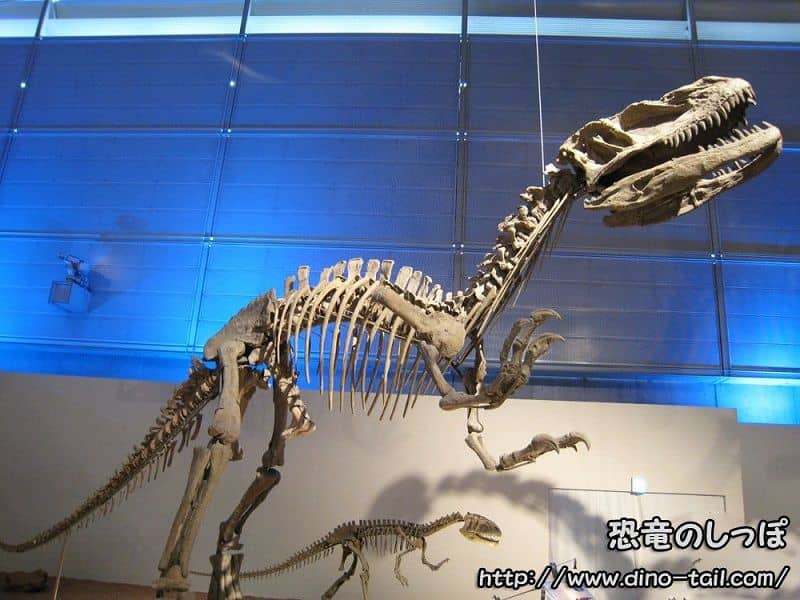
The first fossil (specimen number: CV 00215) was discovered by chance in 1977 by a worker during the construction of the Shangyou reservoir dam in Yongchuan County, Sichuan Province, China (now Yongchuan District, Chongqing City). Excavated and recovered by paleontologist Dong Zhiming and others, this specimen was a precious, nearly complete skeleton from head to tail, measuring about 8 meters in total length (skull length 82 cm, estimated weight 1.4 tons). The following year, in 1978, it was described as the type species "Yangchuanosaurus shangyouensis," named after the discovery site "Yongchuan" and the excavation site "Shangyou Dam."
Integration of the Giant Species "magnus" and Taxonomic Changes
In 1983, an almost complete skeleton specimen (specimen number: CV 00216), even larger than the first specimen, was excavated near a machinery factory in Yongchuan County. This individual had a skull length of 1.11 meters, reached a total length of 10.5 to 11 meters, and had an estimated weight of 3 to 3.5 tons, making it one of the largest carnivorous dinosaurs in Jurassic Asia.
Previously, this giant specimen was classified as a separate second species, "Yangchuanosaurus magnus," based on its body size, the absence of a hole in the lower jaw, an additional opening in the maxillary fenestra, and differences in the shape of its neck bones (cervical vertebrae). However, a comprehensive reassessment in 2012 by paleontologist Matthew Carrano and others concluded that the differences in the neck bones could be explained by their position along the spine, and that the differences in the maxillary openings were not due to species differences, but to changes with growth (ontogeny) and individual variation. Therefore, today, Y. magnus is considered the same species (a synonym) as the type species Y. shangyouensis, and is thought to have been a fully grown giant adult individual.
Also, the family "Metriacanthosauridae," to which Yangchuanosaurus belongs, was once sometimes called "Sinraptoridae." However, according to the rules of the International Code of Zoological Nomenclature (the principle of priority for earlier named terms), the name Metriacanthosauridae is now used. Yangchuanosaurus occupies a basal position in this family, holding an important key to understanding the early evolution of medium to large theropods in Eurasia.
| Specimen Number | Original Name (Year) | Current Common Classification | Remarks |
|---|---|---|---|
| CV 00215 | Y. shangyouensis (1978) | Y. shangyouensis | Type specimen (holotype) of this genus. Subadult or adult with an 82cm skull. |
| CV 00216 | Y. magnus (1983) | Y. shangyouensis | Now considered a synonym of the type species. A fully grown giant individual reaching a skull length of 111cm. |
| CV 00214 | Szechuanosaurus "yandonensis" (1978) | Y. shangyouensis | Specimen without a skull found near Zigong City, Sichuan. After some changes, now integrated into this species. |
| ZDM 9011 | Szechuanosaurus zigongensis (1993) | Y. zigongensis, etc. | Moved to another species in this genus in 2012. However, a 2024 analysis excluded it from this genus, and debates continue. |
| ZDM 0024 | Y. hepingensis (1992) | Sinraptor hepingensis, etc. | The mainstream view moves it to the closely related genus Sinraptor, but recent analyses have also included it in the genus Yangchuanosaurus again. |
Glossary: Synonym
In biological classification, when multiple species given different scientific names are later found to actually be the "same single species," those names are called "synonyms." According to international rules, the previously published scientific name (in this case, Y. shangyouensis in 1978) is given priority as the valid name, and the later named one (Y. magnus in 1983) is integrated as a "junior synonym."
Features: Elaborate Skull and Body Specialized for "Slicing"
Lightweight Skull and Display Ornaments
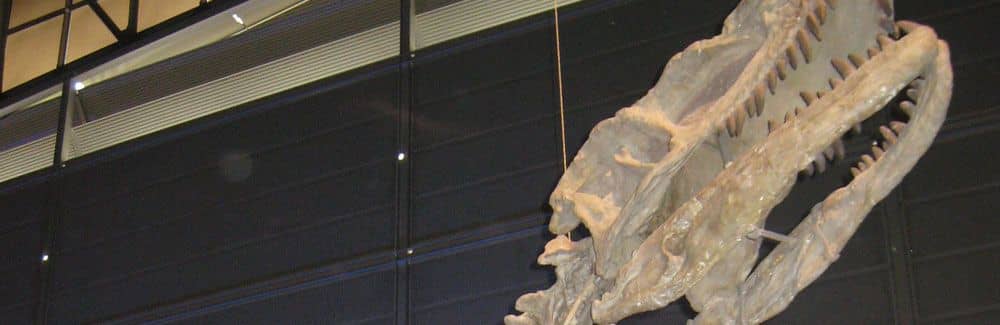
One of the most distinctive features of Yangchuanosaurus is its skull, which, while massive, was cleverly lightened. The skull had six openings, including a large antorbital fenestra in front of the eyes, and large cavities (sinuses) developed within the upper jawbone. This significantly reduced the weight of the giant skull, which exceeded 1 meter, allowing it to quickly move its short, muscular neck. It is also speculated that the spacious sinus cavity dramatically increased respiratory efficiency, supporting the high metabolism needed for active behavior.
On top of its head, similar to Allosaurus and Ceratosaurus, it had rugged, low ridges (crests) and several small bumps on the bridge of its snout, as well as a pair of small horn-like ornaments in front of its eyes (lacrimal bones). These ornaments lacked the strength to be used as physical weapons to bash against each other, so they are thought to have functioned primarily as visual signals (displays) to identify peers, appeal to the opposite sex, or intimidate rivals.
Dagger-like Teeth for Tearing Prey and High Back Projections
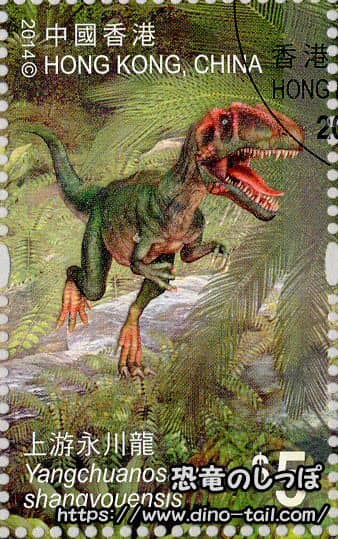
The teeth lining its jaws were shaped like backward-curving daggers, flat when viewed from the side, and equipped with sharp, steak-knife-like serrations on the edges. This structure is distinctly different from the "thick teeth for crushing bone" seen in Late Cretaceous tyrannosaurids. Yangchuanosaurus specialized in a "slicing" tactic, where it would sink its blade-like teeth into the flesh of its prey and then tear backward using its strong neck muscles, causing fatal deep wounds and massive bleeding.
Additionally, the neural spines extending above its backbone were very long, about 2.5 times the height of the vertebral body itself (compared to about 1.5 times in Allosaurus), forming a strong muscular ridge or a low sail-like structure from its back to the base of its tail. This likely served as an attachment point for muscles supporting the giant head and generating powerful jaw movements, while also highly possibly functioning as a visual display to make the body look larger when viewed from the side.
Its hind limbs, built for complete bipedal walking, were long and muscular, with three toes supporting its weight. The optimized muscle arrangement in its pelvis allowed it to have sufficient speed and mobility to track prey despite its multi-ton body. Furthermore, its thick and long tail, accounting for about half of its total length, functioned as a balancer while running and hunting. Its forelimbs were relatively small, but not extremely degenerated (like the two-fingered limbs of tyrannosaurids), and it could firmly hold down prey with three fingers equipped with sharp claws.
Excellent Sensory Abilities and Rapid Growth
Recent analyses of the braincase and inner ear using high-resolution CT scans have revealed that Yangchuanosaurus possessed advanced sensory abilities. Its Encephalization Quotient (EQ), a measure of dinosaur intelligence, is estimated to be between 1.0 and 1.9, which is very high for a dinosaur. In particular, the olfactory bulb, which senses smell, was well-developed, and it is thought that it could detect distant prey and carrion by utilizing over 600 olfactory receptor genes. Furthermore, it combined excellent stereoscopic vision (the ability to accurately measure distance) thanks to forward-facing eyes, and a high sense of balance from the semicircular canals of its inner ear.
Moreover, bone histology studies examining cross-sections of fossil bones have confirmed highly vascularized bone tissue and cyclical lines of arrested growth. This indicates that Yangchuanosaurus maintained a high metabolic rate (endothermy or mesothermy) and grew rapidly from hatching into a massive build of 10 meters in length and over 3 tons in weight in a short period of just a decade or two.
"Convergent Evolution" with the North American Allosaurus and Close Relatives
Because Yangchuanosaurus shared a similar ecological niche with Allosaurus, which ruled the North American continent at the same time, it is often compared as the "Asian Allosaurus."
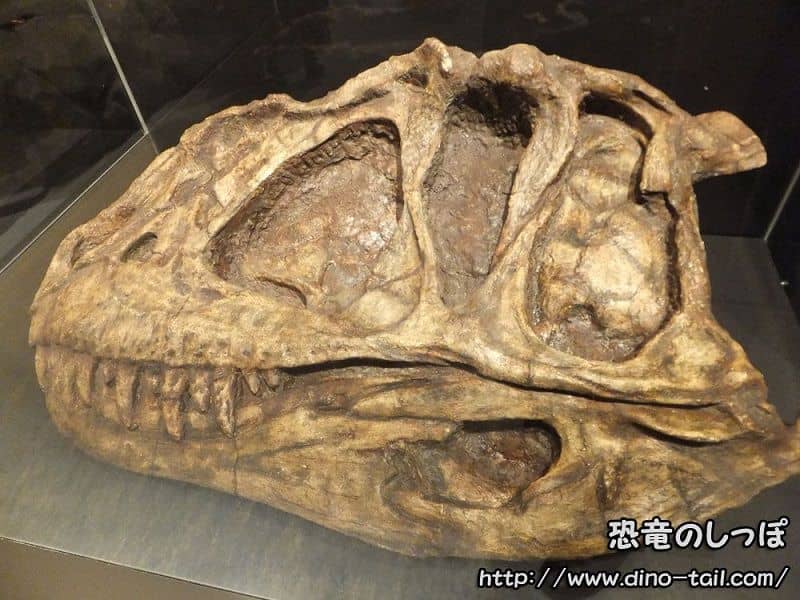
From the Middle to Late Jurassic, the supercontinent Pangea continued to split, and as the continents were separated by the sea, the dinosaurs of East Asia and North America evolved along their own unique paths. Nevertheless, the fact that both acquired very similar features, such as "horns in front of the eyes and ridges on the snout" and "dagger-like teeth for slicing flesh," is a prime example of "convergent evolution," where adapting to the common challenge of preying on giant sauropods and armored stegosaurs resulted in similar traits acquired in different places. However, upon detailed comparison, there are clear differences: Yangchuanosaurus had relatively longer forelimbs than Allosaurus, a shorter and more robust skull, and highly developed neural spines on its back.
Additionally, Sinraptor, discovered in the Xinjiang Uygur Autonomous Region of China, is one of its closest relatives. The two were roughly equal in size (Sinraptor's skull length was about 90 cm, while the largest Yangchuanosaurus was 111 cm), but anatomically, the shape of the tip of the upper jaw (premaxilla) in Yangchuanosaurus was nearly square, with height and length almost equal, whereas Sinraptor's was slightly longer front-to-back. Such subtle differences in skull structure may reflect variations in how force was dispersed when biting, or differences in the types and body parts of targeted prey.
It is sometimes compared to Tyrannosaurus rex, famous as another large carnivorous dinosaur, but Tyrannosaurus lived at the end of the Cretaceous period (about 68 to 66 million years ago), roughly 90 million years after Yangchuanosaurus. In contrast to Tyrannosaurus, which had extremely degenerated forelimbs and specialized in crushing bone with a robust skull, Yangchuanosaurus retained functional three-fingered forelimbs and was a more classic, mobility-focused hunter that sliced its prey with a lightweight skull and blade-like teeth.
Glossary: Convergent Evolution
A phenomenon in which organisms from systematically different groups or geographically distant locations evolve independently to acquire similar body shapes and organs as a result of adapting to similar living environments or ecological roles (such as prey types and hunting methods). The East Asian Yangchuanosaurus and the North American Allosaurus acquired very similar head ornaments and tooth structures by adapting to similar environments as apex predators in their respective regions.
The Ecosystem of the "Dinosaur Paradise" and the Revision of Its Era
Dating Correction from Late Jurassic to "Middle Jurassic"
The "Upper Shaximiao Formation" (reddish-brown sandstone and mudstone layers including the Dashanpu Formation) in the Sichuan Basin, where Yangchuanosaurus fossils are found, was long thought to be a Late Jurassic stratum (about 161.2 to 157.3 million years ago) based on comparisons of excavated vertebrate fossils.
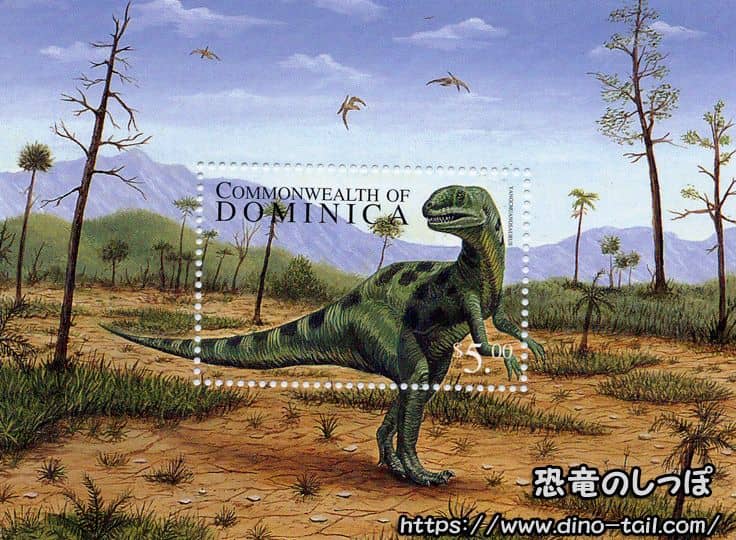
However, in recent years, the latest radiometric dating (such as uranium-lead dating) and microfossil surveys using minerals (zircon) contained in the volcanic ash layers (tuff) sandwiched between the strata have been conducted. As a result, the prevailing view is that the age of this entire stratum should be pushed back to the older "Middle Jurassic (about 168.3 to 163.5 million years ago)." This major age correction has become an important discovery proving that metriacanthosaurid dinosaurs, including Yangchuanosaurus, had achieved rapid gigantism and diversification in East Asia from an early Middle Jurassic stage, on par with or earlier than the allosauroids in North America.
As the Apex Predator of a Rich Ecosystem
The Sichuan Basin at that time was warmer than today, with meandering rivers flowing like a net, and lush plains and forests overgrown with conifers and ferns. Diverse dinosaurs lived in this rich ecosystem, which could be called a "dinosaur paradise," serving as prey and competitors for Yangchuanosaurus:
- Sauropods (giant herbivorous dinosaurs with very long necks): Mamenchisaurus, Omeisaurus, Shunosaurus, Yuzhoulong
- Stegosaurs (herbivorous dinosaurs with bony plates and sharp spikes on their backs): Tuojiangosaurus, Chungkingosaurus, Chialingosaurus, Gigantspinosaurus
- Small Ornithischians (agile, small herbivorous dinosaurs): Xiaosaurus
- Other small-to-medium theropods (carnivorous dinosaurs with divided niches): Gasosaurus, Kaijiangosaurus
Yangchuanosaurus stood at the top of this complex food web. Analysis of fossils suggests that Yangchuanosaurus may have attacked Mamenchisaurus, which was much larger than itself, indicating fierce battles targeting giant sauropods and their juveniles.
When hunting, it is thought to have utilized the high stamina provided by its developed sinuses, the accurate sense of distance from its binocular vision, and its agile movements supported by its semicircular canals to precisely attack the flanks and weak points of heavily armored stegosaurs like Tuojiangosaurus, driving them to massive blood loss. Furthermore, beyond being a pure hunter, it would have flexibly functioned as a scavenger, using its excellent sense of smell to locate carcasses of animals that died naturally or prey killed by other predators over a wide area.