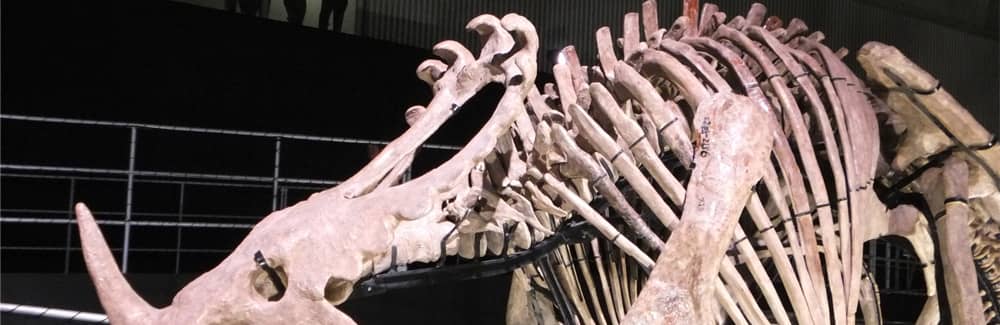
About Sinoceratops
| Scientific Name (Genus) | Sinoceratops |
| Meaning of Name |
Chinese horned face from Zhucheng
Sino (Chinese) - ceratops (horned face) - zhuchengensis (of Zhucheng) |
| Classification | Ornithischia, Marginocephalia (Ceratopsidae, Centrosaurinae) |
| Total Length | Approx. 4.8-6.4m |
| Weight | Approx. 2.0-2.3 tons |
| Diet | Herbivorous |
| Period | Late Cretaceous (Campanian, approx. 77.3 to 73.5 million years ago) |
| Sub-classification / Species Name | Sinoceratops zhuchengensis (Type species) |
| Year of Paper Publication | 2010 |
| Genus Name Publication |
First ceratopsid dinosaur from China and its biogeographical implications.
Chinese Science Bulletin, 55(16), 1631-1635. by Xu, X., Wang, K., Zhao, X. & Li, D. 2010. |
The First Large Ceratopsid in Asia and the "U-Turn Hypothesis"
Sinoceratops was a large ceratopsian (Ceratopsidae) that lived in what is now eastern Asia (Shandong Province, China) during the Late Cretaceous period, about 77.3 to 73.5 million years ago. Its fossils were discovered in 2008 and named in 2010 by the renowned Chinese paleontologist Xu Xing and his colleagues.
The discovery of Sinoceratops caused a "paradigm shift" in the world of paleontology, overturning previous established theories. For many years, it was widely accepted that advanced ceratopsians with giant frills and horns like Triceratops (true ceratopsids) lived only on the North American continent (then Laramidia). It was thought that Asia only had early, small ceratopsians like Psittacosaurus. However, the discovery of Sinoceratops proved that giant ceratopsians rivaling those of North America also existed in Asia.
The ancestors of ceratopsians are thought to have originally originated in Asia, migrated to North America, and evolved into the giant Ceratopsidae. With the discovery of Sinoceratops, a new hypothesis gained traction: that a portion of the group that grew massive in North America (Centrosaurinae) made a "U-turn" back to Asia across the "Bering Isthmus," a continuous land bridge of temperate forests.
Secrets of the Crown-like Frill and Skull
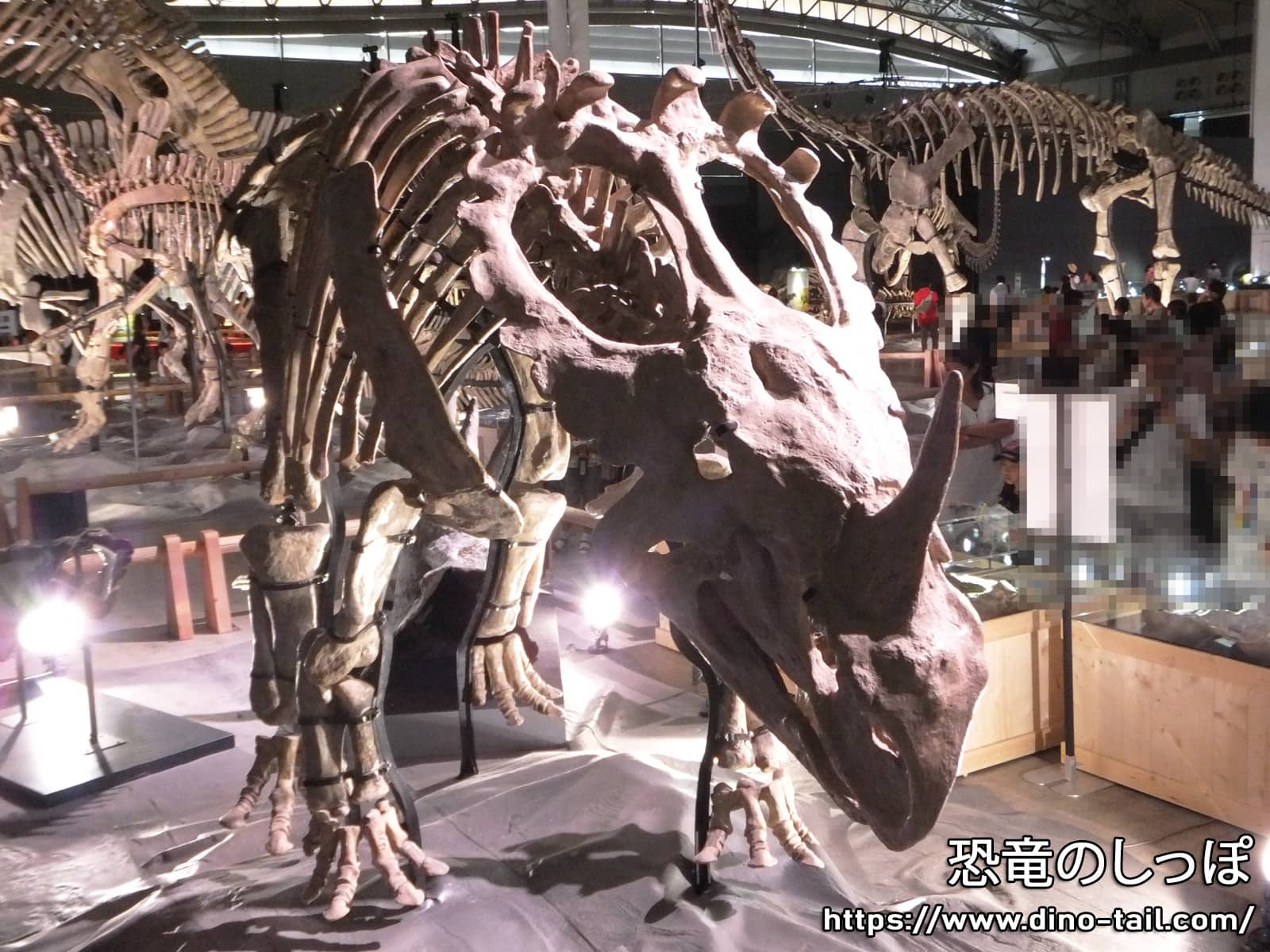
The most striking features of Sinoceratops are its massive skull, estimated to reach up to 180 cm, and the frill that spreads behind its neck. It had a thick, single horn on its nose (nasal horn).
On the back of the frill, there were more than 10 forward-curving horn-like projections (epiparietals) lined up, giving it the appearance of a magnificent "crown." Furthermore, it possessed a uniquely evolved feature not seen in other ceratopsians: a series of "low bumps" running down the center of the top of the frill.
| Comparison Item | Sinoceratops | Styracosaurus |
|---|---|---|
| Habitat | Asia (Shandong, China) | North America (Laramidia) |
| Estimated Length | 4.8-6.4 meters | 4.8-5.4 meters |
| Estimated Weight | Approx. 2.0-2.3 tons | Approx. 1.7-2.6 tons |
| Frill Ornamentation | Numerous forward-curving projections. Bumps along the midline | Extremely long spike-like horns extending backwards and sideways |
| Nasal Horn Morphology | Relatively short and thick | Long, straight, or forward-leaning strong horn |
Skull Cooling Windows and Rapid Growth
Another feature of Sinoceratops's skull is the presence of large holes (fenestrae) called "accessory openings." It is speculated that these spaces served not only to lighten the massive head but also functioned as a "thermoregulation system (air conditioner)" to release excess heat from its giant body through a rich network of blood vessels.
Additionally, studies of their bone tissue have revealed that their impressive horns and frills grew rapidly due to special cellular changes. In their youth, the skull was porous and vascular like a sponge, but in adulthood, growth stopped, bone density increased, and a sturdy frill was completed.
Sinoceratops belongs to the primitive group "Centrosaurinae," yet it possessed features of both groups, such as the broad-based projections seen in the advanced group "Chasmosaurinae" (like Triceratops). This appearance of traits from different groups combining like a puzzle during the evolutionary process is called "mosaic evolution."
Zhucheng's Harsh Ecosystem and Life in a "Herd"
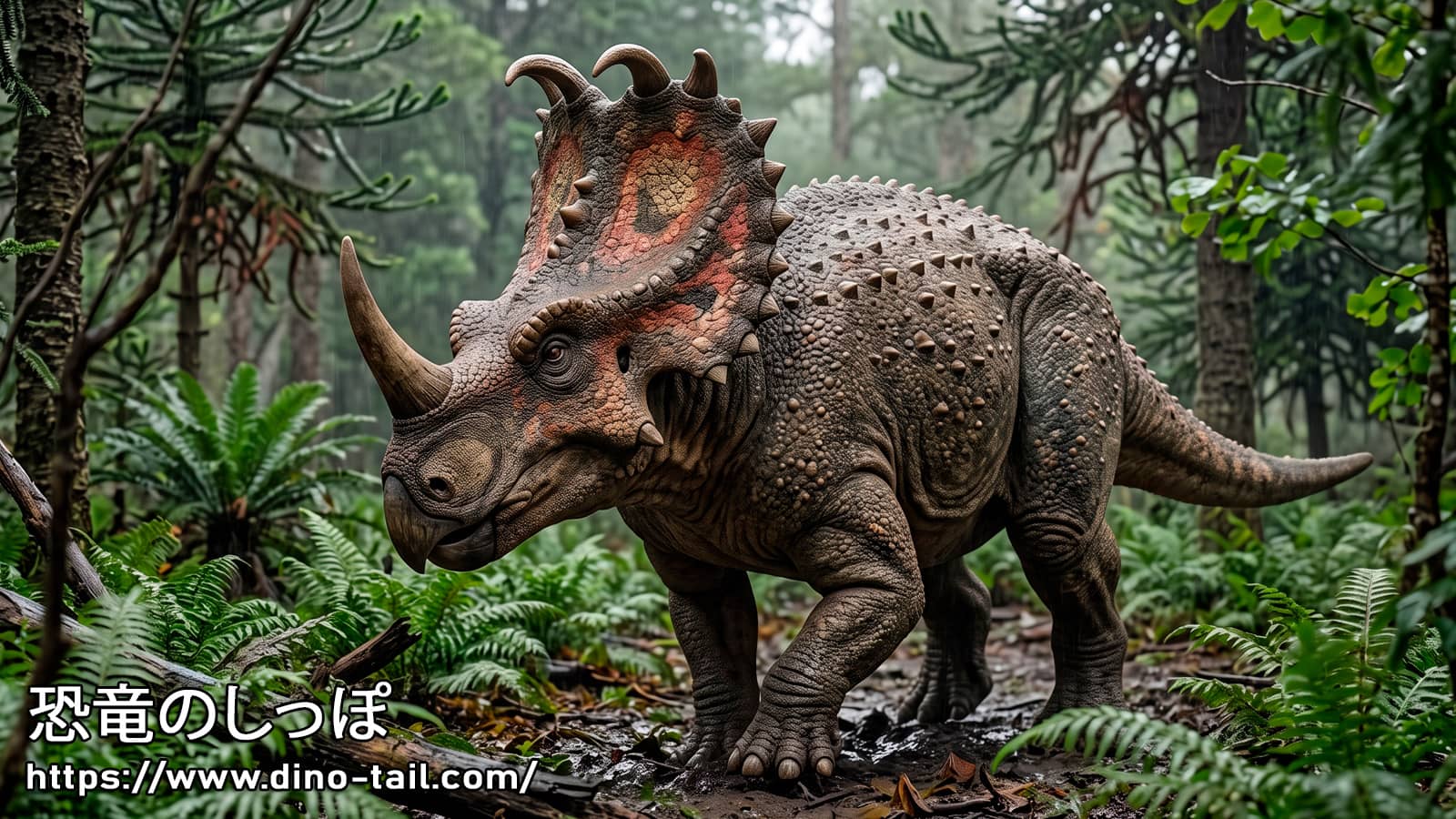
by Gemini.
According to the latest U-Pb radiometric dating, the Wangshi Group in Shandong Province, China, where Sinoceratops was found, was formed about 77.3 million years ago.
The region at that time was surprisingly similar to the rich dinosaur ecosystems of North America. It was a fiercely competitive and harsh environment crowded with giant dinosaurs, such as the 15-meter-long large herbivorous dinosaur "Shantungosaurus" and the apex predator "Zhuchengtyrannus," a relative of Tyrannosaurus. Sinoceratops's robust lower jaw was adapted to chew large amounts of fibrous, tough shrub-level plants in such an environment.
A Message from a Massive "Bonebed"
At the excavation site, one of the largest bonebeds has been confirmed, where dinosaurs were instantly swallowed up by floods and debris flows associated with volcanic activity and large-scale weather disasters. This suggests that Sinoceratops did not act alone, but lived in giant "herds" of hundreds to thousands of individuals for seasonal migration in search of abundant food and water sources. It is thought that they possessed advanced sociality, protecting their young from terrifying predators like Zhuchengtyrannus by having adults with strong frills and horns form a defensive perimeter.
Misconceptions in Popular Culture: The "Frill Holes" Issue
Sinoceratops suddenly gained global recognition when it appeared in the 2018 blockbuster movie "Jurassic World: Fallen Kingdom." However, it is known that the depiction of this dinosaur in the movie significantly departed from scientific accuracy.
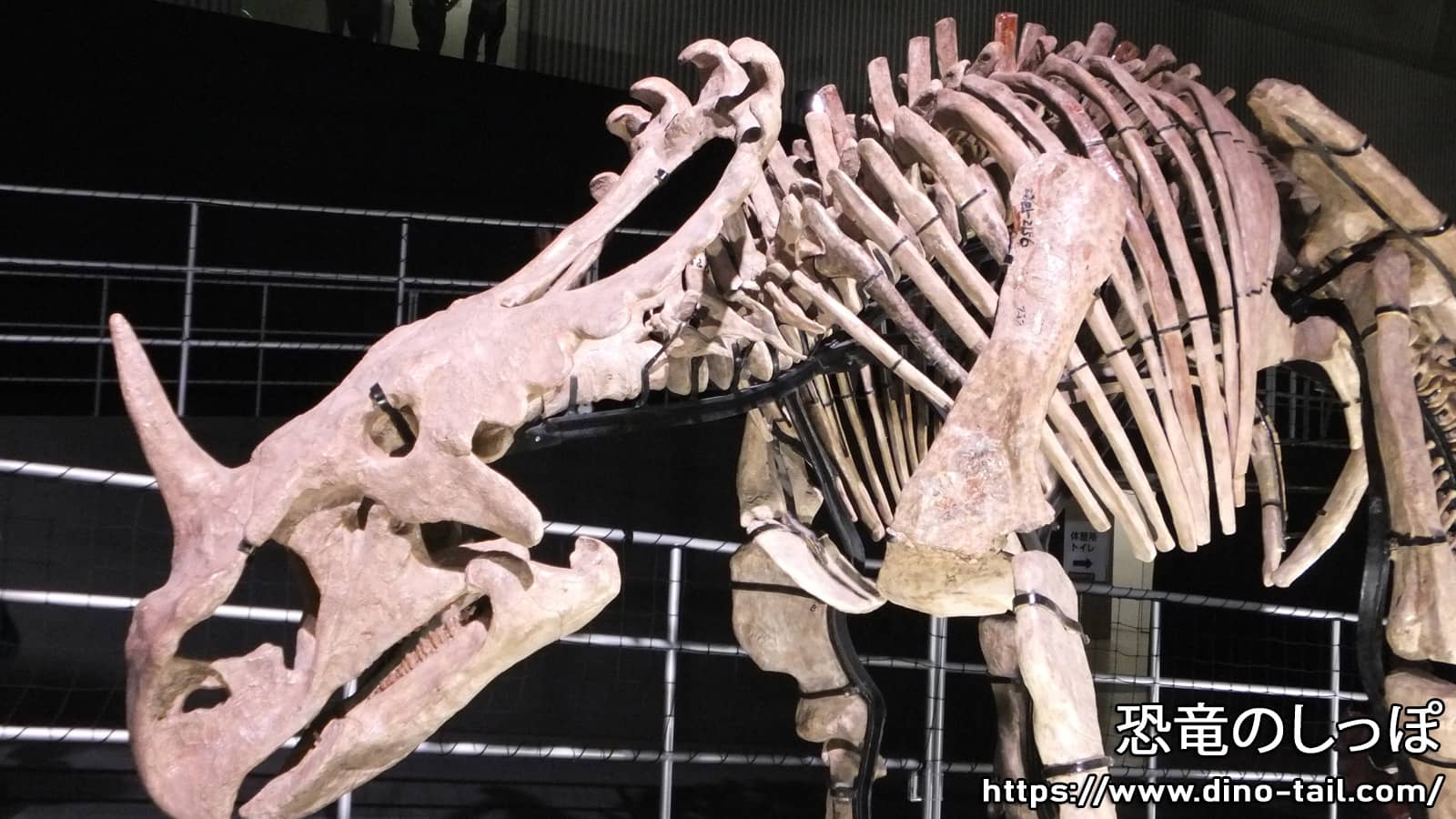
The most serious error is that the frill of the Sinoceratops in the movie has "two penetrating holes that you can see through." Indeed, the skulls of real ceratopsians have giant openings (such as parietal fenestrae) to lighten the head and allow for muscle attachment. However, in living animals, these spaces were completely filled and covered by thick muscle, connective tissue, blood vessel networks, and skin, and would never be seen as "hollows (holes)" externally.
It is said that this misunderstanding originated when the film's production team mistook a special design depicted in another movie as a "ceratopsian injured by a carnivorous dinosaur's bite" for "the original, natural form of this dinosaur." This uproar is known as an example of how an unrealistic fleshing-out, merely draping extremely thin skin over a skeleton when restoring a dinosaur, can instill a false biological image.
On the other hand, it is also a fact that its appearance in this movie served as an opportunity for people all over the world to learn about the existence of this unique dinosaur, "the largest and only ceratopsid in Asia."