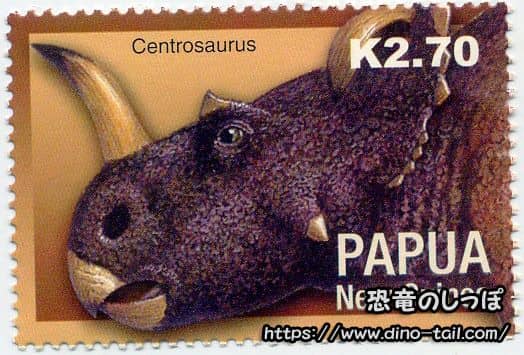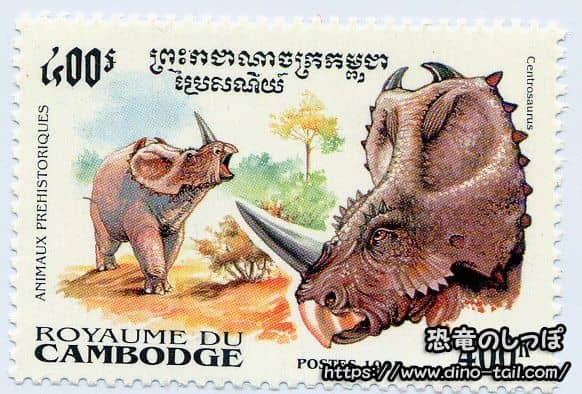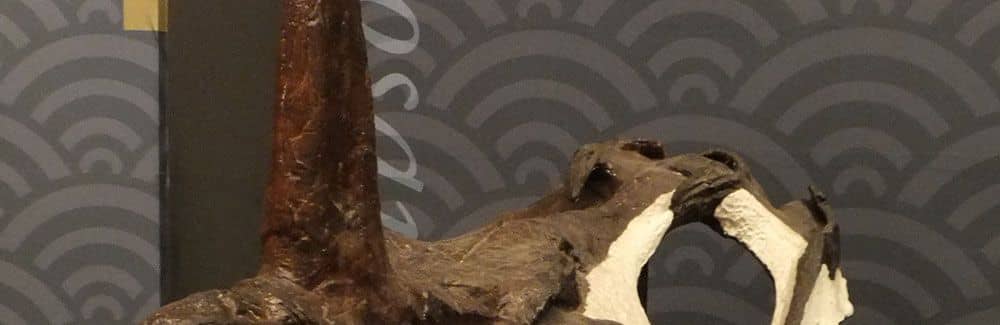
About Centrosaurus
| Scientific Name (Genus) | Centrosaurus |
| Meaning of Name |
Pointed lizard (horned lizard)
kentron (horn, spine) [Greek] - saurus (lizard) [Greek] |
| Classification | Ornithischia, Marginocephalia (Ceratopsia) |
| Total Length | Approx. 5.5m |
| Weight | Approx. 2 tons |
| Diet | Herbivorous |
| Period | Late Cretaceous (Campanian) |
| Sub-classification / Species Name | Centrosaurus apertus |
| Year of Paper Publication | 1904 |
| Genus Name Publication |
On the squamoso-parietal crest of the horned dinosaurs Centrosaurus apertus and Monoclonius canadensis from the Cretaceous of Alberta.
Proceedings and Transactions of the Royal Society of Canada. 2. 10 by Lambe, L. M. 1904. |
Features and Changes with Growth
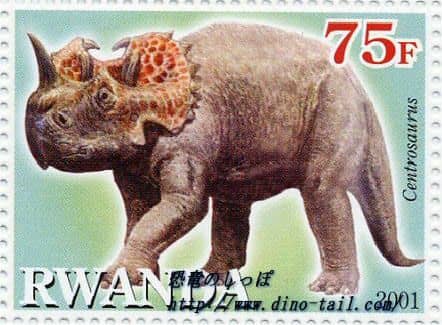
Centrosaurus was a medium-sized herbivorous dinosaur that lived on the North American continent (present-day Alberta, Canada, etc.) during the Late Cretaceous. It is estimated that adults reached about 5.5 meters in length and weighed about 2 tons.
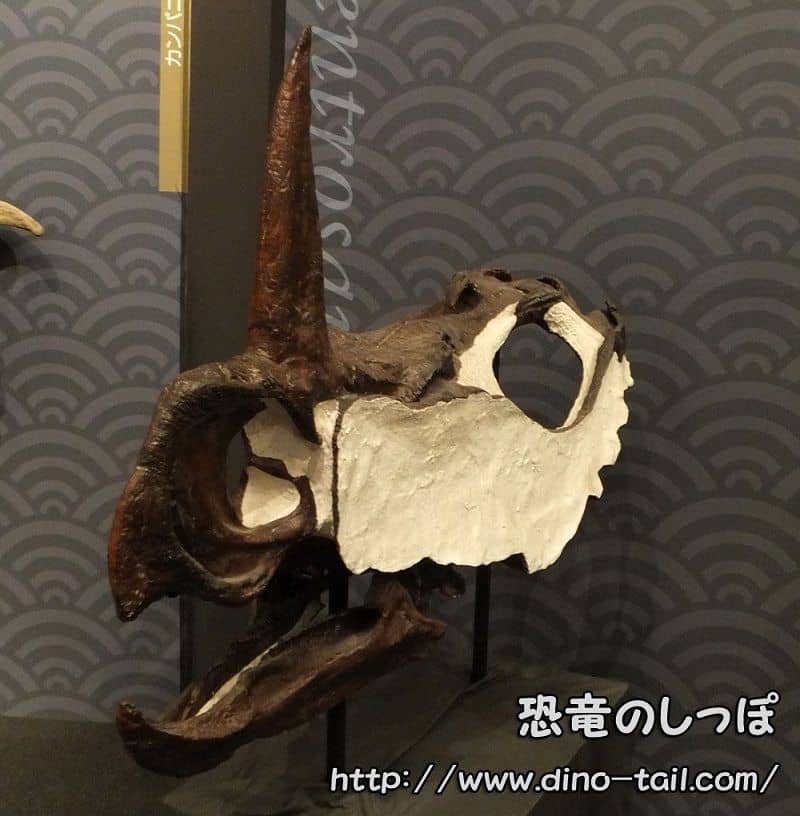
Its major features were the frill (head shield) extending to the back of its head and the magnificent horn on its nose. On the rear edge of the frill, there were long, hook-like processes strongly curved forward, and short hook-like processes curled inward. In addition, there were large holes (fenestrae) in the center of the frill to reduce weight.
It is the process by which an organism is born from an egg, grows, and becomes an adult. Fossils of Centrosaurus have been found in the thousands at various ages, making it highly suitable for studying how dinosaurs change their appearance as they grow (ontogeny).
Recent studies have shown that the head ornaments of Centrosaurus changed dramatically with growth. For example, the nasal horn in juveniles was rounded and curved backward, but as they grew, it grew straight, and when fully mature, it curved forward. In addition, the small horns above the eyes (supraorbital horns) were absorbed into the bone as they became adults, regressing into blunt ridges.
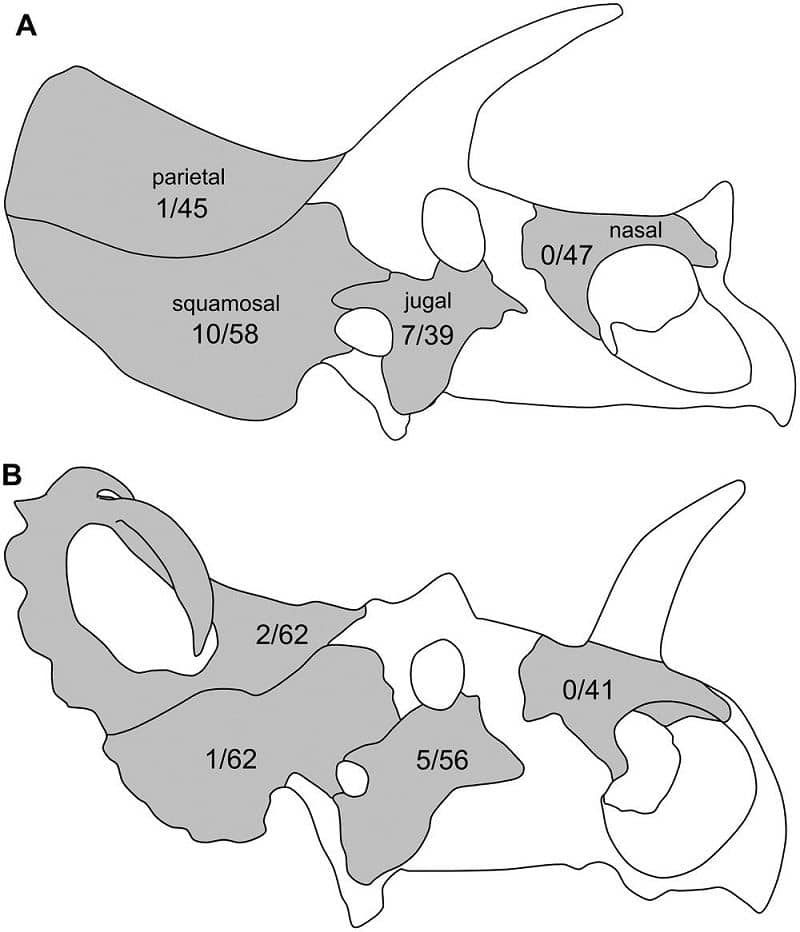
Cranial lesions in horned dinosaurs. Sketch comparing ceratopsian skulls
Source: Evidence of Combat in Triceratops.
PLoS ONE. 4
by Andrew A. Farke Ewan D. S. Wolff Darren H. Tanke. 2009.
Such dramatic changes in head ornamentation are thought to have functioned more likely as displays to appeal to each other (visual displays) or as signals of maturity, rather than as weapons to defend against predators.
In addition, their mouths had a densely packed structure of blade-like teeth (dental battery), which efficiently chopped up tough plants for them to eat. They had different skull depths and snout heights compared to other ceratopsians (such as Chasmosaurinae) living in the same period, and it has been found that they coexisted by magnificently dividing their food sources (niche partitioning) by eating plants of different heights.
History of Discovery and Name Changes
Fossils of Centrosaurus were first discovered in 1901 by paleontologist Lawrence Lambe along the Red Deer River in Alberta, Canada. Initially, Lambe considered this fossil to be a member of an existing dinosaur genus and reported it under the name "Monoclonius dawsoni." However, as cleaning progressed, it became clear that the shape of the frill was extremely unique, and in 1904 it was formally renamed as a new genus and species, "Centrosaurus apertus."
Later, an interesting episode occurred: it was pointed out that "the same name (Centrosaurus) might already be in use for an extant lizard," and there was a temporary attempt to change this dinosaur's name to Eucentrosaurus. However, it turned out that the lizard belonged to a different species and its name was changed, so they were able to continue using the name Centrosaurus.
Because ceratopsians undergo drastic changes in appearance with growth and have high individual variation, the classification of Centrosaurus was confused for a long time. "Centrosaurus brinkmani," once considered a separate species, has also been established as the new independent genus Coronosaurus through detailed recent analysis. Currently, the genus Centrosaurus is strictly defined to include only the type species "Centrosaurus apertus."
Mass Death by Mega-Flood and Sociality
For many years, whether ceratopsians lived in herds remained a matter of speculation, but a vast fossil bed discovered near Hilda in Alberta, Canada, provided conclusive evidence.
Here, thousands of Centrosaurus of all ages were buried as a single herd. As a result of geological surveys, it was found that the area at the time was hit by a devastating mega-flood caused by a strong tropical cyclone (hurricane). With nowhere to escape, the massive herd drowned en masse due to the sudden rise in water level.
The traces of this tragic catastrophe paradoxically proved that Centrosaurus possessed an advanced sociality (gregariousness), forming massive herds consisting only of the same species and undertaking large seasonal migrations.
Discovery of Malignant Tumor (Cancer) in Centrosaurus
In 2020, a historical breakthrough regarding Centrosaurus was published in a medical journal. A Canadian research team identified a "malignant tumor (cancer)" in a fossilized Centrosaurus leg bone.
Using the same latest CT scans and microscopic examinations used in human cancer diagnosis, it was found that severe "osteosarcoma" had spread inside the fossilized bone. This tumor had destroyed the bone to the extent that it could be called terminal, and it is presumed that this individual was in severe pain and had difficulty walking properly.
If it could not walk properly, it would normally be immediately preyed upon by carnivorous dinosaurs like Gorgosaurus. However, this cancerous bone was found among a herd of thousands that died all at once in a massive flood. In other words, despite having a fatal disease, this individual was able to survive for a long time by being in the midst of a massive herd of companions, protected from natural enemies.
This discovery indicates that cancer is not a disease unique to modern times but a disease that has lurked in the genes of organisms since ancient times, and it strongly supports the possibility that Centrosaurus exhibited behaviors such as protecting weak companions stricken by illness within the herd.
Centrosaurus Stamp and Fossil Gallery