About Bactrosaurus
| Scientific Name (Genus) | Bactrosaurus |
| Meaning of Name |
Club lizard
baktron (club) [Greek] - saurus (lizard) [Greek] |
| Classification | Ornithischia, Ornithopoda, Hadrosauroidea |
| Total Length | Approx. 6-8m |
| Weight | Approx. 2-3 tons |
| Diet | Herbivorous |
| Period | Late Cretaceous (approx. 95.8 to 85 million years ago) |
| Sub-classification / Species Name | Bactrosaurus johnsoni |
| Year of Paper Publication | 1933 |
| Genus Name Publication | Gilmore, C.W. (1933). On the dinosaurian fauna of the Iren Dabasu Formation. |
A Bridge in Evolution and the Characteristic Appearance of Bactrosaurus
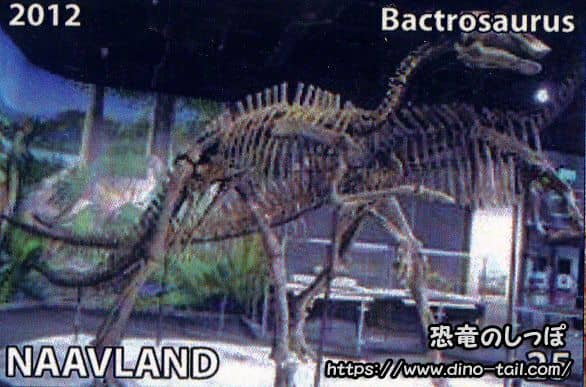
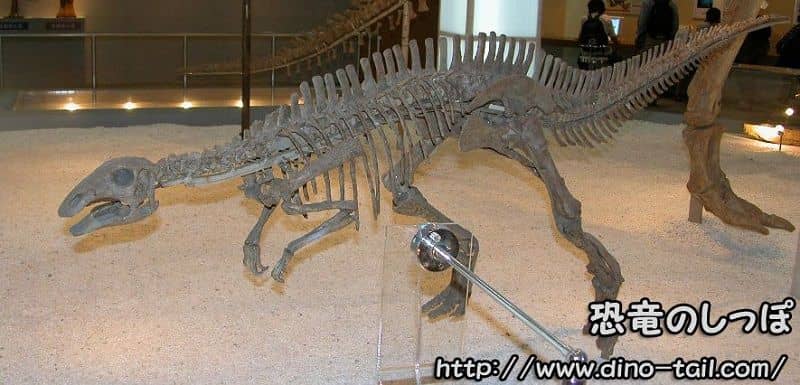
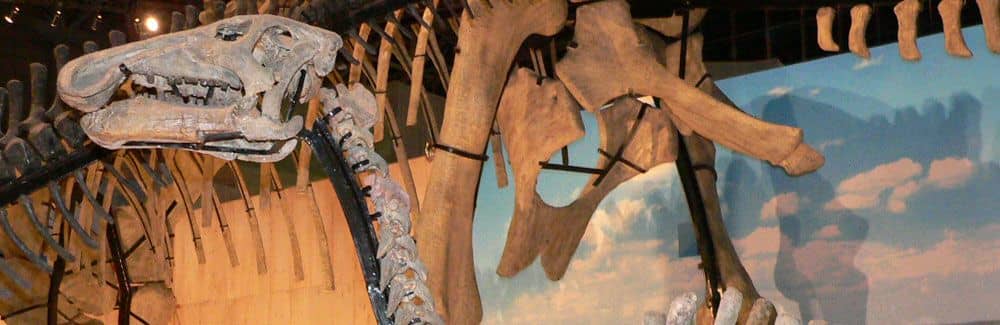
Bactrosaurus is a medium to large herbivorous dinosaur that lived in eastern Eurasia (such as present-day China and Mongolia) during the Late Cretaceous (about 95.8 to 85 million years ago). Its estimated total length was about 6-8 meters, and it is thought to have weighed about 2-3 tons.
It was once considered an early member of the Hadrosauridae family, but is now regarded as a representative of the early "Hadrosauroidea," positioned outside the true Hadrosauridae. It is a dinosaur that vividly records the evolutionary process, possessing both the archaic features characteristic of its ancestors, the iguanodontians, and the new features seen in the hadrosaurids that would later prosper globally.
It is a phenomenon in the process of biological evolution where old (ancestral) features and new (derived) features evolve at different speeds in different parts of the body, appearing mixed together like a patchwork (mosaic) within a single organism.
The origin of its genus name, "club lizard," comes from the neural spines extending upwards from its vertebrae to its tail, which are enlarged into a large club shape. The tips of these parts are thought to have been covered by thick cartilage caps, and were likely used to support back muscles or for visual appeal within the species.
Furthermore, biomechanical analysis of its skeleton strongly suggests that it practiced "facultative bipedalism," walking slowly on all fours normally, such as when eating, but running only on its hind legs when eating leaves from high trees or escaping from carnivorous dinosaurs.
Head Crests and Advanced Herds
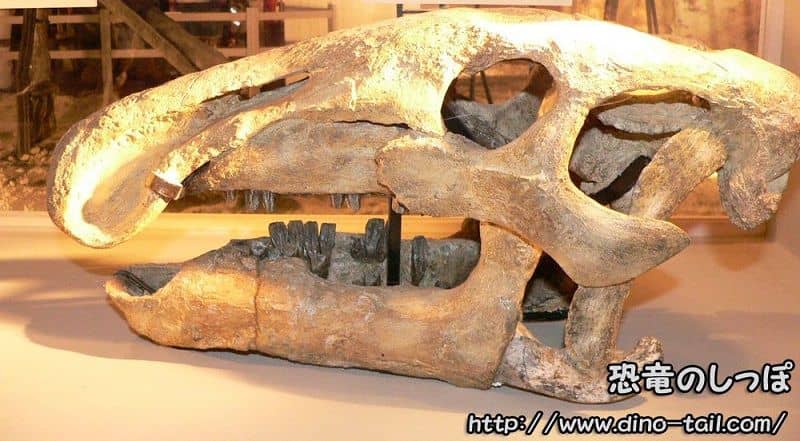
For many years, Bactrosaurus has been restored as a "flat-headed" dinosaur without a crest on its head. However, a study published in 2026 is completely overturning this perception.
As a result of CT scanning newly discovered skulls of closely related species, a "hollow head crest" was discovered for the first time in a non-lambeosaurine. This makes it highly likely that early groups, including Bactrosaurus, also engaged in complex "acoustic communication" using deep, horn-like calls to signal the approach of predators or attract mates in the dense Cretaceous forests.
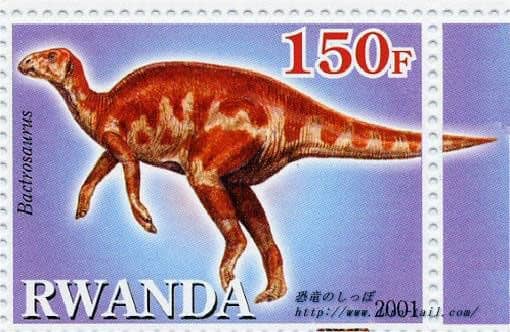
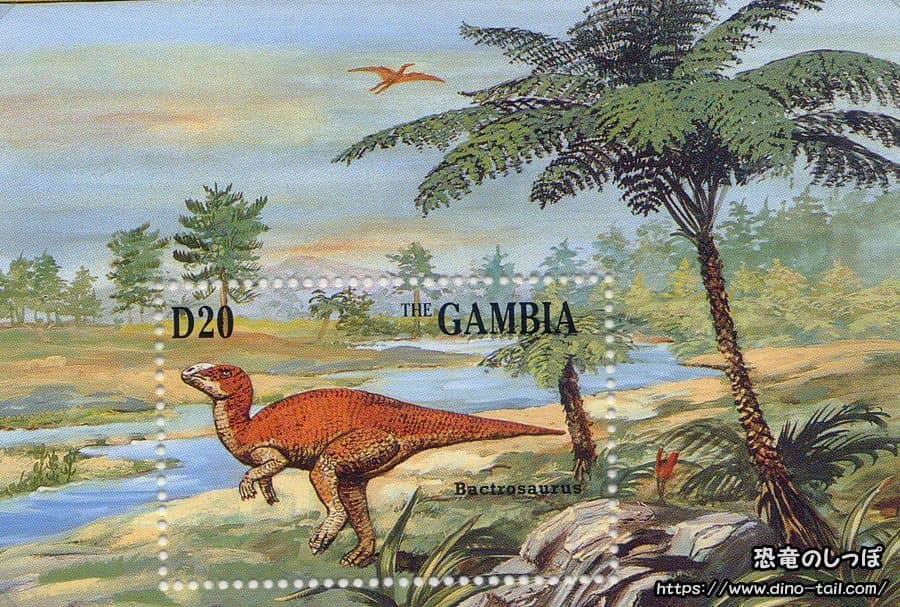
In addition, densely packed fossils of Bactrosaurus at various growth stages, from newly hatched juveniles to fully grown adults, have been discovered. According to the latest reports from the field studying how fossils accumulate, it was found that the excavated fossils are predominantly skewed towards "hatchlings" and "juveniles." This is evidence of "age segregation," where adults and children act separately at certain times, confirming that Bactrosaurus was a highly social animal that formed highly organized "herds."
It is the study of the processes (decay, transport, burial, etc.) from the death of an organism until it is discovered as a fossil. By analyzing how fossils gathered there, we can infer the environment at that time and the behavior of the organisms (e.g., whether they formed herds).
Paleopathology Reveals Dinosaur Diseases
Bactrosaurus is also extremely important in the field of "paleopathology," which investigates what kind of diseases dinosaurs suffered from.
In a large-scale survey published in 2003, over 10,000 dinosaur vertebrae fossils were examined using non-destructive testing (such as CT scans). Surprisingly, evidence of "tumors (benign hemangiomas and malignant cancers)" in the bones was found to be concentrated almost exclusively in the hadrosaur group, including Bactrosaurus. Research is ongoing as to whether they had a genetic predisposition to develop cancer, or if it was the effect of eating large amounts of plants (such as conifers) containing carcinogens present in the environment at the time.
Also, the upper jaw bone of a Bactrosaurus found shows signs of bone erosion due to severe periodontal disease, or lesions that look like wounds from being bitten by a carnivorous dinosaur that healed over a long period. This is evidence that dinosaurs survived the harsh wild environment while enduring the pain of diseases and injuries on a daily basis.
History of Discovery and Fossil Protection
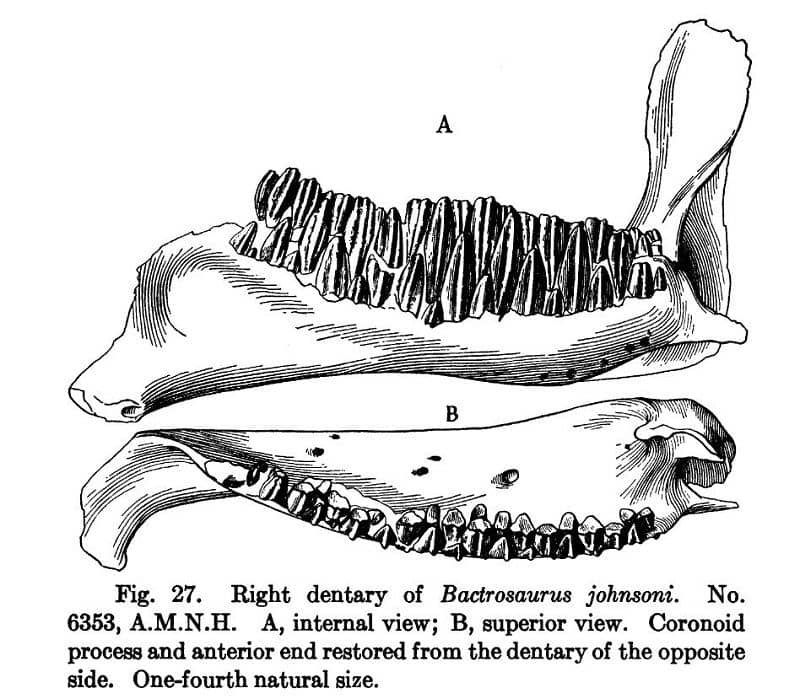
Source: Gilmore, C.W. (1933). On the dinosaurian fauna of the Iren Dabasu Formation.
Bactrosaurus was first discovered in 1921 when a large-scale expedition team from the American Museum of Natural History investigated the Iren Dabasu Formation in the Gobi Desert, China. Multiple skeletons were found by Albert Johnson and the research team, and in 1933, American paleontologist Charles Gilmore formally described it as a new genus and species, "Bactrosaurus johnsoni".
Although Bactrosaurus is highly valuable paleontologically, it has recently become a target for poachers in the black market. Illegal excavation of fossils completely destroys valuable geological stratum data, causing fatal damage to scholarship.
In 2016, there was an incident where a Bactrosaurus skeletal specimen, smuggled into the United States falsely labeled as a "replica" and about to be sold at a high price in an online auction, was seized through a long-term undercover investigation by law enforcement agencies. It was proven authentic by expert appraisal and safely returned to its country of origin. These events highlight the importance of international cooperation to protect valuable academic specimens from commercial exploitation.
Bactrosaurus Gallery