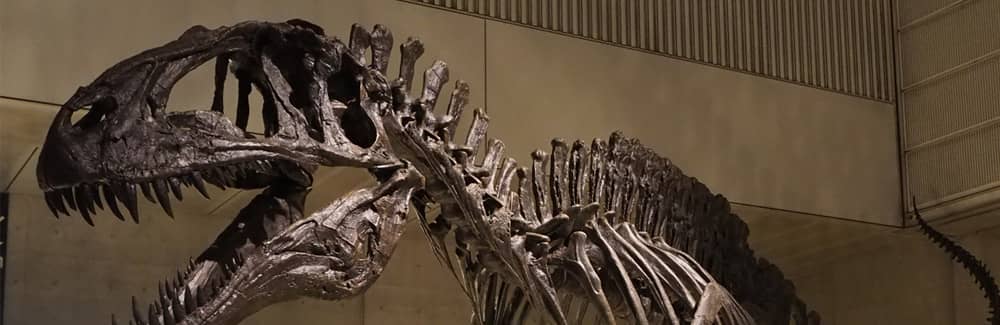
About Acrocanthosaurus
| Scientific Name (Genus) | Acrocanthosaurus |
| Meaning of Name |
High-spined lizard
akros (high) [Greek] - akantha (spine/thorn) [Greek] - saurus (lizard) [Greek] |
| Classification | Saurischia, Theropoda (Tetanurae, Allosauroidea, Carcharodontosauridae) |
| Total Length | Approx. 11 - 11.5m (Max approx. 12m) |
| Diet | Carnivorous |
| Period | Early Cretaceous (approx. 125 to 99.6 million years ago) |
| Sub-classification / Species Name | Acrocanthosaurus atokensis |
| Year of Paper Publication | 1950 |
| Genus Name Publication | Stovall, J. Willis; Langston, Wann Jr. (1950). "Acrocanthosaurus atokensis, a new genus and species of Lower Cretaceous Theropoda from Oklahoma". American Midland Naturalist. 43 (3): 696–728. |
Apex Predator of the North American Continent in the Early Cretaceous
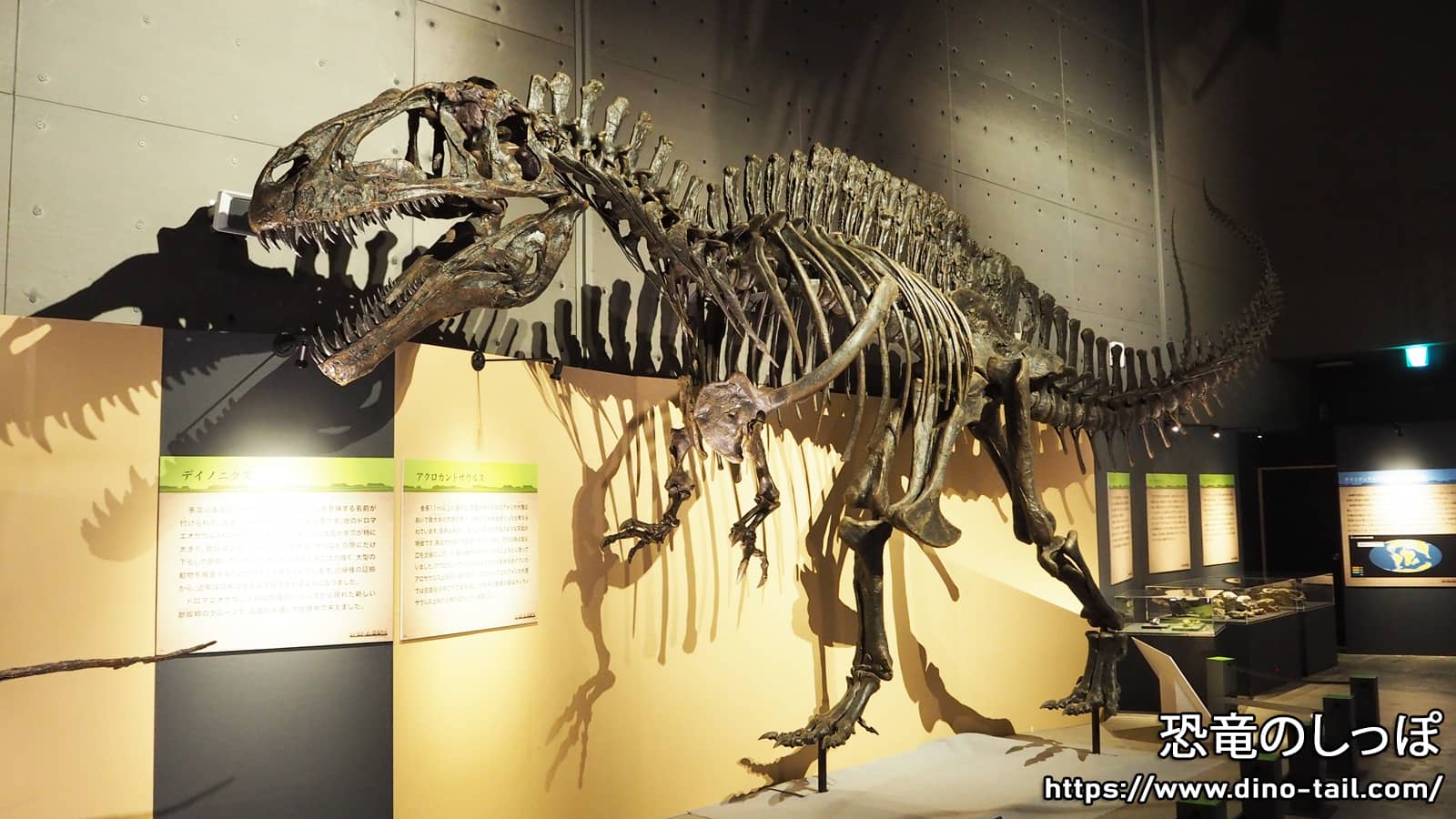
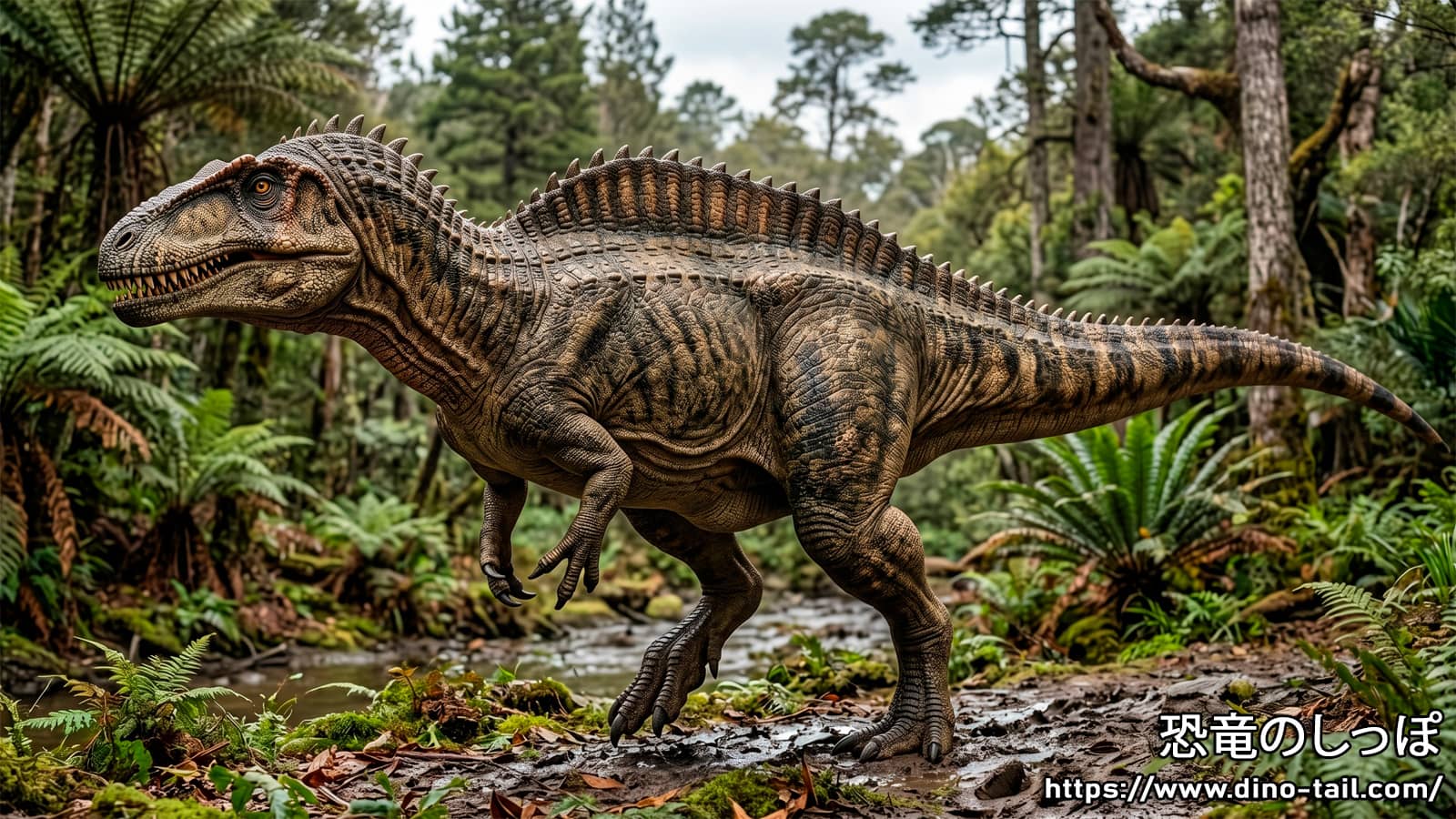
Acrocanthosaurus was one of the largest carnivorous dinosaurs that lived on the North American continent during the Early Cretaceous period. It is estimated to have exceeded 11 meters in length and weighed between 4.4 and 8.4 tons. Fossils have been discovered over a wide area, from western states like Oklahoma, Texas, and Wyoming to Maryland on the East Coast, indicating it reigned as the "apex predator" of the ecosystem across the entire North American continent at the time.
This era was a transitional period when the Allosaurus and Stegosaurus groups that flourished in the Jurassic declined, and new types of dinosaurs began to emerge. Acrocanthosaurus is thought to have primarily preyed on super-giant sauropods like Sauroposeidon and heavily armored ankylosaurs (like Sauropelta).
The Secret of the High "Spines" Towering on its Back
The most striking feature of Acrocanthosaurus is the highly elongated bony projections running from its neck down its back to its hips. These are called "neural spines," and their height could be more than 2.5 times that of the vertebral body itself. Its genus name, "high-spined lizard," also derives from this feature.
In older encyclopedias, it was introduced that it had a thin skin "sail" like Spinosaurus, which was used for thermoregulation. However, recent biomechanical analysis and comparative bone studies have revealed that these projections were firm attachment points for powerful muscles and ligaments, similar to modern bison.
In other words, it formed a thick, muscular "ridge" rather than a thin sail. This functioned as a practical armor and a muscular base to support its huge, heavy head, and to firmly stabilize its entire spine when grappling with giant prey.
Powerful Jaws to Tear Prey and a Downward Posture to Follow Scents
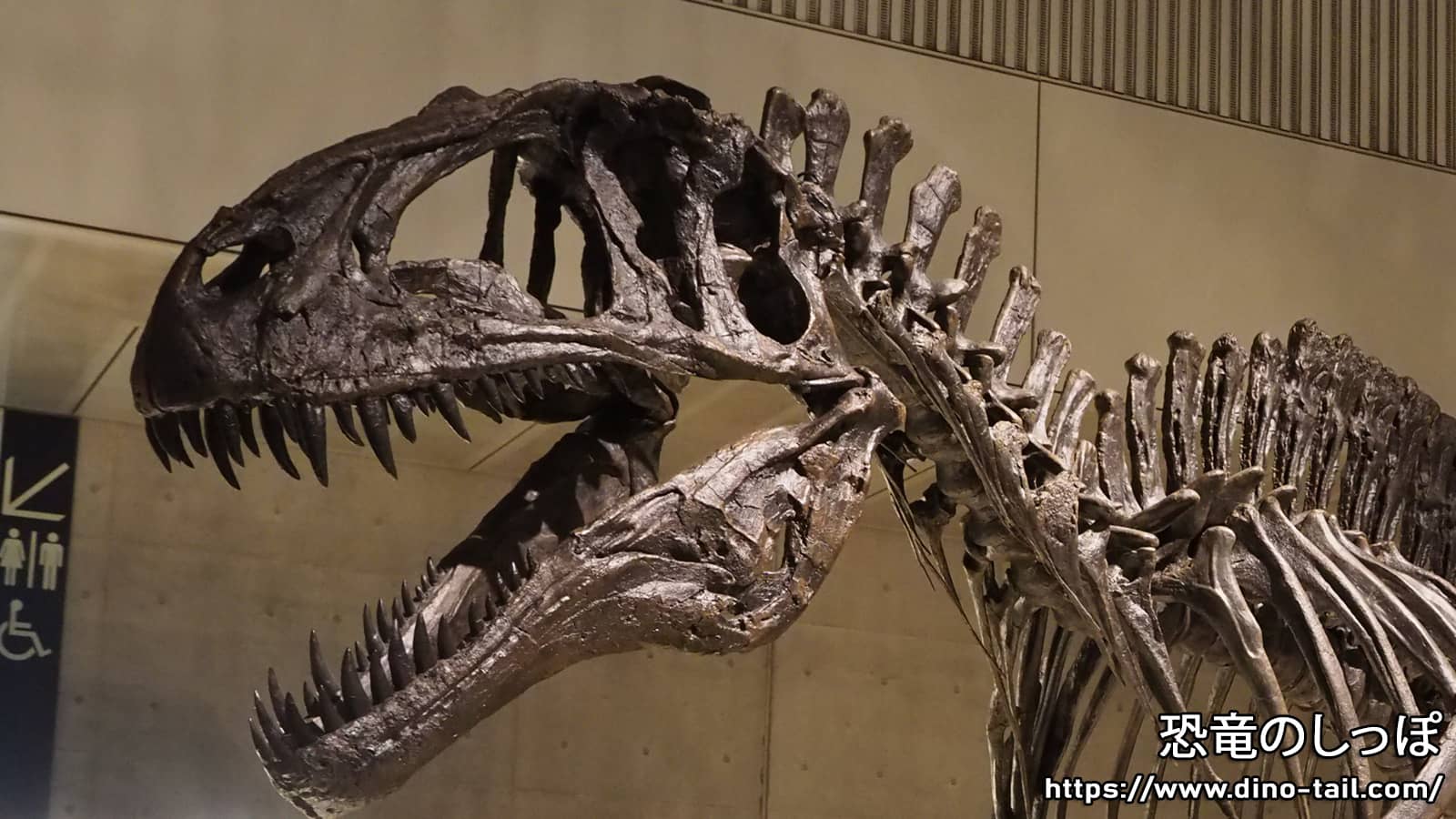
The skull reached about 1.3 meters in length. The upper jaw had 19 teeth per side with serrated edges. Bite force simulations estimate that it could bite with a tremendous force, about 3.8 times that of a modern crocodile. These jaws were specialized for slicing through the flesh of prey and causing bleeding.
Even more interesting is the research that examined the shape of its brain using CT scans of the inside of the skull. The results showed that the olfactory bulbs (the part that senses smells) were highly developed, indicating it possessed an extremely acute sense of smell.
Furthermore, the structure of the inner ear (semicircular canals) revealed that Acrocanthosaurus habitually walked with its head pointing about 25 degrees "diagonally downward" relative to the ground. By combining this posture with its keen sense of smell, it is believed to have effectively tracked prey by following scents and blood trails on the ground.
No Escape! Front Legs Like "Giant Meat Hooks"
Although its front legs were larger and more developed compared to Tyrannosaurus, studies examining the range of motion of its joints revealed a surprising fact.
It was physically impossible for Acrocanthosaurus to reach its arms forward, spread them wide to the sides, or fully extend or deeply bend its elbows. It also couldn't twist its wrists, so its palms always faced inward toward its own body.
However, the force to "pull its arms strongly backward" was extremely powerful. Additionally, the three fingers could bend backwards extremely far until they touched the wrist, and the thumb, bearing the largest claw, was permanently fixed in an inward-curving position.
This was a structure not for catching distant prey with its hands, but to hold the prey tightly against its chest and pierce it with its claws after initially biting with its jaws, ensuring it could never escape. It was adapted so that the fingers would not dislocate even if the giant prey struggled, creating a terrifying mechanism where the more the prey writhed, the deeper the claws dug in.
Rapid Growth and Traces of a Fierce Battle with a Crocodile
"Bone histology" research, which involves thinly slicing fossil bones to examine ring-like patterns inside, has revealed that Acrocanthosaurus had a "rapid growth spurt" from early to mid-life. It is estimated that it took about 18 to 24 years to reach adult size (skeletal maturity). This rapid growth was the evolutionary secret that allowed them to become giants.
Also, fossils have been found that tell how harsh their lives were. When cleaning the skull of one of the most complete fossils (specimen number NCSM 14345), a "giant crocodile tooth" was found deeply embedded in the back of the upper jaw bone.
This indicates that while alive, this Acrocanthosaurus engaged in a fierce fight to the death with a giant crocodile by the water's edge. This wound caused a severe infection (osteomyelitis), and some of its teeth never grew back. Nevertheless, the bone shows signs of healing, proving their vitality to survive despite the pain.
What Acrocanthosaurus Footprints Tell Us
In places like the Glen Rose Formation in Texas, numerous giant three-toed footprint fossils believed to be from Acrocanthosaurus have been discovered.
In the most famous trackways, it is recorded that a carnivorous dinosaur walked parallel to, and sometimes overlapping, the tracks left by a herd of sauropods (giant, long-necked plant-eating dinosaurs). In the past, this caused a stir as it was interpreted as "evidence that they attacked sauropods in packs and leaped on them."
In modern research, it is also said that "a carnivorous dinosaur might have simply passed by the same path by chance a few hours later," so it is not necessarily considered conclusive evidence of pack hunting.
However, computer walking simulations have proven that a giant theropod weighing over 7 tons could not "run" (a gait where both feet are off the ground simultaneously) because its bones would shatter. Therefore, it is thought that Acrocanthosaurus's basic hunting style was to target slow-moving giant sauropods or to hunt by ambush.