Introduction
Metabolic Evolution and Thermal Physiological Diversity in Mesozoic Dinosaurs: A comprehensive report combining geochemical and molecular paleontological approaches
The question of dinosaur thermal physiology—whether they were "warm-blooded" (endothermic) or "cold-blooded" (ectothermic)—has been a central subject of debate in paleontology since Richard Owen defined "Dinosauria" in 1842. From the 19th-century image of sluggish reptiles, through the "Dinosaur Renaissance" of the 1960s and 70s that shifted the view to active bird-like animals, to the establishment of direct physiological measurement techniques in the 21st century, our perspective on dinosaurs has undergone dramatic transformations. Recent studies reveal that dinosaurs did not adopt a single metabolic strategy; instead, they underwent extremely diverse and dynamic thermal physiological evolution across different lineages.
Dinosaur Metabolism and Thermoregulation: Definitions and Historical Background
To understand dinosaur thermal physiology, it is first necessary to clarify the biological concepts of metabolism and thermoregulation. Modern animals are broadly divided into endotherms (mammals and birds), which generate heat internally through metabolism, and ectotherms (reptiles, amphibians, and fish), which rely on heat from the external environment. Endotherms have a high basal metabolic rate (BMR) and maintain a stable, high body temperature (homeothermy), ensuring high activity levels independent of the environment, but at the cost of requiring large amounts of food.
In the history of dinosaur research, early estimates were based mainly on bone histology (bone growth rates) and anatomical features (erect posture). However, these indicators were indirect, and there was persistent counterargument that fast growth rates did not necessarily mean highly advanced endothermy like modern birds. In 2014, based on a comprehensive analysis of growth rates, a theory was proposed that dinosaurs were "mesothermic," positioned between endothermy and ectothermy. This model, however, sparked fierce debate over the validity of its scaling methods.
Direct Body Temperature Estimation Using Clumped Isotope Paleothermometry
In the 21st century, the introduction of "Clumped Isotope Paleothermometry" as part of a geochemical approach made it possible to calculate internal body temperatures directly from fossils. This method is based on the physicochemical principle that the proportion of heavy isotopes carbon-13 (13C) and oxygen-18 (18O) bonding (clumping) together within the crystal lattice of carbonate minerals (like tooth enamel and eggshells) depends on the temperature at which the mineral formed. Unlike traditional analysis using the oxygen isotope ratio (δ18O), there is no need to know the isotopic composition of the surrounding environmental water, making it a highly reliable "paleothermometer."
Taxon-Specific Data from Isotope Analysis of Eggshells and Teeth
A series of analyses conducted by research teams from Caltech, Yale University, UCLA, and others have revealed the internal body temperatures of major dinosaur groups. The table below compares the estimated internal body temperatures of major dinosaurs based on clumped isotopes (Δ47) with the estimated environmental temperatures of their time.
| Dinosaur Taxon | Estimated Internal Temp (℃) | Estimated Environmental Temp (℃) | Notes |
|---|---|---|---|
| Brachiosaurus | 38.2(℃) | 25(℃) | Giant sauropod. Maintained high body temperature. |
| Camarasaurus | 35.7(℃) | 25(℃) | Sauropod. Temperature close to mammals. |
| Maiasaura | 44(℃) | 25(℃) | Ornithischian. Suggests extremely high endothermy. |
| Troodon | 27, 28(℃) | 25~(℃) | Theropod. Heterogeneous body temperature. |
| Oviraptorid | 32(℃) | 26(℃) | Small theropod. Slightly higher than the environment. |
| Titanosaurs (dwarf species) | 36(℃) | 30(℃) | Maintained high temperature despite small size. Evidence of metabolic control. |
An important insight drawn from these data is that dinosaurs universally possessed the ability to raise their body temperatures above environmental temperatures through metabolism, regardless of body size. In particular, the fact that relatively small Troodon and medium-sized Maiasaura showed body temperatures significantly higher than the environment confirms that they were not ectotherms relying merely on thermal inertia (the phenomenon where a massive body cools slowly), but were actively generating heat.
Advanced Verification Using Dual Clumped Isotopes (Δ47 and Δ48)
Recent studies have introduced the "dual clumped isotope thermometer," which measures Δ48 in addition to Δ47, allowing for consideration of even the non-equilibrium nature (kinetic effects) of mineral formation processes. Analysis using Troodon eggshells confirmed mineral formation in an equilibrium state closer to reptiles, unlike the highly non-equilibrium processes seen in birds. However, the internal body temperature itself was higher than the environment and involved "heterothermy," varying among individuals or physiological states, suggesting a form of endothermy. This is crucial evidence indicating that homeothermy was acquired gradually during the evolutionary process from dinosaurs to birds.
Innovation in Molecular Paleontology: Direct Measurement Using Metabolic Markers
A 2022 study by Jasmina Wiemann and colleagues published in the journal Nature presented an innovative method that fundamentally overturned dinosaur thermal physiology research. This method detects the "chemical waste products" generated when oxygen taken in through respiration is metabolized, rather than measuring isotopes within bone tissue.
Detection of Advanced Lipoxidation End-products (ALEs)
When oxygen is consumed in cellular metabolic processes, reactive oxygen species (ROS) are produced as byproducts. These react with lipids, proteins, and sugars, accumulating in hard tissues as "advanced lipoxidation end-products (ALEs)" and "advanced glycation end-products (AGEs)." These molecules are extremely stable, are not lost during fossilization, and their accumulated amount positively correlates with the amount of oxygen the animal consumed in life, i.e., its metabolic rate.
Wiemann's team used Raman spectroscopy and Fourier-transform infrared spectroscopy (FT-IR) to analyze the bones (mostly femurs) of 55 species of modern and extinct vertebrates. This non-destructive method quantified the distribution of metabolic rates across the entire dinosaur phylogenetic tree for the first time.
Metabolic Separation of Saurischians and Ornithischians
The analysis revealed a striking contrast in metabolic strategies among major dinosaur lineages.
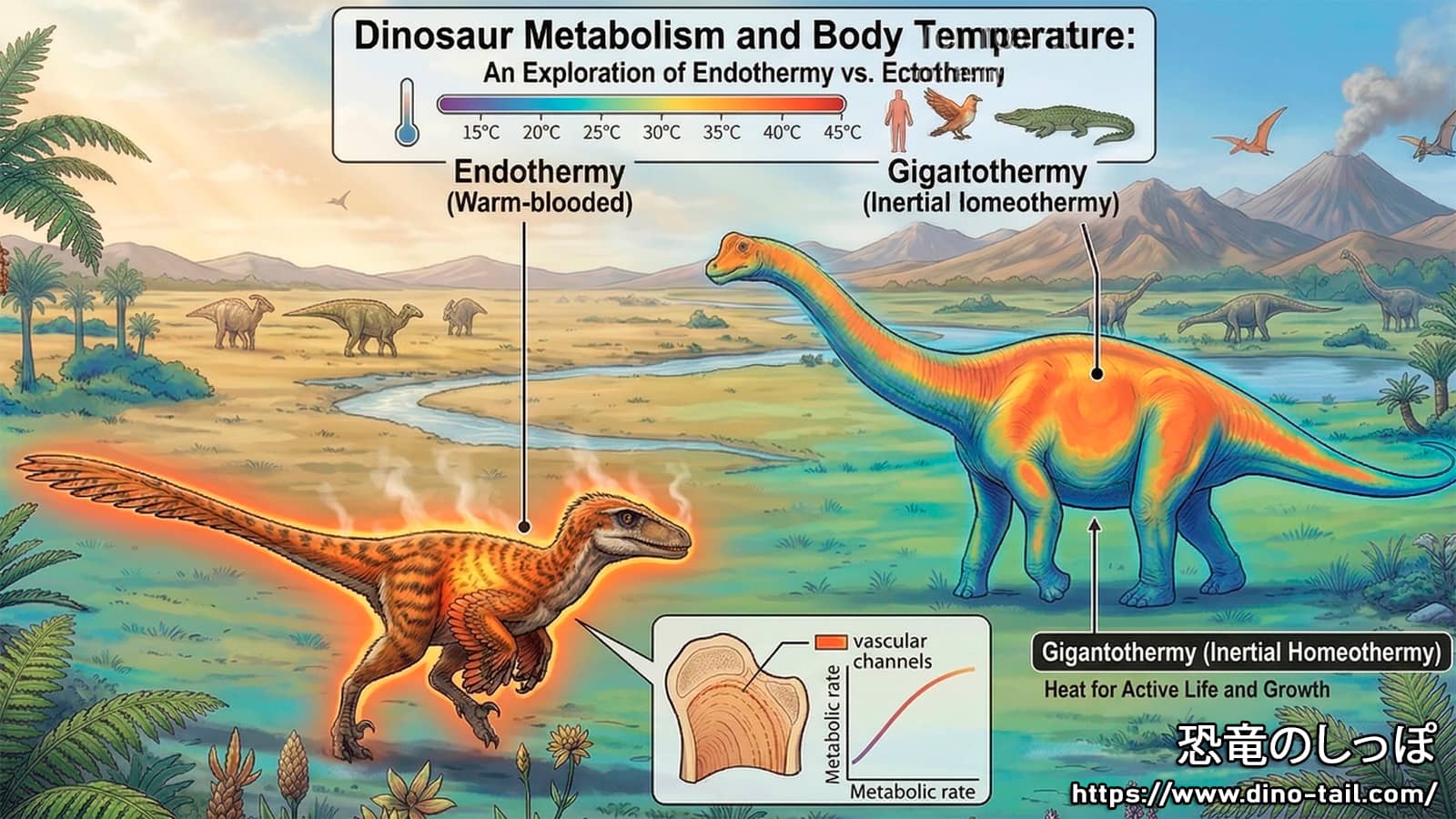
- Theropoda : This group, including Tyrannosaurus, Velociraptor, and modern birds, showed extremely high metabolic rates. Some species possessed metabolic rates surpassing those of modern birds, confirming them as active predators and "true endotherms."
- Sauropodomorpha : Giant herbivorous dinosaurs such as Brachiosaurus and Diplodocus also maintained high metabolic rates comparable to endotherms. This refutes the long-held hypothesis that their high temperatures were due to thermal inertia from their massive bodies (gigantothermy), indicating it was instead driven by active physiology.
- Ornithischia : In contrast, this group, including Triceratops, Stegosaurus, and hadrosaurs, exhibited extremely low metabolic rates. Their numbers were comparable to modern lizards and turtles, highlighting the possibility that they secondarily evolved ectothermy or adapted to their environment with low metabolic rates.
These findings suggest that while dinosaurs inherited a high metabolism from a common ancestor, this trait was lost in ornithischians, telling us that dinosaur evolution did not follow a simple path of becoming "warm-blooded."
Evolutionary Triggers and Climate Adaptation: The Origins of Endothermy
Addressing the question of when and why dinosaurs acquired endothermy, a 2024 study by Alfio Alessandro Chiarenza and colleagues provides a new perspective by combining the geographic distribution of fossils with paleoclimate models.
Early Jurassic Climate Change and the Jenkyns Event
Approximately 183 million years ago, the "Jenkyns Event" in the Early Jurassic brought about rapid global warming and changes in flora due to massive volcanic activity. This environmental stress is thought to have prompted different physiological evolution among dinosaur lineages.
The research team analyzed over 1,000 fossil records and found that theropods and ornithischians expanded into colder, higher-latitude regions during this period. Meanwhile, sauropods remained in warmer, lower-latitude areas. This shift in distribution patterns coincides with the time theropods and ornithischians developed endothermy (and feathers for insulation) to enable activity in colder environments.
Evolutionary Consequences: Adaptations and Constraints
The acquisition of endothermy gave dinosaurs the massive advantage of high growth rates and expansion into diverse environments, including cold regions. However, for the massive sauropods, high basal metabolism may have become a constraint, making heat dissipation difficult and increasing the risk of overheating. The fact that sauropods were restricted to tropical and subtropical regions suggests they relied on an ectothermic physiology that cleverly utilized environmental temperature, or controlled "thermal inertia (gigantothermy)."
Analyzing Discrepancies and Debates Among Studies: The Case of Maiasaura
There is a notable discrepancy regarding the metabolism of ornithischians between the latest research (Wiemann 2022) and previous isotope studies (Dawson 2020).
Core of the Discrepancy
- Isotope Data (Dawson 2020) : The ornithischian Maiasaura showed an extremely high internal body temperature of 44℃, indicating advanced metabolic control.
- Molecular Marker Data (Wiemann 2022) : Hadrosaurs (relatives of Maiasaura) are reported to have low metabolic rates comparable to lizards.
The key to interpreting this contradiction lies in the "separation" of metabolic rate and internal body temperature. Medium to large dinosaurs like Maiasaura could maintain a high body temperature through thermal inertia even if their basal metabolic rate was low. It's also possible they had facultative endothermy, raising their metabolism only during certain activities or breeding seasons. Furthermore, the possibility of a "thermal mosaic," where temperatures and metabolic product accumulation differ depending on the bone formation site (extremity vs. core), is an issue that must be tested in the future.
Correlation of Physiological Functions and Morphological Evidence: Brain, Heart, and Respiration
A high metabolic rate is closely related not only to the animal's activity level but also to its anatomical complexity.
Evolution of Circulatory and Respiratory Systems
Efficient oxygen supply to tissues is essential to maintain a high metabolism.
- Heart Structure : Theropods and sauropods with high metabolic rates are presumed to have had a powerful four-chambered heart that completely separated pulmonary and systemic circulation, similar to mammals and birds.
- Air Sac System : The cavities (pneumaticity) found in the bones of theropods and sauropods suggest the existence of a unidirectional respiratory system (air sac system) similar to birds. This not only maximized respiratory efficiency but likely also functioned as a cooler to help dissipate heat from their massive bodies.
Intelligence and Brain Size
Recent neuroanatomical studies have discussed the correlation between metabolic rate and brain size (encephalization quotient).
- Theropoda : Large theropods like Tyrannosaurus, supported by high metabolic rates, are pointed out to have potentially had nerve cell densities close to those of primates.
- Ornithischians and Sauropods : In contrast, these had relatively smaller brain sizes, which aligns with their low metabolism (especially ornithischians) or strategies that specialized energy towards body maintenance.
The DAEDALUS Project: A New Approach Through Inner Ear Morphology
The ongoing "DAEDALUS Project" is developing new methods for estimating body temperature that are not dependent on chemical preservation conditions.
The semicircular canals in the inner ear of vertebrates are organs that govern the sense of balance. The viscosity of the endolymph fluid that fills them changes dramatically with temperature.
Thermo-Mobility Index (TMI) : Ricardo Araújo's team constructed a model to calculate the "design temperature" at which the animal's sense of balance functions most efficiently, based on the shape and size ratio of the semicircular canals.
Introduction of AI and Nano-viscometers : By using the latest AI algorithms and nano-level viscosity measurement technology, this attempt to back-calculate internal body temperature from fossil CT scan data is expected to become the third pillar complementing chemical analysis (isotopes and molecular markers).
Summary: The Landscape of Thermal Physiology in the Mesozoic Era
The latest research results on dinosaur thermal physiology show that we must break away from traditional simple dualism and require multifaceted analysis where multiple factors overlap.
- Widespread Distribution of Endothermy : Clumped isotope analysis indicates that metabolic control exceeding environmental temperatures existed across all major dinosaur lineages. The ability to generate metabolic heat was an early evolved trait in dinosaur ancestors.
- Metabolic Differentiation Between Lineages : Analysis by molecular markers revealed that the intensity of endothermy varied greatly by lineage. While theropods and sauropods maintained a "high metabolism, active" strategy, it is highly likely that ornithischians shifted to a "low metabolism, energy-saving" strategy.
- Interaction with the Environment : Climate change in the Early Jurassic accelerated the physiological adaptation of dinosaurs, allowing them to dominate the entire globe from high latitudes to the tropics.
- Activity and Adaptation Strategies : High metabolism made possible the development of feathers, the maintenance of massive bodies, the acquisition of advanced intelligence, and ultimately the realization of "flight" by birds.
Findings on dinosaur thermoregulation are the key not just to measuring the temperature of animals in the past, but to unraveling the fundamental strategies of life—how organisms broke through the limits of energy to evolve into global dominators. In the future, with the addition of new physical approaches represented by the DAEDALUS project, the thermal physiology of dinosaurs will move towards a more precise and integrated understanding.
| Taxon | Estimated Metabolic Rate | Body Temperature Stability | Main Adaptations / Characteristics |
|---|---|---|---|
| Theropoda | Very High (Bird-level) | Homeothermic or Heterothermic | Feathers, air sacs, high intelligence, predatory activity, origin of flight. |
| Sauropodomorpha | High (Mammal-level) | Homeothermic (combined with thermal inertia) | Massive body, heat dissipation through long neck, highly efficient digestion. |
| Ornithischia (Hadrosaurs) | Low (Reptile-level) to Medium | Poikilothermic or Homeothermic (thermal inertia) | Complex teeth, herd behavior, some secondary low metabolism. |
| Ornithischia (Thyreophorans / Marginocephalians) | Low | Close to Poikilothermic | Armor and horns, low activity levels, environment-dependent thermoregulation. |
| Pterosaurs | High | Homeothermic | High-energy metabolism required for flight, common ancestor with dinosaurs. |