About Tylosaurus
| Scientific Name (Genus) | Tylosaurus |
| Meaning of Name |
Lizard with a knob
Derived from Ancient Greek "tylos" (knob, projection) and "sauros" (lizard) |
| Classification | Squamata, Mosasauridae, Tylosaurinae |
| Period | Late Cretaceous (approx. 92 - 66 million years ago) |
| Habitat | Pan-North Atlantic basin including North America, Europe, and Africa |
| Sub-classification / Species Name |
Tylosaurus proriger (Type species) Tylosaurus nepaeolicus Tylosaurus bernardi (formerly Hainosaurus) Tylosaurus pembinensis Tylosaurus saskatchewanensis, etc. |
| Year of Paper Publication | 1872 |
| Genus Name Publication | Note on Rhinosaurus. American Journal of Science 4 (20): 147. Marsh OC. 1872. |
Tylosaurus was a large marine reptile of the Mosasauridae family that stood at the apex of the ecosystem in the Late Cretaceous seas. On the North American continent, it was the third mosasaur taxon to be described and was widely distributed across vast oceanic regions in North America, Europe, and Africa.
Weapon or Sensor: The Enigmatic Rostrum
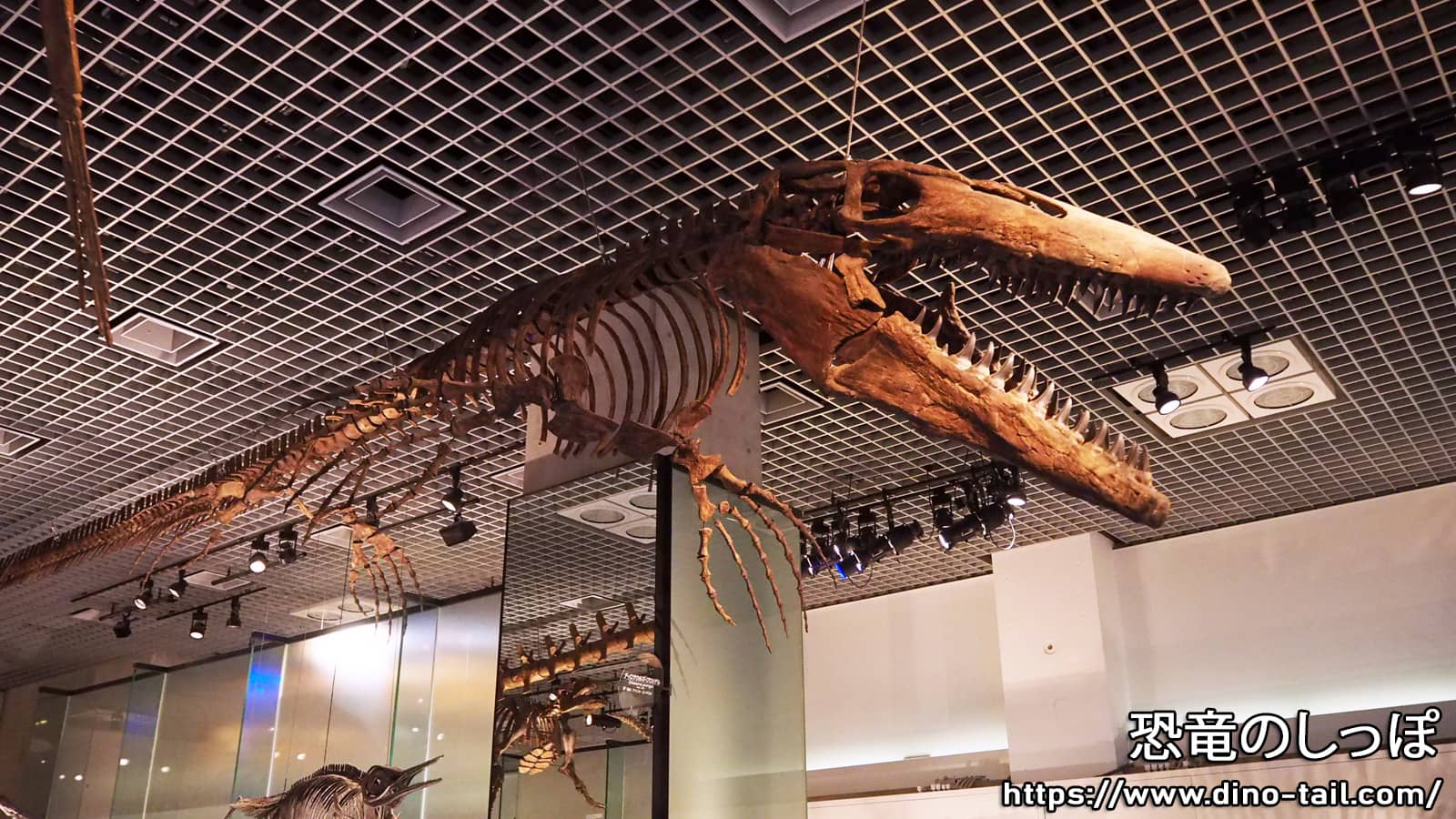
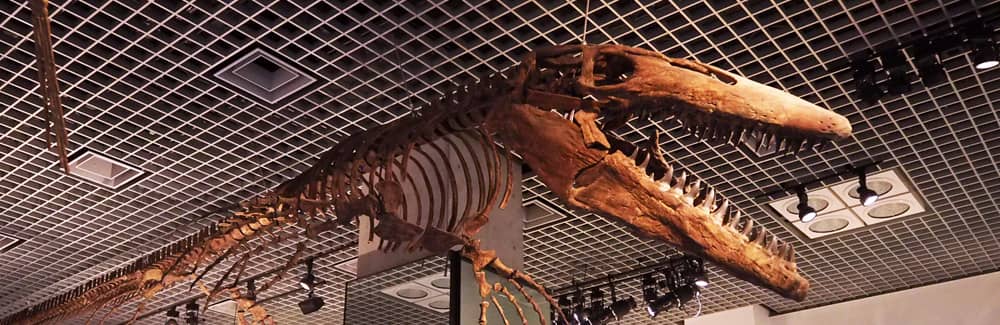
The most striking feature of Tylosaurus is its "rostrum," a long, forward-projecting snout with no teeth at the tip. This robust projection, which gave the genus its name, was long thought to have been used as a "weapon for ramming and stunning prey or rivals."
However, recent 3D CT scan analyses have revealed a complex network of nerves within this rostrum. This suggests that rather than being a weapon for collision, it likely functioned as a "high-precision target detection sensor" capable of sensing minute water currents and electricity generated by prey movements in murky waters or the dark deep sea.
Furthermore, biomechanical simulations have shown that the lower jaw of Tylosaurus possessed extremely high strength toward the back. Tylosaurus did not merely swallow prey whole; it had the ability to bite into massive marine vertebrates of equal or greater size and violently twist to tear off chunks of flesh.
Reverse-Shark-Like Tail Fin and Black Body
Until the end of the 20th century, mosasaurs like Tylosaurus were thought to swim by undulating their entire bodies like eels or modern sea snakes. Older restorations typically depicted them with dorsal fringes and straight, simple-shaped tails.
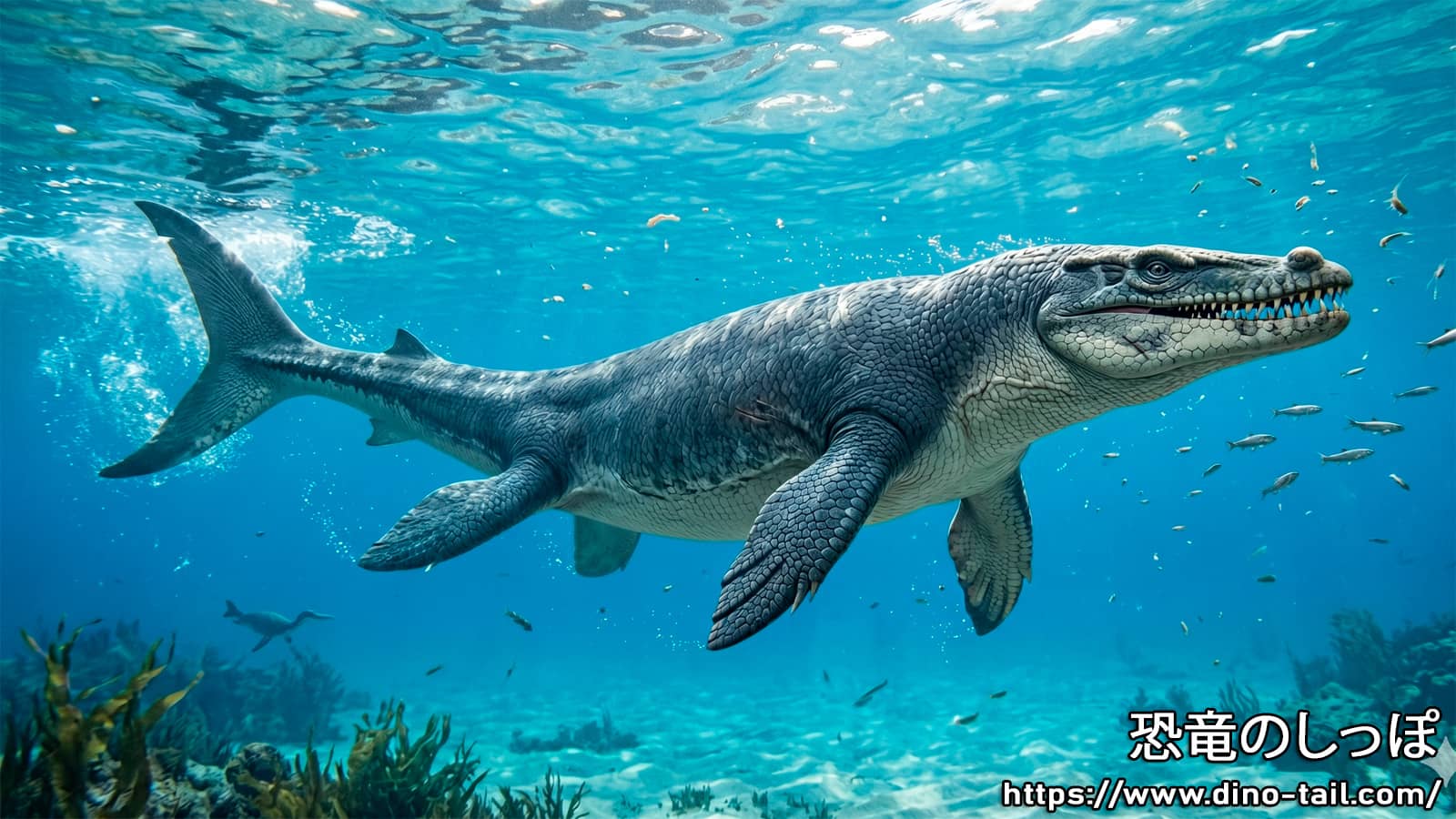
However, this classical image has been overturned in recent years. According to a 2013 paper published in Nature Communications by Dr. Johan Lindgren and his team at Lund University, traces of a "hypocercal" (reverse-shark-like) tail fin—where the end of the tail vertebrae bends downward with a fleshy lobe above it—were identified from rare fossils with preserved soft tissue.
This proved that mosasaurs did not undulate their entire bodies. Instead, they kept the front part of their body rigid and violently swung this powerful crescent-shaped tail fin from side to side to generate explosive thrust and acceleration.
An even more astonishing discovery was published by the same team in the journal Nature in 2014. Analyzing the fine structure and chemical composition of fossilized scales using advanced mass spectrometry (such as ToF-SIMS), high concentrations of eumelanin (black pigment) traces were detected from Tylosaurus scales. This indicates that their dorsal side was extremely dark black or dark gray.
This "black body color" is thought to have functioned as a "thermoregulatory mechanism," efficiently absorbing sunlight to raise body temperature, much like the modern leatherback sea turtle. At the same time, it is speculated to have provided camouflage (characteristic of a stalking hunter), completely hiding its silhouette against the dark deep sea or from prey looking down when diving from the surface to the depths.
Diet and Ecology: Spatial Generalists of the Sea
Tylosaurus was an "absolute predator" in the Cretaceous seas. Fossil records from the abdominal cavity (around the stomach) demonstrate that they preyed on an extremely diverse range of organisms.
| Stomach Contents / Prey | Details |
|---|---|
| Other mosasaurs | The skeleton of a smaller mosasaur (such as Clidastes) was found in the stomach of an individual about 9 meters long. |
| Plesiosaurs | A plesiosaur (polycotylid) reaching 2.5 meters in length was found swallowed whole in the stomach of an 8.8-meter-long specimen. |
| Marine birds, sharks, and fish | Flightless diving birds (Hesperornis), large bony fish, and shark teeth have all been detected together. |
| Terrestrial dinosaurs (carcasses) | Evidence of powerful bite marks left by scavenging on the carcass of a hadrosaurid (a terrestrial dinosaur) washed out to sea also exists. |
Chemical analysis of fossils (rare earth element ratios) has proven that Tylosaurus routinely traveled not only in shallow seas but also to the deep pelagic zones exceeding depths of 150 meters. Furthermore, the frequent presence of fierce bite marks inflicted by members of the same species on fossils suggests they were highly territorial and ferocious hunters constantly engaging in violent conflicts.
A Turbulent History of Discovery and Naming
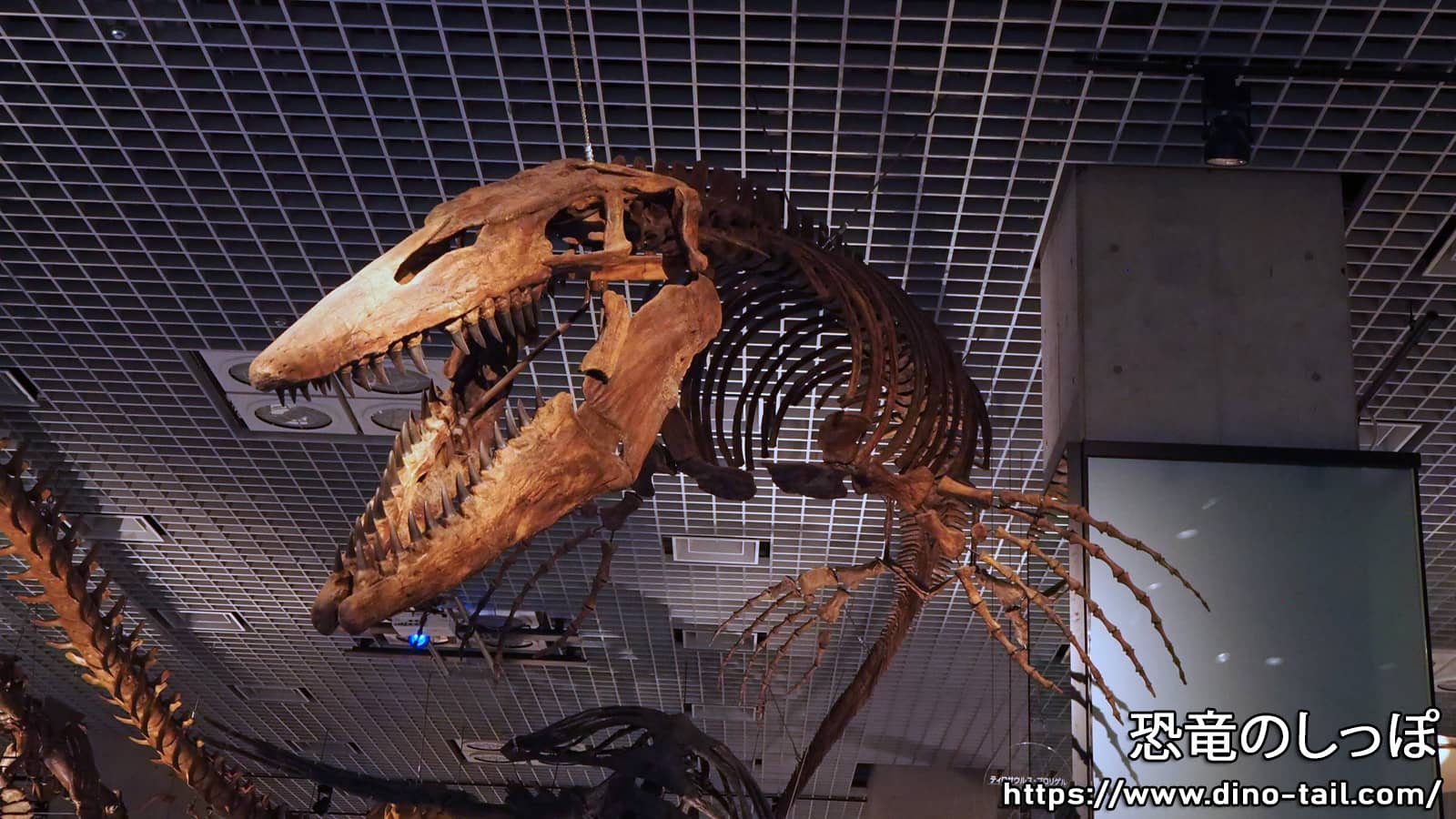
The academic description history of Tylosaurus was caught in the maelstrom of the "Bone Wars," which embroiled the American paleontological community in the late 19th century.
In 1868, Edward Drinker Cope, having acquired the first specimen (a fragmentary skull and 13 vertebrae), proposed the scientific name Macrosaurus proriger, classifying it as an ornithopod dinosaur ([Remarks on Macrosaurus proriger.] Proceedings of the Academy of Natural Sciences of Philadelphia 11(81): 123.). A year later, Cope redescribed the same specimen in detail and reclassified it to the mosasaurid genus Liodon, known from England.
However, his rival, Othniel Charles Marsh, argued that it was a distinct new genus, sparking a fierce dispute over naming rights. Marsh proposed several names but finally established the genus name "Tylosaurus" in 1872.
Growth Stage or Distinct Species: The Controversy Over T. kansasensis
Even today, debates surrounding the taxonomy of Tylosaurus continue. The species Tylosaurus kansasensis, described in 2005, was initially considered a "more primitive, smaller species." However, recent analyses have raised the theory that they are merely "juveniles" of the larger species T. nepaeolicus. Yet, the latest bone histology examinations (studies examining bones under a microscope) strongly suggest that this group of small fossils represents an "independent species with its own growth cycle," keeping the discussion active at the forefront of paleontology.