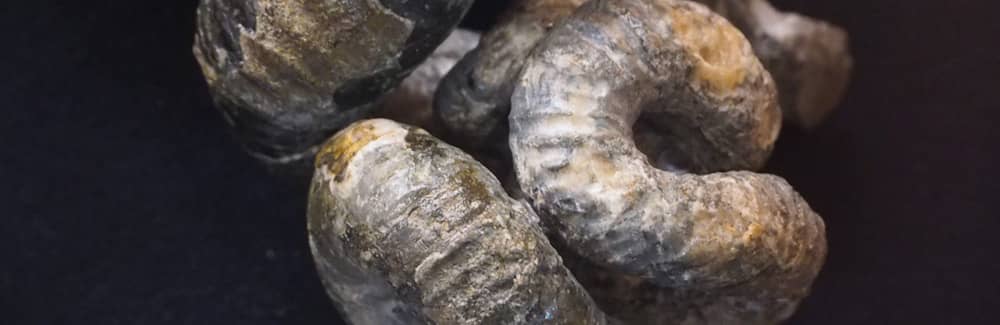
About Nipponites
| Scientific Name (Genus) | Nipponites |
| Meaning of Name | Japanese stone Nippon(Japan) - ites(stone) |
| Classification | Mollusca, Cephalopoda, Ammonoidea, Nostoceratidae |
| Period | Late Cretaceous (Turonian - Coniacian) |
| Discovered in | Japan (Hokkaido), Sakhalin (Russia), Madagascar, Oregon (USA), etc. |
| Sub-classification / Species Name |
Nipponites mirabilis Nipponites sachalinensis Nipponites bacchus Nipponites occidentalis |
| Year of Paper Publication | 1904 |
History of Discovery and Overcoming the "Deformity" Theory
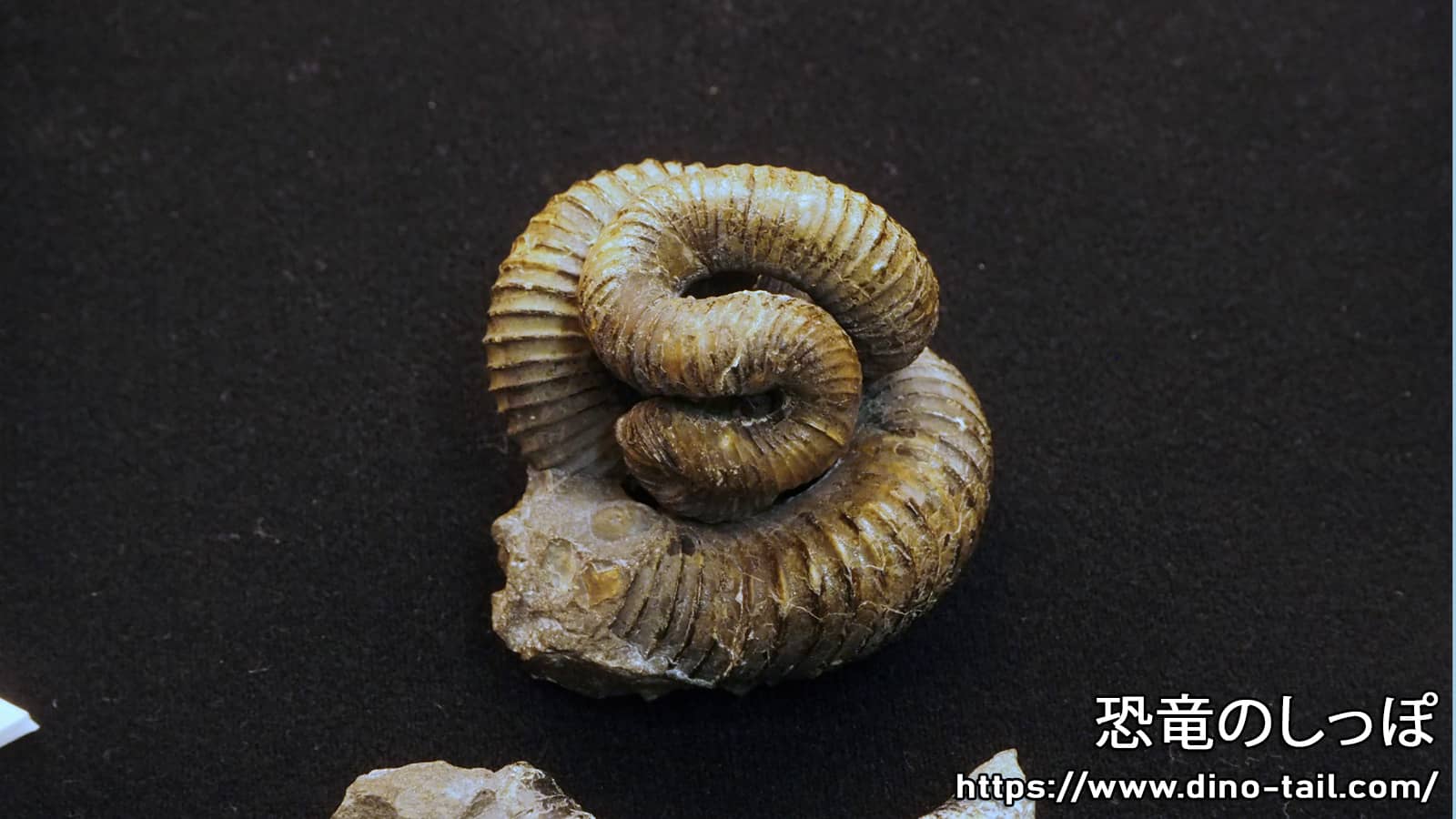
Ammonites, the cephalopods that symbolize the Mesozoic oceans, are mostly known for having a "planispiral" shell coiled in a single plane. However, entering the Late Cretaceous, "heteromorph ammonites" rapidly diversified, exhibiting a variety of coiling patterns that seemed to break free from existing geometric constraints.
Among the heteromorph ammonites, Nipponites, reported from Japan, is a globally unique existence due to the bizarreness and complexity of its morphology. In 1904, it was described as a new genus and species, Nipponites mirabilis, by Hisakatsu Yabe, then a graduate student at Tokyo Imperial University and later considered the father of Japanese geology and paleontology, based on a single specimen collected from the Obirashibe River basin in northwestern Hokkaido. The scientific name means "amazing (mirabilis) Japanese stone (Nipponites)".
Immediately after the announcement of Nipponites, foreign paleontologists expressed strong doubts that this specimen was not an independent species, but rather a "deformity" or "pathological abnormality" caused by an ontogenetic error. This was because it was thought impossible for such a complex morphology to be stably inherited in the evolution of ammonites, which is based on a planispiral coil. However, when another individual with the exact same coiling pattern was discovered in Hokkaido in 1926, Nipponites came to be globally recognized as an established taxon with a specific growth program.
Amazing Geometric Rules: The Growth Model of Nipponites
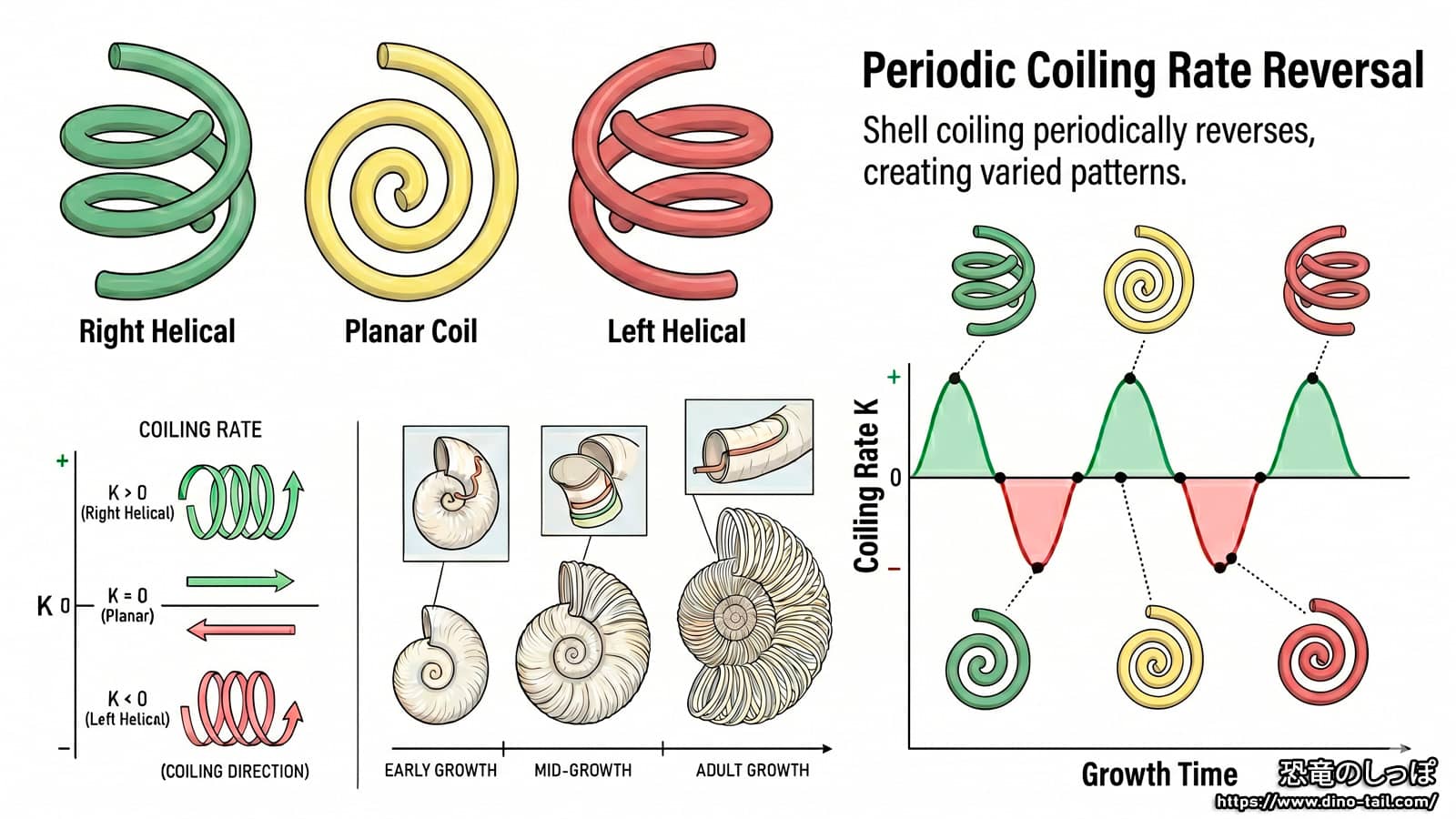
At first glance, Nipponites has a shape like a chaotically tangled string, but in reality, it grows based on strict mathematical rules. In the 1980s, research by Dr. Takashi Okamoto elucidated the rules of its complex shape by formulating the growth of ammonites as a "growing tube model".
In the case of Nipponites, it was found that the "torsion rate" at which the shell twists three-dimensionally periodically reverses, alternately repeating right-handed spirals, plane coiling, and left-handed spirals. The coiling pattern in the middle growth stage can be approximated to the shape of the "seams of a tennis ball". The aperture meanders through three-dimensional space, arranged to wrap around the already formed initial shell. At this time, the growth direction is controlled so that it fits into the most compact space possible while avoiding the shells colliding with each other (self-interference).
Why this shape? Posture Control and Lifestyle
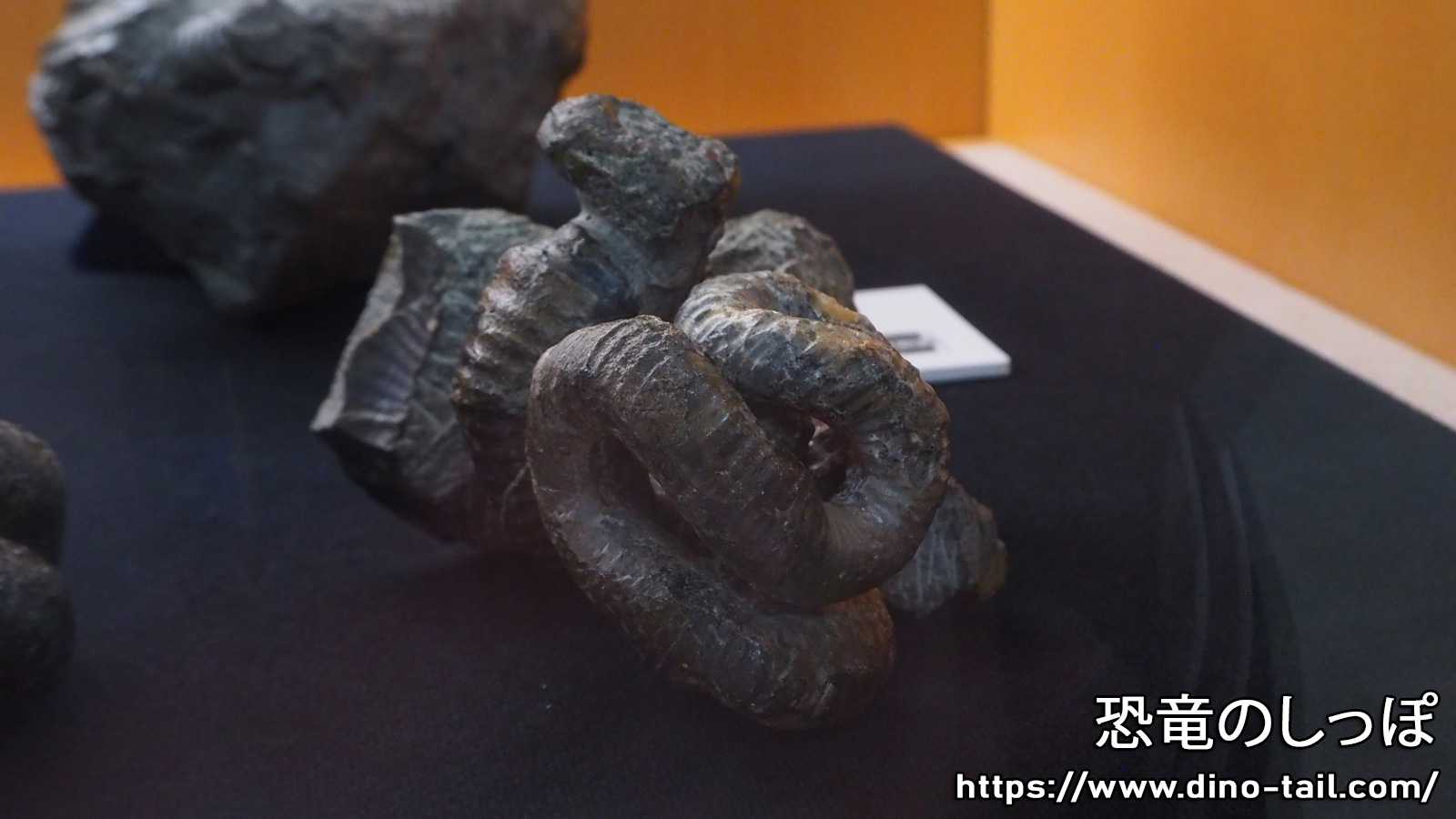
To the adaptive question of "why did it evolve into such a complex shape?", research using the latest 3D modeling and hydrostatic simulations has provided an answer. According to a study by Lemanis et al. (2020), Nipponites possessed the ability to achieve neutral buoyancy at all stages of growth, meaning it was never sunk on the seafloor but had free-floating capabilities.
Dr. Takashi Okamoto has proposed the hypothesis that the meandering growth of Nipponites arises from a "regulatory function to maintain a constant posture in the sea". As the ammonite grows and its shell becomes heavier, its center of gravity shifts, causing the aperture to point too far up or down. Nipponites is thought to have sensed this change in posture and countered the moment by switching the way the shell coiled, always keeping the aperture pointing in the proper direction. The interpretation is that as a byproduct of repeating the simple posture control feedback of "always wanting to be in the same orientation", that complex three-dimensional meandering morphology was formed.
Their lifestyle is inferred to have been that of a low-energy "quasi-planktonic" drifter, rather than an active swimmer. They probably preyed on floating plankton and the like while slowly turning (pirouetting) in the sea.
Symbiosis theory with sponges
There was once a hypothesis that sponges lived in symbiosis in the gaps of the complexly meandering shell of Nipponites. The idea was that the sponge provided camouflage and defense, while the ammonite provided mobility and access to fresh seawater. However, at present, no conclusive fossil evidence supporting this has been found, and the latest simulations show that Nipponites alone could perfectly control the balance of buoyancy and posture without symbiotic organisms.
Evolutionary Jump: Divergence from Eubostrychoceras
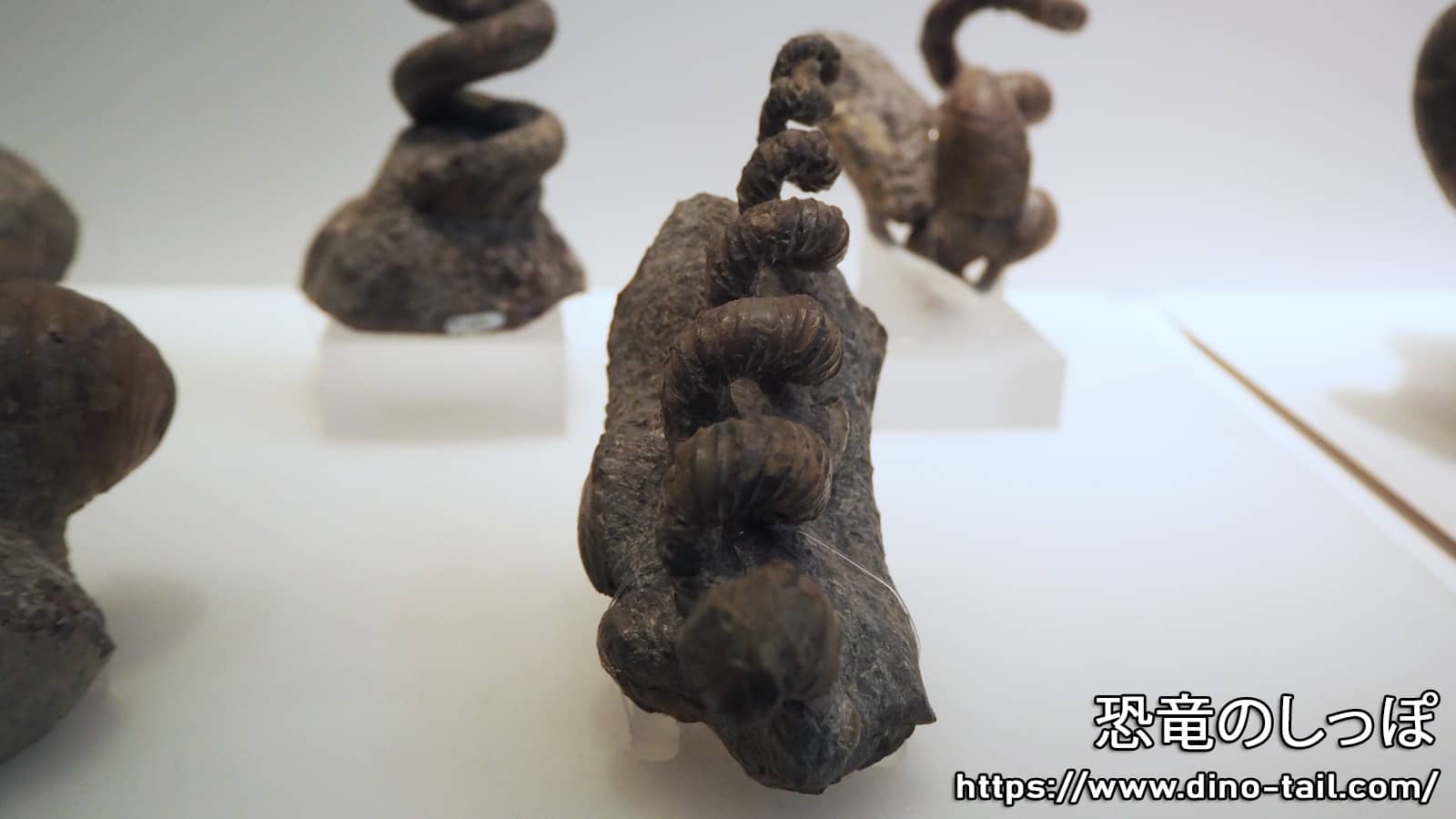
The appearance of Nipponites is considered a prime example of "saltational evolution" in the evolutionary history of ammonites. Nipponites is thought to have evolved from a group in the same family Nostoceratidae called "Eubostrychoceras", which has a simple spiral coil resembling soft-serve ice cream.
Simulations using growth models have shown that morphology transitions dramatically from a simple spiral like Eubostrychoceras to a complex meander like Nipponites simply by slightly changing the threshold for posture control. This suggests that without the need for large-scale genetic mutations, a radically different new morphology can evolve with just a slight change in parameters in the growth program.
Japanese Paleontology and "Fossil Day"
Nipponites mirabilis has been adopted as the symbol mark of the Palaeontological Society of Japan as a highly unique fossil representative of Japan. This is also an expression of respect for the fact that Hisakatsu Yabe's research was the first step toward the internationalization of Japanese paleontology.
Furthermore, in 2018, October 15th, the date when Hisakatsu Yabe's paper describing Nipponites as a new species was published, was established as "Fossil Day". Nipponites transcends the boundaries of a mere fossil and has become an existence that occupies a special place in the history of Japanese science, continuing to pave the way at the forefront of modern paleontology.