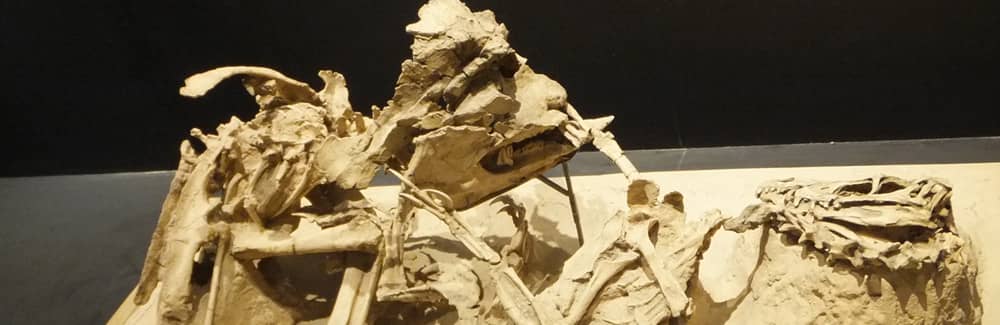
Even within the long history of paleontology, fossils that capture the exact moment extinct animals were "alive and acting" are extremely rare.
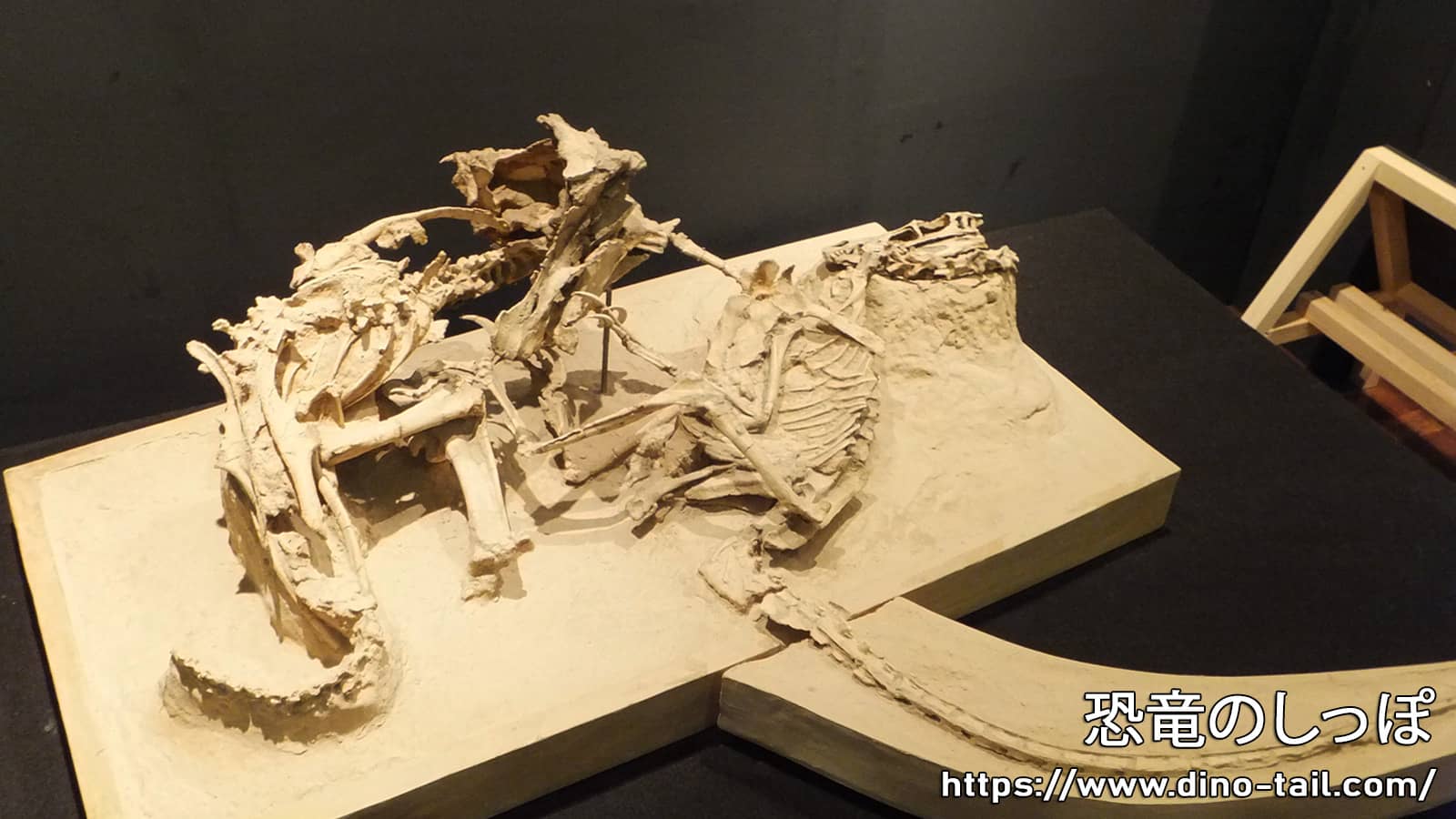
One of the most famous examples is the complete skeleton specimen—commonly known as the "Fighting Dinosaurs"—discovered in the Gobi Desert of Mongolia in 1971. It preserves the plant-eating ceratopsian Protoceratops andrewsi and the meat-eating theropod Velociraptor mongoliensis locked in combat.
In this column, we will explain in detail why this life-and-death drama that occurred in the desert approximately 75 to 71 million years ago was preserved so three-dimensionally, the offense and defense revealed by the details of the skeletons, and the 50-year debate over their cause of death.
1. The Miraculous Discovery of 1971 and the Harsh Environment of the Gobi Desert
The "Fighting Dinosaurs" fossil was discovered on August 3, 1971, during the final year of the "Polish-Mongolian Palaeontological Expeditions," which took place from 1963 to 1971. The discovery site was an area called Tugrikin-Shireh (meaning "a plateau where money (coins) is found" in Mongolian), located about 30 kilometers west of the famous fossil locality Bayanzag (the "Flaming Cliffs").
The first clue was a fragment of a Protoceratops skull peeking out from the surface of weathering sandstone. Because there was a high risk of breaking the bones if they tried to extract them separately on-site, the expedition team dug around the massive sandstone block, stabilized it with plaster, and excavated it whole. Subsequently, after more than 10 years of slow cleaning work (removing the rock) at the Mongolian Academy of Sciences, the dramatic figure of the two dinosaurs locking their limbs and jaws was revealed.
The two dinosaurs are preserved within a single rock block, but academically they are given separate specimen numbers. Currently, they are registered and housed at the Mongolian Paleontological Center (MPC) in Ulaanbaatar, with the Protoceratops as specimen number: MPC-D 100/512 and the Velociraptor as specimen number: MPC-D 100/25.
Basic Data and Comparison of the Fighting Dinosaurs
| Item | Protoceratops Individual | Velociraptor Individual | Notes / Geological Data |
|---|---|---|---|
| Scientific Name (Species) | Protoceratops andrewsi | Velociraptor mongoliensis | Two representative species living in the same formation and era |
| Classification Group | Ornithischia, Ceratopsia, Protoceratopsidae | Saurischia, Theropoda, Dromaeosauridae | A quadrupedal plant-eating dinosaur and a bipedal meat-eating dinosaur |
| Current Specimen Number | MPC-D 100/512 | MPC-D 100/25 | Housed at the Mongolian Paleontological Center (Old designations: GIN, IGM, etc.) |
| Discovery Date / Expedition | August 3, 1971 (Polish-Mongolian Joint Expedition) | August 3, 1971 (Same as left) | Excavated and recovered as a single massive sandstone block |
| Locality / Formation | Tugrikin-Shireh, Gobi Desert, Mongolia (Djadochta Formation) | Same as left | A fine-grained sandstone layer consisting mainly of wind-blown dune sand |
| Era Lived | Late Cretaceous Campanian (approx. 75 to 71 million years ago) | Same as left | Sometimes introduced as "approx. 80 million years ago" in exhibitions |
Why were the bones preserved without being scattered?
By examining the rocks of the "Djadochta Formation (Upper Tugrikin Member)" where the fossil was discovered, we can understand what the environment was like at that time. The strata preserve cross-bedding patterns created by wind-blown sand dunes, and since aquatic turtles and fish are rarely found while tortoises are common, it is known that Tugrikin-Shireh was a desert (sand dune region) spreading under a warm and dry climate.
This harsh desert environment acted as a time capsule, preserving miraculous complete skeletons like the Fighting Dinosaurs and brooding oviraptorids (Citipati). Because the animals were buried alive instantly by events such as "sand debris flows" caused by dunes suddenly collapsing after heavy rains, or violent sandstorms, they were fossilized in their three-dimensional, articulated states without their bodies rotting and falling apart or being scattered by scavengers.
Glossary: What is Taphonomy?
Taphonomy is a field of research that investigates how organisms are buried in soil or sand after death and what changes they undergo to remain as fossils today. By closely examining scratches on bones, joint dislocations, and the characteristics of the surrounding rocks, researchers can deduce the natural environment of the time and the true cause of the creature's death, much like scientific investigation at a crime scene.
2. Deciphering the "Moment of Offense and Defense" from the Intertwined Postures
The reason the Fighting Dinosaurs shocked researchers worldwide is that the two skeletons were not just close together, but their specific parts of "attack" and "defense" were locked and preserved. First, let's look at the characteristics of the two combatants and the state of the battle etched into the fossil.
The Bulkier Protoceratops and the Agile Velociraptor
The defending Protoceratops is an early ceratopsian (horned dinosaur) and ancestor to dinosaurs like Triceratops, being a quadrupedal plant-eater. Adults reached a total length of about 2 to 2.5 meters and an estimated weight of 62 to 104 kilograms. It had a short frill (neck shield) at the back of its head, and with its sharp, parrot-like beak and strong jaw muscles, it could deliver an extremely powerful bite. The individual in the Fighting Dinosaurs fossil is believed to be a young adult, slightly smaller than the maximum size, but it was still much heavier and bulkier than the attacking Velociraptor.
On the other hand, the attacking Velociraptor is a small to medium-sized bipedal meat-eating dinosaur. Its total length is about 2 meters, but its hip height is only about 50 centimeters, and its estimated weight is only 15 to 20 kilograms, making it a much smaller and slimmer dinosaur than its depiction in the "Jurassic Park" movie series. Its elongated jaws were lined with over 60 sharp, serrated teeth. Studies of other fossils suggest that in life, its entire body was covered in feathers, and it had well-developed wings (flight feathers) on its forelimbs.
4 Decisive Points of Offense and Defense
Observing the specimen, the Protoceratops is positioned in the upper left, taking a "crouching (semi-standing) posture" as if bracing itself on all fours, while the Velociraptor lies in a low posture beneath it, with its back and right flank on the ground. The Velociraptor's neck maintains a strong S-curve, and since the muscles have not relaxed and straightened after death, we know they were buried rapidly while alive and fighting (or immediately after dying).
The bodies of the two are violently clashing at the following four points:
- 1. Protoceratops' jaws and Velociraptor's right arm: The Protoceratops has closed its powerful upper and lower beak (jaws) squarely on the Velociraptor's right forelimb (right arm), completely restricting its movement. This is decisive evidence that plant-eating dinosaurs were not defenseless prey, but engaged in desperate counterattacks.
- 2. Velociraptor's left hand and Protoceratops' skull: The Velociraptor has extended its left forelimb upward and is firmly gripping the edge of the Protoceratops' frill from the side of its face with its three sharp claws, as if scratching it.
- 3. Velociraptor's left foot and Protoceratops' belly: Positioned underneath, the Velociraptor is forcefully kicking its left hind leg into the Protoceratops' belly (around the area below the ribs).
- 4. Velociraptor's right sickle claw and Protoceratops' throat: As the most decisive blow, the Velociraptor's right hind leg is thrust even deeper, and the massive, sickle-shaped claw measuring over 6.5 centimeters long on the second digit (the "index finger" of the foot) is pierced deeply into the Protoceratops' throat. This is a critical vulnerable spot where major blood vessels (carotid artery, jugular vein) supplying the brain and the trachea pass through.
Anatomical Contact Points and Skeletal State
| Target Area | Protoceratops (MPC-D 100/512) | Velociraptor (MPC-D 100/25) | Scientific Significance |
|---|---|---|---|
| Overall Posture | Positioned upper left, semi-standing (crouching) posture. Head is horizontal, spine and tail strongly curved. | Positioned lower right, low posture with back to right flank on the ground. Neck maintains a strong S-curve. | No post-mortem muscle relaxation, proving they were locked in place during combat or immediately after death. |
| Clash Point 1 (Jaws and Right Arm) | Clamping down with strong upper and lower beak, restraining the opponent's right forelimb. | Right forelimb wrapped around the side of the opponent's head, completely caught within the closed jaws. | Evidence that the Protoceratops was alive and vigorously fighting back (biting). |
| Clash Point 2 (Skull and Left Hand) | Frill edge grabbed by the opponent's left hand from the side of the skull. | Left forelimb extended upward, sharp hand claws scratching and holding the opponent's skull/frill. | Indicates it was holding the prey's head with its forelimbs to accurately deliver kicks to the vital spots. |
| Clash Point 3 (Throat and Right Foot) | Pierced by the sickle claw in the underside of the neck (throat where the trachea and major vessels pass). | Right hind leg thrust high, the massive sickle claw of the second toe deeply pierced into the throat. | Evidence that the foot claw was used not for slicing open the belly, but for piercing the vital throat area. |
| Clash Point 4 (Belly and Left Foot) | Receiving a kick from the opponent's left foot in the belly/lower rib area. | Left hind leg thrust toward the underside of the opponent's belly, held in a kicking position. | Shows that from a position underneath, it linked both legs to attack the throat and belly simultaneously. |
| Missing Bones/Dislocation | Fractured pieces in shoulder bone (coracoid). Right forelimb and shoulder dislocated left-rearward from the body; parts of hind legs and tail tip missing. | Preserved completely from skull to fingertips and tail tip, with almost no missing parts or unnatural dislocations. | Suggests the Velociraptor underneath was protected by sand first, while the Protoceratops on top likely suffered external forces after death. |
A "Mysterious Gap" in the Preservation State of the Two
While it is generally introduced that "both were found in perfect condition," close examination by experts has revealed a significant difference in how the two were preserved.
The Velociraptor underneath is preserved almost perfectly articulated from its head to the tip of its tail and fingertips. However, the Protoceratops on top has shattered shoulder bones (coracoids), its right forelimb has been torn away from the torso along with the shoulder and shifted significantly to the left-rear, and some of the bones in its hind legs and the tip of its tail are completely missing. This mystery of "why the Velociraptor is complete, while the Protoceratops is partially broken and missing" became a major key in the "debate over the cause of death" introduced in the next section.
3. Why Couldn't They Separate? A 50-Year Debate Over Their Cause of Death
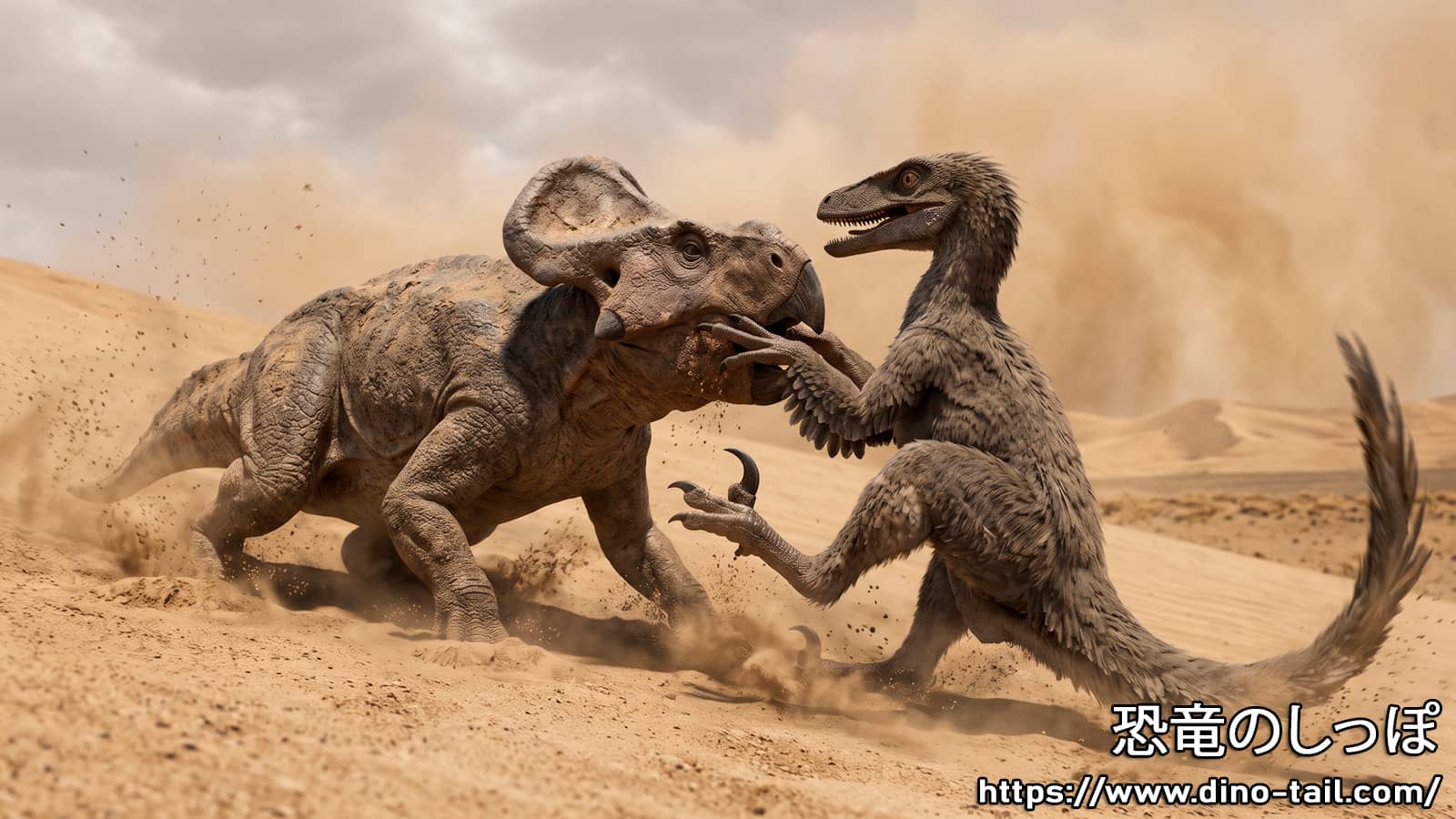
Since its discovery in 1971, five major hypotheses have been proposed by paleontologists worldwide regarding the question, "Why couldn't these two separate while grappling, and how were they buried in the sand?"
1. Drowning in Water or Quicksand (1974: Rinchen Barsbold)
Shortly after the discovery in 1974, Mongolian paleontologist Dr. Barsbold proposed the theory that the fiercely fighting pair fell into a swampy waterside or sank into quicksand at the bottom of a lake, drowned underwater, and were buried as is. However, subsequent geological surveys revealed that the strata at Tugrikin-Shireh are dry dune deposits, and deep lakes or swamps capable of drowning dinosaurs did not exist, leading to the rejection of this theory.
2. Dune Collapse and Suspected "Scavenging" (1993: Halszka Osmólska)
In 1993, Polish paleontologist Dr. Osmólska proposed a new theory fitting the desert environment. It is the "dune collapse theory," suggesting that while the two were fighting, a massive adjacent sand dune suddenly collapsed, burying them alive simultaneously. The phenomenon of a water-logged dune collapsing like a debris flow after heavy rain aligns well with the burial patterns of other fossils in the Djadochta Formation and is still considered a very plausible mechanism today.
At the same time, Dr. Osmólska posed a cautious question: "Were they really fighting?" She hypothesized that perhaps the Velociraptor was eating (scavenging) the carcass of an already dead Protoceratops when it was buried in the sand, and it merely looks like they are fighting by coincidence.
3. Ambush During a Sandstorm and Simultaneous Live Burial (1995: David Unwin et al.)
In 1995, Dr. Unwin's research team provided a clear counterargument to this "scavenging theory." Based on the facts that the Protoceratops was bracing itself on all fours with its head horizontal, biting hard on the Velociraptor's right arm, and the Velociraptor had slipped under the prey kicking up at its throat and belly with both feet, they proved that "it is impossible to consider it was eating a carcass; they undoubtedly died simultaneously while both were alive and fighting."
Furthermore, Dr. Unwin's team believed the two were buried alive by a severe "sandstorm," presenting a fascinating deduction. It is thought that Protoceratops living in the desert had a habit of crouching low to the ground to protect their eyes and nose from the sand during a severe sandstorm. The scenario suggests that the Velociraptor, well aware of this habit, deliberately launched a surprise attack "during a sandstorm" when visibility was poor and the prey was crouching defenselessly, and both were subsequently swallowed by rapidly accumulating sand.
4. Death from Blood Loss and "Dragging Down" in a Delayed Death (1998: Kenneth Carpenter)
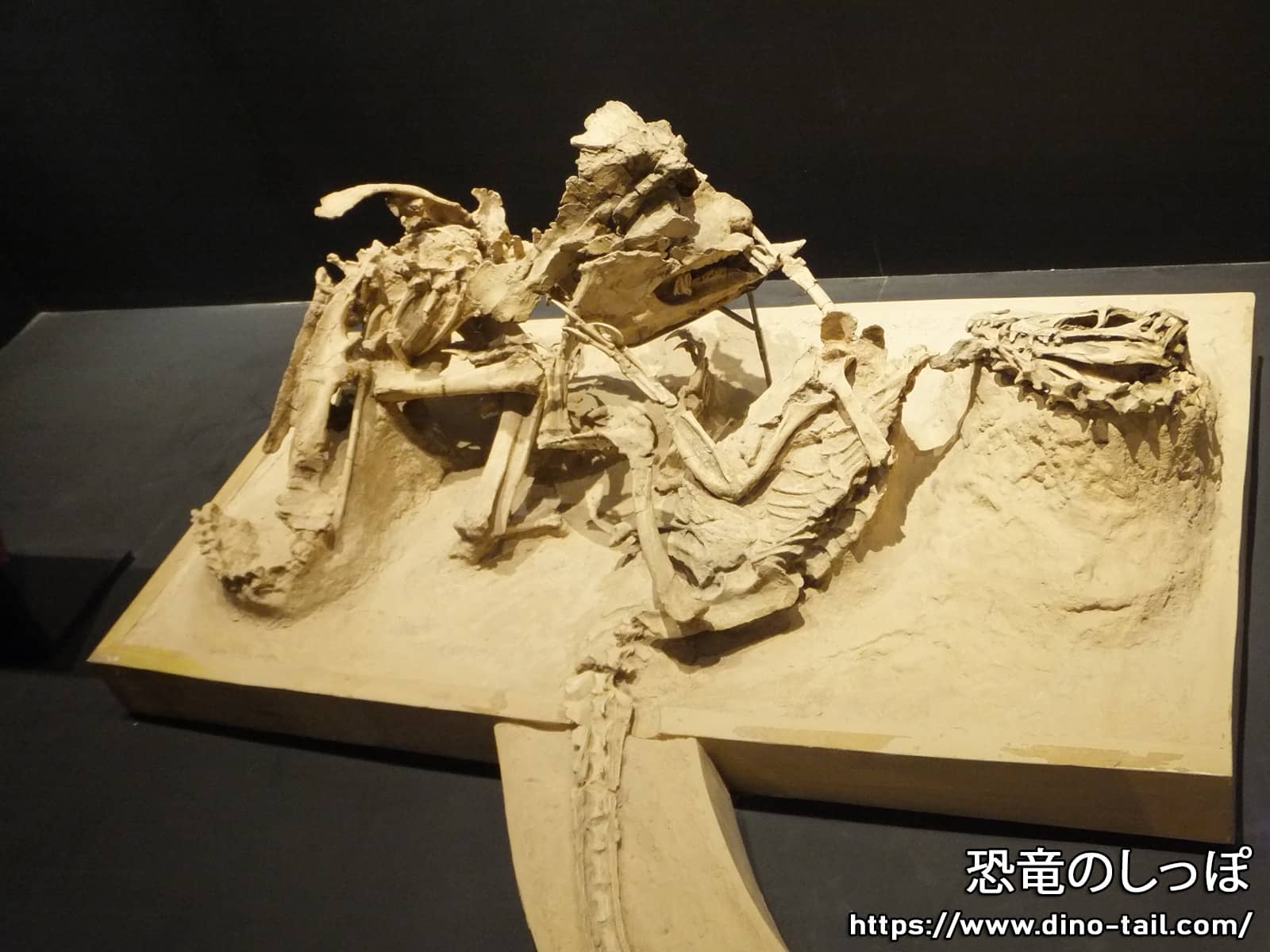
In 1998, American paleontologist Dr. Carpenter presented a brilliant deduction that rather than being buried instantly by a sudden natural disaster, "the outcome of the fight itself left both animals immobile, leading to death at different times." Because if they had been buried alive deeply in an instant, it would not explain why only the Protoceratops on top is missing its hind legs and tail.
Dr. Carpenter's reconstructed drama is as follows: The Velociraptor pierced the Protoceratops' throat with its right sickle claw, damaging major blood vessels and the trachea, causing the Protoceratops to bleed to death. However, in its dying moments, the Protoceratops mustered its final strength to bite down on the Velociraptor's right arm, collapsed forward, and pinned the Velociraptor down with its heavy weight. The Velociraptor had its right arm locked by the powerful beak, was crushed under a carcass many times its weight, and its foot claw, deeply embedded in the throat, became stuck, rendering it completely immobilized.
As a result, although the Velociraptor won the fight, it could not escape from under its prey and died of dehydration and starvation in the dry desert. The Velociraptor, trapped at a low position on the ground, was quickly covered and protected by wind-blown sand, while the carcass of the Protoceratops draped over it remained exposed on the surface for a while. Consequently, scavengers that arrived later tore off its hind legs and tail, before everything was eventually buried in sand and fossilized. This scenario reasonably explained the differences in bone preservation between the two.
5. Slamming and Post-mortem "Pulling" Theory (2016: Rinchen Barsbold)
In 2016, 45 years after the discovery, Dr. Barsbold, the original researcher, re-examined the specimen in detail and published a new analysis focusing on the Protoceratops' "fractures in both shoulder bones (coracoids)" and "the left-rearward dislocation of its right forelimb."
Dr. Barsbold theorized that at the climax of the battle, the Protoceratops used its weight and momentum to forcefully slam the leaping Velociraptor into the ground, where they became locked together, immobilized, and buried in the sand. He analyzed that "something forcibly pulled" the body of the partially buried Protoceratops toward the left rear, which shattered its shoulder bones, tore off its right forelimb, and created a slight gap between the two skeletons. While the culprit behind the pulling is highly likely to be another carnivore (scavenger) trying to drag the carcass out of the sand, Dr. Barsbold also touched upon another unique possibility: "Could the Protoceratops herd members have tried to pull their immobilized comrade backward to save it?" (However, since no trace fossils like footprints of the herd remain around, pulling by a scavenger is considered more realistic.)
4. The True Use of the Velociraptor's "Claw" and Its Hunting Style
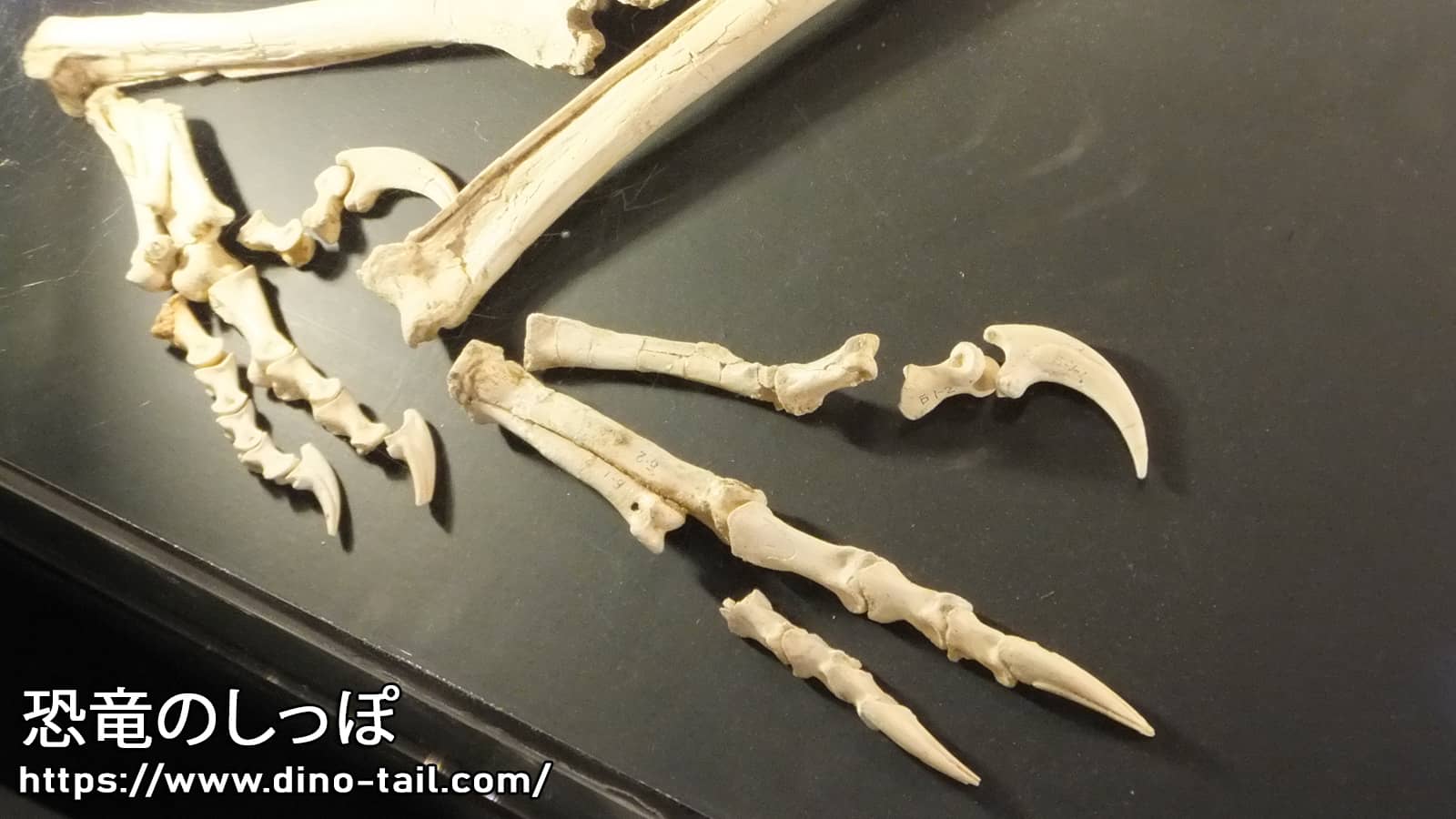
The scientific contribution the Fighting Dinosaurs brought to paleontology is not limited to figuring out the cause of death for these two. It also provided the greatest clue to solving the mystery of how "dromaeosaurid" carnivorous dinosaurs like Velociraptor and Deinonychus hunted.
Not a Knife to Slice the Belly, but a "Hook" to Pierce Vitals!
Previously, it was thought that the massive sickle claw on the hind leg (second digit) of the Velociraptor was a weapon like a "knife" used to kick and cleanly slice open the prey's belly, tearing through skin and muscle to disembowel it.
However, Dr. Carpenter (1998), after closely examining the Fighting Dinosaurs, questioned this common belief. First, the inner edge of the sickle claw was actually rounded and not a sharp blade suited for making long slices through thick reptilian skin. More importantly, the right foot claw of the Velociraptor in the Fighting Dinosaurs was not slicing open a belly, but was preserved deeply "pierced" into the soft part of the Protoceratops' throat.
Subsequent robotic experiments and computer analyses conducted in the 2000s (such as Dr. Manning's research) proved that this claw was not suited for "slicing force," but was optimized to act like "crampons for climbing" or a "hook," thrusting in deeply from the tip to apply body weight and pin down the prey firmly so it could not escape. It is also known that if the surface of the claw was covered with a hard keratin sheath as it was in life, its cross-section would look like a heavy carving knife, possessing high lethality capable of inflicting deep puncture wounds to the blood vessels and trachea in the throat.
Glossary: What is the RPR Model?
Proposed by Dr. Denver Fowler and colleagues in 2011, it is the latest model explaining the hunting methods of dinosaurs like Velociraptor (Raptor Prey Restraint model). Because their foot bone structure closely resembles that of modern birds of prey (raptors) like hawks and eagles, it is believed that Velociraptors would jump onto their prey, pin them down with their body weight, sink their massive second-digit sickle claws in deeply like anchors to hold the prey down (pin-down), and while flapping their feathered arms (wings) wildly to maintain balance atop the struggling prey, finish it off by biting with their jaws and teeth. It has been pointed out that this "flapping to maintain balance on prey" might have eventually led to the evolution of flight in birds.
A Lone Hunter or a Scavenger? Comparison with Other Fossils
In dinosaur research, there has long been a debate over whether "carnivorous dinosaurs were hunters (predators) attacking live prey, or scavengers feeding on carcasses." The Fighting Dinosaurs are undeniable direct evidence that a Velociraptor desperately attacked a live Protoceratops heavier than itself.
On the other hand, in 2010, Dr. David Hone's research team reported another fascinating fossil from Bayan Mandahu in Inner Mongolia, China (a formation of the same age and environment as the Djadochta Formation). Numerous shed teeth of a Velociraptor-like dinosaur with broken tips were found around the bones of an adult Protoceratops, and many bite marks perfectly matching those teeth were left around the Protoceratops' jawbones.
If it were prey they had killed themselves, they would likely eat the meaty thighs and internal organs first. Gnawing desperately on hard jawbones with very little meat, to the point of breaking their own teeth, indicates that they arrived later at a Protoceratops carcass that had died from other causes and had little meat left, scavenging the meager remaining flesh on its cheeks.
In other words, just like modern lions and wolves, Velociraptor was an active hunter boldly leaping at prey larger than itself when given the chance, but also an adaptable "flexible hunter" that wasted no leftover meat from carcasses in the harsh, food-scarce desert environment. The Fighting Dinosaurs from 1971 and the bite mark fossil from 2010 reveal the two faces of the Velociraptor: "hunting" and "carcass utilization."
Conclusion: A Drama of Life Delivered from a 70-Million-Year-Old Desert
Looking back at the scientific value of the Protoceratops and Velociraptor "Fighting Dinosaurs," it can be summarized into three main points.
First, it is "evidence directly recording dinosaur behavior."
The four contact points—the Protoceratops' beak clamping down on the Velociraptor's right arm as if to crush it, the left hand gripping the skull, and the foot claws accurately kicked into the vital throat and belly—convey the life-and-death struggle that occurred in a desert over 70 million years ago to the present day with millimeter precision.
Second, the "advancement of taphonomy (fossilization process) research."
The discussion that evolved from the initial drowning theory to live burial by dune collapse or sandstorm, and further into the "delayed death by blood loss and crushing, and pulling by scavengers" focusing on the differences in bone preservation between the two, serves as a prime example of how many events can be deciphered from a single fossil.
And third, the "elucidation of the weapons and ecology of carnivorous dinosaurs."
It proved that the massive sickle claw of the Velociraptor was not a "blade to slice the belly" but a "hook to pierce the throat and pin the prey," sparking the unraveling of the evolution of hunting leading to modern birds. Even now, over half a century since its discovery, this Fighting Dinosaurs fossil continues to shine as one of the world's premier scientific heritages, speaking to us about how active and robust the dinosaurs of the Mesozoic era truly were.
References
- “The Fighting Dinosaurs”: The position of their bodies before and after death - ResearchGate, https://www.researchgate.net/publication/313540605_The_Fighting_Dinosaurs_The_position_of_their_bodies_before_and_after_death
- Fighting Dinosaurs - Wikipedia, https://en.wikipedia.org/wiki/Fighting_Dinosaurs
- Protoceratops and Velociraptor Fighting Fossil - Wikipedia (Japanese), https://ja.wikipedia.org/wiki/%E3%83%97%E3%83%AD%E3%83%88%E3%82%B1%E3%83%A9%E3%83%88%E3%83%97%E3%82%B9%E3%81%A8%E3%83%B4%E3%82%A7%E3%83%AD%E3%82%AD%E3%83%A9%E3%83%97%E3%83%88%E3%83%AB%E3%81%AE%E6%A0%BC%E9%97%98%E3%81%AE%E5%8C%96%E7%9F%B3
- Velociraptor: the state of the art 100 years after the discovery of this iconic dinosaur - Italian Journal of Geosciences, https://pubs.geoscienceworld.org/sgi/italianjgeo/article/144/3/460/661959/Velociraptor-the-state-of-the-art-100-years-after
- Follow the Fossil Specimen | AMNH, https://www.amnh.org/research/paleontology/vertebrate/fossil-preparation/follow-the-specimen
- Fighting Dinos | AMNH, https://www.amnh.org/explore/ology/paleontology/fighting-dinos2
- Protoceratops vs Velociraptor: The Fighting Dinosaurs fossil - Extinct Atlas, https://extinctatlas.org/species-guide/protoceratops-vs-velociraptor/
- The skull of Velociraptor (Theropoda) from the Late Cretaceous of Mongolia - Acta Palaeontologica Polonica, https://www.app.pan.pl/archive/published/app44/app44-189.pdf
- New evidence for a trophic relationship between the dinosaurs Velociraptor and Protoceratops - Semantic Scholar, https://www.semanticscholar.org/paper/New-evidence-for-a-trophic-relationship-between-the-Hone-Choiniere/473ca2ee2baa79159a0ed72bde7673e177d5d953
- Kanna Dinosaur Center Public Relations Material - Kanna Town, https://www.town.kanna.gunma.jp/material/files/group/2/110_06.pdf