About Yi
| Scientific Name (Genus) | Yi |
| Meaning of Name |
Wing
Yi (Wing) [Chinese] |
| Classification | Saurischia, Theropoda, Maniraptora, Scansoriopterygidae |
| Estimated Length | Pigeon-sized (wingspan about 60 cm, weight about 380 g) |
| Diet | Omnivorous (insects, small vertebrates, fruits, seeds, etc.) |
| Period | Middle to Late Jurassic (about 159 million years ago) |
| Sub-classification / Species Name | Yi qi |
| Year of Paper Publication | 2015 |
| Genus Name Publication | A bizarre Jurassic maniraptoran theropod with preserved evidence of membranous wings. Nature 521. by Xu Xing et al., 2015. |
An Anomalous Discovery in Theropod Evolution
East Asia during the Middle to Late Jurassic of the Mesozoic Era was a place that symbolized one of the most dramatic turning points in the history of biology: the evolution from dinosaurs to birds. From the Tiaojishan Formation, which extends across Liaoning and Hebei provinces in China, numerous fossils of feathered dinosaurs have been excavated, deepening our understanding of the origin of birds. However, a dinosaur named "Yi" (Yi qi), described in 2015, became a stunning discovery that revealed just how diverse and non-linear the path of evolution was.
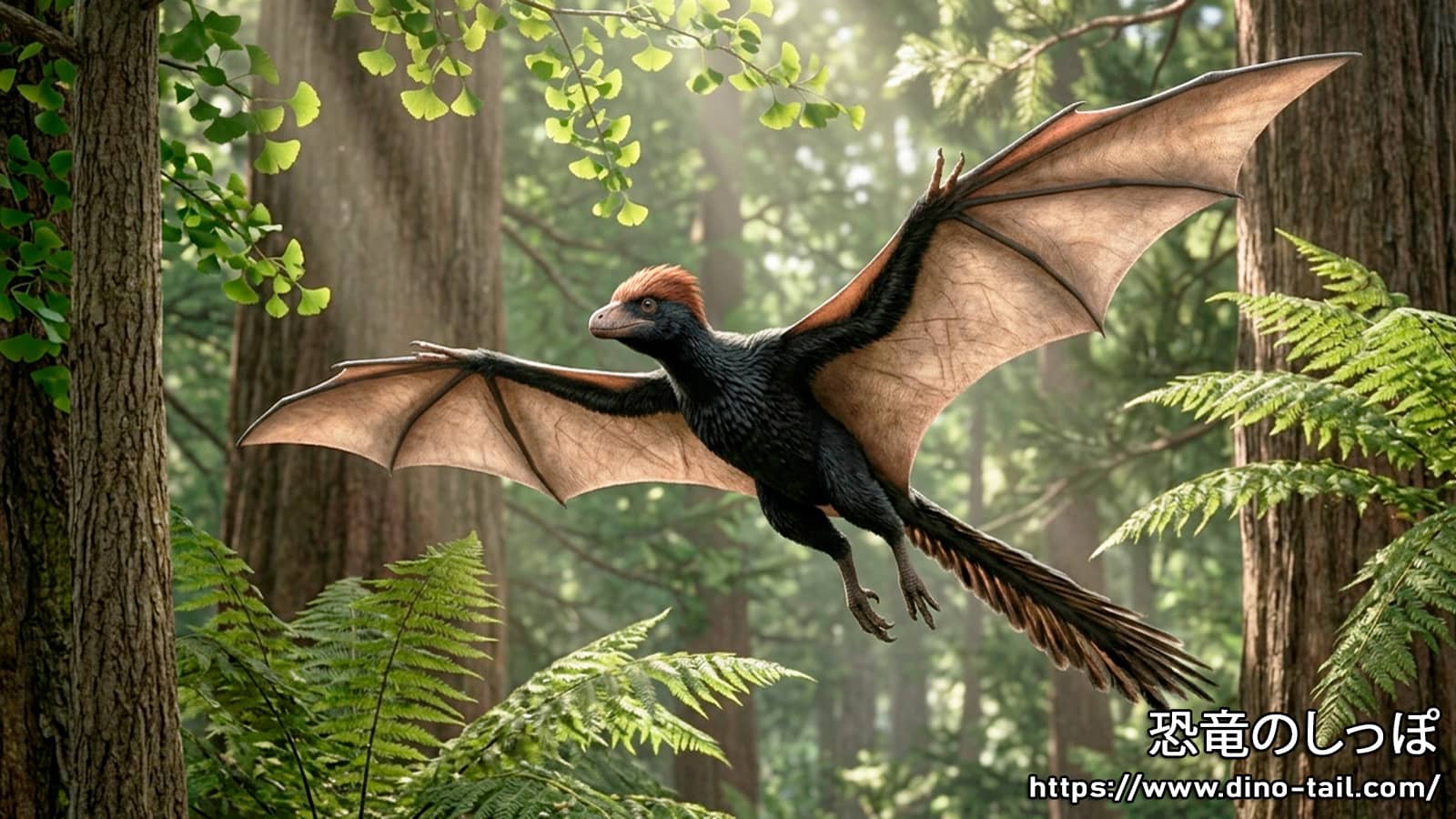
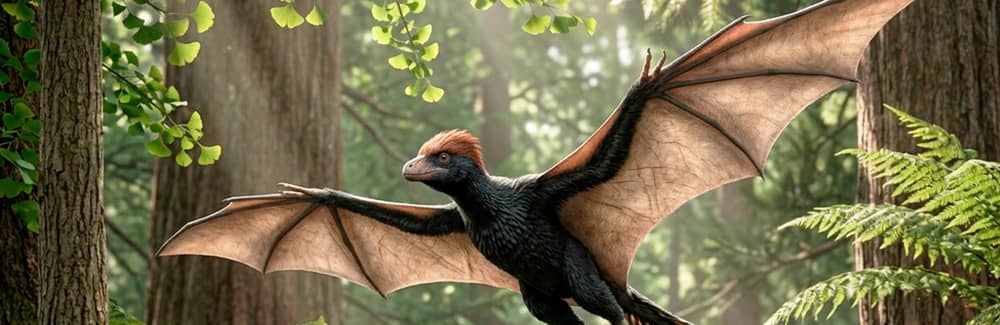
"Yi (Yi qi)" means "strange wing" in Chinese, and as its name suggests, it had a morphology that overturned conventional concepts of dinosaurs. This pigeon-sized theropod was entirely covered in feathers, but its wings were not composed of flight feathers like those of birds. Instead, they were formed by a "patagium" (membranous skin), reminiscent of bats, pterosaurs, or modern flying squirrels.
This discovery suggests that as vertebrates ventured into the sky, multiple "evolutionary experiments" were taking place alongside the feathered wing model.
Classification and Phylogeny: The Mystery of Scansoriopterygidae
Yi belongs to the family Scansoriopterygidae within the Maniraptora. This family is a highly specialized group of small theropods adapted to an arboreal lifestyle and is considered one of the dinosaur lineages closest to birds. However, its exact phylogenetic position is still actively debated among paleontologists.
Constituent Species of Scansoriopterygidae
| Genus Name | Discovery Year | Features | Notes |
|---|---|---|---|
| Scansoriopteryx | 2002 | Extremely long third finger, feet adapted for arboreal life | Possible synonym of Epidendrosaurus |
| Epidexipteryx | 2008 | Short tail and 4 long ornamental feathers, no clear evidence of membranous wings | Possessed derived display structures |
| Yi | 2015 | Wings with a styliform element and a patagium | Introduced on this page. Direct evidence of membranous wings. |
| Ambopteryx | 2019 | Membranous wings very similar to Yi; stomach contents proved omnivory | Strengthened the possibility that membranous wings are a common trait of the family. |
The phylogenetic position of Scansoriopterygidae ranges widely in hypotheses: from being the most basal group within Maniraptora, to being closely related to Oviraptorosauria, or being included within Anchiornithidae. Notably, a 2024 analysis by Cau placed this family within Anchiornithidae, highlighting the complexity in the evolutionary lineage leading to birds.
Anatomical Features: An Evolutionary Chimera
Yi's holotype specimen (STM 31-2) is housed in the Shandong Tianyu Museum of Nature. It is preserved with its skull, lower jaw, cervical vertebrae, and limb bones articulated, but most of its spine, pelvis, and tail are missing. Its estimated weight is about 380 g, making it similar in size to a modern pigeon.
Skull and Tooth Morphology
Yi's skull was short with a rounded snout. This morphology is similar to some pterosaurs (Anurognathidae) and is thought to have been suited for catching flying insects in the forest. The lower jaw curved downward, and the teeth were angled to point forward. This "buck-toothed" structure may have been an adaptation for extracting insects or larvae hidden in tree bark.
Wing Structure: The Mystery of the Styliform Element
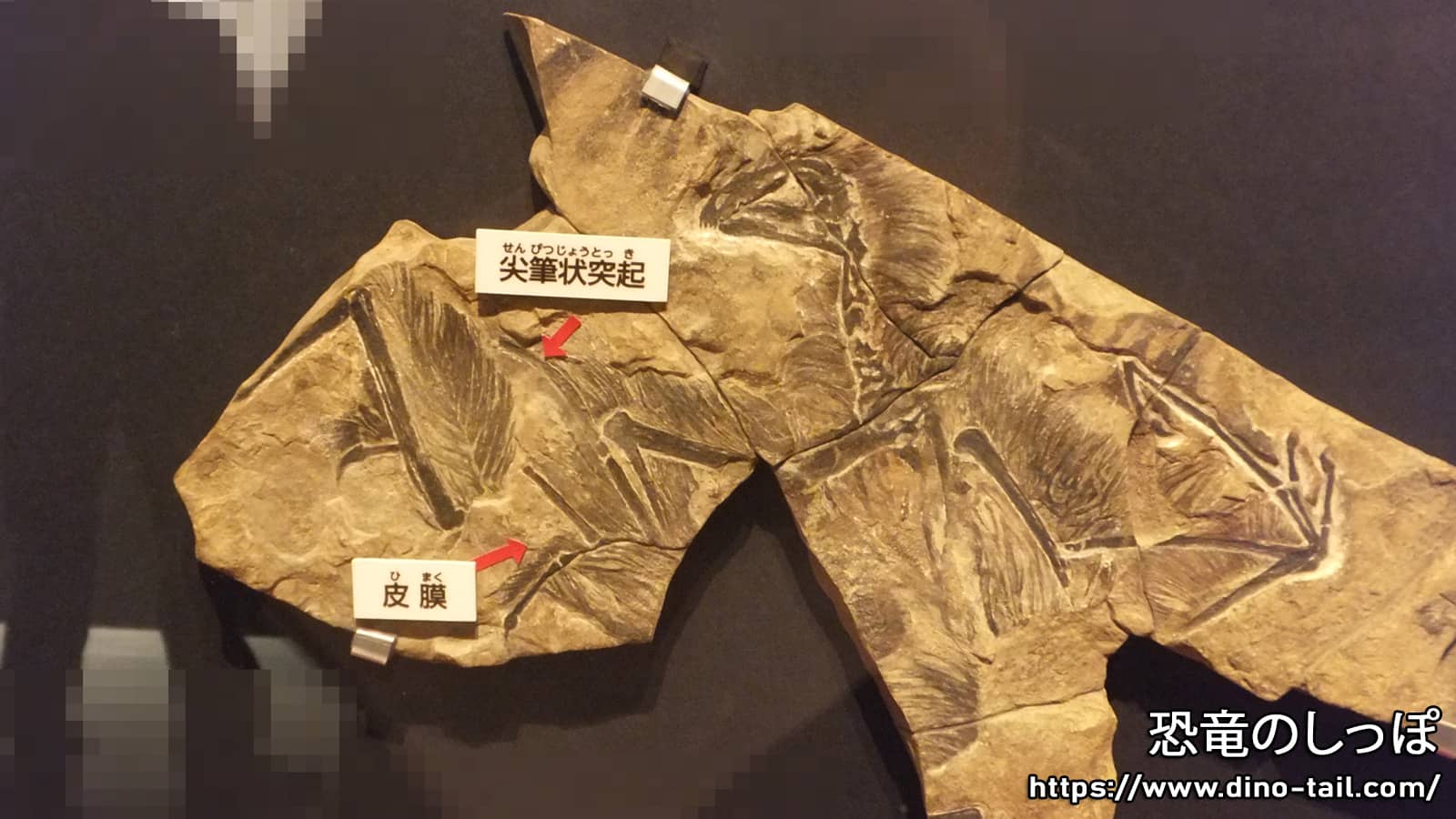
Styliform element seen in Yi's fossil
Yi's most astonishing feature is a long bony projection extending from the wrist, known as the "styliform element." This structure is not seen in any other known dinosaur and is thought to be calcified cartilage or a newly evolved bone.
This styliform element was longer than the ulna and curved slightly outward. In addition to this, the third finger was exceptionally elongated. Evidence of skin preserved in the fossil confirms that these structures acted as struts to spread a membranous skin (patagium).
This structure is accompanied by the following physical measurements:
- Estimated wingspan: About 60 cm
- Length of styliform element: About 42% of the entire forelimb (about 32% in Ambopteryx)
- Forelimb length: About 4.65 times the femur
Such membranous wings are only found in Yi and its close relative Ambopteryx among dinosaurs. This indicates that while the bird lineage was perfecting feathered wings, another lineage was attempting an evolution similar to bats.
Integumentary Structure and Color: Coexistence of Feathers and Membranes
Despite having membranous wings, Yi was entirely covered in feathers, giving it a visually highly peculiar appearance. This "hybrid integument" is a prime example of the high adaptability of dinosaurs.
Yi's feathers were not complex "contour feathers" with a rachis and barbs like modern birds, but rather had a simpler, filamentous structure. These feathers have been described as "paintbrush-like," with multiple fine filaments erupting from a stiff basal portion. These feathers thickly covered its head, neck, and limbs, with long feathers reaching about 6 cm observed particularly on the upper arms and shins. These feathers were likely not for flight but were primarily used for insulation or display (courtship or intimidation).
Analysis of melanosomes (pigment granules) within the fossil using an electron microscope has revealed some of Yi's body coloration. The feathers covering its body were mostly black (eumelanosomes), but reddish-brown and yellow pigments (phaeomelanosomes) were detected on its head and the membranous part of its wings. It is suggested that it may have had a flashy reddish-brown crest on top of its head, which would have been useful for visual communication in the forest.
Aerodynamic Considerations: Gliding or Flapping?
How Yi moved through the air is one of the most debated topics in paleontology. Early studies considered the possibility of flapping flight like bats, but recent analyses using aerodynamic models have presented negative views.
Anatomical Factors Constraining Flight Ability
Birds achieve powerful flapping flight thanks to a sternum with a "keel" that supports massive pectoral muscles. However, Yi's sternum showed no such structure, and the crest where muscles attach to the humerus (deltopectoral crest) was also small, suggesting it lacked the muscle power necessary for flapping.
There were also issues with flight stability. Yi's wings were concentrated on its forelimbs, and there is no evidence that the membrane extended from the wrists to the ankles like modern flying squirrels. In this case, the center of gravity would be positioned further back than the center of lift, making it prone to pitching (up and down wobbling) during flight, resulting in a highly unstable state.
| Model Name | Structural Features | Aerodynamic Evaluation |
|---|---|---|
| Bat Model | Styliform element points backward, connecting to the torso. Large wing area. | Generates the most lift, but also high air resistance. |
| Maniraptoran Model | Styliform element points inward, reinforcing the trailing edge of the wing. | Narrow wing area, but allows folding the wings similarly to birds. The most likely candidate currently. |
| Pterosaur Model | Styliform element points outward, stretching the wing laterally. | Elongated wings similar to a pterosaur. Considered unnatural for dinosaur joint structures. |
| Frog Model | Membrane limited only around the wrists (like a flying frog's hands). | Flight ability is extremely low, limited to parachute-like descent. |
A 2020 study by Dececchi et al. combined detailed soft-tissue mapping using Laser-Stimulated Fluorescence (LSF) with mathematical models and concluded that Yi and Ambopteryx were "clumsy gliders." They were likely incapable of taking off from the ground on their own and only possessed the ability to jump from trees and glide to neighboring branches.
Habitat and Ecosystem: A Jurassic "Testing Ground"
The Tiaojishan Formation about 159 million years ago, where Yi lived, was a place exploding with biodiversity. It was a warm, humid subtropical to temperate forest region under the influence of active volcanic activity.
The forest consisted primarily of gymnosperms; ginkgoes and conifers formed a massive canopy, while bennettitaleans grew densely in the understory, providing diverse hiding places. The ground was covered with ferns, horsetails, and mosses on damp soil.
Yi had to compete with many gliding and flying creatures living in the same environment. There were formidable rivals competing for the same arboreal niche, such as dinosaurs with more efficient feathered wings like Anchiornithidae (e.g., Anchiornis), pterosaurs with true flight capabilities like the Anurognathidae, and even gliding mammaliaforms.
Although Yi's stomach contents have not been found directly, inferring from its close relative Ambopteryx, they are thought to have been omnivorous, eating insects, small vertebrates, fruits, and seeds. Arboreal life was an effective means of escaping ground-dwelling predators (such as large theropods), but new rivals awaited them in the air.
Evolutionary Significance: A Failed Flight Architecture
The discovery of Yi (Yi qi) definitively proved that the evolution from dinosaurs to birds was not a single, linear process.
The "styliform element" and "membranous wings" possessed by Yi have independently appeared many times in vertebrates other than dinosaurs. Pterosaurs elongated their fourth finger; bats elongated their second through fifth fingers; flying squirrels and sugar gliders support their membranes with cartilaginous struts extending from their wrists. Despite being one of the lineages closest to birds, Yi chose the path of flying squirrels and bats (membrane-stretched wings) rather than the path of birds (feathered wings). This is a prime educational example demonstrating that organisms can independently evolve solutions to the challenge of flight (convergent evolution).
So, why did Yi go extinct? "Membrane-winged dinosaurs" like Yi and Ambopteryx only appeared during a relatively short period in the Jurassic and did not survive into the Cretaceous.
The reason is thought to lie in the "incompleteness" of their flight system. While feathered wings allow for fine adjustments by moving individual feathers, early unstable membranous wings had low maneuverability and were unsuited for complex movements within a forest. Additionally, their inability to take off from the ground severely limited their range of movement and increased the risk when attacked by predators. Losing the struggle for survival against the soon-to-appear true birds and other highly agile feathered dinosaurs (like Microraptor), they were pushed into an "evolutionary dead end."
Researchers describe them as "failed experiments that never got the chance to be refined," but that very failure speaks volumes about the richness of early trial-and-error as life aimed for the skies.
Conclusion: The Evolutionary Truth Told by Bizarre Wings
The dinosaur Yi (Yi qi) teaches us that evolution is a process that doesn't always derive the optimal solution via the shortest path, but proceeds through repeated experiments—sometimes bizarre and sometimes short-lived.
- Morphological Peculiarity: Despite being a dinosaur, it possessed both feathers and membranous wings, supported by a unique bone extending from the wrist called the "styliform element."
- Limited Flight Ability: They were clumsy gliders and found active flapping flight difficult.
- Coloration and Sociality: Their appearance, predominantly black with reddish-brown accents, suggests social behaviors emphasizing display.
- Evolutionary Lesson: Membranous-winged dinosaurs disappeared due to competition accompanying the emergence of birds, but their existence shows that the "origin of flight" was a polyphyletic and complex event.
If more specimens are discovered in the future, details such as how Yi folded its wings and how its tail shape contributed to flight stability may be revealed. For now, Yi continues to stimulate our imagination as "the dinosaur that tried to have wings but couldn't become a bird." As its short scientific name suggests, Yi (Yi qi) is truly a "bizarre wing" etched into evolutionary history.