Colombia's "Dinosaur Gap" and the Paleontological Renaissance
While South America is famous as a "Dinosaur Continent" with countries like Argentina, dinosaur discovery records in Colombia, located at its northern tip, have historically been very limited.
This is because, during most of the Mesozoic Era (especially the Cretaceous), a large part of Colombia's territory was covered by a shallow sea (Epicontinental Sea).
Due to this geological background, Colombia has yielded many fossils of ammonites and marine reptiles (plesiosaurs, ichthyosaurs, marine turtles) rather than dinosaurs. Opportunities for terrestrial dinosaurs to remain as fossils were limited to rare cases where carcasses were washed out to sea.
However, the situation changed dramatically in recent years when the 2016 peace agreement made it possible to conduct research in areas that were once conflict zones. Now entering a "Renaissance" of paleontology, important new species such as Perijasaurus lapaz are being discovered one after another.
True Dinosaurs of Colombia (Dinosauria)
Although discoveries are few, Colombian dinosaur fossils are an important presence that fills the missing link in evolution in the northern part of the South American continent.
Symbol of Peace: Perijasaurus lapaz
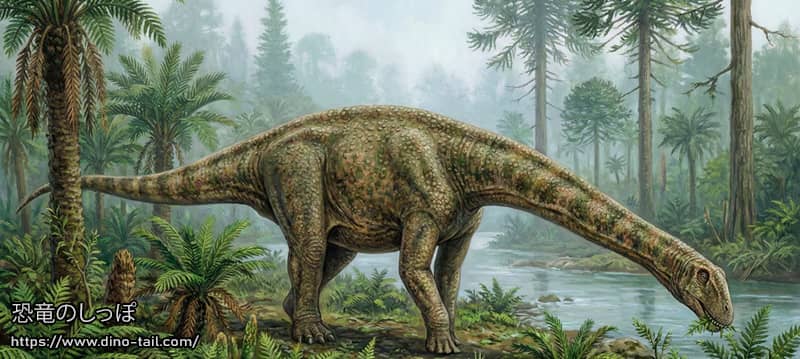
Described in 2022, Perijasaurus lapaz is an iconic discovery of Colombian paleontology. It was a medium-sized sauropod from the Early to Middle Jurassic (about 175 million years ago), estimated to be about 12 meters long.
Although the fossil itself was found in 1943, it was long considered an "unidentified sauropod." After the peace agreement made it possible to identify the discovery site (Serranía del Perijá), it was formally described, and the specific name was named "lapaz" meaning peace.
It is the northernmost sauropod record in South America, suggesting that early true sauropods were distributed on a Pangaea-wide scale.
Survivor of the Cretaceous: Padillasaurus
Described in 2015, Padillasaurus leivaensis is a brachiosaurid dinosaur from the Early Cretaceous (about 130 million years ago).
Until then, it was thought that brachiosaurids had disappeared from the Southern Hemisphere during the Cretaceous, but this discovery showed that the tropical region might have functioned as a "refugium" (refuge) for them.
Although originally terrestrial, it was found along with ammonites in a shallow marine stratum (Paja Formation), suggesting it was washed out to sea after death.
Other Dinosaur Traces
Numerous footprints of theropods, sauropods, and ornithopods have been discovered in the Arcabuco Formation in Chíquiza, Boyacá Department, proving that a diverse dinosaur fauna once existed.
In addition, teeth fossils of Abelisauridae and Dromaeosauridae (raptors) have been found in the Tolima Department, suggesting biological exchange between North and South America.
Rulers of the Paja Formation: Marine Reptiles
The Early Cretaceous Paja Formation is a world-class fossil site preserving the marine ecosystem of that time. Here, marine reptiles even larger and more terrifying than dinosaurs thrived.
The Ultimate Marine Predators: Pliosaurs
The giant predator once known as "Colombia's Kronosaurus" is now classified as a distinct genus called Monquirasaurus. It was about 10 meters long, with a skull alone exceeding 2 meters.
Furthermore, in 2018, the even larger Sachicasaurus, reaching an estimated weight of 17 tons, was described. These reigned at the top of the marine ecosystem pyramid of that time.
Diversity of Ichthyosaurs and Plesiosaurs
Among long-necked plesiosaurs, Callawayasaurus is well known.
Also, ichthyosaurs, which were thought to be in decline during the Cretaceous, maintained high diversity in Colombia. Kyhytysuka, with its specialized teeth, and Platypterygius elsuntuoso, described just recently in 2024, have been found, suggesting they may have evolved as "macropredators" targeting large prey.
Cenozoic Giant Reptiles: The World After Dinosaurs
Even in the Cenozoic Era after the extinction of dinosaurs (post-K-Pg boundary), reptiles became "gigantic" again in tropical Colombia and stood at the top of the ecosystem.
Largest Snake in History: Titanoboa
Discovered in the Cerrejón Formation dating back about 60 million years, Titanoboa cerrejonensis is the largest snake in history, estimated to be about 13 meters long and weigh over 1 ton.
It is also valued as a "paleothermometer" indicating that the tropical rainforest of that time was much hotter (average temperature 30-34°C) than today. From the same stratum, Carbonemys, a giant turtle with a shell reaching 1.7 meters, has also been found.
Largest Caiman: Purussaurus
In the Tatacoa Desert (La Venta fauna) of the Miocene (about 13 million years ago), lived Purussaurus, a caiman exceeding 10 meters in length.
Its bite force is said to rival that of Tyrannosaurus, making it the ruler of the massive "Pebas System" wetlands. Coexisting with it were Langstonia, a terrestrial crocodile thought to have hunted by running on land, and giant carnivorous birds (terror birds).
Museums and Tourism Guide
In Colombia, museums are often established near excavation sites, allowing visitors to enjoy paleontological tourism in cooperation with local communities.
| Facility Name | Location | Main Attractions |
|---|---|---|
|
Center for Paleontological Research (CIP)
Centro de Investigaciones Paleontológicas |
Villa de Leyva | Latest research labs, viewing of cleaning work. Research base for Padillasaurus. |
|
El Fósil Museum
Museo El Fósil |
Villa de Leyva | A complete skeleton of Monquirasaurus (formerly Kronosaurus) is preserved and exhibited exactly as it was discovered. |
|
Geological Museum
Museo Geológico Nacional |
Bogotá | Stores and exhibits type specimens such as Callawayasaurus. |
|
Tatacoa Desert
Desierto de la Tatacoa |
Huila Department | Field of the La Venta fauna. Visitors can enjoy fossil hunting tours in the desolate desert landscape. |