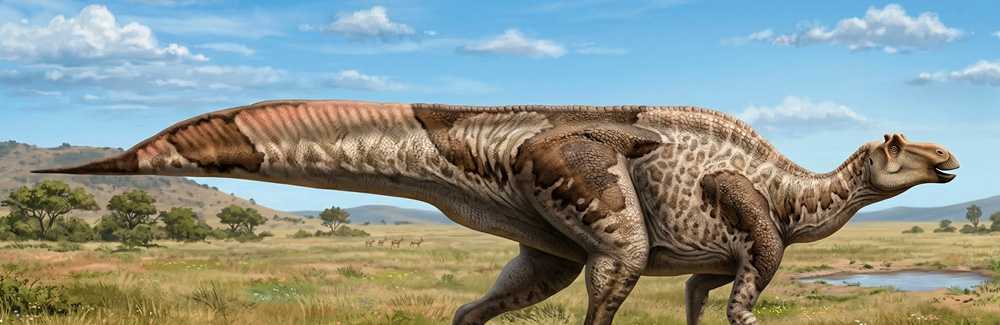
A new genus and species of hadrosaurid dinosaur, Gongshuilong fanwei, has been discovered from the Upper Cretaceous strata in Jiangxi Province, China.
This new species exhibits the following unique morphological features and evolutionary significance, distinguishing it from other hadrosaurids.
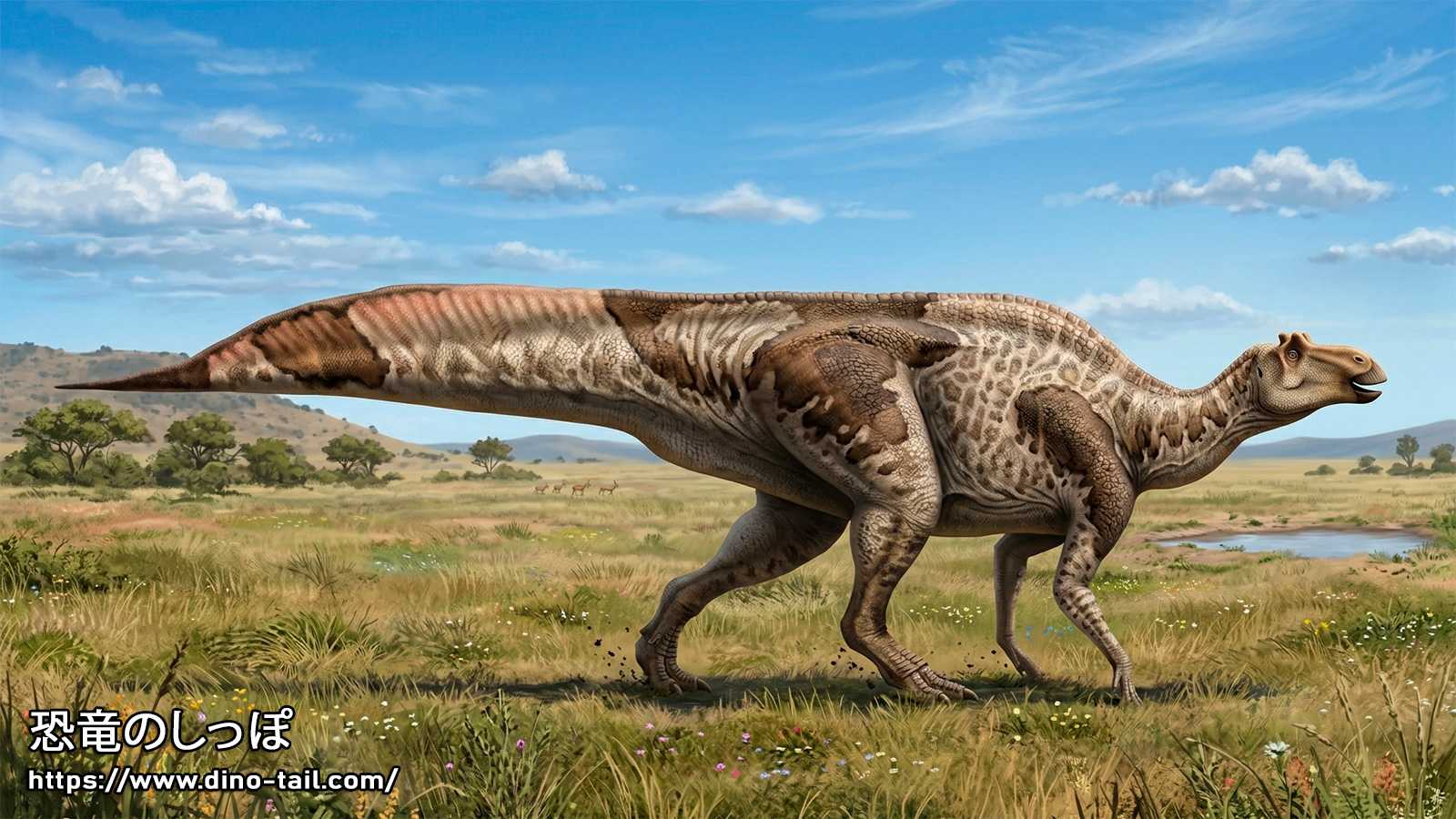
- Sail-like tail: A tall display sail formed by neural spines on the tail that reach approximately 8.5 times their normal height.
- Powerful chewing apparatus: Adapted for efficient plant grinding with an extremely short edentulous margin and teeth possessing a strong primary median ridge.
- Reinforcement of the Asian origin hypothesis: It represents a basal lineage that supports the Asian origin of the Brachylophosaurini, a group previously thought to have originated in North America.
This page delves into the detailed anatomical features of Gongshuilong, characterized by its bizarre sail, and explores the latest research that unravels the mysteries surrounding the evolutionary history and geographic distribution of hadrosaurids.
Introduction: New Developments in Hadrosaurid Research in Southern China
In March 2026, the details of a newly discovered genus and species of dinosaur, Gongshuilong fanwei, unearthed from the Ganzhou Basin in Jiangxi Province, China, were published in the prestigious international academic journal Journal of Systematic Palaeontology.
This discovery holds immense scientific significance beyond merely adding a new species to the record; it plays a crucial role in reconstructing the evolutionary history of the Hadrosauridae, particularly concerning the processes of their phylogenetic origins and geographic dispersal. Gongshuilong marks the first formally named hadrosaurid dinosaur from the southern region of China, thereby significantly extending the distribution record of the Brachylophosaurini—previously heavily skewed towards North America—into Asia.
The name Gongshuilong derives from the "Gong River" (Gongshui) that flows through Ganzhou City, the site of discovery, and the Chinese word "fanwei", meaning "sail tail," which highlights its most prominent feature. The genesis of this research was the fortuitous discovery of an exposed bonebed at a construction site in Shahe Town, Zhanggong District, Ganzhou City, in March 2021. The recovered fossils comprised discontinuous skeletal elements belonging to at least two individuals. Following several years of meticulous restoration and analysis, the full picture of this remarkable dinosaur was finally revealed.
Discovery Background and Geological Context
Gemini Generated Image
The fossil assemblage, which includes the holotype and paratype of Gongshuilong, was excavated from the middle section of the Late Cretaceous Lianhe Formation, widely distributed within the Ganzhou Basin. The Ganzhou Basin is a fault basin formed between the Mesozoic and Cenozoic eras, characterized predominantly by Late Cretaceous red sedimentary rocks.
The Lianhe Formation is primarily composed of purplish-red calcareous mudstones and calcareous siltstones, suggesting that the environment during that period was characterized by an arid or semi-arid climate. According to sedimentological analyses, it is highly probable that the layer containing the buried fossils was formed by seasonal floods or debris flow events.
Dating and Paleoenvironment
The geological age of the Lianhe Formation has been determined to correspond to the Maastrichtian stage of the terminal Cretaceous (approximately 72.1 to 66 million years ago). The fossils of Gongshuilong are estimated to be about 70 million years old, a timeframe that overlaps with the period when hadrosaurids achieved their maximum diversity.
| Formation Name | Estimated Age | Main Lithofacies | Examples of Excavated Fossils |
|---|---|---|---|
| Lianhe Formation | Maastrichtian (~70 Ma) | Purplish-red siltstone, mudstone | Gongshuilong, tyrannosaurids, turtles |
| Tangbian Formation | Santonian to Campanian | Red sandstone, mudstone | Minioolithus (small dinosaur eggs) |
| Hekou Formation | Late Cretaceous | Red conglomerate, sandstone | Xenodontolacerta (lizards) |
| Zhoutian Formation | Late Cretaceous | Red mudstone, calcareous siltstone | Trionychid turtles |
Taxonomic Identification: True Identity as a Hadrosaurid
The taxonomic identity of Gongshuilong was established through rigorous phylogenetic analysis. This species is identified as a derived ornithopod belonging to the "Hadrosauridae," and more specifically, it is classified within the Brachylophosaurini, a tribe of the Saurolophinae (hadrosaurids lacking hollow crests).
The results of the phylogenetic analysis demonstrated that Gongshuilong forms a polytomy at the base of the Brachylophosaurini, alongside Wulagasaurus discovered in China, and Acristavus, Maiasaura, and Brachylophosaurus from North America. This indicates that this species possesses a combination of relatively primitive traits within the tribe and unique derived traits.
Basis for Assignment to Brachylophosaurini
The primary evidence for classifying this species into the Brachylophosaurini includes an elevated anterodorsal process of the maxilla, the presence of a single prominent median ridge on the dentary tooth crowns, and a scapula that, while following the basic structure of the Saurolophinae, features an expanded proximal end.
Detailed Morphological Features
Skull and Chewing Mechanism
Although the cranial elements of Gongshuilong are fragmentary, they clearly exhibit the highly specialized feeding adaptations typical of hadrosaurids. The edentulous margin of the dentary (the base of the beak) is extremely shortened, suggesting that the snout was shorter compared to other hadrosaurids, which may have facilitated a more powerful bite force.
Anatomical Peculiarity of the "Sail-like Tail"
The most idiosyncratic feature of this species, and a decisive diagnostic trait for its classification, is the "sail"-like structure located on its tail. Analysis revealed that the neural spines of the caudal vertebrae positioned in the posterior part of the tail are significantly elongated vertically, reaching an astonishing 8.5 times the height of the vertebral centra.
| Skeletal Part | Main Morphological Features | Comparison and Significance |
|---|---|---|
| Dentary | Extremely short edentulous margin. Tooth crowns possess a strong median ridge. | Adapted for efficient plant grinding. Typical characteristic of Saurolophinae. |
| Scapula | Poorly developed deltoid ridge. Proximal end is expanded. | Ancestral trait shared with primitive hadrosauroids. |
| Humerus | Deltopectoral crest occupies about 59% of the total length and is robust. | Adapted to support weight during quadrupedal walking. Development is comparable to that seen in larger species. |
| Caudal vertebrae | Neural spines of the posterior caudal vertebrae reach 8.5 times the centrum height. | The largest autapomorphy. Forms the distinctive sail-like tail. |
Ecological and Functional Considerations
Role of the Sail-like Structure: Display and Identification
Hadrosaurids are generally considered to have been highly social dinosaurs. While the Lambeosaurinae utilized complex hollow head crests, the saurolophine Gongshuilong may have specialized the sail on its tail primarily for visual display. Researchers hypothesize multifaceted functions, such as sexual selection, species recognition among conspecifics inhabiting vast arid plains, and visual intimidation against predators.
Another prevalent hypothesis suggests that the sail-like structure could have functioned as a heat exchanger, often referred to as the thermoregulation theory. Given the arid climate of the Ganzhou Basin, an effective heat dissipation mechanism to prevent overheating might have provided a significant survival advantage for a medium-sized dinosaur like Gongshuilong. However, when taking into account the physical fragility of the elongated neural spines, the prevailing consensus within the current paleontological community leans toward its primary significance being a visual display, as mentioned above.
Phylogenetic Evolution and Paleobiogeographical Significance
Reinforcement of the "Asian Origin Hypothesis"
The discovery of Gongshuilong has cast a stone into the conventional wisdom regarding the early evolution of the Hadrosauridae. Previously, the dominant theory held that the Saurolophinae and the Brachylophosaurini originated in Laramidia on the North American continent and subsequently dispersed to Asia. However, the identification of Gongshuilong as a basal lineage of the Brachylophosaurini situated in Asia strongly suggests that this group may have instead originated in Asia before spreading to North America.
| Species Name | Classification | Est. Length | Characteristic Ornamentation | Age | Discovery Region |
|---|---|---|---|---|---|
| Gongshuilong | Saurolophinae | 7m | High sail on tail (neural spines 8.5x) | ~70 Ma | Jiangxi, China |
| Wulagasaurus | Saurolophinae | 9m | Modest ornamentation | ~70 Ma | Heilongjiang, China |
| Brachylophosaurus | Saurolophinae | 9m | Flat paddle-like crest on head | ~78 Ma | North America |
| Maiasaura | Saurolophinae | 9m | Small bony crest over eyes | ~76.7 Ma | North America |
| Edmontosaurus | Saurolophinae | 12m | Soft tissue cockscomb (some) | 73-66 Ma | North America |
| Istiorachis | Basal ornithopod | 7m | Sail extending from back to tail | ~125 Ma | United Kingdom |
| Trait | Saurolophinae | Lambeosaurinae | State in Gongshuilong |
|---|---|---|---|
| Head crest | Solid or absent | Hollow complex structure | Unknown (nasals etc. non-hollow) |
| Tooth crown ridges | Single median ridge dominant | Often have multiple secondary ridges | Single median ridge only |
| Humeral deltopectoral crest | Highly developed, extending distally | Relatively short and robust | Reaches 59% of total length |
| Scapular deltoid ridge | Often well-developed | Relatively undeveloped | Undeveloped (primitive state) |
Conclusion and Future Prospects
The discovery and description of Gongshuilong stand as remarkable achievements in Asian paleontology. Its "true identity" has been revealed as a derived hadrosaurid belonging to the Saurolophinae and the Brachylophosaurini. Its most prominent and defining feature, the "sail-like tail," is considered to be a highly sophisticated display organ that evolved as a result of visual communication or sexual selection.
Based on comprehensive taxonomic and phylogenetic analyses, Gongshuilong provides some of the most decisive evidence to date supporting the Asian origin hypothesis of the Hadrosauridae, effectively reflecting the ancestral form of famous North American dinosaurs such as Maiasaura and Brachylophosaurus. If additional fossils are discovered in the future, it is highly anticipated that the growth process of its unique sail and a more detailed understanding of its ecology will be fully revealed.
References
- A new saurolophine hadrosaurid (Dinosauria: Ornithopoda) from the Upper Cretaceous of South China, providing further support for the possible Asian origin of Brachylophosaurini - ResearchGate
- New species of hadrosaurid dinosaur from 70 million years ago discovered in Jiangxi Province, China, https://jp.news.cn/20260410/ddd2d5b89d0742269e5782dc632501d3/c.html
- Gongshuilong - Wikipedia, https://en.wikipedia.org/wiki/Gongshuilong
- Global historical biogeography of hadrosaurid dinosaurs - ResearchGate
- Gongshuilong fanwei - A New Hadrosaur from China, https://blog.everythingdinosaur.com/blog/_archives/2026/03/30/a-new-hadrosaur-from-jiangxi-province.html