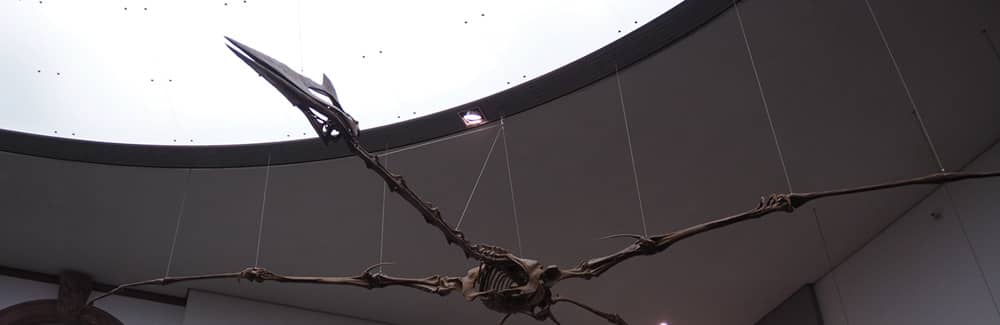
Basic Data of Quetzalcoatlus
| Scientific Name (Genus) | Quetzalcoatlus |
| Meaning of Name | Derived from Quetzalcoatl, the "feathered serpent god" of the sky in Aztec mythology |
| Classification | Pterosauria, Pterodactyloidea, Azhdarchidae |
| Wingspan | Max approx. 10-11m (for the type species northropi) |
| Estimated Weight | Approx. 150-250kg |
| Period | Late Cretaceous Maastrichtian (approx. 68-66 million years ago) |
| Discovered in | USA (Big Bend National Park, Texas, etc.) |
| Year of Paper Publication | 1975 |
| Genus Name Publication | Lawson, D. A. 1975a. Pterosaur from the latest Cretaceous of West Texas. Discovery of the largest flying creature. Science 187:947–948. Lawson, D. A. 1975b. Could pterosaurs fly? Science 188:676–678 |
History of Discovery and Naming
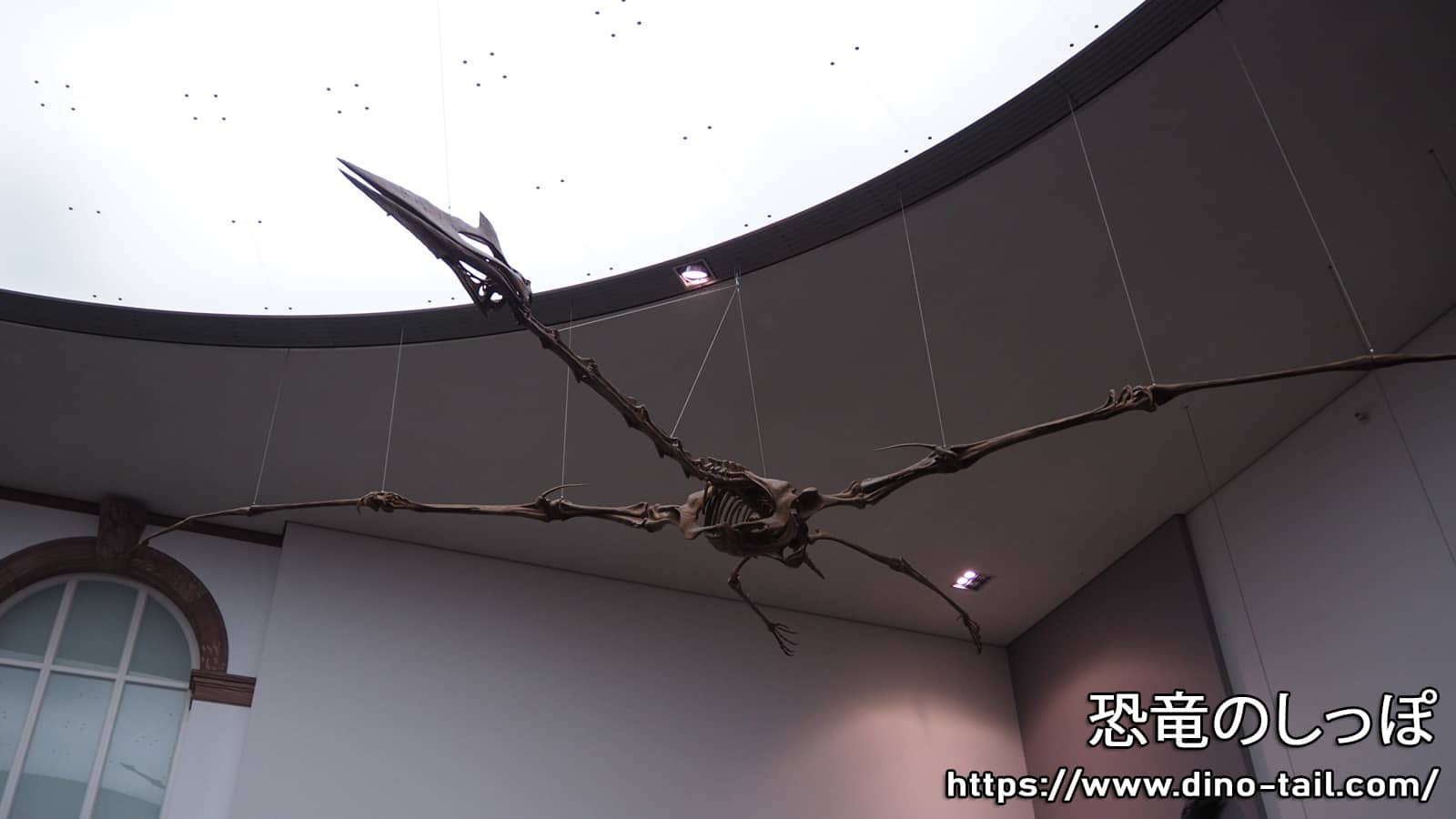
Quetzalcoatlus, which lived in the North American continent during the Late Cretaceous, is a very important subject of research in the fields of paleontology and biomechanics as one of the largest flying animals to have ever soared the skies in Earth's history.
The discovery of this giant pterosaur began in 1971 when Douglas Lawson, a graduate student majoring in geology at the University of Texas at Austin, conducted fieldwork in Big Bend National Park, Texas. From bone fragments he found in the Javelina Formation, it was revealed that there existed a creature with a wingspan exceeding 10 meters, significantly larger than Pteranodon (with a wingspan of about 7 meters), which was considered the "largest pterosaur" at the time.
In 1975, Lawson named and described the type species "Quetzalcoatlus northropi" in the scientific journal "Science". The genus name was derived from the sky serpent god of Aztec mythology, and the specific name was in honor of Jack Northrop, a pioneer in the design of flying wing aircraft and a great figure in aviation.
A Half-Century Shrouded in Mystery and the 2021 Discovery
While Quetzalcoatlus frequently appeared in dinosaur books and media following Lawson's 1975 paper, its detailed morphological description and taxonomic evaluation were not published in peer-reviewed academic journals for 46 years.
This long stagnation was broken by the publication of the Society of Vertebrate Paleontology's specialized book "Memoir 19" in 2021. Through this memoir, hundreds of specimens previously treated simply as "small Quetzalcoatlus" were formally named as an entirely independent new species, "Quetzalcoatlus lawsoni", based on the presence of unique morphological derived traits. After 46 years, "Quetzalcoatlus" had returned to the forefront of paleontological research.
Two Species and Niche Differentiation
Detailed geological analysis from this memoir revealed that the giant species Quetzalcoatlus northropi and the small species Quetzalcoatlus lawsoni, which coexisted in the same habitat of the Javelina Formation, inhabited completely different ecological niches and environments.
| Species Name | Estimated Wingspan | Main Fossil Horizon (Habitat) | Estimated Ecology and Behavior | Estimated Diet |
|---|---|---|---|---|
| Q. northropi (Giant species) |
10-11 m | Fluvial channel deposits (Vast floodplains and riverbeds) |
Prefers solitary behavior | Small terrestrial vertebrates, etc. |
| Q. lawsoni (Small species) |
Approx. 4.5 m | Abandoned channel lake deposits (Around shallow alkaline lakes) |
Forms flocks | Invertebrates such as arthropods and bivalves |
Functional Morphology and Biomechanics: How did Quetzalcoatlus Walk and Fly?
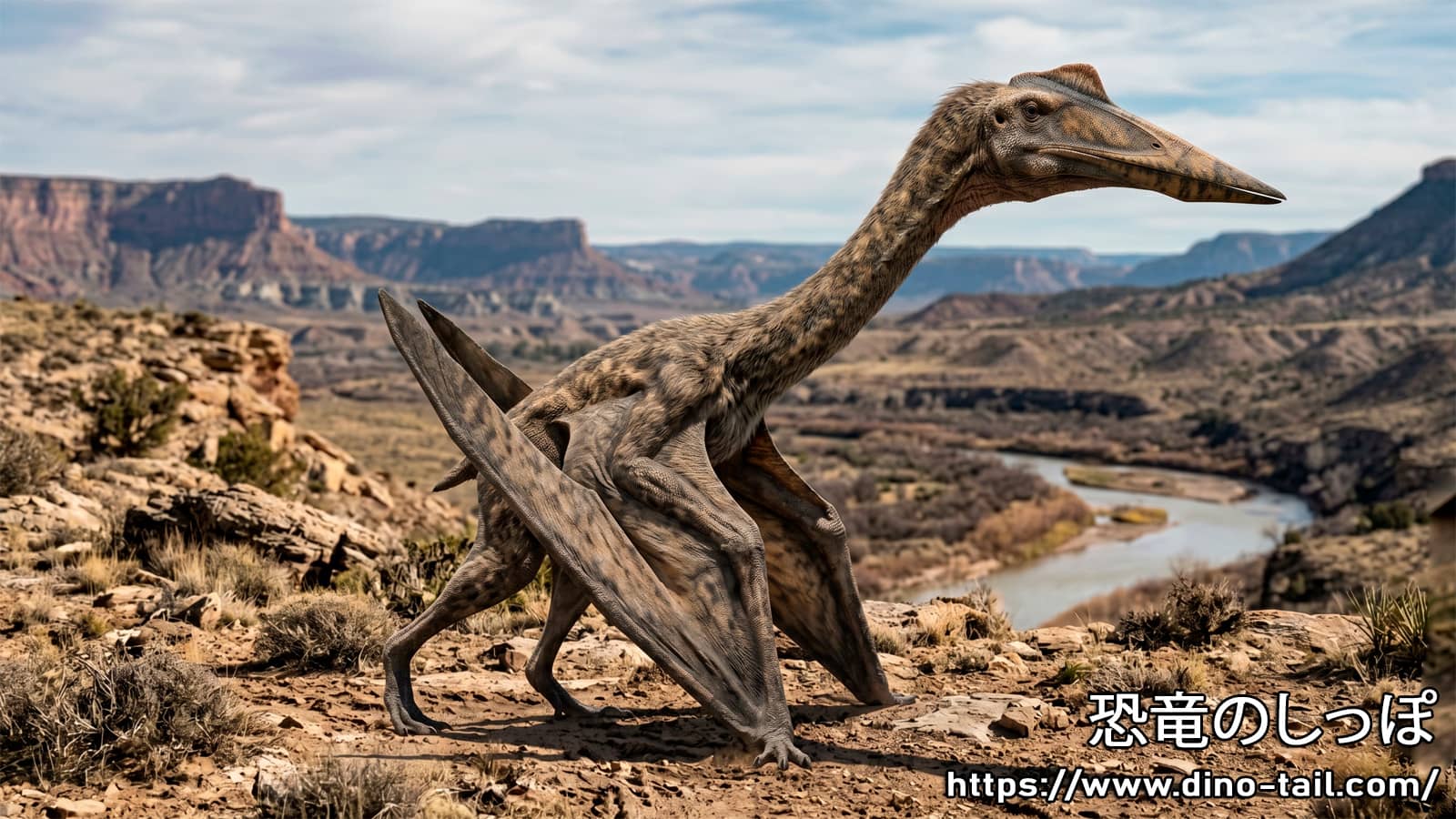
Terrestrial Stalker Hypothesis and Quadrupedal Walking Mechanism
It was once thought that pterosaurs were clumsy on the ground, having no choice but to crawl on their bellies or waddle like penguins. However, the "Terrestrial Stalker Hypothesis" proposed in 2008 dramatically overturned this view.
Quetzalcoatlus took a quadrupedal posture on the ground, but its way of walking was unique. The folded giant wings (forelimbs) were not used to kick the ground to move forward, but rather served as "canes" to support its heavy upper body.
The propulsive force when walking on land relied almost entirely on the strong hind legs, making it mechanically closer to bipedal walking. They are considered to have been giant predators highly adapted not only to flying in the sky but also to life on the ground.
Controversy: Quetzalcoatlus's Takeoff Mechanism (Quadrupedal vs. Bipedal Launch)
How a giant creature with a wingspan of 10 meters and weighing over 200 kilograms managed to soar into the sky remains a subject of intense debate.
The currently mainstream theory is the "Quadrupedal launch model", which uses both forelimbs and hindlimbs. This theory suggests that by utilizing the massive forelimb muscle groups, which were extremely developed for flight, for a catapult-like kick-off during takeoff, they could obtain sufficient initial jumping velocity without compromising skeletal strength.
On the other hand, a "Bipedal launch model" jumping vertically using only the hind limbs has also been proposed, but it has received severe criticism from many biomechanists because it is difficult to prove the physical propulsive force.
Flight Style
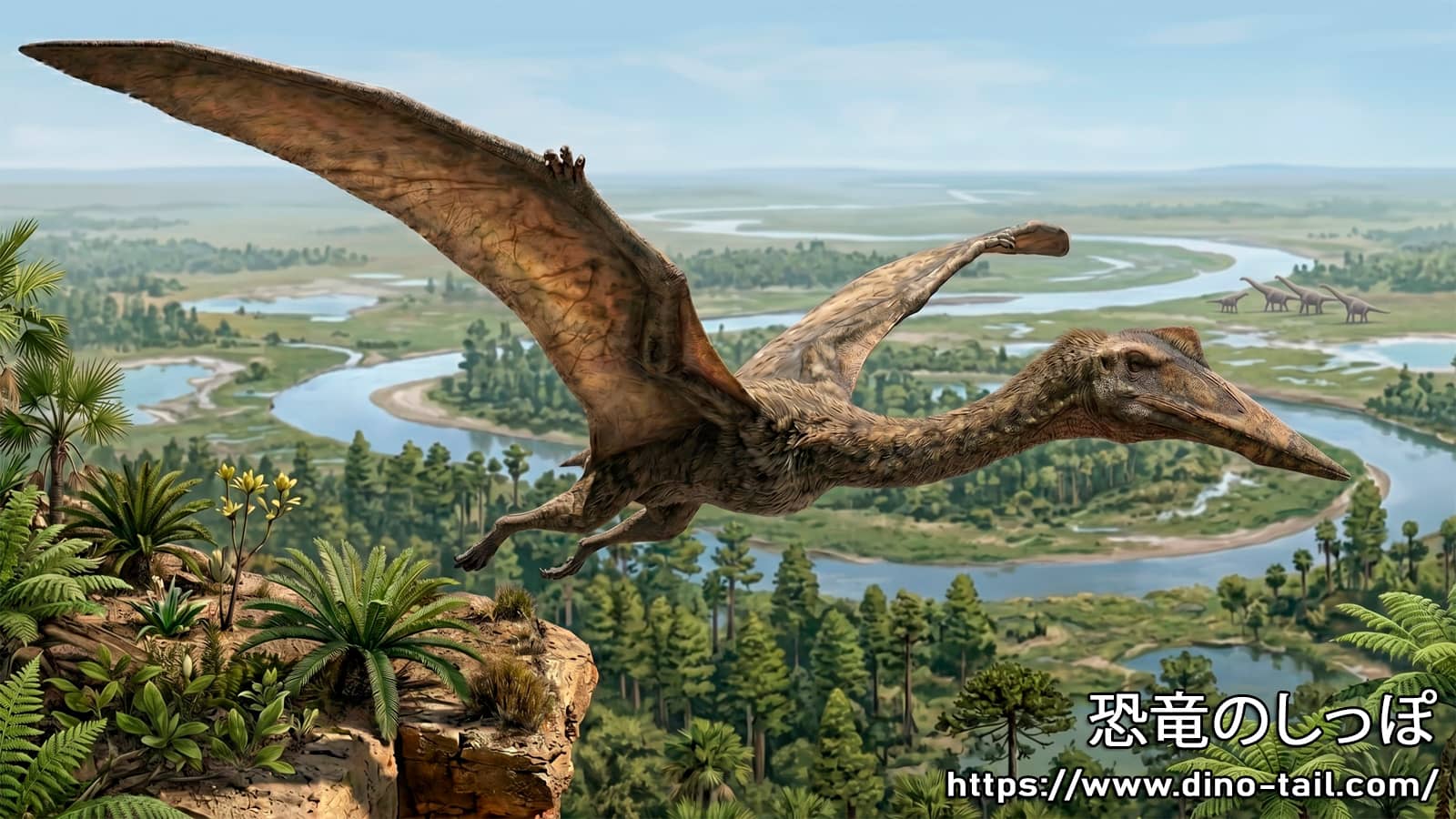
Late Cretaceous Maastrichtian, Texas, USA.
Regarding the question of what kind of flight style Quetzalcoatlus adopted once it was airborne, recent studies have contradicted previous understandings.
It was once presumed that they performed long-distance gliding flights like albatrosses. However, according to a comprehensive aerodynamic modeling study published in 2022, data indicated that Quetzalcoatlus was "significantly inferior" in gliding performance utilizing updrafts. These findings strongly suggest that they were not specialized for sustained long-distance gliding, but rather relied on short bursts of powerful "flapping flight" to move within a narrower spatial range.
2025 Latest Phylogenetic Analysis: Polyphyly and Convergent Evolution of Gigantism
The latest research results shaking the foundation of Quetzalcoatlus's taxonomy were announced in late 2025. The largest phylogenetic analysis of the Azhdarchoidea to date revealed that Quetzalcoatlus northropi and Quetzalcoatlus lawsoni, long considered different species of the same genus, are actually located on distantly separated branches of the evolutionary tree.
In other words, it was definitively proven that the genus Quetzalcoatlus is not a natural taxonomic group consisting of a single common ancestor, but a "polyphyletic group". Quetzalcoatlus lawsoni, which we have traditionally used as the base for ecological restoration as the "small Quetzalcoatlus", was actually a completely different genus of creature, and is expected to be given a new genus name in the future.
Gigantism was the result of "Convergent Evolution"
Furthermore, this study proved that the "gigantism" of Azhdarchidae, reaching wingspans over 9 meters, was not a single evolutionary event, but the result of "convergent evolution" that occurred independently in at least four different lineages throughout evolutionary history.
The giant body seen in Quetzalcoatlus was not a unique, one-time evolutionary miracle, but seems to have been a manifestation of a rational and repetitive adaptation strategy to the carrying capacity of the ecosystem at the time.