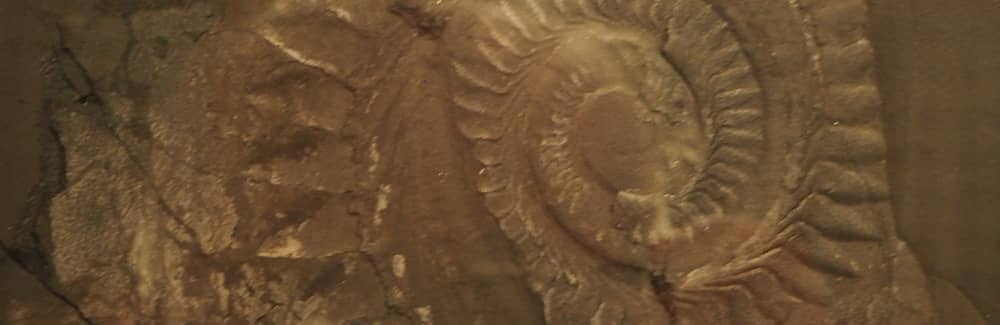
About Helicoprion
| Scientific Name (Genus) | Helicoprion |
| Meaning of Name | Spiral saw |
| Classification | Holocephali, Eugeneodontida, Helicoprionidae |
| Period | Late Carboniferous to Middle Permian (approx. 290 - 270 million years ago) |
| Diet | Carnivorous (soft-bodied prey such as cephalopods) |
| Discovered in | Various parts of the world including North America, Russia, Japan, and Australia |
| Sub-classification / Species Name |
Helicoprion bessonowi Helicoprion davisii Helicoprion ergassaminon |
| Year of Paper Publication | 1899 |
| Genus Name Publication | Karpinsky, A. (1899). Ueber die Reste von Edestiden und die neue Gattung Helicoprion. Verhandlungen der Kaiserlichen Russischen Mineralogischen Gesellschaft zu St. Petersburg, Zweite Series 36:1-111. |
Features: The Circular Saw-Like Tooth Whorl
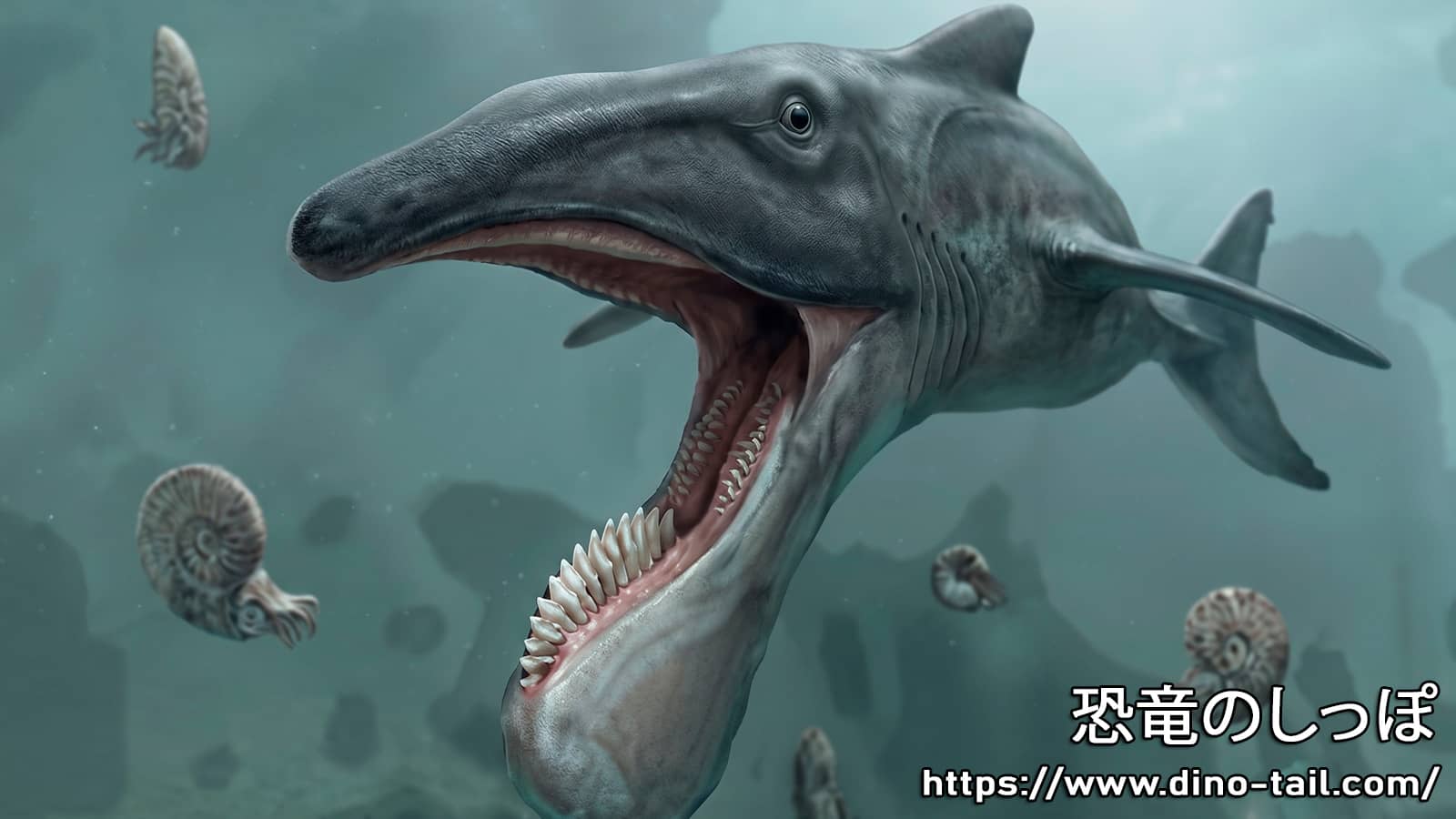
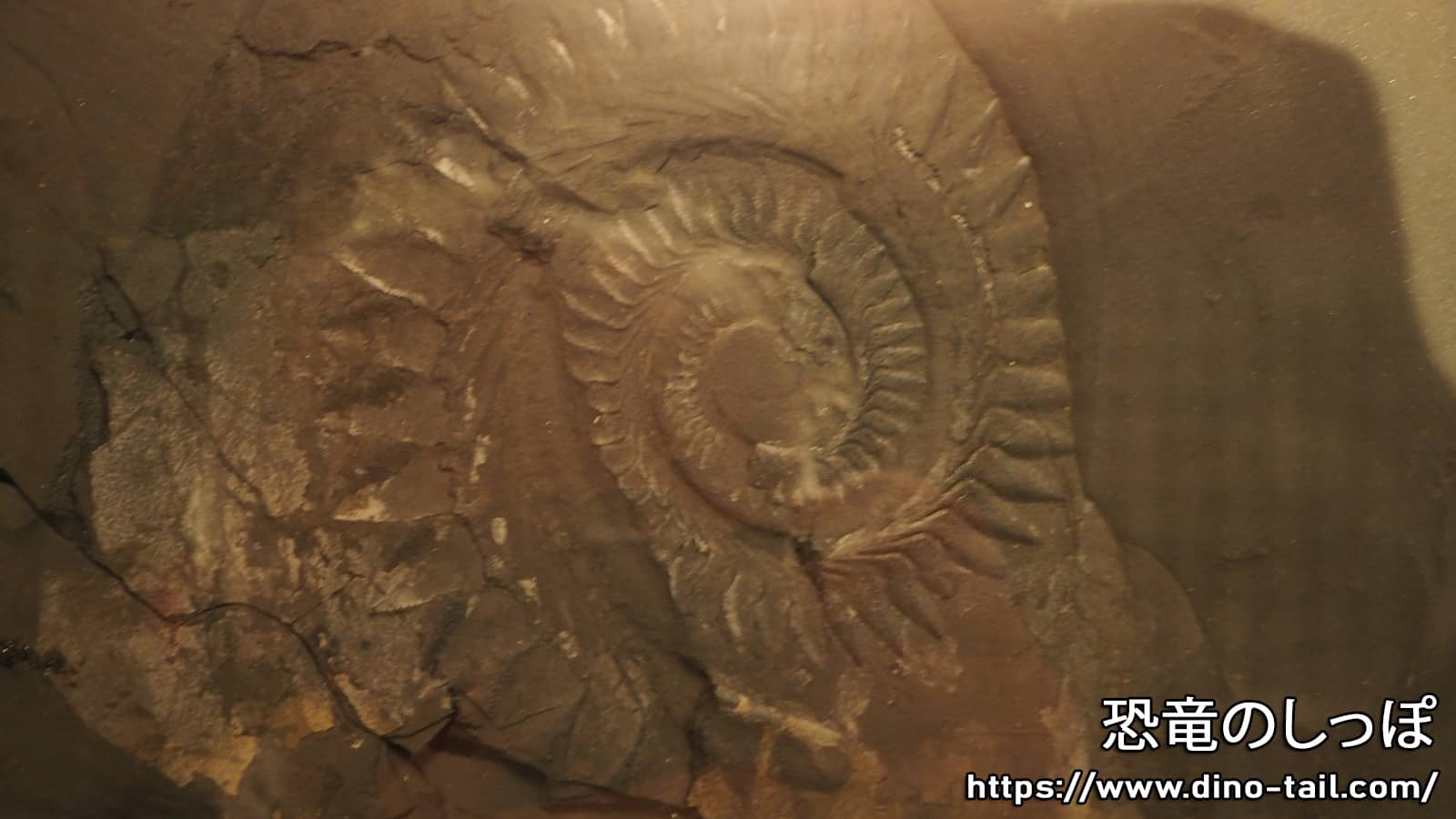
Helicoprion is a bizarre cartilaginous fish that inhabited the marine ecosystems from the Late Carboniferous to the Permian period of the Paleozoic era. Its most defining characteristic, which symbolizes them, is the "Tooth Whorl" located at the symphysis of the lower jaw. Since it was first described in 1899, scientific debates have raged for over a century regarding the placement and function of this bizarre dentition.
They were long considered relatives of sharks (Elasmobranchii), but recent anatomical analyses using non-destructive high-resolution CT scans have revealed that they belong to Holocephali, which is closer to modern chimaeras.
Helicoprion's teeth differ from the system of modern sharks, where teeth regularly fall out and are replaced.
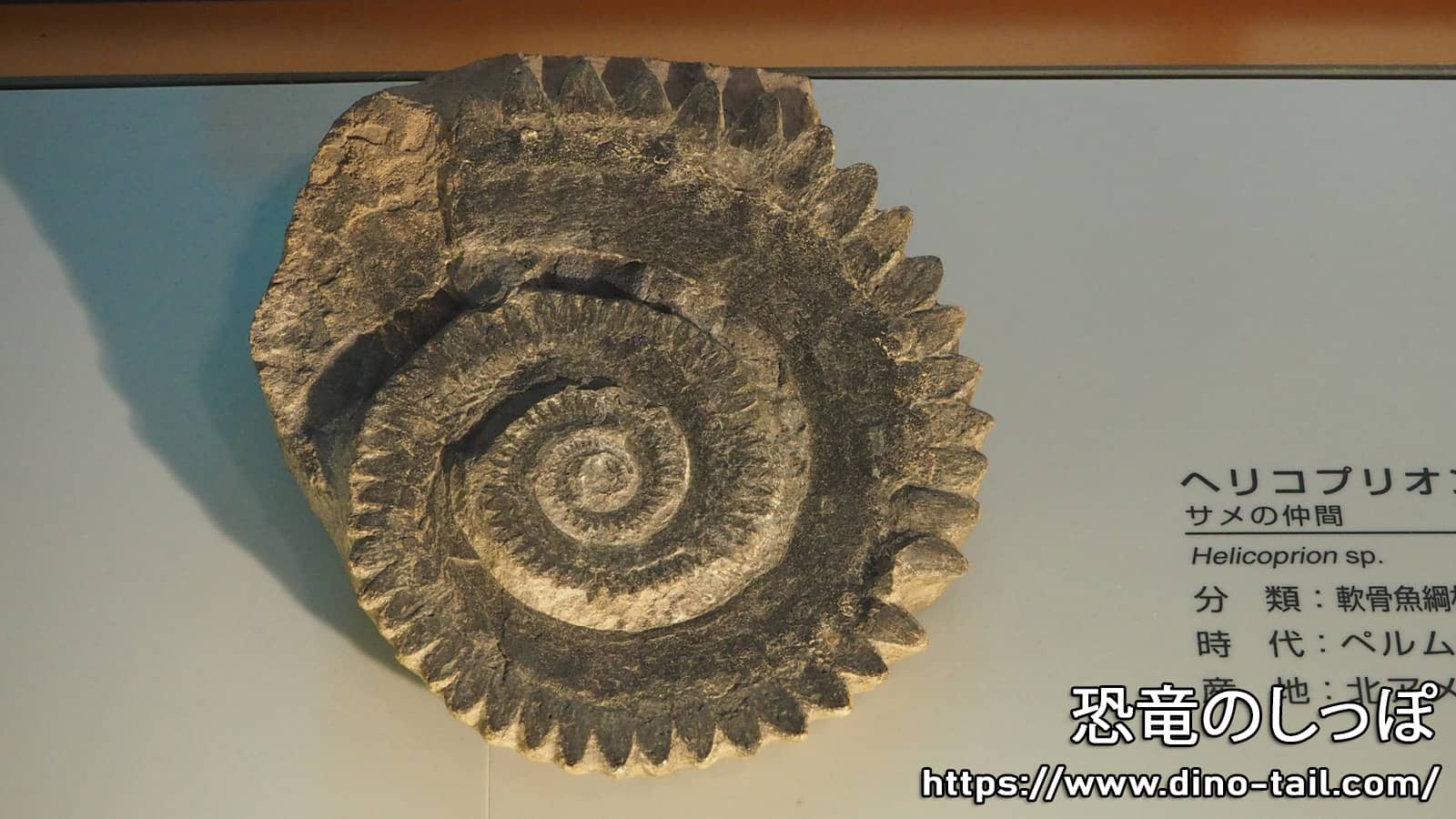
Their teeth never fell out throughout their lives. As new, giant teeth were pushed out at the base, the older, smaller teeth were curled inward into the jaw and retained in the center. It is estimated that the largest individuals held as many as 180 teeth and reached lengths of about 10 meters, reigning as one of the apex predators in the Permian oceans.
Historical Transition: From Ammonite Shell to Lower Jaw Teeth
When first discovered, this geometric spiral structure was misidentified as the shell of a mollusk like an ammonite. This was because it was not accompanied by a skeleton and did not match the anatomy of any known vertebrate. Even after it was recognized as the teeth of a cartilaginous fish, unimaginable reconstructions proliferated, such as "a weapon protruding from the tip of the upper jaw's snout" or "part of the dorsal or caudal fin." It was only recent 3D reconstructions of the jaw cartilage via CT scans that provided the conclusive evidence to settle on the current form fitting within the lower jaw.
Feeding Mechanism: How the Spiral Tooth Whorl Was Used
How this strange dentition was used remained a mystery for many years, but facts have been revealed through studies based on biomechanical models.
Helicoprion could generate a massive bite force of up to 4,732 newtons, comparable to modern large carnivores, but its jaw structure was not suited for crushing hard shells. It seems there weren't even teeth on the upper jaw. Instead, they are thought to have been carnivores specialized in "dragging out only the soft parts" from shelled cephalopods like ammonites. Observing the teeth left in fossils supports this, as there are few signs of severe wear indicating they were crushing hard objects.
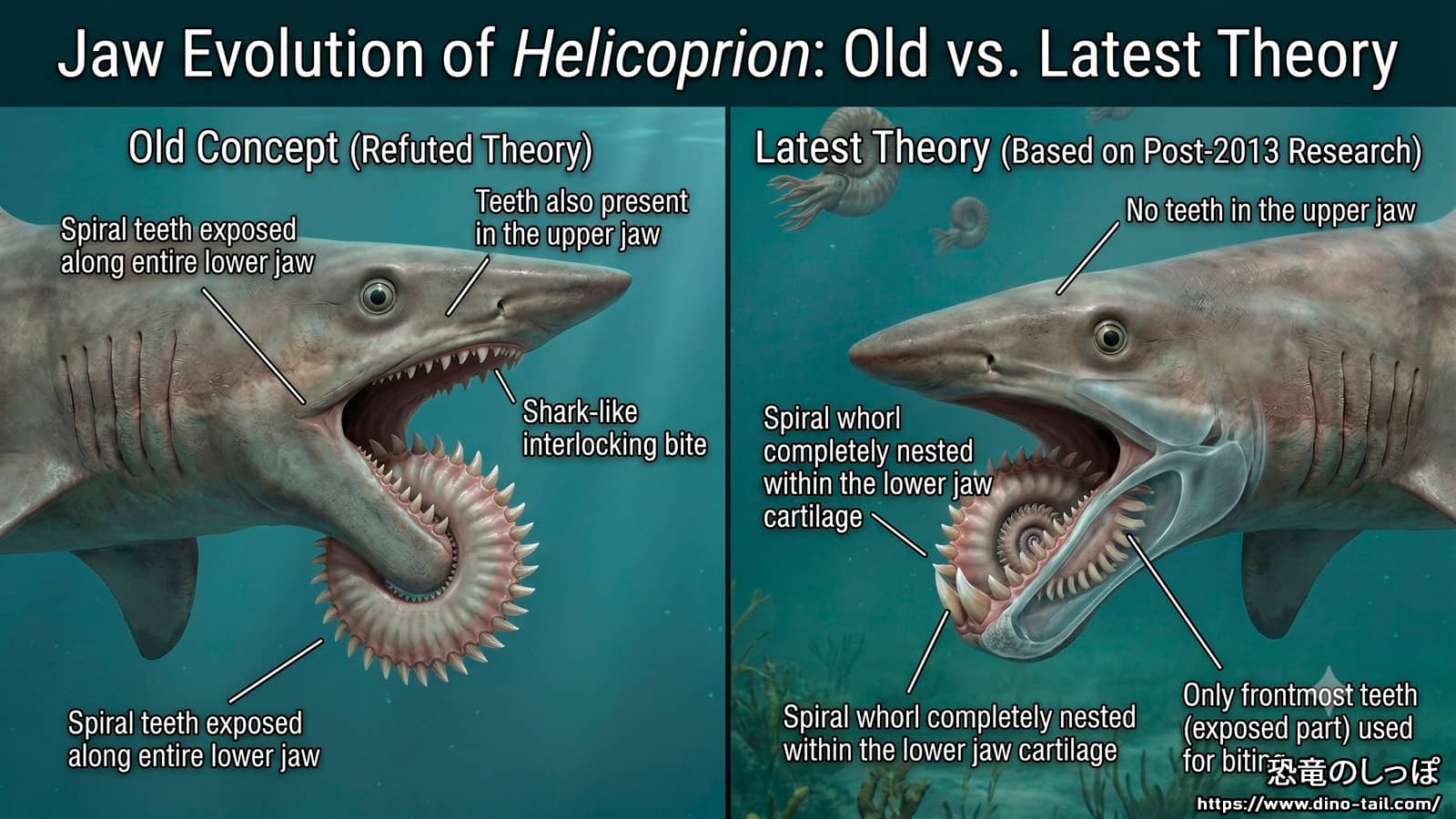
For over a century, scientific debates have raged regarding the placement and function of this bizarre dentition.
Powered by Gemini, 2026.
The spirally arranged teeth continuously performed three completely different functions: hooking and dragging in fleeing prey at the front like a hook, sharply slicing the meat in the middle section, and pushing the meat mass down the throat at the back. Furthermore, the trajectory when opening and closing the jaws was biomechanically very similar to the downward swing of a slashing weapon like a sword, forming an unprecedented "shell-peeling system" as a living circular saw.
Discoveries in the Japanese Archipelago and Paleobiogeography
Helicoprion inhabited a vast area of the ocean surrounding the supercontinent Pangea, showing a cosmopolitan distribution across North America, Europe, Asia, and Australia. In particular, an extremely large number of well-preserved fossils have been excavated from the "Phosphoria Formation," a phosphate deposit extending across western North America.
Especially noteworthy are the fossil records from the present-day Japanese archipelago. Fossils of Helicoprion's tooth whorl have been discovered in the limestone of the "Ashio Belt" distributed in places like Midori City, Gunma Prefecture. This region was originally a shallow coral reef ecosystem dotted across the superocean "Panthalassa," which was transported and accreted by plate tectonics. Their discovery in Japan serves as crucial evidence indicating that they lived as predators even in the seamount ecosystems floating in the open ocean of Panthalassa.
Extinction at the End of Specialization
Although often misunderstood in the media as having "survived the greatest mass extinction in Earth's history (the P-T boundary)," the genus Helicoprion itself completely disappeared by the end of the Middle Permian (Guadalupian), without waiting for the end-Permian mass extinction about 252 million years ago.
It is estimated that their extinction was not caused by a cataclysm but was an ecological "background extinction." The primary factors were the "extreme specialization" of their feeding mechanism and their "gigantism." A system that was extremely specialized for preying on soft-bodied cephalopods and demanded enormous amounts of energy to maintain a massive body boasted strength during periods of environmental stability, but it was extremely fragile once environmental changes occurred.
As environmental changes during the Middle Permian disrupted the food web and led to a decline in specific prey, the extremely specialized Helicoprion could not adapt to the shifting environment, ultimately meeting its demise in a chain reaction. The trajectory of their evolution and extinction teaches us the ruthless trade-off between the [ecological advantages brought by morphological specialization] and the [adaptation risks during environmental changes].