About Deinosuchus
| Scientific Name (Genus) | Deinosuchus |
| Meaning of Name | Terrible crocodile |
| Classification | Crocodilia stem-group (formerly considered Superfamily Alligatoroidea) |
| Period | Campanian stage of the Late Cretaceous (approx. 82 - 73 million years ago) |
| Habitat | North America (Montana, Texas, North Carolina, etc.) |
| Total Length | Approx. 10.5m (Deinosuchus riograndensis) |
| Year of Paper Publication | 1909 |
| Genus Name Publication | W. J. Holland (1909) "Deinosuchus hatcheri, a new genus and species of crocodile from the Judith River beds of Montana" |
The "Terrible Crocodile" that Reigned over the Cretaceous Coasts
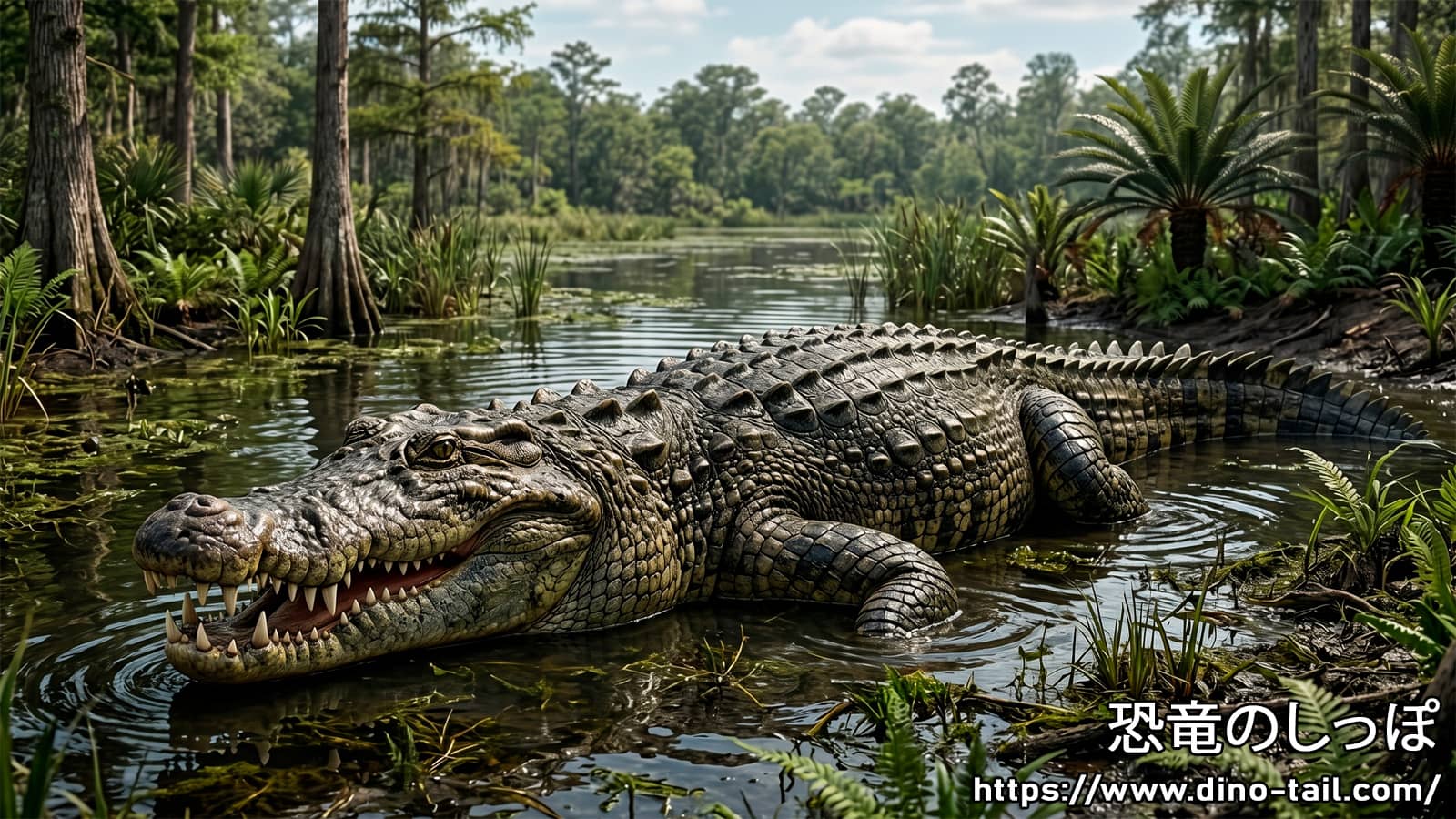
Deinosuchus is an extinct giant crocodyliform that lived in North America during the Late Cretaceous period. As its scientific name meaning "terrible crocodile" suggests, it reigned as one of the largest apex predators in coastal and estuarine ecosystems.
Estimates of the maximum length of Deinosuchus have changed with the updates in scientific knowledge. It was once overestimated to be over 12 meters based on skull length, but a more accurate Bayesian phylogenetic approach based on "head-width" was adopted in a 2025 study. As a result, the maximum size was revised to about 10.5 meters in total length and 3 to 5 tons in weight. Although revised downward, it still boasted a scale that far exceeded the largest living saltwater crocodile (about 6 to 7 meters).
The Secret of Growth: Slow and Long-Lived
The reason Deinosuchus was able to grow so huge was not due to rapid growth (accelerated growth) like dinosaurs. Analysis of the lines of arrested growth seen in the cross-sections of their bones revealed that their annual growth rate was almost the same as that of small living crocodiles. Unlike modern crocodiles, which typically stop growing after about 30 years, they acquired their massive bodies through a "prolongation of the growth period," continuing to grow steadily for at least 50 years.
Bite Force Surpassing Tyrannosaurus and Predatory Behavior
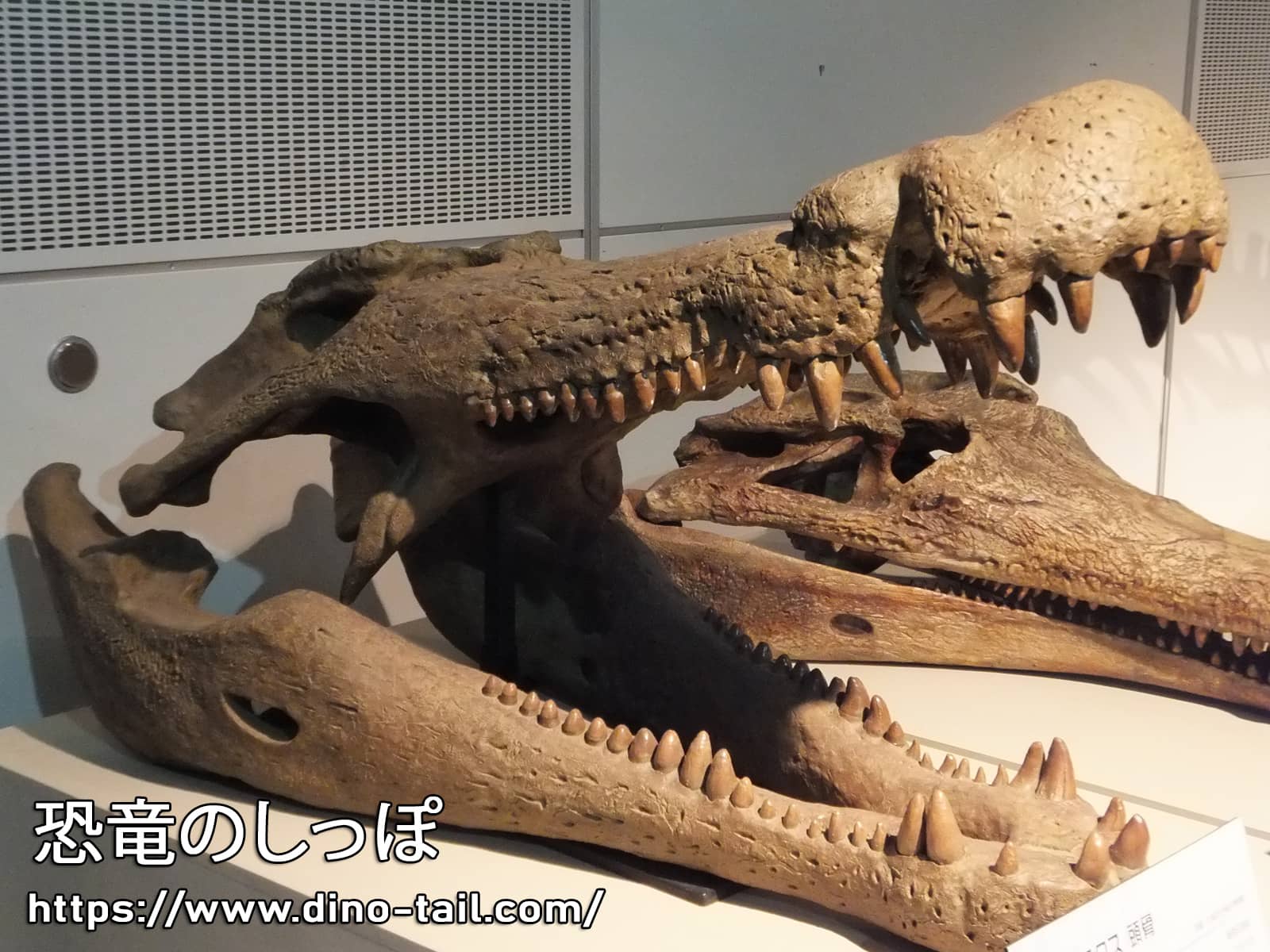
Deinosuchus's most formidable weapon was its extraordinary bite force. Estimates from biomechanical modeling calculate that it reached a maximum of 102,750 newtons (N). This far exceeds the estimated bite force of the contemporary Tyrannosaurus rex (about 57,000 newtons), making it the highest known value among terrestrial and semi-aquatic animals.
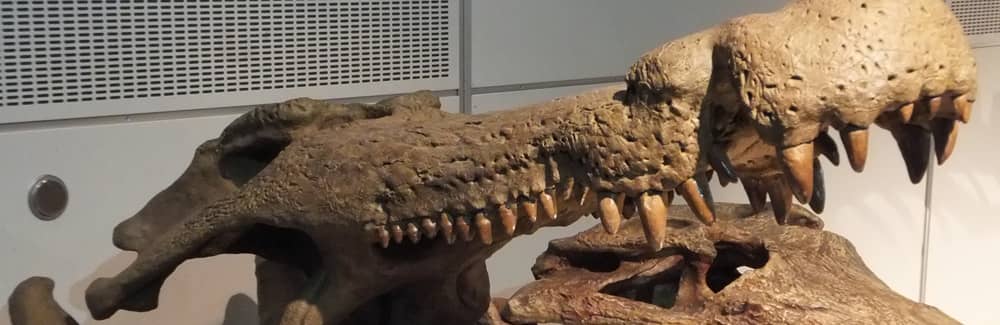
Their teeth were not sharp cones, but thick, rounded, "banana-like" shapes. It is thought that they were specialized in completely crushing the bones and shells of giant prey using their powerful bite force and sturdy teeth.
Direct Evidence of Eating Dinosaurs
Fossil evidence shows that Deinosuchus preyed not only on aquatic creatures like turtles but also on contemporary giant dinosaurs. Clear Deinosuchus bite marks have been left on the skeletons of large carnivorous dinosaurs (Tyrannosauroidea) measuring around 9 meters long, such as Appalachiosaurus and Albertosaurus.
Importantly, some bite marks showed "healing traces" where the bone tissue had regenerated. This conclusively proves that Deinosuchus was not merely a scavenger feeding on carcasses, but an "active predator" that launched attacks on living giant carnivorous dinosaurs.
Physical Constraints on Terrestrial Locomotion: Belly-dragging
Although Deinosuchus possessed overwhelming power, its massive mass placed severe physical constraints on its terrestrial locomotion.
Small modern crocodiles are capable of a "high walk," lifting their bodies off the ground to walk. However, biomechanical simulations by the Royal Veterinary College (RVC) have shown that adult Deinosuchus weighing over 3 tons were unable to fully lift their massive bodies off the ground.
When moving on land, they resorted to "belly-dragging," dragging their abdomens on the ground, and could not run quickly to chase prey. Deinosuchus was a waterside ambush predator, quietly waiting underwater for dinosaurs coming to drink to enter its striking range.
Classification Changes and the Marine Dispersal Model
Our understanding of Deinosuchus's classification and evolutionary history underwent a dramatic shift in the 2020s. Deinosuchus was once considered an early member of the "Alligatoroidea," the lineage leading to modern alligators.
However, a phylogenetic analysis published in 2025 repositioned Deinosuchus into the "stem-group crocodylians," an independent lineage that branched off before the crown group of crocodilians (the common ancestor of living crocodilians).
This taxonomic change solved an ecological mystery. Modern alligators lack salt glands to excrete salt and cannot tolerate seawater for long periods. However, Deinosuchus was widely distributed on both shores of the vast shallow "Western Interior Seaway" that divided the North American continent from east to west. The new phylogenetic tree suggests that Deinosuchus possessed "salt tolerance" inherited from its ancestors. Because they could process highly saline seawater, they were able to swim across the sea, disperse, and thrive on both the western continent of Laramidia and the eastern continent of Appalachia.
History of Discovery: Recognition of the "Terrible Crocodile" Began with a Misidentification
Deinosuchus fossils first appeared in the academic record in the 1850s, when the concept of dinosaurs was just beginning to become popular. Geologist Ebenezer Emmons discovered thick fossilized teeth at the time, but they were initially misidentified as those of a plesiosaur (genus Polyptychodon), a marine reptile.
Non-dental skeletal remains were first collected in 1903. Paleontologist John Bell Hatcher discovered giant osteoderms (bony scutes) and thought they belonged to an ankylosaur (armored dinosaur). There is an anecdote that when subsequent analysis revealed it to be the skeleton of a giant "crocodile," Hatcher, who was passionate about dinosaur research, lost interest and abandoned the study.
After Hatcher's death, his colleague William Jacob Holland took over the research on the giant "crocodile" and formally described the genus as "Deinosuchus hatcheri" in 1909. This was the first time it was proven that a giant crocodyliform exceeding 10 meters in length existed on the North American continent. Currently, taxonomic revisions are underway, with western specimens classified as Deinosuchus riograndensis and eastern specimens as Deinosuchus schwimmeri.